
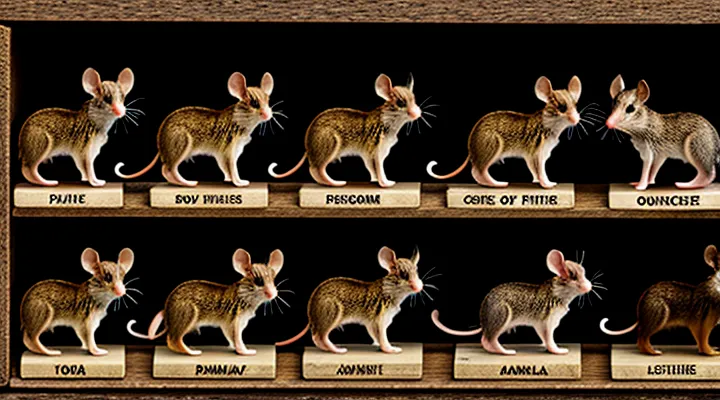
Introduction to Mouse Diversity
What Defines a Mouse?
General Characteristics
Mice represent a broad group of small rodents distinguished by several shared biological traits. Body length typically ranges from 6 to 10 cm, with tail length comparable to or slightly shorter than the torso. Fur coloration varies among species, commonly brown, gray, or black, providing camouflage in diverse habitats such as grasslands, forests, and human‑occupied structures.
Dietary habits are omnivorous; most species consume seeds, grains, insects, and occasional plant material. Digestive systems feature a large cecum that facilitates fermentation of fibrous content. Reproductive capacity is high: gestation periods average 19–21 days, and litters frequently contain 4–8 offspring. Breeding cycles can occur year‑round in temperate zones, leading to rapid population growth under favorable conditions.
Sensory adaptations include acute hearing, whisker‑mediated tactile perception, and a well‑developed olfactory system. Vision is limited to detecting motion and low‑light conditions, while nocturnal activity patterns reduce predation risk. Social structures differ among species; some exhibit solitary behavior, whereas others form complex colonies with hierarchical organization.
Key morphological features encompass a robust skull with strong incisors adapted for gnawing, a flexible spine enabling agile movement, and hind limbs suited for climbing or burrowing. These characteristics collectively support the ecological versatility observed across the extensive array of mouse species.
Habitat and Distribution
Mice occupy a wide range of habitats, reflecting their adaptive versatility. Forested regions host species such as the wood mouse, which prefers leaf litter and dense understory for shelter and foraging. Grassland ecosystems support the meadow vole and related forms, exploiting tall grasses and burrow networks. Arid zones accommodate desert-adapted mice, including the cactus mouse, which utilizes sparse vegetation and rocky crevices to avoid extreme temperatures. Urban environments provide abundant resources for the house mouse, which thrives in human dwellings, sewers, and waste sites.
Geographic distribution of mouse species extends across all major continents, with distinct patterns shaped by climate and ecological barriers. North America harbors the deer mouse and its relatives, ranging from temperate forests to high‑altitude plateaus. Eurasia features the striped field mouse, occupying temperate zones from western Europe to central Asia. South America includes the Andean mouse, restricted to mountainous corridors. Africa presents the African pygmy mouse, found in savanna and semi‑desert habitats. Oceania contains several endemic island species, limited to isolated archipelagos.
Key factors influencing habitat selection include food availability, predator pressure, and nesting material. Seasonal changes drive temporary migrations, such as movement from high‑elevation winter refuges to lower valleys during spring. Human activity expands the range of commensal species, while habitat fragmentation isolates populations of specialist mice, potentially leading to localized extinctions.
True Mice («Muridae»)
House Mouse («Mus musculus»)
Characteristics and Behavior
Mouse species display a broad spectrum of morphological traits that facilitate adaptation to varied environments. Size ranges from the diminutive African pygmy mouse, measuring approximately 5 cm in body length, to the larger Eurasian harvest mouse, exceeding 10 cm. Fur coloration spans from uniform brown tones to speckled patterns that provide camouflage in specific habitats. Tail length correlates with arboreal versus terrestrial lifestyles, with longer tails supporting balance in climbing species. Ear dimensions reflect thermoregulatory needs, larger ears appearing in desert‑adapted mice. Dental formulae remain consistent across the group, yet enamel thickness varies according to diet hardness.
Key behavioral characteristics include:
- Foraging strategies: granivorous species exploit seed caches, while omnivorous mice exhibit opportunistic feeding on insects and plant material.
- Social organization: some species form cohesive family groups with defined hierarchies; others maintain solitary territories marked by scent glands.
- Reproductive cycles: breeding seasons align with resource availability, producing multiple litters per year in temperate zones and continuous reproduction in tropical regions.
- Habitat preference: burrowing mice construct extensive underground networks, whereas arboreal species inhabit forest canopies and construct nests in vegetation.
- Activity patterns: predominantly nocturnal activity reduces predation risk, though crepuscular peaks are recorded in species inhabiting open fields.
These characteristics and behaviors collectively illustrate the ecological versatility of the mouse clade, underscoring its capacity to occupy diverse niches across continents.
Global Impact
Mouse species exhibit extensive geographic distribution, with more than 30 recognized genera and hundreds of distinct taxa across all continents except Antarctica. Adaptations to diverse habitats—arid deserts, tropical forests, alpine zones—enable each lineage to occupy specific ecological niches.
The worldwide presence of these rodents generates measurable effects on natural systems:
- Seed predation and dispersal influence plant community composition, altering regeneration patterns in temperate and tropical ecosystems.
- Burrowing activity enhances soil aeration and nutrient mixing, supporting microbial processes essential for fertility.
- Prey availability sustains populations of raptors, snakes, and carnivorous mammals, thereby stabilizing trophic networks.
In agricultural landscapes, mouse populations intersect with human food production. Species that thrive in cultivated fields consume grains and vegetables, contributing to measurable yield reductions. Certain taxa serve as reservoirs for zoonotic pathogens such as hantavirus and leptospira, facilitating disease transmission to livestock and humans.
Biomedical research relies heavily on laboratory mouse strains, which provide standardized genetic backgrounds for studying genetics, immunology, and pharmacology. The global output of scientific publications and therapeutic advances reflects the central role of these model organisms in addressing health challenges.
Conservation assessments reveal that invasive mouse species disrupt island ecosystems by preying on native birds and invertebrates, accelerating biodiversity loss. Simultaneously, habitat fragmentation and climate change threaten endemic mouse taxa, prompting the inclusion of several species on international red‑list categories. Mitigation strategies—population control, habitat restoration, and biosecurity measures—aim to balance ecological functions with agricultural and health interests.
Deer Mouse («Peromyscus maniculatus»)
Habitat and Diet
Mice occupy a wide range of habitats, from human dwellings to arid deserts and temperate forests. The house mouse (Mus musculus) thrives in urban and agricultural settings, exploiting structures that provide shelter and warmth. Deer mice (Peromyscus maniculatus) prefer grasslands, shrublands, and forest edges, often nesting in burrows or under logs. Wood mice (Apodemus sylvaticus) are associated with deciduous woodlands, utilizing dense undergrowth for protection. The grasshopper mouse (Onychomys spp.) inhabits semi‑desert regions and open scrub, seeking rocky crevices for denning. Water‑associated species, such as the marsh rice rat (Oryzomys palustris), are found in wetlands and riverbanks, where vegetation offers both cover and foraging opportunities.
Dietary strategies reflect the ecological niches of each species. House mice are omnivorous opportunists, consuming stored grains, processed foods, and occasional insects. Deer mice exhibit a mixed diet of seeds, fruits, insects, and occasional plant material, shifting composition seasonally. Wood mice favor seeds and nuts, supplementing with berries and invertebrates when available. Grasshopper mice are carnivorous specialists, preying on insects, scorpions, and small vertebrates, with occasional plant matter. Marsh rice rats primarily eat aquatic vegetation, seeds, and small aquatic organisms, adapting to fluctuating water levels. Across these taxa, diet flexibility correlates with habitat variability, enabling mice to exploit resources ranging from human‑derived stores to natural forage in remote ecosystems.
Health Concerns
The wide range of mouse species presents distinct health challenges for humans and domestic animals. Each species carries a unique profile of pathogens, allergens, and behavioral traits that influence disease risk and management strategies.
Zoonotic diseases transmitted by rodents include:
- « Hantavirus » – causes severe respiratory illness; prevalence varies among species inhabiting rural and urban environments.
- « Leptospira » – bacterial infection spread through urine; certain species act as reservoirs in flood‑prone regions.
- « Salmonella » – gastrointestinal pathogen; more common in species that forage in waste sites.
- « Bartonella » – vector for febrile illnesses; documented in several wild and commensal mice.
Allergic reactions arise from mouse urine, dander, and saliva proteins. Species that produce larger colonies generate higher concentrations of these allergens, increasing the incidence of asthma and rhinitis in sensitive individuals.
Control measures must consider species‑specific behavior. For example, arboreal mice evade ground‑level traps, requiring bait stations positioned at elevated sites. Burrowing species create extensive tunnel networks that protect nests from conventional rodenticides, demanding systematic soil treatment.
Monitoring programs that identify the dominant mouse species in a given area enable targeted health interventions, reduce disease transmission, and limit allergen exposure.
Field Mouse («Apodemus sylvaticus»)
European Distribution
The European continent hosts a notable assemblage of mouse taxa, each occupying distinct biogeographic zones and ecological niches. Distribution patterns reflect both historical colonisation events and contemporary anthropogenic influences.
Native species dominate temperate woodlands and grasslands. Key representatives include:
- Apodemus sylvaticus (wood mouse) – widespread from the Iberian Peninsula through Scandinavia, favouring deciduous forests and hedgerows. - Apodemus flavicollis (yellow‑necked mouse) – prevalent in central and southeastern Europe, restricted to mountainous and forested regions. - Micromys minutus (harvest mouse) – scattered populations across eastern and western Europe, associated with tall grasses and floodplain vegetation.
Introduced taxa exhibit broader, often synanthropic, ranges. The house mouse, Mus musculus, thrives in urban and agricultural settings from the British Isles to the Russian frontier. The striped field mouse, Apodemus agrarius, originally eastern, now extends westward into Germany and Poland, facilitated by agricultural expansion.
Island archipelagos host endemic forms. The Balearic mouse, Mus spretus, occupies the Balearic Islands, while the Corsican mouse, Mus musculus domesticus, persists on Corsica and Sardinia, reflecting ancient human‑mediated transport.
Conservation assessments reveal varying statuses. Species such as Micromys minutus are classified as near‑threatened in parts of northern Europe due to habitat loss, whereas Apodemus sylvaticus maintains stable populations across most of its range.
Overall, European mouse distribution demonstrates a mosaic of native resilience, introduced adaptability, and localized endemism, shaped by climatic gradients, habitat availability, and human activity.
Ecological Role
Mice represent a wide range of species that occupy habitats from temperate forests to arid deserts. Their abundance and adaptability enable them to interact with multiple trophic levels, influencing ecosystem processes across diverse environments.
- Consumption of seeds and nuts limits plant recruitment, shaping vegetation patterns.
- Transport of seeds in fur or digestive tracts facilitates dispersal to new sites, promoting plant colonization.
- Burrowing activity mixes organic matter with mineral soil, enhancing aeration and water infiltration.
- Predation by raptors, snakes, and carnivorous mammals provides a reliable food source, supporting higher‑order consumers.
- Carriage of ectoparasites and pathogens links disease dynamics between wildlife, livestock, and humans.
These functions generate feedback loops that regulate population densities, nutrient cycling, and habitat structure. Alterations in mouse species composition can shift these loops, leading to measurable changes in biodiversity and ecosystem resilience. Conservation strategies that maintain species richness therefore preserve the multifaceted ecological contributions of mice.
Other Rodents Commonly Called «Mice»
Vole Species («Arvicolinae»)
Meadow Voles («Microtus pennsylvanicus»)
Meadow voles («Microtus pennsylvanicus») represent a widespread North American rodent within the family Cricetidae. They belong to the genus Microtus, which comprises numerous small, herbivorous species occupying diverse habitats.
The species inhabits moist grasslands, meadows, and agricultural fields across the eastern United States and parts of Canada. Distribution extends from the Atlantic coast westward to the Great Lakes region, favoring areas with dense ground cover and abundant vegetation.
Physical characteristics include a compact body length of 10–13 cm, short tail, and dense brown to gray dorsal fur. Hind feet are elongated, facilitating rapid locomotion through dense foliage. Dental formula 1/1, 0/0, 0/0, 3/3 reflects a specialization for grinding plant material.
Key ecological traits:
- Primarily herbivorous diet: grasses, sedges, forbs, and occasional seeds.
- High reproductive rate: multiple litters per year, each with 3–7 offspring.
- Seasonal coat change: thicker fur in winter, lighter coloration in summer.
- Burrowing behavior: extensive tunnel systems used for nesting and predator avoidance.
Conservation status is classified as Least Concern by the IUCN, reflecting a stable population trend despite localized habitat alteration. Management practices in agricultural landscapes often consider meadow voles as both a target for pest control and a component of native biodiversity.
Bank Voles («Myodes glareolus»)
The bank vole, scientifically designated as «Myodes glareolus», is a small rodent occupying a broad range of temperate forest ecosystems across Europe and parts of western Asia. Adult individuals typically measure 10–13 cm in body length, with a tail short relative to the torso, and weigh between 20–30 g. Fur coloration varies seasonally, ranging from reddish‑brown in summer to a muted grayish tone in winter, providing camouflage against leaf litter and undergrowth.
Habitat preference includes deciduous and mixed woodlands, hedgerows, and shrub‑dominated clearings where dense ground cover offers protection from predators. The species demonstrates adaptability to agricultural landscapes, often inhabiting field margins and orchards where herbaceous vegetation is abundant.
Key biological traits:
- Diet consists primarily of seeds, berries, and invertebrates; seasonal shifts favor higher protein intake during the breeding period.
- Reproductive cycle features multiple litters per year; each litter comprises 3–7 offspring after a gestation of approximately 21 days.
- Population density can reach up to 150 individuals per hectare under optimal conditions, with fluctuations driven by food availability and predation pressure.
Conservation status is classified as Least Concern by the IUCN, reflecting a stable overall population. However, localized declines have been recorded in regions experiencing extensive habitat fragmentation and intensive forestry practices. Management recommendations emphasize preservation of continuous understory vegetation and maintenance of hedgerow networks to sustain viable bank vole populations.
Dormice («Gliridae»)
Edible Dormouse («Glis glis»)
The edible dormouse, scientifically designated as «Glis glis», belongs to the family Gliridae and inhabits broad regions of Europe and western Asia. Its range extends from the British Isles through the Mediterranean basin to the Ural Mountains, favoring deciduous and mixed forests, hedgerows, and rocky outcrops.
Morphologically, the species exhibits a robust body length of 12–20 cm, a tail shorter than the head‑body segment, and dense fur that varies from brown to reddish‑brown in summer and grayish in winter. Dental formula I 3/1 C 1/0 PM 3/3 M 3/3 supports the processing of both hard seeds and soft fruit.
Behavioral patterns include nocturnal activity, arboreal foraging, and seasonal hibernation lasting up to six months. Diet comprises nuts, acorns, berries, and occasional insects, enabling the dormouse to accumulate fat reserves essential for overwintering.
Human interactions focus on two aspects:
- Culinary tradition: historically prized as a delicacy in parts of Central Europe, the animal is harvested during active months and prepared by roasting or stewing.
- Conservation considerations: classified as “Least Concern” by the IUCN, yet regional populations experience pressure from habitat fragmentation and illegal trapping.
These characteristics underscore the edible dormouse’s role within the broader diversity of mouse species, illustrating ecological adaptability and cultural relevance.
Hazel Dormouse («Muscardinus avellanarius»)
The hazel dormouse, scientifically designated as «Muscardinus avellanarius», belongs to the family Gliridae and represents a distinct lineage among European small rodents. Its range extends from western France through the British Isles to the Balkans, occupying deciduous and mixed woodlands where mature understory provides shelter.
Adult individuals display a head‑body length of 6–9 cm, a tail of comparable length, and a weight of 15–30 g. The dorsal pelage is uniformly brown, while the ventral surface is pale, and large, dark eyes facilitate nocturnal foraging. Seasonal coat changes are minimal, reflecting adaptation to temperate climates.
Key ecological attributes include:
- Arboreal locomotion, enabled by a prehensile tail and opposable thumbs on the hind feet.
- Diet comprised primarily of nuts, seeds, fruits, and occasional insects, supporting seed dispersal within forest ecosystems.
- Breeding season from April to September, with litters of 3–7 juveniles, each reaching independence after approximately six weeks.
Habitat preference centers on dense shrub layers and hedgerows rich in hazel, oak, and beech. The species relies on continuous canopy cover for nesting and winter hibernation, making it sensitive to fragmentation and loss of mature woodland.
The International Union for Conservation of Nature classifies the hazel dormouse as “Near Threatened”. Primary pressures involve habitat degradation, agricultural intensification, and climate‑induced shifts in food availability. Conservation measures prioritize the preservation of hedgerow networks, woodland management that maintains understory complexity, and monitoring programs that track population dynamics across its range.
Jumping Mice («Zapodinae»)
Meadow Jumping Mouse («Zapus hudsonius»)
The meadow jumping mouse, scientifically designated as «Zapus hudsonius», belongs to the family Dipodidae and represents a distinct lineage within murine biodiversity.
Native to North America, the species occupies moist grasslands, meadows, and riparian zones from southern Canada through the northern United States. Its distribution correlates with regions offering dense herbaceous cover and soft, loamy soils that facilitate burrowing activity.
Morphologically, the animal exhibits elongated hind limbs, a reduced tail length, and a streamlined body adapted for rapid, sinusoidal leaps. Fur coloration ranges from brown to gray, providing camouflage against ground vegetation.
Key biological traits include:
- Locomotion: powerful hind‑foot propulsion enables jumps exceeding two meters, allowing swift escape from predators.
- Diet: omnivorous feeding on seeds, insects, and green plant material, with seasonal shifts toward higher protein intake during breeding periods.
- Reproduction: multiple litters per year, each comprising three to six altricial young; gestation lasts approximately 21 days, and offspring achieve independence within four weeks.
According to the IUCN Red List, the meadow jumping mouse holds a status of Least Concern, yet localized population declines arise from habitat fragmentation, agricultural conversion, and pesticide exposure. Conservation measures prioritize the preservation of wet meadow ecosystems and the maintenance of connectivity between habitat patches.
Woodland Jumping Mouse («Napaeozapus insignis»)
The woodland jumping mouse, identified scientifically as «Napaeozapus insignis», belongs to the family Dipodidae and represents a distinct lineage within North‑American rodent fauna. Its range extends from the boreal forests of Canada through the northern United States, favoring moist, densely vegetated woodlands and riparian zones. The species occupies elevations from sea level to approximately 2,000 m, where leaf litter and understory cover provide protection from predators.
Morphologically, the mouse exhibits a compact body, a long tail exceeding body length, and unusually elongated hind limbs adapted for leaping. Fur coloration varies from dark brown on the dorsal surface to lighter, grayish tones ventrally. Key physiological and ecological traits include:
- Powerful hind‑limb musculature enabling vertical jumps of up to 30 cm.
- Seasonal fur densification and increased body mass in preparation for winter torpor.
- Primarily nocturnal activity with a diet composed of seeds, insects, and green vegetation.
- Reproductive cycle producing two to three litters per year, each containing three to six offspring.
Conservation assessments list the woodland jumping mouse as a species of least concern, yet localized population declines have been documented in areas experiencing habitat fragmentation and wetland drainage. Preservation of contiguous forested corridors and maintenance of natural water regimes are critical for sustaining viable populations. The species' specialized locomotion and foraging behavior contribute to seed dispersal and invertebrate population regulation within its ecosystem.
Evolutionary History and Classification
Rodentia Order Overview
The order Rodentia comprises the largest number of mammalian species, exceeding 2,500 described taxa. Members share a distinctive dental formula with continuously growing incisors that require constant gnawing to maintain functional length. This adaptation underlies the ecological success of the group across diverse habitats.
Key families that contain the species commonly referred to as mice include:
- Muridae – the largest family, encompassing the true mice and rats of the subfamily Murinae.
- Cricetidae – contains voles, lemmings, and the New World mice of the subfamily Neotominae.
- Dipodidae – includes jerboas and birch mice, representing less typical mouse forms.
Rodents inhabit all continents except Antarctica, occupying niches from arid deserts to tropical forests. Their omnivorous diets and high reproductive rates enable rapid colonization of new environments, contributing to the extensive variation observed among mouse species.
Phylogenetic analyses indicate that the diversification of mice aligns with major paleoclimatic events, where lineage splits correspond to habitat fragmentation and expansion. Consequently, the order’s evolutionary dynamics provide a framework for understanding the breadth of mouse species diversity.
Diversification of Muridae
The family Muridae exhibits extensive diversification, encompassing more than 700 species distributed across approximately 150 genera. This breadth reflects the group’s capacity to occupy a wide range of habitats and ecological roles.
Phylogenetic analyses identify several principal clades within Muridae. The subfamily «Murinae» contains the majority of mouse and rat species, while «Deomyinae» includes brush‑tailed mice and related taxa. Lesser‑known lineages such as «Gerbillinae» and «Dendromurinae» contribute additional morphological and ecological variation.
Key morphological adaptations support the family’s success:
- Skull morphology varies from compact, robust forms in desert dwellers to elongated structures in arboreal species.
- Dental patterns range from high‑crowned molars suited for abrasive diets to low‑crowned teeth adapted for softer plant material.
- Tail length correlates with locomotor demands, from short, sturdy tails in burrowing species to long, prehensile tails in climbing taxa.
Ecological niches occupied by Muridae span:
- Forest understoreys, where seed‑predation and insectivory dominate.
- Arid regions, with species exploiting sparse vegetation and nocturnal activity to avoid heat stress.
- Human‑modified environments, where commensal species thrive on stored food and shelter.
Geographic distribution demonstrates pronounced regional radiations. Southeast Asia hosts a dense concentration of endemic species, driven by complex topography and island isolation. African savannas and montane zones present distinct assemblages, while the Americas exhibit relatively recent colonization events followed by rapid diversification.
Evolutionary mechanisms underlying this diversification include:
- Allopatric speciation resulting from geographical barriers such as mountain ranges and water bodies.
- Adaptive radiation in response to novel ecological opportunities, especially on islands and fragmented habitats.
- Hybridization events that generate genetic introgression and novel trait combinations.
Collectively, these factors illustrate how Muridae has achieved remarkable species richness and ecological breadth, underscoring its role as a model for studying vertebrate diversification.
Convergent Evolution in Mouse-like Rodents
Convergent evolution describes the independent acquisition of similar morphological or ecological traits by distantly related rodent lineages that occupy comparable niches. In mouse‑like rodents, parallel adaptations involve body size reduction, elongated rostrum, and nocturnal foraging behavior, despite divergent phylogenetic origins.
Key examples include:
- Peromyscus (North American deer mice) and African Praomys species, both exhibiting cryptic fur coloration and seed‑handling dentition, yet belonging to separate subfamilies.
- Asian Apodemus and South American Akodon, each developing high‑frequency vocalizations for territory communication, despite lineage separation over 30 million years.
- Island dwarf forms such as Mus musculus insular populations and the Malagasy Microgale (though technically not a mouse), both showing reduced skeletal mass and increased reproductive output in resource‑limited environments.
Underlying mechanisms involve similar selective pressures: predator avoidance, limited food resources, and microhabitat specialization. Genetic studies reveal convergent changes in regulatory genes controlling growth pathways (e.g., IGF1 modulation) and sensory receptor families (e.g., olfactory receptor expansion). These molecular parallels reinforce the morphological patterns observed across the diverse assemblage of mouse‑like rodents, illustrating how parallel evolution contributes to the overall variety within the rodent clade.
Ecological Roles of Mice
Role as Prey
The remarkable variety of mouse species occupies a central position in terrestrial food webs, providing a substantial portion of the diet for numerous carnivores and raptors. Their small size, rapid reproductive cycles, and widespread distribution make them a reliable energy source across ecosystems.
- Small mammalian predators such as foxes, weasels, and coyotes routinely capture mouse prey.
- Avian hunters including owls, hawks, and shrikes depend on mice for protein during breeding seasons.
- Reptilian predators—particularly snakes like rattlesnakes and colubrids—target mouse populations in both arid and forested habitats.
- Amphibians and larger arthropods, for example bullfrogs and giant centipedes, also exploit mice when opportunity arises.
Predation pressure influences mouse population structure by regulating density, prompting selection for cryptic coloration, heightened vigilance, and nocturnal activity patterns. Mortality rates fluctuating with predator abundance drive cyclical population dynamics, often observable in multi‑year studies of rodent communities.
Conservation assessments recognize that declines in predator species can lead to mouse overabundance, resulting in increased crop damage and altered seed dispersal processes. Conversely, excessive hunting of mice may diminish food availability for endangered raptors, underscoring the need for balanced ecosystem management.
«Predation pressure shapes mouse populations», a principle echoed in numerous ecological models, illustrates the reciprocal relationship between diverse mouse taxa and their role as prey.
Seed Dispersal and Pollination
Mice exhibit a broad spectrum of ecological functions that intersect with plant reproductive processes. Certain mouse taxa collect seeds, transport them away from parent plants, and deposit them in caches that may later germinate, thereby influencing plant community composition. The same individuals frequently visit flowers to feed on nectar or pollen, unintentionally moving pollen grains between conspecific blossoms and facilitating cross‑fertilization.
Key mechanisms linking rodent diversity to seed and pollen movement include:
- cache creation by granivorous species, providing spatially separated germination sites;
- opportunistic foraging on flower resources, resulting in incidental pollen transfer;
- seasonal shifts in diet that alter the relative contribution to seed dispersal versus pollination;
- habitat specialization that determines the plant species encountered and thus the genetic flow patterns.
Research across temperate and tropical ecosystems demonstrates that variations in mouse species traits—body size, foraging range, and habitat preference—correlate with distinct patterns of seed redistribution and pollen distribution. Consequently, the diversity of mouse species directly shapes plant regeneration dynamics and genetic exchange within vegetative communities.
Impact on Ecosystems
Mouse diversity contributes to multiple ecological processes. Species ranging from field mice to forest-dwelling voles interact with vegetation, soil, and food webs, shaping ecosystem dynamics.
- Seed predation and dispersal modify plant recruitment patterns.
- Burrowing activity enhances soil aeration, influences moisture retention, and promotes nutrient mixing.
- Small mammal populations serve as prey for raptors, snakes, and carnivorous mammals, supporting higher trophic levels.
- Carrier potential for pathogens affects disease transmission cycles among wildlife and, occasionally, humans.
- Competitive interactions with other rodent taxa regulate community composition and resource allocation.
Fluctuations in mouse abundances generate measurable effects. Population declines reduce seed turnover, potentially altering vegetation structure. Excessive growth may intensify herbivory pressure, suppressing seedling establishment. Shifts in predator–prey balance can cascade through trophic networks, influencing predator reproductive success and distribution.
Overall, the functional roles of diverse mouse species reinforce ecosystem resilience, productivity, and health. Monitoring population trends and habitat requirements remains essential for maintaining these contributions.