
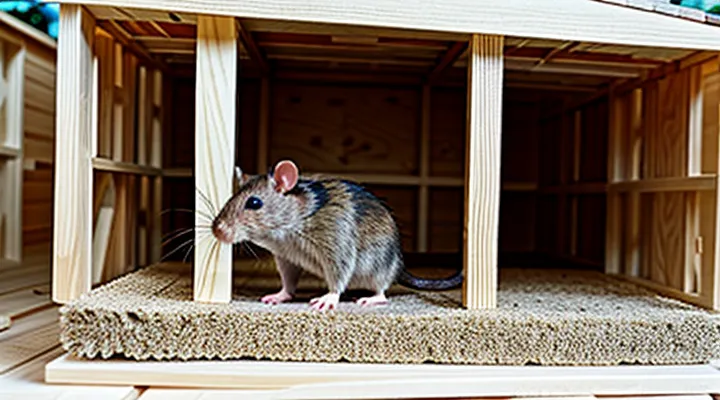
Getting Started: Planning Your Rat's Abode
Understanding Rat Needs
Space Requirements
When planning a DIY rat house, allocate enough floor area for the animal to move freely, exercise, and exhibit natural behaviors. A single adult rat requires at least 200 cm² of usable floor space; a pair benefits from 400 cm² or more. Provide a vertical dimension of 15–20 cm to allow comfortable standing and climbing.
Include a separate zone for nesting material, preferably a corner or enclosed chamber that occupies roughly 20 % of the total interior volume. This area should be insulated with soft bedding and positioned away from food and water sources to maintain hygiene.
Ventilation must be ensured through openings that total at least 10 % of the wall surface area. Small mesh screens prevent escape while allowing airflow; place vents near the top of the enclosure to promote circulation without creating drafts at floor level.
If the structure is intended for multiple rats, increase the floor space proportionally and add additional climbing platforms or tubes. Each added element should be spaced at least 5 cm apart to prevent overcrowding.
Typical dimensions for a compact yet functional rat house:
- Length: 30 cm
- Width: 20 cm
- Height: 20 cm
These measurements satisfy the minimum spatial requirements for a solitary rat while leaving room for enrichment accessories. Adjust the size upward if the enclosure will host more than one animal or if larger enrichment items are planned.
Enrichment Opportunities
Designing a self‑constructed rat habitat provides a platform for diverse enrichment that promotes natural behaviors and reduces stress. Incorporate elements that encourage climbing, chewing, foraging, and exploration to keep the animal mentally and physically active.
- Vertical structures: Install wooden dowels, PVC ladders, or stacked platforms to create climbing routes. Secure each piece firmly to prevent wobble.
- Tunnels and hideouts: Use flexible tubing, cardboard tubes, or drilled PVC pipes to form concealed passages. Position entrances at varying heights for choice of retreat.
- Chewable materials: Attach untreated wood blocks, natural branches, or sisal rope to the interior walls. Replace worn items regularly to maintain safety.
- Foraging puzzles: Hide seed mixes in rolled paper, small mesh bags, or treat‑dispensing toys. Rotate locations to sustain interest.
- Sensory enrichment: Place a shallow dish of fresh water with floating vegetables, or scatter a few drops of pet‑safe essential oil on a cotton ball placed out of reach.
Integrate these components during the construction phase to ensure structural stability. Anchor heavy items to the base, use non‑toxic adhesives, and verify that all openings are large enough for the rat to pass but small enough to prevent escape. Regularly inspect and refresh enrichment pieces to sustain effectiveness and prevent wear.
Safety Considerations
When constructing a small rodent shelter, safety must guide every material choice and assembly step.
Select non‑toxic components. Natural woods such as untreated pine, birch, or maple avoid chemical treatments that could harm the animal. Avoid plastics that contain BPA or phthalates; opt for food‑grade silicone or stainless steel hardware.
Prevent sharp edges. Sand all cut surfaces until they are smooth, then round any corners. Use a fine‑grit sandpaper for interior surfaces to eliminate splinters that could puncture delicate skin.
Secure structural stability. Fasten joints with rust‑free screws or nails, and reinforce corners with brackets. Verify that the frame can support the weight of bedding and the rat’s activity without collapsing.
Control ventilation. Incorporate at least two openings of 1–2 cm in diameter, positioned opposite each other, to ensure fresh air flow while preventing escape. Mesh screens should be fine enough to block the animal but allow adequate circulation.
Guard against fire hazards. Keep all electrical devices, such as heating pads or light sources, at a safe distance from the shelter. Use low‑wattage LED lighting and verify that cords are insulated and out of reach.
Maintain hygiene. Choose materials that can be disinfected with mild, animal‑safe solutions. Design the interior for easy removal of bedding, allowing regular cleaning without dismantling the entire structure.
Check for hazards regularly. Inspect the shelter weekly for loose fasteners, worn mesh, or emerging cracks, and repair issues promptly to sustain a safe environment.
Gathering Materials and Tools
Recommended Materials
When constructing a small rodent shelter, choose materials that balance durability, safety, and ease of assembly. Wood offers structural strength; pine or untreated birch panels cut to 2‑4 mm thickness provide sufficient rigidity without excessive weight. Avoid pressure‑treated lumber, as chemical preservatives can harm the animal. For interior walls, consider non‑abrasive cardboard or recycled paperboard; these surfaces are soft, replaceable, and inexpensive.
Ventilation requires mesh that prevents escape yet allows airflow. Stainless‑steel or aluminum hardware cloth with 1‑mm openings resists rust and can be trimmed with tin snips. Secure the mesh with small brass staples to eliminate sharp edges.
Flooring should be easy to clean and resistant to chewing. High‑density polyethylene (HDPE) sheets, 1‑mm thick, offer a smooth, waterproof surface that rats cannot easily gnaw through. Place a thin layer of natural fiber bedding, such as aspen shavings, atop the sheet for comfort.
Fasteners must be non‑toxic and tamper‑proof. Small brass screws and nails avoid corrosion and are less likely to be chewed than steel alternatives. For adhesives, use a water‑based, non‑solvent wood glue that dries clear and poses no inhalation risk.
Optional accessories—such as a removable roof or access panel—benefit from hinges made of brass or stainless steel, ensuring long‑term functionality without rust.
Recommended material list
- Pine or birch wood panels, 2‑4 mm
- Cardboard or paperboard for interior lining
- Stainless‑steel/aluminum hardware cloth, 1‑mm mesh
- HDPE sheet, 1‑mm for floor
- Aspen shavings or similar natural bedding
- Brass screws, nails, and hinges
- Water‑based non‑solvent wood glue
Select each component based on availability, cost, and the specific size requirements of the intended enclosure. Proper material choice simplifies construction, enhances longevity, and provides a safe environment for the rat.
Essential Tools
When constructing a small rodent enclosure, the choice of tools determines precision, safety, and efficiency. Basic hand tools form the foundation of any DIY project and should be of high quality to avoid warping or uneven cuts.
- Measuring tape or ruler: ensures accurate dimensions for each component.
- Carpenter’s square: verifies right angles, critical for stable frame joints.
- Fine‑tooth handsaw or Japanese pull saw: produces clean cuts in plywood or balsa without splintering.
- Power drill with assorted bits: speeds up pilot hole drilling and screw insertion.
- Countersink bit: creates recessed screw heads, preventing snagging inside the habitat.
- Sandpaper (120‑grit and 220‑grit) or a rotary sander: smooths edges and eliminates rough surfaces that could injure the animal.
- Clamps (C‑clamp or spring clamp): hold pieces firmly while glue or screws set.
- Wood glue (PVA or water‑based): provides additional reinforcement for non‑structural joints.
- Screwdriver set (Phillips and flathead): necessary for assembling pre‑drilled holes.
- Utility knife: trims excess material and shapes ventilation openings.
For finishing touches, a small paintbrush and non‑toxic sealant protect the interior from moisture and odor while remaining safe for the occupant. A digital level can be added for larger projects to maintain horizontal alignment, but the items listed above constitute the essential toolkit for a functional, durable rat shelter built by hand.
Construction Steps
Designing the Structure
Sketching the Layout
Sketching the layout defines the spatial relationships between compartments, entrance tunnels, and ventilation openings. A clear plan prevents material waste and ensures structural stability.
- Measure the intended floor area; typical rat enclosures range from 30 × 20 cm for a single animal to 60 × 40 cm for a small group.
- Draw a rectangle representing the base, then mark interior walls that separate sleeping zones, feeding stations, and play sections.
- Allocate at least 5 cm of clearance around each wall to accommodate wooden framing and adhesive.
- Position a 2‑cm high escape hatch on one side; locate a 1‑cm ventilation slit opposite the hatch to promote airflow.
- Sketch the roof angle (15‑20°) to allow water runoff if the enclosure will be placed outdoors.
After the sketch, verify that all dimensions fit within the available workspace and that the total material list matches the plan. Adjust wall positions if the layout creates narrow corners that could restrict the rat’s movement. Use the finalized drawing as a reference when cutting plywood, assembling frames, and installing accessories.
Measuring and Cutting Pieces
Accurate measurement precedes every successful small‑animal enclosure project. Begin by sketching the desired dimensions on graph paper, accounting for the rat’s natural movement range and ventilation openings. Transfer the plan onto the chosen material—typically lightweight plywood or untreated pine—using a fine‑point pencil to mark each cut line.
- Measure length and width with a steel ruler; verify each dimension twice before marking.
- Include an extra 1 mm allowance on every side to accommodate blade kerf.
- For curved sections, trace the curve with a flexible curve ruler, then cut with a fine‑toothed jigsaw.
- Cut straight edges using a circular saw set to the material thickness; maintain a steady feed rate to prevent splintering.
- After each cut, sand the edge with 120‑grit sandpaper to remove burrs and ensure safe interior surfaces.
Confirm that all pieces correspond to the original schematic before proceeding to assembly. Misaligned cuts compromise structural integrity and may create gaps that affect insulation and security.
Assembling the Frame
Securing Walls and Floor
A stable enclosure begins with walls and floor that resist deformation, prevent escape, and protect the animal from external hazards. Properly anchored panels eliminate gaps, maintain consistent temperature, and simplify cleaning.
Select materials that balance durability and weight. Plywood or medium‑density fiberboard (MDF) provides a rigid surface; acrylic sheets offer visibility without compromising strength. Non‑toxic wood glue, stainless‑steel screws, and corner brackets create lasting joints. For floor coverage, consider a thin sheet of waterproof polymer to resist urine and droppings, secured directly to the base frame.
- Cut each wall panel to the exact dimensions of the design, allowing a ¼‑inch allowance for joint overlap.
- Drill pilot holes at 2‑inch intervals along the edges to prevent splitting.
- Apply a thin layer of adhesive, then align panels with the floor sheet and press firmly.
- Insert screws through pre‑drilled holes, fastening into the corner brackets; use washers to distribute pressure.
- Seal all internal seams with a pet‑safe silicone sealant, smoothing the bead to avoid sharp edges.
- Install a removable latch on the front panel for easy access while maintaining a lockable closure.
After assembly, test the structure by applying moderate pressure to each wall and the floor surface. Verify that no movement occurs and that the latch holds under tension. Periodically inspect screws for loosening and reapply sealant to any developing cracks. Routine reinforcement prolongs the enclosure’s lifespan and ensures a safe environment for the rat.
Adding a Roof
When completing a small rodent shelter, the roof provides protection from predators, moisture, and temperature fluctuations. Choose a material that is lightweight, easy to shape, and safe for the animal—thin plywood, corrugated cardboard, or smooth plastic sheets work well.
- Measure the interior dimensions of the enclosure. Extend each measurement by 2–3 cm to create an overhang that shields the walls.
- Cut the roofing material to the calculated size, ensuring the edges are smooth to prevent injury.
- Attach a small ridge beam along the centerline of the roof if a pitched design is desired; secure it with non‑toxic wood glue and tiny nails or screws.
- Align the roof with the top of the walls. For a removable cover, drill two or three small holes near each corner and insert brass or stainless‑steel hinges, allowing the roof to swing open for cleaning.
- Seal the joints with a thin bead of pet‑safe silicone sealant to block drafts while maintaining ventilation through one or two small holes covered with fine mesh.
- Test the fit by gently pressing the roof onto the structure; it should sit firmly without warping the walls.
After installation, inspect the roof for sharp edges, loose fasteners, or gaps. Regularly clean the surface with a mild, animal‑safe detergent and dry thoroughly to prevent mold growth. This simple roof design enhances durability and comfort for the resident rat while remaining easy to remove for maintenance.
Finishing Touches
Creating Openings and Doors
When building a rat enclosure, precise openings and functional doors are essential for ventilation, access, and safety. Begin by planning the location of each aperture. Measure the interior dimensions, then mark cut‑out positions on the side panels, leaving at least 2 cm of clearance around each opening to preserve structural integrity.
Cutting the openings
- Use a fine‑toothed jigsaw or a rotary tool with a metal‑cutting blade to follow the marked lines.
- Drill a starter hole at each corner of the outline to insert the blade safely.
- Cut slowly, maintaining a straight path to avoid jagged edges that could injure the animal.
- Deburr the edges with a file or sandpaper, then smooth with a brush to remove metal shavings.
Installing doors
- Frame each opening with thin strips of aluminum or stainless‑steel to reinforce the perimeter.
- Attach hinges to the frame using self‑tapping screws; place hinges near the top and bottom for balanced movement.
- Fit a latch mechanism on the opposite side of the hinge, selecting a spring‑loaded or magnetic latch that secures without requiring excessive force.
- Test each door repeatedly to confirm smooth operation and reliable sealing.
Sealing and finishing
- Apply a thin layer of non‑toxic silicone sealant around the door edges to prevent drafts while allowing easy removal for cleaning.
- Paint or coat the exterior with a rust‑inhibiting primer, followed by a water‑based enamel suitable for small‑animal habitats.
By following these steps, the enclosure will have well‑defined openings for airflow and convenient doors for maintenance, ensuring a safe and manageable living space for the rat.
Incorporating Internal Features
Designing the interior of a homemade rat dwelling requires clear zones that support natural behaviors while maintaining easy access for cleaning and observation. Separate sections for nesting, feeding, and activity prevent competition for space and reduce stress.
A functional layout typically includes:
- A secluded nest chamber lined with soft, chew‑safe material.
- A feeding platform positioned away from the nest, equipped with a shallow dish to contain spills.
- An exercise corridor or wheel enclosure allowing vigorous movement.
- A hideaway tunnel connecting the zones, offering privacy and enrichment.
Materials should balance durability with comfort. Use untreated pine or plywood for walls, ensuring edges are sanded smooth to eliminate splinters. Install removable panels secured with thumb screws; this design enables rapid inspection and replacement of bedding. Incorporate a thin layer of breathable insulation behind interior panels to regulate temperature without obstructing airflow.
Ventilation must be continuous yet unobtrusive. Cut small slits near the top of each wall and cover them with fine mesh to prevent escape while promoting air exchange. Position a low‑profile fan in a corner to create gentle circulation, avoiding drafts directly on the nest.
Safety measures include sealing all joints with non‑toxic wood glue and checking for loose fasteners before each use. Avoid glass or metal components that could become hazardous if broken. Regularly inspect the interior for worn material, replacing any compromised sections promptly.
Decorating and Personalizing
When a rat’s enclosure is finished, visual appeal and individual character enhance both the animal’s well‑being and the owner’s satisfaction. Personal touches transform a functional shelter into an engaging environment that encourages exploration and reduces stress.
Select lightweight, non‑toxic materials that attach securely to the frame. Natural wood slats, untreated cardboard, and washable fabric provide safe surfaces while allowing easy replacement. Paints and stains must be water‑based, low‑odor, and certified pet‑safe; apply multiple thin coats to avoid drips that could become hazards.
- Hideouts: Small wooden boxes, PVC tunnels, or fabric pouches mounted at varied heights create concealed retreats.
- Climbing structures: Rope ladders, bamboo sticks, and textured branches encourage vertical movement.
- Enrichment objects: Chew‑resistant toys, mirrored shards, and puzzle feeders stimulate curiosity.
- Aesthetic elements: Decorative tiles, patterned bedding, and removable wall panels permit seasonal or thematic changes without altering the underlying structure.
All additions require regular inspection. Verify that edges are smooth, fasteners are tight, and surfaces show no signs of wear. Clean removable components weekly with mild soap and rinse thoroughly; replace any material that becomes frayed or contaminated. By adhering to these guidelines, the rat’s dwelling remains both attractive and safe throughout its lifespan.