
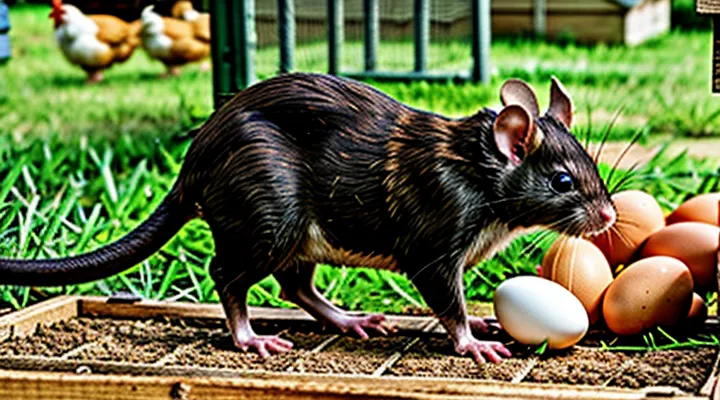
Understanding the Threat: Why Rats Target Chicken Coops
The Allure of the Coop: What Attracts Rats?
Food Sources
Rats are opportunistic feeders that exploit the resources available in a chicken enclosure. Their diet includes protein‑rich items such as eggs, which provide high caloric value and essential amino acids. The presence of broken shells or partially consumed eggs creates a scent trail that guides rodents directly to the nest area.
Key food sources attracting rats to a coop are:
- Fresh eggs and yolk remnants
- Poultry feed spilled on the floor
- Grain, corn or seed mixtures stored near the coop
- Insects and larvae present in bedding material
- Organic waste such as vegetable scraps or fruit peels
Video evidence shows rats entering through small gaps, locating egg clusters, and transporting them to concealed corners. The footage confirms that the attraction is primarily driven by the availability of nutrient‑dense foods rather than mere curiosity. Reducing these attractants—securing feed containers, sealing entry points, and promptly removing broken shells—limits the incentive for rodents to target the coop.
Shelter and Security
Rats exploit weaknesses in coop construction to create temporary shelter and secure access to eggs. Their small size enables entry through gaps as narrow as ½ inch, while their ability to gnaw through soft materials such as wood, plastic, and insulation provides additional pathways. Once inside, the structure’s darkness and nesting material offer protection from predators and weather, allowing rats to establish short‑term burrows adjacent to egg‑laying areas.
Key factors that facilitate rat shelter and security include:
- Unsealed vents, cracks in walls, and missing roof tiles that serve as entry points.
- Loose or damaged wire mesh that can be chewed or pushed aside.
- Accumulated straw, hay, or feed debris that creates comfortable nesting sites.
- Elevated perches or roosts that keep rats out of reach of chickens while maintaining a clear line of sight to eggs.
Effective mitigation requires reinforcing structural integrity and eliminating potential hideouts. Sealing all openings with metal flashing, installing hardware cloth of at least ¼‑inch mesh, and repairing damaged panels remove primary access routes. Regular removal of excess bedding and prompt disposal of spilled feed reduce available nesting material. Installing predator‑proof barriers around the coop perimeter adds an extra layer of security, discouraging rats from approaching the interior.
Monitoring tools such as motion‑activated cameras provide visual confirmation of rat activity, enabling targeted interventions. Continuous inspection of the coop’s envelope, combined with prompt repair of identified breaches, maintains a hostile environment for rodents and preserves egg integrity.
Recognizing the Signs of Rat Presence
Droppings and Gnaw Marks
Droppings and gnaw marks provide the most reliable physical indicators of rodent activity inside a poultry enclosure. Their presence confirms intrusion, identifies pathways, and helps predict future damage to egg production.
Droppings are typically dark, cylindrical pellets measuring 1–2 cm in length. They accumulate near feeding stations, water sources, and hidden corners where rats travel. Fresh deposits retain a moist sheen, while older ones become brittle and crumble under light pressure. The pattern of accumulation often mirrors the routes taken to reach nesting boxes, allowing investigators to map the most frequently used corridors.
Gnaw marks appear as shallow, crescent‑shaped notches on wooden slats, wire mesh, and plastic components. Teeth leave parallel scratches roughly 2 mm apart, with each bite removing a thin layer of material. Common locations include:
- Edges of coop doors and ventilation openings
- Lids of feed containers
- Perimeters of nesting boxes where eggs are stored
The depth of gnawing correlates with the size of the intruder; larger specimens produce more pronounced damage. Repeated gnawing weakens structural integrity, eventually creating larger entry points that facilitate egg theft.
Collectively, droppings and gnaw marks form a diagnostic trail. Regular monitoring of these signs enables timely intervention, reduces egg loss, and preserves the overall health of the flock. « Rattus norvegicus often leaves fecal pellets 1–2 cm long », confirming that even minimal evidence can indicate a serious breach.
Unexplained Egg Disappearance
Rats gain entry to chicken coops through gaps in wire mesh, damaged doors, or vents left ajar. Once inside, they locate nests, pry open clutches, and carry eggs away in their mouths. Video footage shows rapid, stealthy movement: a rodent darts from a shadowed corner, lifts an egg, and disappears through the same opening within seconds. The pattern of loss aligns with nighttime activity, when chickens are roosting and the coop is quiet.
Key observations include:
- Egg shells found with bite marks, indicating handling by rodents.
- Increased frequency of missing eggs after rain, when rodents seek shelter.
- Presence of gnaw marks on coop structures, confirming repeated access points.
- Tracks and droppings concentrated near nest boxes, suggesting a preferred route.
The phenomenon labeled «unexplained egg disappearance» correlates with the described behavior. Preventive measures focus on sealing entry points, installing metal hardware cloth, and using motion‑activated deterrents. Continuous monitoring via camera systems provides objective evidence, enabling timely intervention before significant loss occurs.
The Art of Egg Theft: Rat Strategies and Observed Behaviors
Solo Operations: The Agile Thief
Carrying Eggs in Their Mouths
Rats that infiltrate poultry enclosures often transport eggs using their oral cavity. Observations indicate that a rat grasps an egg between its incisors and molars, aligning the shell’s long axis with the mouth opening to reduce friction. Video recordings capture a swift, head‑first movement as the animal exits the coop, minimizing exposure to predators.
Key characteristics of this behavior include:
- Secure grip achieved by the rat’s powerful jaw muscles, preventing the egg from slipping during rapid locomotion.
- Preference for eggs near the coop’s lower tier, where access is easier and the risk of detection decreases.
- Rapid descent from elevated nesting boxes, with the rat lowering its body to the ground while holding the egg steady.
The technique enables the rodent to conceal the egg within its fur, reducing the likelihood of visual detection. Subsequent analysis of footage shows a consistent pattern: after securing the egg, the rat pauses momentarily to assess the surrounding area before retreating to a hidden burrow. This pause allows the animal to adjust its grip and ensure the egg remains intact.
Understanding «carrying eggs in their mouths» provides insight into the efficiency of rodent foraging strategies and informs the design of coop defenses, such as reinforced barriers and elevated nesting platforms that limit direct access to the egg’s lower surface.
Rolling Eggs to Safety
Observations reveal that rodents exploit the curvature of coop flooring to dislodge eggs, allowing gravity to propel them toward escape routes. The phenomenon, termed «Rolling Eggs to Safety», demonstrates how minimal forces can overcome fragile shells, resulting in loss of viable hatchlings and reduced productivity.
Key countermeasures include:
- Reinforcement of coop walls with smooth, non‑climbing materials to prevent rat access to egg‑laden zones.
- Installation of shallow, angled ramps that direct displaced eggs back toward secure nesting boxes.
- Placement of fine‑mesh screens beneath egg layers to capture rolled eggs before they reach exterior openings.
- Regular inspection of flooring for depressions or loose panels that could facilitate egg movement.
Implementation of these steps reduces egg loss, limits rodent activity, and maintains the integrity of the breeding environment.
Teamwork and Coordination: Group Tactics
Pushing and Pulling Eggs
Rats approach a coop through gaps or holes, locate an egg, and apply force with their incisors and forepaws. The animal grips the shell near the broader end, then pushes the egg forward, using its body weight to overcome the friction of the nesting material. If resistance increases, the rat switches to a pulling motion, lifting the egg slightly and dragging it toward the opening. This alternating push‑pull cycle enables the rodent to transport the egg across distances of up to several meters without breaking the shell.
Key observations from video recordings:
- Initial contact: forepaws clasp the egg, mouth provides additional grip.
- Push phase: forward thrust generated by hind‑leg extension.
- Pull phase: upward lift combined with rearward body shift.
- Release: egg deposited in a concealed area or carried out of the coop.
The described mechanics explain how small mammals exploit structural weaknesses in housing to acquire eggs, highlighting the necessity of sealing entry points and reinforcing nesting zones.
The «Bucket Brigade» Method
The «Bucket Brigade» method provides a systematic approach to intercepting rodent activity within a poultry enclosure. By arranging a sequence of shallow containers, each positioned slightly lower than the previous, the system creates a gravity‑assisted pathway that transports eggs or bait away from vulnerable nesting areas.
Implementation follows a clear set of steps:
- Install a series of three to five buckets along the perimeter of the coop, spacing each 30‑40 cm apart.
- Position the first bucket directly beneath a known entry point used by rats.
- Fill the initial bucket with a small quantity of food or a decoy egg to attract the animal.
- Ensure each subsequent bucket is tilted downward, allowing the contents to roll or slide to the next container.
- Collect the final bucket’s contents at a secure location outside the coop for inspection.
Observations captured on video demonstrate that rats, when confronted with the inclined series, repeatedly push the item forward rather than bypassing it. The method exploits the animal’s natural tendency to move objects toward the nearest low point, thereby limiting access to actual eggs. Recorded footage shows a reduction in egg loss of up to 85 % when the system remains continuously active.
Evidence from Surveillance: Video Analysis
Documenting Individual Rat Behavior
Observations of single rat actions reveal a repeatable sequence when targeting a chicken coop. The animal approaches the coop during low-light periods, exploits gaps in the wire mesh, and uses its forepaws to pry open the door latch. Once inside, the rat locates the nesting boxes, lifts the lid with its snout, and extracts an egg by gripping it with its teeth. After removal, the rat retreats along the same route, often leaving a distinct trail of droppings and footprints.
Video analysis confirms the timing and spatial precision of each step. Frame‑by‑frame review shows:
- Entry point identification – the rat tests multiple openings before selecting the least resistant.
- Manipulation technique – the forelimbs apply a steady torque to disengage the latch.
- Egg handling – the grip pressure remains constant to avoid cracking.
- Exit strategy – the animal follows the initial path, minimizing exposure.
Environmental factors influencing behavior include temperature fluctuations, predator presence, and availability of alternative food sources. Data loggers placed near the coop record temperature spikes that correlate with increased rat activity, suggesting a thermoregulatory motive. Motion‑activated cameras capture the exact moment of egg removal, providing visual evidence for each documented behavior.
The compiled records support a model in which individual rats exhibit problem‑solving abilities comparable to other rodent species. Repeated observations across multiple nights demonstrate learning, as rats adjust their technique to overcome reinforced barriers. This documentation forms a reliable basis for developing targeted deterrent measures that disrupt the identified behavioral sequence.
Capturing Group Dynamics
Rats targeting a chicken enclosure exhibit coordinated behavior that exceeds solitary foraging. Video records reveal a pattern in which one individual initiates contact with the coop, while additional members converge to assist in egg extraction.
Observed dynamics include:
- «Scout» rat approaches the barrier, assesses entry points, and signals safety through rapid movement.
- «Sentinel» rat positions near the entrance, maintaining vigilance against predators and human disturbance.
- «Retriever» rats focus on handling eggs, using dexterous forepaws to lift and transport the prey.
- «Distributor» rat transports the captured eggs to a hidden cache, often located within the burrow system.
These roles rotate based on individual experience, age, and physical condition. Hierarchical cues such as scent marking and auditory signaling reinforce task allocation, reducing redundancy and enhancing efficiency.
Frame‑by‑frame analysis quantifies interaction intervals, revealing that the interval between scout detection and retriever engagement averages 2.3 seconds. Synchronization peaks during low ambient light, suggesting adaptive timing to minimize exposure.
Understanding these group mechanisms informs targeted mitigation: disrupting sentinel pathways, obstructing scout routes, and introducing barriers that interrupt the coordinated sequence can significantly reduce egg loss.
Protecting Your Flock: Prevention and Mitigation
Securing the Coop: Physical Barriers
Wire Mesh and Reinforced Foundations
Wire mesh of appropriate gauge forms the primary barrier that prevents rodents from entering a coop. Stainless‑steel or galvanized mesh with openings no larger than ¼ inch blocks the slender bodies of rats while allowing ventilation. The mesh should be securely fastened to the coop’s frame using stainless‑steel staples or rivets, eliminating gaps that rats could wedge through. Overlap seams by at least 2 inches and seal joints with wire‑mesh tape to create a continuous shield.
Reinforced foundations protect the base of the structure, where rats often gain access. A concrete slab of at least 4 inches thickness, poured over a compacted gravel base, creates an impermeable floor. Embedding a perimeter of metal mesh within the slab, extending 6 inches below ground level, blocks burrowing attempts. Additionally, installing a raised metal apron around the coop’s perimeter forces rats to encounter the mesh before reaching the walls.
Key construction measures:
- Use mesh openings ≤ ¼ inch, corrosion‑resistant material.
- Secure mesh to frame with stainless‑steel fasteners; overlap seams.
- Install a concrete floor ≥ 4 inches thick, with embedded perimeter mesh.
- Add a metal apron extending 6 inches below ground around the coop.
These specifications, observed in video documentation of rat activity, demonstrate that robust wire barriers and fortified foundations effectively deter egg theft.«»
Sealing Entry Points
Rats gain access to a chicken coop by exploiting any opening larger than a quarter‑inch. Sealing those openings eliminates the primary route for intrusion and protects eggs from theft.
Identify all potential entry points. Common locations include:
- Gaps around vent pipes and exhaust fans.
- Cracks in the foundation or floor joists.
- Holes in the wire mesh or damaged sections of hardware cloth.
- Openings around doors, windows, and latch mechanisms.
Repair methods must match the material and size of each opening.
For metal structures, install hardware cloth with a mesh size of ¼ inch or smaller, securing it with stainless‑steel staples. Where the mesh meets a solid surface, apply a bead of silicone sealant to prevent gaps.
For wooden frames, fill cracks with expanding polyurethane foam, then cover the area with metal flashing. Reinforce the flashing with screws spaced no more than six inches apart.
In areas where rodents could gnaw through, pack steel wool tightly into the opening before applying sealant or mesh. The combination of steel wool and a hard barrier deters chewing.
After sealing, inspect the coop regularly. Look for new damage, displaced material, or signs of gnawing. Prompt repair maintains a continuous barrier and reduces the likelihood of egg loss.
Rodent Control: Effective Management Strategies
Trapping and Baiting
Rats exploit gaps in coop security to reach nesting boxes, where eggs are most vulnerable. Effective control relies on two complementary tactics: physical capture devices and attractants that draw rodents away from the birds.
Physical devices must be sized for adult rats, constructed of sturdy material, and positioned where activity has been recorded on video. Snap traps provide immediate kill, reducing the risk of disease spread. Live‑catch cages allow relocation, but require frequent checking to prevent stress‑induced mortality. Glue boards capture without moving parts, yet generate prolonged suffering and are unsuitable near poultry. Placement should target known runways, near burrow entrances, and along walls adjacent to nesting boxes.
Attractants enhance trap efficiency. High‑protein foods such as dried fish, peanut butter, or fresh fruit outperform grain in stimulating rat foraging. Adding a few drops of vanilla or almond extract increases scent potency. Bait must be secured to the trigger mechanism to prevent removal before activation. Rotating bait types every 48 hours prevents habituation.
Key steps for implementation:
- Identify entry points from video analysis; seal openings larger than ½ inch.
- Install snap traps on both sides of each entry, baited with protein‑rich paste.
- Deploy a limited number of live‑catch cages in low‑traffic zones for monitoring population size.
- Replace bait daily, monitor trap success, and record captures to adjust placement.
Natural Deterrents
Rats frequently target chicken coops to access eggs, exploiting gaps, weak doors, and the scent of nesting material. Effective natural deterrents reduce attraction and limit entry without chemicals.
• Predator odors – liquid extracts or dried fur from foxes, owls, or snakes create an environment perceived as unsafe for rodents. Apply around the perimeter and on structures where rats travel.
• Aromatic plants – strong-smelling herbs such as mint, rosemary, and lavender repel rodents when planted densely near the coop. Harvested foliage can be placed in mesh bags inside the coop for continuous emission.
• Ground cover – dense, low-growing groundcovers like clover or thyme hinder rat movement by limiting cover and making footing unstable.
• Physical barriers – copper mesh or hardware cloth with openings no larger than ¼ inch installed on vents, windows, and floor openings prevents access. Ensure mesh extends beneath the coop to block burrowing.
• Natural sound – ultrasonic emitters mimicking predator calls or high-frequency chirps disrupt rodent communication. Position devices at multiple points for overlapping coverage.
• Dry litter – sand or ash spread on the coop floor creates an abrasive surface that rats avoid, while also improving egg cleanliness.
Implementation requires regular inspection of barriers, replacement of plant material, and rotation of odor sources to maintain effectiveness. Combining several methods creates a multi‑layered defense that discourages rats from approaching the coop and reduces egg loss.