
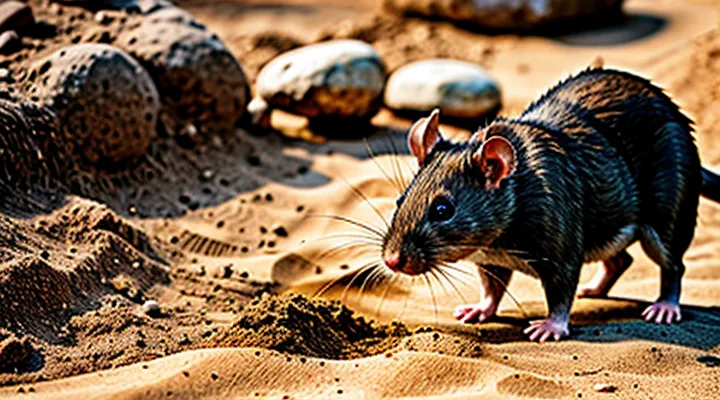
Understanding Rat Burrowing Behavior
The Basics of Rat Burrow Construction
Primary Reasons for Burrowing
Rats construct underground tunnels primarily to secure shelter, obtain food, protect offspring, and regulate temperature.
- Shelter: Burrows provide refuge from predators and harsh weather, offering a stable environment where rats can rest and hide.
- Food storage: Tunnels allow rats to cache seeds, grains, and insects, keeping supplies safe from competitors and spoilage.
- Reproduction: Female rats use burrows as nesting sites, where the enclosed space reduces exposure of pups to external threats and environmental fluctuations.
- Thermoregulation: Subterranean chambers maintain a relatively constant temperature and humidity, reducing the energy required for body heat maintenance.
These functions drive the excavation behavior observed in many rat species, confirming that burrowing serves essential survival and reproductive needs.
Common Characteristics of Rat Burrows
Rats construct burrows that serve as shelter, food storage, and breeding sites. These underground systems display several consistent traits.
- Entrance tunnels are short, typically 10–30 cm, and often concealed by vegetation or debris.
- Main chambers are located 30–100 cm below the surface, providing stable temperature and humidity.
- Multiple branching tunnels connect the primary nest to secondary chambers used for waste disposal and food caches.
- Walls are reinforced with compacted soil, sometimes lined with shredded plant material to increase insulation.
- Burrows feature a single, narrow escape route; larger species may add a secondary exit to reduce predator risk.
- Seasonal adjustments occur: in colder months, tunnels extend deeper and incorporate additional insulating material, while in warm periods, they become shallower and more ventilated.
These characteristics enable rats to maintain a protected microenvironment, support reproductive cycles, and sustain foraging efficiency throughout varying ecological conditions.
Types of Rats and Their Burrowing Tendencies
Norway Rats «Rattus norvegicus»
Preferred Environments for Norway Rat Burrows
Norway rats (Rattus norvegicus) construct underground tunnels when soil and surrounding conditions meet specific criteria.
Suitable soil must be loose enough for excavation yet retain shape. Loamy or sandy‑clay mixtures provide the optimal balance of cohesion and ease of digging. Excessively compacted or rocky substrates impede tunnel formation.
Moisture levels influence tunnel stability. Slightly damp soil prevents collapse, while overly saturated ground risks flooding. Ideal conditions occur when soil moisture ranges between 10 % and 20 % by volume.
Temperature regulates metabolic activity and burrow usage. Temperatures between 5 °C and 25 °C support continuous tunnel maintenance; colder environments drive rats to seek insulated chambers, whereas extreme heat forces relocation to cooler microhabitats.
Cover and concealment reduce predation risk. Dense vegetation, leaf litter, or debris layers conceal entrance openings, allowing rats to enter and exit with minimal exposure.
Proximity to food and water sources determines burrow placement. Burrows are typically located within 30–50 m of refuse piles, grain stores, or water runoff zones, ensuring efficient foraging.
Common anthropogenic sites that replicate these conditions include:
- Storm‑drain networks with loose sediment and constant moisture
- Basement crawl spaces featuring stable temperatures and concealed entry points
- Compost heaps offering nutrient‑rich soil and high humidity
- Agricultural fields where irrigation maintains moderate moisture and vegetation provides cover
When all these factors converge, Norway rats reliably develop extensive burrow systems that serve as nesting sites, escape routes, and storage chambers. Absence of any element—poor soil structure, extreme moisture, unsuitable temperature, lack of concealment, or distance from resources—reduces the likelihood of subterranean activity.
Structural Features of Norway Rat Burrows
Norway rats construct underground systems that differ markedly from the simple tunnels of many wild rodents. The burrows consist of a primary entrance, one or more auxiliary openings, and a network of horizontal and slightly inclined passages. Primary tunnels typically measure 5–10 cm in diameter, matching the body size of the animal, and extend 30–150 cm from the entrance before branching.
Key structural components include:
- Nest chamber: located at the deepest point of the system, lined with shredded material, insulation, and fecal pellets; dimensions range from 15 cm to 30 cm across.
- Food storage alcove: separate from the nest, positioned near an auxiliary opening for easy access.
- Waste zone: a designated area, often adjacent to the outer tunnel, where rats deposit urine and feces, reducing contamination of the nesting space.
- Escape routes: secondary openings provide rapid egress when predators approach or when the primary entrance is blocked.
The overall architecture reflects a balance between protection, thermoregulation, and efficient foraging. Burrows are shallow enough to maintain moderate temperature fluctuations yet deep enough to avoid surface disturbances, typically 15–45 cm below ground level. Soil composition influences tunnel stability; rats preferentially excavate in loose, well‑drained substrates, reinforcing walls with compacted earth. This structural design enables Norway rats to thrive in both natural habitats and urban environments.
Roof Rats «Rattus rattus»
Differences in Nesting Habits from Norway Rats
Rats exhibit a range of nesting strategies, but Norway rats (Rattus norvegicus) differ markedly from species that construct extensive underground burrows. While some rodents create deep tunnel systems, Norway rats typically establish nests in surface-level shelters.
Key distinctions in Norway‑rat nesting habits include:
- Preference for man‑made structures such as basements, sewers, and building cavities.
- Use of loose materials—paper, fabric, insulation—to line nests rather than excavating soil.
- Limited digging activity confined to shallow chambers for food storage or waste removal.
- Seasonal adjustments that involve relocating nests to warmer interiors rather than deepening burrows.
In contrast, burrowing rodents like prairie dogs or certain field rats invest energy in extensive tunnel networks that provide temperature regulation, predator avoidance, and complex social organization. Norway rats rely on proximity to human environments for protection and resource access, reducing the evolutionary pressure to develop deep subterranean dwellings.
Seldom Ground Burrowing
Rats are primarily surface dwellers; only a minority of species regularly excavate permanent tunnels. The common brown rat (Rattus norvegicus) constructs shallow nests in burrows only when shelter is scarce, but its primary activity remains above ground. In contrast, the grassland species Rattus rattus seldom burrows, preferring arboreal or crevice habitats.
Factors limiting extensive digging include:
- High metabolic demand, which favors quick foraging rather than prolonged excavation.
- Soil composition; compact or waterlogged substrates increase energy costs.
- Predation pressure; surface movement allows rapid escape routes.
- Social structure; colonies rely on shared nesting sites rather than individual tunnels.
Consequently, ground burrowing among rats is an occasional behavior, employed chiefly as a temporary refuge under adverse conditions rather than a defining ecological strategy.
Other Rat Species and Their Habitats
Less Common Burrowers
Rats are often cited as primary excavators, yet numerous other mammals and invertebrates construct underground tunnels with far lower frequency. Their burrowing activity influences soil aeration, predator avoidance, and seasonal shelter, albeit on a more limited scale than that of prolific diggers.
- European hedgehog (Erinaceus europaeus): creates shallow, temporary tunnels beneath leaf litter to escape predators and overwinter.
- Northern short‑tailed shrew (Blarina brevicauda): fashions brief, branching galleries for foraging, typically no deeper than 20 cm.
- American pika (Ochotona princeps): excavates modest retreats in talus slopes; chambers serve mainly for nesting rather than extensive feeding grounds.
- Desert pupfish (Cyprinodon spp.) larvae: produce minute sediment burrows in temporary pools, primarily for protection during early development.
- Carpenter ants (Camponotus spp.): carve narrow tunnels in decaying wood and soil, used for brood rearing rather than large‑scale habitat modification.
These organisms demonstrate that burrowing is not exclusive to highly specialized diggers. Their constructions are transient, shallow, and often serve singular purposes such as refuge or reproductive sites, contrasting with the extensive networks commonly associated with more dominant burrowers.
Factors Influencing Rat Burrowing
Environmental Conditions
Soil Type and Accessibility
Rats construct underground tunnels primarily when the substrate permits efficient excavation and long‑term stability. Soil composition directly governs the energy expenditure required for digging and the durability of the resulting burrow.
- Sandy soils: low cohesion, high drainage; enable rapid digging but collapse quickly under moisture fluctuations.
- Loamy soils: balanced particle size and organic content; provide moderate resistance and sufficient structural support for complex tunnel networks.
- Clay soils: high plasticity and cohesion; increase digging effort, yet produce exceptionally stable burrows once formed.
- Rocky or heavily compacted substrates: present physical barriers that rats typically avoid, limiting burrow depth and length.
Accessibility factors further modulate burrow feasibility. Moisture levels soften cohesive soils, reducing resistance, while excessive saturation leads to tunnel flooding. Soil compaction elevates the force rats must apply, often redirecting activity toward surface runways or alternative shelters. Vegetation cover supplies both concealment and a source of loosened litter, facilitating entry points and tunnel ventilation.
Overall, rats preferentially select soils that combine manageable resistance with long‑term structural integrity, adjusting their burrowing behavior to the prevailing texture, moisture, and compaction conditions.
Proximity to Food and Water Sources
Rats construct burrows primarily where food and water are readily accessible. The proximity reduces the energy expended on foraging, allowing more time for nest maintenance and reproduction. Burrow entrances are often positioned within a few meters of grain stores, refuse piles, or water seepage points, creating a direct route between shelter and resources.
Key factors influencing burrow placement include:
- Presence of permanent water sources such as underground springs or surface runoff.
- Availability of high‑calorie food items, especially during seasonal scarcity.
- Soil composition that permits easy excavation while remaining stable near resource zones.
When food supplies are concentrated, rats expand tunnel networks outward to maximize access, linking multiple chambers to distinct feeding sites. In arid environments, burrows are oriented toward moisture‑rich microhabitats, with deeper chambers retaining higher humidity levels that support physiological needs.
The spatial relationship between burrow systems and resource clusters dictates colony density. Areas with abundant nourishment and water support larger groups, leading to more extensive tunnel complexes. Conversely, sparse resources limit burrow size and may force rats to relocate frequently in search of sustenance.
Shelter from Predators and Elements
Rats construct underground tunnels primarily to avoid detection by predators and to protect themselves from harsh weather. The burrow system consists of shallow entry points, deeper nesting chambers, and escape routes that enable rapid retreat when threats appear.
- Narrow tunnels limit the size of potential predators that can follow.
- Soil covering insulates against temperature extremes, maintaining a stable microclimate.
- Moisture retention within the burrow reduces dehydration risk during dry periods.
- Ventilation shafts allow airflow while preventing exposure to wind and rain.
These structural features collectively provide a reliable refuge, allowing rats to sustain activity across diverse habitats.
Human Impact on Rat Burrowing
Urban Environments and Infrastructure
Rats frequently create subterranean tunnels beneath cities, adapting natural digging behavior to the constraints of built environments. Soil pockets, utility corridors, and abandoned basements provide accessible substrates where colonies can establish extensive networks.
Burrows in urban areas differ from rural systems. Typical dimensions range from 2 cm to 5 cm in diameter, extending 30 cm to 1 m deep. Construction relies on displaced soil, debris, and loose insulation, often reinforced by compacted earth or concrete fragments. Entrance points cluster around food sources, drainage openings, and structural cracks.
These tunnels intersect critical infrastructure. Direct contact with water mains can cause corrosion, while proximity to electrical conduits raises fire risk. Structural foundations may experience settlement when rat activity displaces supporting soil. Sidewalks and road surfaces develop unevenness as voids collapse.
Mitigation strategies employed by municipalities and property managers include:
- Sealing entry points on foundations, pipes, and utility boxes.
- Installing stainless‑steel mesh barriers beneath sidewalks and around drainage systems.
- Conducting regular inspections with ground‑penetrating radar to locate hidden galleries.
- Applying rodent‑resistant concrete mixes in new construction.
- Deploying integrated pest‑management programs that combine baiting, trapping, and habitat modification.
Effective control requires coordination between urban planners, civil engineers, and public‑health officials to limit tunnel formation and protect the integrity of city infrastructure.
Agricultural Settings
Rats commonly inhabit agricultural fields, where their ability to excavate subterranean tunnels influences crop production and soil integrity. The Norway rat (Rattus norvegicus) creates extensive burrow systems that can reach depths of 30 cm, while the roof rat (Rattus rattus) prefers shallow, surface-level galleries. Burrowing activity modifies soil aeration, alters moisture distribution, and can destabilize irrigation channels, potentially reducing yields of root crops such as carrots and potatoes.
Burrow networks also serve as shelters for parasites and predators, creating microhabitats that affect pest dynamics. In grain storage areas, tunnel entrances facilitate entry of rodents into silos, increasing contamination risk.
Effective control in farm environments relies on integrated measures:
- Physical barriers: metal mesh around field edges, sealed storage structures.
- Habitat reduction: removal of debris, tall grasses, and excess mulch that provide cover.
- Population management: bait stations with anticoagulant rodenticides, live traps positioned near active tunnels.
- Soil disturbance: regular plowing to collapse existing burrows and deter new construction.
Monitoring programs that map burrow locations and assess activity levels enable timely interventions, minimizing economic losses and preserving soil health.
Identifying Rat Burrows
Visual Cues and Signs
Entry and Exit Points
Rats that construct subterranean tunnels create distinct openings that serve as access routes for movement, ventilation, and predator avoidance. Each burrow typically features at least two openings: a primary entrance used for regular traffic and a secondary exit that provides an escape path when the main portal is blocked or threatened.
The primary entrance is positioned at ground level, often concealed by debris, vegetation, or a shallow mound of excavated soil. This opening is widened by repeated use, allowing a single adult rat to pass quickly while maintaining a narrow profile that limits exposure to predators. The entrance may also incorporate a short, sloping tunnel that directs water away from the burrow, reducing flood risk.
The secondary exit, sometimes located a few meters away from the main portal, functions as a safety valve. Rats establish this passage by extending a side tunnel that emerges at a lower point on a slope or near a dense cover of roots. The exit is frequently narrower than the primary entrance, serving as a discreet route for rapid retreat.
Key characteristics of rat burrow openings:
- Primary entrance: ground‑level, concealed, widened by traffic, includes drainage slope.
- Secondary exit: offset location, lower elevation, narrower, provides emergency escape.
- Both openings: lined with compacted soil, maintain structural integrity, allow airflow for temperature regulation.
These entry and exit points enable rats to navigate complex underground networks while minimizing detection and maximizing survival prospects.
Runways and Tracks
Rats create extensive underground tunnel systems that serve as protected routes for foraging, nesting, and escape. These natural passages share functional objectives with engineered ground surfaces designed for vehicle movement, such as runways and tracks.
Runways are long, flat surfaces constructed from reinforced concrete or asphalt, intended to support the weight and speed of aircraft during take‑off and landing. Tracks, whether for trains, automobiles, or athletic competition, consist of precisely graded and often paved pathways that guide movement and maintain consistent traction.
Both natural burrows and artificial groundways prioritize stability, drainage, and resistance to deformation. Burrows achieve stability through compacted soil and strategic branching, while runways rely on layered sub‑base materials and regular maintenance to prevent settlement. Drainage in tunnels is managed by sloped walls and ventilation shafts; runways incorporate permeable layers and drainage channels to remove surface water.
Key points of comparison:
- Purpose: provide a defined route for movement.
- Structural integrity: depend on material compaction and reinforcement.
- Maintenance: require periodic inspection to address erosion or wear.
- Environmental interaction: both must accommodate moisture and temperature fluctuations.
Understanding the engineering principles of runways and tracks offers insight into the efficiency of rat burrowing systems, highlighting common solutions to the challenges of supporting weight, ensuring safety, and preserving functionality in varied environments.
Droppings and Other Indicators
Rats leave distinct signs that reveal underground activity. Fresh fecal pellets appear in clusters near entry points, typically 0.5–1 cm in length, dark brown, and glossy when moist. As pellets dry, they become brittle and crumble easily, indicating prolonged exposure to air. A pattern of successive piles along a linear corridor suggests continuous tunneling.
Other reliable indicators include:
- Soil displacement: excavated soil forms small mounds or loose patches at tunnel openings, often mixed with plant material.
- Chewed vegetation: stems and roots near burrow entrances show gnaw marks, reflecting foraging within the tunnel system.
- Gnaw marks on hard surfaces: wood, plastic, or concrete near suspected burrows display parallel scratches consistent with rodent incisors.
- Odor: a musky, ammonia-like scent accumulates in confined tunnels, detectable by close inspection.
- Tracks: faint footprints in soft substrate, visible when moisture is present, align with the direction of the tunnel.
Combined, these observations allow accurate assessment of subterranean rat presence without visual confirmation of the burrow itself.
Differentiating from Other Pests' Burrows
Moles and Voles
Rats occasionally excavate shallow tunnels, but their burrowing activity differs markedly from that of true subterranean mammals. Moles and voles illustrate the range of underground behavior found in small mammals and provide a comparative framework for evaluating rat digging.
Moles are specialized for extensive tunneling. Their forelimbs are broad and equipped with strong claws that enable rapid soil displacement. The resulting network consists of:
- Deep, permanent tunnels used for foraging and shelter.
- Surface runways that connect to feeding zones.
- Separate chambers for nesting and food storage.
Voles, while not as adept at soil removal, create modest burrows primarily for protection and breeding. Their tunnels are shallow, often branching from existing rodent holes, and are characterized by:
- Simple, short passages leading to a nest chamber.
- Frequent use of existing cracks and leaf litter to reduce excavation effort.
- Seasonal adjustments, with deeper burrows in winter for thermal regulation.
Both moles and voles demonstrate consistent, species‑specific digging patterns, contrasting with the opportunistic, surface‑level burrows occasionally produced by rats. Understanding these distinctions clarifies that rats do not engage in the extensive, purpose‑built burrowing typical of true burrowers such as moles and, to a lesser extent, voles.
Gophers and Groundhogs
Gophers (family Geomyidae) and groundhogs (Marmota monax) are large, fossorial rodents that construct extensive underground networks. Gophers excavate tunnels primarily for foraging and shelter, creating chambers lined with loose soil and reinforced with compacted walls. Groundhogs dig deeper, seasonal burrows that include nesting chambers, food storage rooms, and escape exits.
Both species employ strong forelimb claws and incisors to displace soil. Typical gopher tunnels range from 0.5 to 2 meters in length, with multiple lateral branches that facilitate ventilation. Groundhog burrows can extend up to 6 meters vertically and horizontally, often featuring a main entrance, a secondary escape tunnel, and a dedicated hibernation chamber.
- Gophers: shallow, maze‑like systems; primarily herbivorous diet; surface activity limited to brief foraging trips.
- Groundhogs: deeper, vertically oriented structures; omnivorous diet including vegetation and insects; seasonal surface activity for breeding and hibernation preparation.
Rats also dig, but their burrows are generally shorter, less complex, and oriented toward immediate shelter rather than long‑term habitation. In contrast, gophers and groundhogs invest considerable energy in constructing durable, multi‑purpose underground habitats that support reproduction, thermoregulation, and predator avoidance.
Managing Rat Burrows
Prevention Strategies
Securing Food Sources
Rats construct extensive underground networks that serve multiple survival functions, including the protection and storage of food. The tunnels provide stable temperature, humidity, and concealment from predators, allowing rats to cache perishable items and maintain a reliable supply.
Key mechanisms of food security within these burrows:
- Cache chambers: Separate compartments lined with shredded material isolate food from moisture and mold, extending shelf life.
- Strategic placement: Stores are positioned near entry points for quick access while remaining hidden from foraging competitors.
- Seasonal rotation: Rats regularly retrieve and replace cached items, preventing spoilage and ensuring fresh provisions throughout winter months.
- Scent masking: Soil and bedding absorb odors, reducing detection by predators and other rodents.
These behaviors demonstrate that the subterranean architecture of rats is integral to their ability to secure and preserve nutritional resources over extended periods.
Eliminating Shelter
Rats construct underground tunnels when suitable conditions exist. The presence of stable, concealed spaces encourages excavation, providing protection from predators and environmental extremes. When those spaces are removed, rats shift to alternative shelters such as surface debris, building cavities, or human-made structures.
Eliminating shelter can be achieved through:
- Removing loose soil and debris that could serve as entry points.
- Sealing cracks, gaps, and openings in foundations, walls, and floors.
- Installing metal or concrete barriers around potential burrowing zones.
- Maintaining vegetation at a low height to reduce cover and access points.
- Regularly inspecting and repairing damaged utility lines and drainage systems.
Each measure reduces the incentive for rats to initiate digging activity, thereby limiting the formation of new burrows. Continuous monitoring ensures that any newly created openings are promptly addressed, preventing re‑establishment of underground habitats.
Property Maintenance
Rats that create underground tunnels can compromise foundations, sidewalks, and utility lines, leading to costly repairs for property owners. Their activity weakens soil structure, creates moisture pathways, and attracts secondary pests, which intensifies the need for systematic upkeep.
Visible indicators of subterranean activity include mounded soil, gnawed wood or plastic, droppings near entry points, and audible scurrying within walls or crawl spaces. Early detection reduces the extent of damage and limits the scope of remedial work.
Effective property maintenance incorporates the following actions:
- Seal cracks, gaps, and openings larger than ¼ inch in foundations, walls, and utility penetrations.
- Install hardware cloth or metal mesh beneath decks, sheds, and exterior walls to deter burrowing.
- Keep vegetation trimmed at least 12 inches away from structures; roots provide cover and food sources for rodents.
- Remove debris, compost, and stored feed that serve as attractants.
- Conduct quarterly inspections of basements, crawl spaces, and drainage systems for signs of tunneling.
When burrows are discovered, eliminate the tunnels by filling them with compacted soil or expanding foam, then apply rodent-proof barriers. Follow up with professional pest control to address ongoing infestations and prevent re‑colonization. Consistent application of these measures preserves structural integrity and minimizes long‑term maintenance costs.
Control Methods for Active Burrows
Trapping Techniques
Rats often create extensive tunnel systems when soil conditions permit, but many populations remain above ground, using walls, debris piles, and vegetation for shelter. Effective capture strategies must address both subterranean and surface activity.
Key trapping methods include:
- Snap traps placed at tunnel entrances or along runways; bait with high‑protein items such as peanut butter or dried meat.
- Live‑catch cages positioned in burrow openings; provide escape routes away from the nest to reduce stress.
- Electronic traps delivering a rapid voltage shock; suitable for sealed burrow chambers where contact is assured.
- Glue boards applied on interior tunnel walls; useful for monitoring activity but require frequent inspection to prevent prolonged suffering.
- Ground‑penetrating bait stations that release a slow‑acting rodenticide within the tunnel network; must comply with local regulations and be inaccessible to non‑target species.
Successful deployment depends on:
- Locating active tunnels by observing fresh soil displacement, droppings, or gnaw marks.
- Setting traps perpendicular to the tunnel axis to intersect the rat’s natural movement.
- Maintaining trap hygiene to preserve bait potency and prevent disease transmission.
- Adjusting trap density to match the estimated size of the burrow system; a minimum of one trap per 10 m² of active tunnel area is recommended.
- Monitoring and resetting traps daily to avoid bait degradation and to record capture rates for population assessment.
Baits and Their Application
Rats that excavate subterranean tunnels require targeted control measures; bait selection directly influences the success of any eradication program. Effective baits combine attractants with toxic agents, ensuring rapid consumption and minimizing non‑target exposure.
- Protein‑based baits (e.g., fish meal, meat hydrolysate) attract omnivorous rodents during nocturnal foraging.
- Grain‑based baits (e.g., wheat, corn) exploit the preference of rats for carbohydrate sources.
- Aromatic baits (e.g., peanut butter, cheese flavor) provide strong olfactory cues that draw individuals from burrow entrances.
- Combination baits blend protein and grain to cover a broader dietary spectrum, increasing encounter probability.
Application techniques must align with burrow architecture and rat behavior:
- Pre‑baiting: place non‑toxic bait for 3–5 days to establish a feeding pattern, then replace with toxic formulation.
- Burrow‑specific placement: insert bait packets directly into tunnel openings using flexible probes, ensuring contact with active pathways.
- Surface stations: locate stations near known entry points, securing them against weather and wildlife interference.
- Rotational deployment: alternate bait types weekly to prevent habituation and maintain high uptake rates.
Monitoring involves regular inspection of bait stations, documentation of consumption rates, and verification of mortality through carcass recovery. Adjust bait composition and placement frequency based on observed efficacy, always adhering to local regulations and safety guidelines.
Professional Pest Control Interventions
Rats frequently create subterranean tunnels to access food, shelter, and water. Their burrowing activity compromises foundations, undermines utility lines, and creates pathways for additional pests. Professional pest‑control services address these risks through a systematic, evidence‑based process.
The initial phase involves a thorough site assessment. Technicians locate entry points, map active tunnels, and identify signs such as fresh soil mounds, gnaw marks, and droppings. Data collection guides the selection of control tactics and establishes a baseline for progress evaluation.
Intervention methods include:
- Exclusion – sealing cracks, installing metal flashing, and repairing vent covers to prevent rodent ingress.
- Sanitation – removing food residues, securing waste containers, and eliminating water sources that attract rodents.
- Trapping – deploying snap or electronic traps at strategic locations within tunnel networks; regular checking ensures timely removal of captured animals.
- Baiting – applying anticoagulant or non‑anticoagulant rodenticides in tamper‑resistant stations; placement follows strict dosage guidelines to minimize non‑target exposure.
- Chemical barrier – applying rodenticide dust or granules along burrow entrances to create a hostile zone that discourages re‑entry.
- Structural repair – reinforcing foundations, filling voids, and installing concrete slabs to collapse existing tunnels and deter new excavation.
Monitoring continues after treatment. Technicians set motion‑activated cameras, inspect for fresh burrow activity, and record trap catches. Persistent signs trigger a reassessment and possible escalation to additional control measures.
Integrated pest management (IPM) underpins all actions. IPM combines environmental modification, mechanical controls, and targeted chemicals to achieve long‑term suppression while complying with regulatory standards and minimizing ecological impact.