
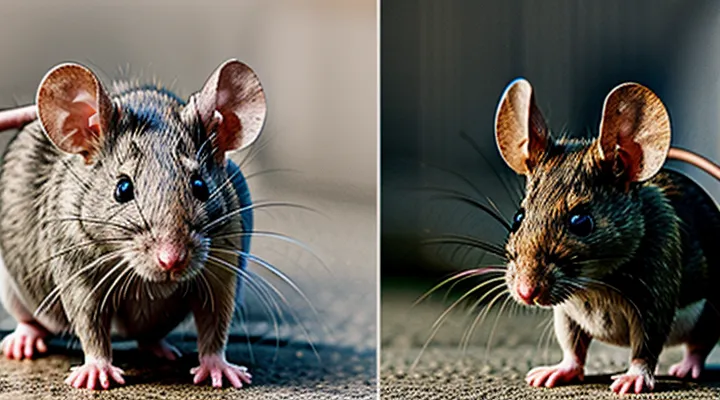
Initial Observations
Size Comparison
The size of a common house mouse (Mus musculus) and a juvenile Norway rat (Rattus norvegicus) differs markedly, providing a reliable metric for species identification.
Typical dimensions:
- Body length (head‑to‑base): mouse ≈ 7–10 cm; young rat ≈ 12–20 cm.
- Tail length: mouse ≈ 6–9 cm, often equal to or slightly shorter than the body; young rat ≈ 10–15 cm, generally longer than the body.
- Weight: mouse ≈ 15–30 g; young rat ≈ 40–120 g, increasing rapidly after weaning.
These measurements reflect the accelerated growth of rat pups compared with the relatively static size of adult mice. The disparity persists across subspecies and environmental conditions, making size a primary distinguishing characteristic.
Tail Characteristics
The tail provides a rapid visual cue for distinguishing a mouse from a juvenile rat.
A mouse tail is typically three to four times the length of its body, slender, and uniformly covered with fine hair. The dorsal surface is densely furred, while the ventral side bears a thin, nearly invisible layer of scales. The tail lacks significant musculature for grasping and remains flexible but non‑prehensile.
A young rat tail exceeds the body length by a factor of two to three, presenting a thicker, more robust structure. Hair coverage is sparse, especially near the tip, exposing a pronounced scaly ventral surface. The tail exhibits a slight prehensile capacity, allowing limited grasping of objects during early development.
Key distinctions:
- Length relative to body: mouse (3–4 ×), young rat (2–3 ×)
- Diameter: mouse (narrow, ~2–3 mm), young rat (wider, ~5–7 mm)
- Fur density: mouse (dense, continuous), young rat (patchy, reduced)
- Ventral scales: mouse (minimal, fine), young rat (prominent, coarse)
- Prehensility: mouse (absent), young rat (present in early stages)
These morphological parameters enable reliable identification without ancillary observations.
Fur Texture and Color
Mice possess a fine, soft coat composed of short guard hairs overlaying a dense underfur. The hair shafts are typically uniform in diameter, giving the fur a sleek appearance. Coloration in common laboratory and wild mice ranges from pale gray to brown, with occasional patches of white on the ventral side. Pigmentation is generally uniform, lacking distinct markings.
Young rats, by contrast, develop a coarser pelage. Guard hairs are longer and stiffer, providing a rougher texture that feels noticeably different to the touch. The underfur is thinner, resulting in a less plush surface. Juvenile rats display a broader spectrum of colors: brown, black, or reddish tones dominate the dorsal area, while the ventral side is often lighter, sometimes exhibiting a distinct stripe or mottling pattern not seen in mice.
Key points:
- Texture: mouse fur – smooth, short; rat fur – coarse, longer guard hairs.
- Color range: mouse – limited, uniform shades; rat – diverse, with possible dorsal‑ventral contrast.
- Visual markers: rats may show subtle patterning; mice generally lack such markings.
Key Physical Differences
Head and Snout Shape
Mice possess a compact head with a short, triangular snout that ends abruptly at the incisors. The nasal bridge is relatively flat, and the muzzle exhibits a pronounced, rounded tip. In contrast, young rats display a longer, more cylindrical snout that tapers gradually toward the mouth. Their head is broader, with a slightly higher cranial dome and a less abrupt transition between the facial and nasal regions.
Key morphological contrasts:
- Snout length: mouse ≈ 1 – 1.5 cm; young rat ≈ 2 – 2.5 cm.
- Shape: mouse – triangular, blunt; young rat – cylindrical, tapered.
- Nasal bridge: mouse – flat; young rat – gently arched.
- Overall head proportion: mouse – small, rounded; young rat – larger, broader.
These differences affect feeding mechanics and sensory perception, allowing each species to exploit distinct ecological niches.
Ear Size and Shape
Mice possess compact, rounded ears that measure approximately 10–12 mm in length. The pinna is thin, covered largely by a sparse layer of fine hair, and the ear margin forms a smooth curve without pronounced points. Auditory canals are short, terminating close to the outer surface, which limits external auditory structures to a minimal profile.
Young rats display significantly larger ears, typically 15–20 mm long, with a noticeably elongated shape. The pinna extends farther laterally and often includes a subtle notch at the apex, giving the ear a more angular appearance. Hair density on the rat’s ear is higher, and the cartilage is thicker, resulting in a firmer, more prominent structure. The auditory canal is deeper, allowing a greater portion of the ear canal to be visible externally.
Key comparative points:
- Length: mouse ears ≈ 10–12 mm; young rat ears ≈ 15–20 mm.
- Shape: mouse ears rounded and smooth; rat ears elongated with a slight apex notch.
- Thickness: mouse pinna thin, low cartilage; rat pinna thicker, firmer.
- Hair coverage: mouse ears sparsely haired; rat ears more densely haired.
These anatomical differences affect species‑specific hearing capabilities and visual identification in laboratory and field settings.
Foot and Paw Structure
The structure of the foot and paw provides reliable criteria for separating a mouse from a juvenile rat. Both species possess digitized extremities, yet the arrangement, size, and skeletal support differ markedly.
Mice display five digits on each fore‑ and hind‑limb. The first digit (hallux) is reduced to a small nail, while the remaining four bear well‑developed claws. Plantar pads consist of a single central pad flanked by two smaller lateral pads on the hind foot; the fore foot contains a compact pad covering the entire sole. The metatarsal bones are short relative to body length, producing a compact foot that facilitates rapid, agile movements across narrow surfaces. Claws are relatively straight, suited for climbing and gripping.
Young rats possess five digits on the forepaws but only four functional digits on the hind paws; the fifth digit is vestigial and lacks a claw. The hind foot features a larger, elongated central pad accompanied by distinct lateral pads that extend farther toward the digits. Metatarsal and metacarpal bones are proportionally longer, giving the juvenile rat a broader, more robust foot. Claws exhibit a pronounced curvature, enhancing digging and burrowing capabilities. The skeletal framework includes a more developed calcaneus and larger ankle joints, reflecting the species’ reliance on ground‑based locomotion.
Key diagnostic points:
- Digit count: mouse = 5/5, young rat = 5/4 (hind).
- Pad configuration: mouse = compact central pad, rat = elongated central pad with extended lateral pads.
- Claw shape: mouse = straight, rat = curved.
- Bone proportion: mouse = short metatarsals, rat = longer metatarsals and robust ankle bones.
These morphological markers enable precise identification of each species based on foot and paw anatomy alone.
Behavioral and Biological Aspects
Dietary Habits
Mice and young rats occupy separate ecological niches, reflected in their feeding strategies. The two species consume overlapping grain and seed resources, yet their preferences, consumption rates, and foraging behaviors diverge markedly.
- Food selection: Mice favor small, high‑carbohydrate seeds such as millet and wheat. Young rats show a broader palate, incorporating protein‑rich insects and occasional plant matter alongside grains.
- Meal frequency: Mice ingest food continuously throughout the night, maintaining a steady intake to support rapid metabolism. Juvenile rats feed in distinct bouts, often clustering meals around dawn and dusk.
- Portion size: Individual mouse meals are modest, typically 2–4 g per feeding episode. Young rats consume larger portions, ranging from 5–10 g per session, to meet growth demands.
- Foraging method: Mice rely on tactile exploration, using whisker‑mediated detection to locate scattered seeds. Young rats employ more aggressive digging and occasional scavenging, allowing access to deeper food sources.
These dietary distinctions influence growth patterns, energy allocation, and susceptibility to nutritional stress, underscoring the need to treat mouse and juvenile‑rat nutrition as separate considerations in research and husbandry.
Habitat Preferences
Mice typically occupy indoor environments such as kitchens, storerooms, and attics, where they exploit human food supplies and nesting materials. Their small size allows them to infiltrate narrow gaps and exploit dense clutter. Outside, they favor fields, grasslands, and low vegetation, constructing shallow burrows near ground cover.
Young rats, in contrast, prefer semi‑urban and peri‑urban settings that combine natural and artificial resources. They are frequently found in sewage systems, basements, and abandoned structures, using larger openings to access these spaces. In outdoor habitats, juvenile rats select dense shrubbery, hedgerows, and riparian zones, where they can dig extensive burrows with multiple chambers.
Key distinctions in habitat preference:
- Location: Mice favor strictly indoor or low‑lying outdoor sites; young rats gravitate toward mixed indoor‑outdoor zones with greater structural complexity.
- Entry size: Mice exploit openings as narrow as 6 mm; rats require passages of at least 12 mm.
- Burrow architecture: Mouse nests are shallow and simple; rat burrows are deeper, multi‑entranced, and often connected to communal tunnels.
These differences reflect each species’ adaptation to resource availability and predator avoidance strategies.
Reproductive Patterns
The reproductive biology of a common laboratory mouse differs markedly from that of a juvenile rat, producing distinct outcomes in breeding programs and population dynamics.
- Mice reach sexual maturity at 5–6 weeks, whereas young rats become fertile at 8–10 weeks.
- Gestation in mice lasts 19–21 days; rats require 21–23 days.
- A typical mouse litter contains 5–8 pups; a young rat litter averages 6–12.
- Mice experience a 4‑day estrous cycle; rats display a 4‑5‑day cycle with a slightly longer luteal phase.
- Post‑natal development proceeds faster in mice, with weaning at 3 weeks compared with 4 weeks for rats.
- Maternal investment per pup is lower in mice, reflected in reduced milk production and shorter nursing periods.
These parameters influence generation time, population growth rates, and experimental scheduling. Researchers must adjust breeding protocols to accommodate the earlier maturation and shorter reproductive intervals of mice, while accounting for the larger litters and extended developmental timeline of young rats.
Common Misconceptions
Age-Related Confusion
Distinguishing a mouse from a young rat becomes problematic when age alters typical size and coat characteristics. Juvenile rats often match adult mice in body length, tail proportion, and fur coloration, creating visual overlap that can mislead observers.
Age‑related changes that generate confusion include:
- Body mass: Young rats gain weight rapidly; a 4‑week‑old rat may weigh as much as a mature mouse.
- Tail length: Rat pups develop longer tails early; the tail‑to‑body ratio approaches that of adult mice by the third week.
- Ear size: Rat ears enlarge proportionally with growth, narrowing the size gap with mouse ears.
- Facial structure: Juvenile rats exhibit softer facial features, resembling the rounded snout of a mouse.
Despite these convergences, reliable criteria persist:
- Incisor shape: Rats possess continuously growing, slightly curved incisors; mouse incisors are straighter and thinner.
- Footpad pattern: Rat hind feet show a distinct arrangement of pads and larger digits compared with the compact footpad of a mouse.
- Whisker length: Rat whiskers exceed those of mice even in early development, providing a tactile cue.
Understanding age‑related confusion is essential for accurate species identification in laboratory settings, veterinary practice, and pest management. Correct identification prevents misclassification of experimental subjects, ensures appropriate medical treatment, and informs targeted control measures.
Species Identification Challenges
Distinguishing a common house mouse from a young rat presents a practical problem for researchers, pest‑management professionals, and veterinarians. Overlapping size ranges, similar coat coloration, and comparable tail proportions create frequent misidentifications, especially when specimens are captured in the field or observed in laboratory settings.
Key identification challenges include:
- Body mass that falls within the upper mouse and lower juvenile‑rat spectrum, eliminating weight as a reliable discriminator.
- Fur coloration patterns that vary with age, season, and genetic background, obscuring species‑specific markings.
- Tail length and hair density that converge in early‑stage rats, making visual assessment ambiguous.
- Dental morphology that requires close examination; incisors appear alike until molar eruption, when species‑specific cusp patterns emerge.
- Behavioral cues such as activity level and foraging habits that overlap in confined environments, reducing reliance on ethology.
Effective resolution relies on a combination of morphological, anatomical, and molecular techniques. Precise measurement of skull dimensions, particularly the length of the nasal bone and width of the zygomatic arch, yields distinct species signatures. Microscopic analysis of molar occlusal surfaces distinguishes the more complex rat pattern from the simpler mouse design. Polymerase chain reaction (PCR) assays targeting mitochondrial cytochrome b or nuclear ribosomal DNA provide rapid, species‑specific confirmation when visual criteria fail. Habitat context, including nesting material and proximity to known rat colonies, offers supplemental evidence but should not serve as the primary determinant.
Accurate species identification underpins experimental reproducibility, informs targeted control strategies, and prevents diagnostic errors in laboratory animal care. Integrating detailed morphological assessment with molecular verification delivers the most reliable differentiation between mouse and juvenile rat specimens.
Why Differentiation Matters
Pest Control Strategies
Effective pest management requires recognizing the anatomical and behavioral traits that separate a mouse from a juvenile rat. Mice are smaller, weigh 15–30 g, and exhibit rapid breeding cycles with litter sizes of 5–8. Young rats reach 150–250 g, develop stronger bite forces, and display more aggressive foraging patterns. These differences influence trap selection, bait placement, and population monitoring.
Control tactics must align with species‑specific habits. For mice, low‑profile snap traps positioned along walls capture their preference for narrow pathways. For juvenile rats, heavier spring traps or electronic devices placed near larger burrow entrances address their capacity to overcome stronger mechanisms. Bait formulations should consider dietary preferences: mice favor high‑carbohydrate seeds, whereas young rats respond better to protein‑rich mixtures.
- Deploy snap or electronic traps in concealed, high‑traffic zones for mice; use larger, reinforced traps for juvenile rats.
- Apply bait stations with species‑targeted attractants, ensuring placement at ground level for mice and slightly elevated or near burrow openings for rats.
- Conduct regular inspections, recording capture rates to adjust trap density and bait composition promptly.
- Integrate environmental sanitation—eliminate food residues, seal entry points, and reduce clutter—to limit shelter options for both pests.
Monitoring data should guide escalation to professional extermination when trap efficacy declines, ensuring that interventions remain proportionate to the identified rodent population.
Research and Laboratory Settings
In research facilities, the choice between a mouse and a juvenile rat influences experimental design, housing requirements, and data interpretation. Mice are small, mature at 6‑8 weeks, and are typically housed in groups of up to five per cage. Juvenile rats reach sexual maturity around 5‑6 weeks, require larger cages, and are often kept in pairs or small trios to reduce aggression. The size differential affects surgical access: mouse anatomy allows microsurgical procedures with instruments under 0.5 mm, whereas rat anatomy accommodates larger tools and provides clearer visualization of organ systems.
Physiological parameters diverge markedly. Mouse heart rates average 500–600 bpm, while juvenile rats record 300–400 bpm, altering cardiovascular monitoring protocols. Blood volume in a mouse (≈ 1.5 ml) limits the frequency of sampling; a juvenile rat (≈ 5 ml) permits repeated draws without compromising hemodynamics. Metabolic rates differ: mice exhibit higher basal metabolic rates, requiring caloric density adjustments in feeding regimens, whereas rats tolerate standard chow with less frequent supplementation.
Behavioral testing must reflect species‑specific traits. Open‑field assays for mice emphasize thigmotaxis and rapid locomotion; rats display exploratory pauses and rearing, necessitating longer observation periods. Conditioning paradigms such as fear‑potentiated startle yield stronger responses in mice due to heightened auditory sensitivity, while rats demonstrate more robust contextual learning, influencing protocol selection.
Regulatory considerations also vary. Institutional animal care committees often classify mice as “small rodents” with streamlined reporting, whereas juvenile rats may fall under a higher tier of oversight, requiring detailed justification for procedures that exceed minimal invasiveness.
Key laboratory distinctions:
- Cage dimensions: mouse ≈ 30 × 15 cm; juvenile rat ≈ 45 × 30 cm
- Housing density: up to 5 mice per cage; 2–3 rats per cage
- Surgical instrument size: ≤ 0.5 mm for mice; 1–2 mm for rats
- Blood sampling limits: ≤ 0.2 ml per mouse; ≤ 0.5 ml per rat per session
- Typical lifespan for experiments: 2–3 months (mouse); 4–6 months (rat)
Selecting the appropriate rodent aligns experimental variables with the biological attributes of the species, ensuring reproducibility and ethical compliance.
Pet Ownership Considerations
When choosing a small rodent as a pet, prospective owners must evaluate size, temperament, care requirements, and long‑term health prospects. A mouse typically reaches a maximum length of 3–4 inches, while a young rat grows to 7–9 inches, influencing cage dimensions and enrichment needs. Larger body mass in rats allows for sturdier handling and reduced risk of accidental injury during routine interaction.
Dietary needs differ noticeably. Mice thrive on a high‑protein seed mix supplemented with occasional fresh vegetables; excessive fat can lead to obesity. Rats require a more balanced grain‑based formula, higher fiber content, and regular provision of fresh fruits and leafy greens to prevent dental overgrowth. Both species need constant access to clean water, but rats benefit from a larger water bottle to accommodate higher intake.
Health monitoring demands distinct attention. Mice are prone to respiratory infections that manifest quickly, requiring prompt veterinary assessment. Young rats exhibit a higher incidence of skin lesions and tumors, necessitating routine skin checks and periodic health screenings. Vaccination is unnecessary for either, but parasite control through monthly deworming remains essential.
Considerations for social environment also vary. Mice often tolerate solitary housing, though they may form small groups if introduced early. Rats display strong social bonds; isolation can result in stress‑induced aggression and reduced lifespan. Providing at least a pair of rats encourages natural play behavior and mental stimulation.
Key practical points can be summarized:
- Cage size: minimum 10 × 10 inches for mice, 18 × 12 inches for a pair of rats.
- Enrichment: tunnels and wheels for mice; chew toys and climbing structures for rats.
- Lifespan: 1.5–2 years for mice, 2–3 years for rats.
- Handling frequency: daily gentle handling recommended for both, with longer sessions feasible for rats.
Prospective owners should align these factors with available space, time commitment, and willingness to manage species‑specific health issues before deciding between a mouse and a young rat.