
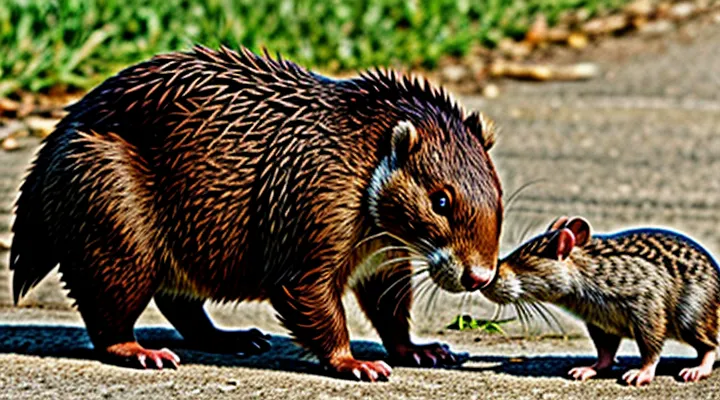
Unraveling the Mystery: Identifying the Animal
Physical Characteristics
Size and Shape
The creature commonly known as the muskrat exhibits a compact body length of 20–30 cm, excluding a laterally flattened tail that adds another 10–15 cm. Weight ranges from 300 g to 900 g, with males typically heavier than females. Its head resembles a small rodent, featuring a blunt snout and prominent whiskers that aid navigation in murky water.
Key aspects of its morphology include:
- Body shape: cylindrical torso covered in dense, water‑repellent fur, providing insulation and buoyancy.
- Tail: flattened, paddle‑like, covered with scales, functioning as a rudder for agile swimming.
- Limbs: short, powerful fore‑ and hind‑feet equipped with webbing between digits, enabling rapid propulsion and digging.
- Ears and eyes: Small, recessed, minimizing drag while submerged.
Overall proportions combine the stoutness of a beaver with the slenderness of a rat, resulting in an animal adapted for both aquatic maneuvering and terrestrial burrowing.
Distinctive Features
The creature that merges beaver‑like and rat‑like characteristics displays a compact body covered with dense, water‑resistant fur. Its tail is broad and flattened, providing propulsion in water while also serving as a rudder during swimming. The hind feet are webbed, enhancing maneuverability in aquatic environments.
Dentition reflects a dual diet: incisors grow continuously, enabling gnawing of vegetation and the cracking of shells. Molars possess flat surfaces for grinding plant material. This dental arrangement supports both herbivorous and omnivorous feeding habits.
Habitat preference includes wetlands, marshes, and the margins of ponds. Burrows are constructed in soft soil or among dense vegetation, offering shelter from predators and extreme temperatures. The animal’s scent glands release a musky odor that marks territory and deters rivals.
Reproductive traits feature a short gestation period of approximately three weeks, followed by litters of four to seven offspring. Young are born hairless and blind, gaining fur and open eyes within two weeks. Parental care continues until the juveniles achieve independent foraging skills.
Key adaptations can be summarized:
- Semi‑aquatic locomotion: webbed hind feet, flattened tail, dense fur
- Dental specialization: continuously growing incisors, flat molars
- Nesting behavior: burrows in wet soils, use of vegetation for concealment
- Territorial marking: musky scent glands
- Rapid reproduction: short gestation, multiple offspring per litter
These distinctive features enable the animal to thrive in water‑rich ecosystems while maintaining the foraging versatility of a small rodent.
Habitat and Distribution
Geographic Range
The nutria (Myocastor coypus) originates from the temperate wetlands of South America. Its native distribution encompasses Argentina, Bolivia, Brazil, Chile, Paraguay, Uruguay, and parts of Peru. In these regions the species inhabits riverbanks, marshes, and irrigation canals, where dense vegetation provides both food and cover.
Human‑mediated introductions have extended the animal’s range far beyond its original habitat. Populations now thrive in North America, especially the central United States (California, Texas, Louisiana, Ohio, and the Great Lakes region) and the southeastern provinces of Canada (Ontario and Quebec). In Europe, established colonies exist in France, Spain, Italy, the Netherlands, Belgium, and the United Kingdom, often concentrated along coastal estuaries and inland waterways.
Additional introductions have resulted in isolated groups in Asia and Africa. Notable occurrences include southern China’s Guangdong province, parts of Japan’s Kyushu island, and South Africa’s Western Cape. These populations typically persist in temperate to subtropical climates where freshwater systems are abundant.
- South America: native range, extensive wetland networks.
- North America: widespread after 20th‑century releases, especially central and eastern states.
- Europe: established in western and southern countries, primarily in low‑lying river basins.
- Asia and Africa: limited, often confined to coastal or irrigated habitats.
The species’ adaptability to diverse aquatic environments, combined with its high reproductive rate, underlies its successful colonization across continents.
Preferred Environments
Muskrats, the semi‑aquatic rodents that combine features of both beavers and typical rats, thrive in wetland ecosystems where water access is constant. Their distribution spans North America, parts of Europe, and introduced populations in Asia, reflecting adaptability to a range of climatic conditions.
Key habitat characteristics include:
- Slow‑moving streams, ponds, and marshes with abundant emergent vegetation.
- Edge zones where water meets terrestrial cover, providing material for lodge construction.
- Areas with soft, water‑saturated soils that facilitate burrowing and tunnel networks.
Population density correlates with the availability of plant matter such as cattails, bulrushes, and sedges, which serve both as food and building resources. In regions where water levels fluctuate seasonally, muskrats relocate to adjacent floodplain meadows or low‑lying fields that retain moisture, ensuring continuous access to suitable foraging grounds.
Behavioural and Ecological Insights
Diet and Feeding Habits
Herbivorous Nature
The species commonly identified as a large, semi‑aquatic rodent shares visual traits with both beavers and rats, yet its feeding strategy is strictly herbivorous. Its diet consists primarily of aquatic and riparian vegetation, including:
- Freshwater grasses and sedges
- Young shoots of cattails and bulrushes
- Bark, twigs, and leaves of willow and alder trees
- Submerged macrophytes such as pondweed
Dental morphology supports this diet; continuously growing incisors are reinforced with enamel on the front edge, allowing the animal to gnaw tough plant material without excessive wear. The gastrointestinal tract features an enlarged cecum where microbial fermentation breaks down cellulose, providing essential nutrients from fibrous sources.
Seasonal variations influence foraging behavior. In spring, the animal favors tender shoots and emergent plants, while in winter it relies more on bark and stored root systems. This flexibility sustains body condition throughout the year and reduces competition with strictly carnivorous or omnivorous sympatric species.
Ecologically, the herbivorous habits contribute to habitat modification. By selectively consuming vegetation, the animal regulates plant density, promotes water flow, and creates open channels that benefit other fauna. Conversely, overgrazing in confined environments can lead to bank erosion and loss of riparian cover.
Reproductive output aligns with dietary abundance. High-quality plant matter accelerates growth rates in juveniles, shortening the interval between birth and independence. This correlation underscores the direct link between herbivorous nutrition and population dynamics.
Foraging Strategies
The animal that merges beaver‑like body shape with rat‑like agility exhibits a highly adaptable foraging repertoire. It exploits both terrestrial and aquatic resources, shifting emphasis according to seasonal availability.
Primary foraging tactics include:
- Aquatic vegetation harvesting – using webbed hind feet to anchor while the incisors clip submerged stems, roots, and leaf buds. Preference moves from tender shoots in spring to tougher fibrous material in late summer.
- Root and tuber excavation – powerful forelimb claws loosen soil, then the animal pulls the plant underground with its forepaws, accessing high‑energy carbohydrates concealed from surface grazers.
- Bark gnawing – incisors strip bark from young trees, exposing cambium rich in sugars. This behavior intensifies during winter when above‑ground greens are scarce.
- Food caching – portions of cut vegetation are stored in shallow burrows or under debris, preserving supplies for periods of low productivity.
- Opportunistic scavenging – carcasses and discarded animal matter are taken when encountered, supplementing the herbivorous diet with protein.
These strategies enable the species to maintain energy balance across diverse habitats, from marshes to forest margins, and to outcompete specialist feeders by exploiting multiple niches.
Social Structure and Reproduction
Group Dynamics
The beaver‑like rodent exhibits social structures that differ markedly from solitary counterparts. Individuals form family units composed of a breeding pair and their offspring, maintaining a shared burrow system that provides shelter and foraging access. Cohesion within these groups reduces predation risk and enhances thermoregulation during cold periods.
Resource allocation follows a hierarchical pattern. Dominant adults control entry to feeding tunnels, while subordinate juveniles receive surplus material during periods of abundance. This arrangement optimizes food intake for the breeding pair and ensures the continued growth of younger members.
Communication relies on a combination of vocalizations, scent marking, and tactile signals. Scent glands located near the tail emit pheromones that reinforce territorial boundaries and identify group members. Short, high‑pitched calls coordinate activity during construction and alert the colony to potential threats.
Key characteristics of group dynamics include:
- Cooperative dam and lodge construction that distributes labor among adults.
- Seasonal dispersal of subadults, typically occurring after the first winter, which expands genetic diversity.
- Mutual grooming that strengthens social bonds and reduces parasite load.
Breeding Patterns
The nutria (Myocastor coypus), a semi‑aquatic rodent with a flat tail reminiscent of a beaver and a body size comparable to a large rat, exhibits a highly prolific reproductive cycle. Breeding occurs year‑round in temperate climates, with peaks during spring and early summer when food availability rises. Females reach sexual maturity at 4–6 months and can produce up to five litters annually; each litter contains 2–13 offspring, averaging eight. Gestation lasts approximately 130 days, after which pups are born hairless and blind, gaining independence at three weeks.
Key aspects of the nutria’s breeding strategy include:
- Rapid population growth: High litter size combined with multiple breeding seasons yields exponential increases when predation pressure is low.
- Territorial flexibility: Males establish overlapping home ranges that encompass several female burrows, facilitating access to multiple mates.
- Seasonal breeding adjustments: In colder regions, reproductive activity diminishes during winter, extending the interval between litters but not eliminating breeding entirely.
- Parental investment: Females provide intensive care during the first three weeks, nursing and protecting pups, which enhances early survival rates.
Effective management of nutria populations relies on understanding these patterns, as control measures must target breeding females before the peak reproductive period to prevent rapid expansion.
Ecological Role
Ecosystem Impact
The animal commonly known as the nutria (Myocastor coypus) exhibits extensive burrowing activity that destabilizes riverbanks and reduces the structural integrity of levees. Its tunnels increase sediment runoff, accelerate erosion, and raise the likelihood of flood events in low‑lying areas.
Feeding behavior concentrates on aquatic vegetation, especially cattails, bulrushes, and reed grasses. Intensive grazing eliminates dense plant stands, creating open water channels that favor invasive algae and alter nutrient cycling. Loss of vegetation diminishes habitat complexity for fish, amphibians, and invertebrates that rely on submerged roots for shelter and breeding.
Competitive displacement occurs when nutria populations expand into territories occupied by native beavers and muskrats. Direct competition for food resources and nesting sites reduces the reproductive success of indigenous species, leading to localized declines.
Disease transmission presents additional ecological pressure. Nutria can carry parasites such as Schistosoma spp. and bacterial pathogens that affect wildlife and, in some regions, domestic livestock. Contamination of water sources amplifies health risks across trophic levels.
Economic repercussions stem from the animal’s impact on agriculture and infrastructure. Crop damage includes loss of corn, soy, and wheat fields adjacent to wetlands. Damage to irrigation canals and flood control structures incurs repair costs that burden municipal budgets.
Mitigation measures typically involve:
- Targeted trapping programs to reduce population density.
- Restoration of native vegetation to counteract overgrazing.
- Reinforcement of bank structures with riprap or geotextiles.
- Monitoring of disease vectors through regular water testing.
Collectively, these actions address the multifaceted influence of the nutria on ecosystem stability, biodiversity, and human interests.
Conservation Status
The beaver‑like rodent known as the nutria (Myocastor coypus) is classified by the International Union for Conservation of Nature as “Least Concern.” This assessment reflects a broad native range across South America, where populations remain stable despite localized pressures.
Key factors influencing its status include:
- Habitat alteration: Wetland drainage and conversion to agriculture reduce suitable environments, yet the species adapts to artificial water bodies and canals.
- Hunting pressure: Commercial fur harvesting and sport hunting provide population control in some regions, preventing overabundance.
- Introduced ranges: In North America, Europe, and Asia, escaped or released individuals have established invasive populations, prompting eradication programs rather than protection.
Legal frameworks vary by jurisdiction. In its native countries, nutria may be harvested under regulated quotas, while many introduced areas list it as a prohibited species, mandating removal to protect native biodiversity.
Monitoring efforts focus on population density surveys, genetic studies to track dispersal, and assessment of disease vectors associated with the animal. Management plans typically combine trapping, habitat restoration, and public awareness campaigns to balance ecological impacts with economic interests.