
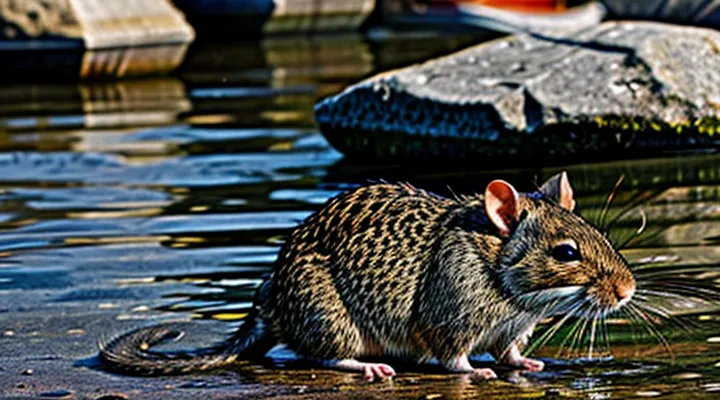
Introduction to the Water Rat
What is a Water Rat?
Physical Characteristics
The water rat exhibits several distinct physical traits that enable efficient aquatic and terrestrial activity.
- Streamlined body length ranges from 20 cm to 30 cm, providing low resistance in water.
- Dense, water‑repellent fur consists of coarse guard hairs overlaying a soft undercoat; coloration varies from dark brown to gray, offering camouflage among riverbanks and vegetation.
- Tail is long, laterally flattened, and covered with stiff hairs, functioning as a rudder for precise steering.
- Hind limbs are robust, with partially webbed toes that increase surface area for propulsion; forelimbs remain dexterous for handling food and constructing nests.
- Eyes are positioned high on the skull, granting a wide field of vision above the water surface; a transparent nictitating membrane protects the eyes during submersion.
- Auditory bullae are enlarged, enhancing low‑frequency hearing crucial for detecting ripples and predator movements.
These characteristics collectively support the species’ semi‑aquatic lifestyle, allowing rapid swimming, effective foraging, and safe navigation of both water and land environments.
Behavioral Traits
The water rat, a semi‑aquatic rodent found across riparian zones of Australia and Southeast Asia, exhibits a suite of behaviors adapted to its moist environment. Activity peaks during night hours, reducing exposure to diurnal predators and aligning foraging with the movement of aquatic prey.
Key behavioral traits include:
- Proficient swimming; webbed hind feet and dense fur enable sustained underwater travel.
- Nocturnal foraging; diet consists of fish, crustaceans, insects, and occasional small vertebrates.
- Solitary territoriality; individuals maintain exclusive burrow complexes along riverbanks.
- Vocal communication; low‑frequency chirps and squeaks convey alarm and reproductive status.
- Burrow construction; nests are lined with vegetation to regulate temperature and humidity.
Observations indicate strong site fidelity; individuals repeatedly return to established waterways and burrow systems throughout their lifespan. «Consistent use of a single watercourse enhances resource predictability and reduces energy expenditure».
Species and Subspecies Overview
The water rat, commonly called the rakali, belongs to the genus Hydromys. Two recognized species and several subspecies occupy distinct riverine and coastal zones across Australasia.
- Hydromys chrysogaster – Southern water rat; inhabits temperate streams of southeastern Australia and Tasmania.
- Hydromys husseyi – New Guinea water rat; restricted to low‑land rivers of New Guinea.
- Hydromys neobritannicus – Subspecies of H. chrysogaster; found in the coastal wetlands of New South Wales.
- Hydromys chrysogaster subsp. australis – Subspecies confined to alpine streams of Victoria and the Australian Alps.
- Hydromys husseyi subsp. papuensis – Subspecies limited to the highland tributaries of the central New Guinea plateau.
All taxa display semi‑aquatic adaptations: dense, water‑repellent fur; webbed hind feet; and a flattened tail for propulsion. Distribution correlates with permanent freshwater sources, mangrove estuaries, and coastal lagoons. Presence in a region indicates a stable, unpolluted water system, as the species serves as a bioindicator of aquatic health. «The rakali’s range reflects the availability of suitable riparian habitats and the integrity of surrounding ecosystems.»
Global Distribution of Water Rats
General Habitat Preferences
Aquatic Environments
The water rat occupies habitats defined by permanent or seasonal water bodies. Presence is recorded where fresh water provides both foraging grounds and shelter.
Typical aquatic environments include:
- Rivers and streams with moderate flow
- Lakes and ponds offering still water
- Marshes and swamps with dense emergent vegetation
- Flood‑plain wetlands that seasonally connect to larger water systems
Adaptations supporting this lifestyle comprise webbed hind feet for swimming, dense fur that retains warmth in damp conditions, and a diet consisting primarily of aquatic plants, insects, and small crustaceans. Burrows are constructed in riverbanks or among root systems, allowing rapid access to water.
Distribution of the species correlates directly with the availability of these environments. Conservation assessments identify habitat degradation—such as channelization, water pollution, and drainage of wetlands—as primary threats to population stability. Maintaining the integrity of freshwater ecosystems therefore sustains viable water‑rat populations.
Terrestrial Components
The water rat occupies environments where land and water intersect, relying on specific terrestrial features to sustain its activities. Solid ground provides shelter, foraging sites, and pathways that connect aquatic zones with the surrounding landscape.
Key terrestrial components include:
- Elevated riverbanks that remain above flood levels, offering stable nesting platforms.
- Dense riparian vegetation such as reeds, cattails, and low shrubs, which supplies cover and material for constructing burrows.
- Root systems of trees and woody plants that create tunnels and cavities for retreat and predator avoidance.
- Open, moist soils adjacent to water bodies, enabling the excavation of shallow burrows and the storage of food items.
- Fallen logs and debris piles that serve as temporary resting spots and facilitate movement across land.
These elements collectively create a mosaic of habitats where the species can transition between aquatic foraging and terrestrial refuge, ensuring survival in fluctuating water regimes.
Specific Regional Habitats
Europe and Asia
The water rat (Arvicola spp.) occupies a broad geographical belt that stretches from western Europe across the Eurasian continent to the far eastern reaches of Siberia.
In Europe, established populations occur in:
- United Kingdom
- Ireland
- France
- Belgium
- Netherlands
- Germany
- Denmark
- Sweden
- Norway
- Finland
- Poland
- Czech Republic
- Slovakia
- Austria
- Hungary
- Romania
- Bulgaria
- Greece
- Baltic states
- Iberian Peninsula (Spain, Portugal)
In Asia, the species extends through:
- Western Russia (Ural region)
- Central Russia
- Siberian territories up to the Yenisei River
- Kazakhstan
- Mongolia
- Northern China
- Korean Peninsula (limited records)
Typical habitats comprise slow‑moving freshwater bodies, marshes, riverbanks, and densely vegetated lakeshores. Preference for dense emergent vegetation provides shelter and foraging opportunities. Seasonal migrations are limited; individuals remain within their local watershed unless displaced by extreme climatic events.
Temperate Zones
The water rat, a semi‑aquatic rodent, primarily inhabits regions classified as temperate zones. These zones are characterized by moderate temperatures, distinct seasonal changes, and sufficient precipitation to support freshwater ecosystems such as streams, marshes, and slow‑moving rivers. The species thrives where vegetation provides both cover and foraging opportunities, and where water bodies remain unfrozen for most of the year.
Key environmental factors in temperate habitats:
- Average annual temperatures ranging from 5 °C to 20 °C.
- Seasonal variation that includes warm summers and cool winters.
- Consistent freshwater availability, with flow rates that support abundant aquatic invertebrates.
- Riparian vegetation offering shelter, nesting sites, and food sources.
Geographic distribution aligns with temperate climate belts across the Northern Hemisphere, including parts of Europe, East Asia, and North America. Populations are most dense in low‑lying floodplains and river valleys where the combination of moderate climate and water resources meets the species’ ecological requirements.
Forested Rivers
Forested rivers provide the essential environment for water rats, offering a combination of flowing water, dense riparian vegetation, and abundant invertebrate prey. The presence of overhanging trees creates shade that moderates water temperature, while fallen logs and root wads furnish shelter and nesting sites. Clean, oxygen‑rich streams support the aquatic insects that constitute the primary diet of the species.
Key characteristics of suitable riverine habitats include:
- Continuous canopy cover along the banks, reducing erosion and maintaining bank stability.
- Submerged and emergent vegetation that supplies cover from predators.
- Substrate composed of gravel, sand, and organic debris, allowing burrow construction.
- Minimal pollution levels, ensuring high dissolved‑oxygen concentrations.
Geographically, water rats occupy forested river systems across temperate regions of Europe, North America, and parts of East Asia. Populations are concentrated in watersheds where forest management preserves riparian corridors and where water quality monitoring limits contaminant influx. Conservation efforts that protect these riverine forests directly sustain the species’ long‑term viability.
North America
The water rat, scientifically known as Ondatra zibethicus, inhabits a broad swath of North America. Its range extends from the Arctic tundra of Canada through the United States to northern Mexico, occupying every major watershed within these borders.
Typical environments include freshwater marshes, slow‑moving rivers, lakeside reed beds, and agricultural irrigation canals. Dense emergent vegetation, such as cattails and bulrushes, provides both food and shelter, while water depths of 0.5–2 meters allow the species to construct burrows and lodges safely below the surface.
Key regions of concentration:
- Great Lakes basin
- Mississippi River valley
- Atlantic coastal plains
- Prairie pothole region
- Pacific Northwest wetland complexes
Population density correlates with the availability of soft‑stem aquatic plants and minimal predation pressure. In areas where wetlands have been restored, muskrat numbers often increase rapidly, demonstrating the species’ reliance on intact riparian habitats.
Wetlands and Marshes
Wetlands and marshes constitute low‑lying ecosystems where water saturates the soil for most of the year. These habitats feature a mosaic of open water, emergent vegetation, and shallow pools that fluctuate with seasonal precipitation. Soil composition often includes peat, silts, and clays, providing a stable substrate for plant roots and invertebrate communities.
The water rat, a semi‑aquatic rodent, relies on the structural complexity of marshes for foraging and shelter. Dense reeds and cattails offer cover from predators, while the abundant aquatic insects and small crustaceans supply a primary food source. Burrowing activity occurs in the soft, water‑logged banks, allowing access to both surface and subsurface water layers.
Geographically, wetlands and marshes appear across temperate, subtropical, and tropical regions. Notable examples include the temperate marshes of northern Europe, the subtropical mangrove‑associated marshes of the southeastern United States, and the high‑altitude wetlands of the Andes. Each location presents variations in water chemistry, plant species, and climate, influencing the distribution patterns of the water rat.
Conservation of these ecosystems directly supports the persistence of the water rat population. Protection measures that maintain water quality, prevent drainage, and preserve native vegetation sustain the habitat conditions essential for the species’ survival.
Stream Banks
The water rat, a semi‑aquatic rodent, occupies the margins of flowing watercourses. Its presence is closely linked to the structure and composition of stream banks, which provide shelter, foraging opportunities, and breeding sites.
Vegetated banks offer dense root systems and herbaceous cover that protect against predators and flooding. Soft, moist soils facilitate burrow construction, while proximity to water ensures constant access to aquatic vegetation and insects. Seasonal variations in water level create a mosaic of microhabitats, supporting year‑round occupancy.
Distribution spans temperate regions of Europe and parts of western Asia, where river networks present suitable bank conditions. Populations decline where bank erosion, agricultural runoff, or channelisation remove essential cover and soil stability.
Key habitat attributes include:
- Dense riparian vegetation (willows, alders, grasses)
- Loamy, water‑saturated soils suitable for burrowing
- Gentle slope gradients that reduce washout risk
- Continuous connection to clean, flowing water
- Minimal human disturbance and low pollutant levels
Maintaining these bank characteristics is essential for sustaining water rat populations across their range.
Factors Influencing Habitat Selection
Food Availability
Diet of Water Rats
Water rats are semi‑aquatic rodents that obtain nutrition primarily from aquatic and riparian sources. Their feeding strategy combines active hunting with opportunistic scavenging, allowing them to exploit a broad range of prey and plant material available in wetland habitats.
«Diet of Water Rats» includes:
- Aquatic insects such as beetle larvae and mayfly nymphs
- Crustaceans, notably small crayfish and freshwater shrimp
- Small fish and amphibian larvae
- Mollusks, including freshwater snails
- Aquatic vegetation, algae, and emergent plant seeds
Seasonal shifts influence prey availability; during spring and summer, insect abundance rises, while autumn brings increased consumption of crustaceans and plant matter. Opportunistic ingestion of carrion and detritus supplements the diet when preferred items are scarce. This flexible feeding pattern sustains water rat populations across diverse wetland ecosystems.
Seasonal Variations
The water rat (Hydromys chrysogaster) occupies freshwater environments across eastern Australia and southern New Guinea. Seasonal shifts dictate its spatial use, reproductive timing, and foraging strategies.
During the wet season, extensive flooding expands riverine floodplains, creating temporary ponds and marshes. These habitats provide abundant aquatic insects, crustaceans, and small fish, prompting the species to extend its range into newly formed waterways. Increased water depth reduces terrestrial predators, allowing higher densities of water rats in peripheral zones.
In the dry season, receding water isolates pools and stream sections. The animal concentrates activity around permanent water bodies, such as deep pools, rock‑filled creeks, and man‑made reservoirs. Food availability contracts, leading to a shift toward more terrestrial prey, including amphibians and insects found along drying margins. Home‑range sizes typically shrink, and individuals may form tighter social groups to defend limited resources.
Key seasonal patterns:
- Wet‑season expansion into floodplain habitats
- Increased reliance on aquatic prey
- Reduced predation pressure from land predators
- Dry‑season confinement to permanent water sources
- Dietary shift toward terrestrial organisms
- Smaller home ranges and heightened social cohesion
Understanding these temporal dynamics informs conservation planning, particularly in regions where water management alters natural flooding regimes.
Predation Pressure
Common Predators
The semi‑aquatic rodent occupies riverbanks, streams, marshes, and adjacent vegetation, where it forages on aquatic plants and invertebrates. Its presence near water attracts a range of carnivorous species that exploit the same habitats.
Common predators include:
- Otters, which pursue the rodent in water and on shorelines.
- Red foxes, employing stealth to capture individuals near vegetation.
- Birds of prey such as hawks, owls, and marsh harriers, attacking from above.
- Herons and egrets, snatching prey from shallow water.
- Domestic cats and dogs, especially in peri‑urban settings.
- Large snakes, ambushing along banks and in dense cover.
- Humans, through trapping and occasional hunting.
Predation pressure influences the rodent’s activity patterns, encouraging nocturnal foraging and the use of dense cover. Survival strategies such as burrow construction and swift swimming mitigate losses to these predators.
Adaptations for Survival
The water rat occupies freshwater ecosystems such as streams, rivers, marshes, and wetland margins. Its distribution correlates with the availability of shallow, slow‑moving water and abundant riparian vegetation, which provide shelter and foraging opportunities.
Adaptations that enable survival in these habitats include:
- Streamlined body shape reduces drag while swimming and facilitates rapid movement through water.
- Dense, water‑repellent fur maintains insulation and prevents saturation, preserving core temperature.
- Webbed hind feet and partially webbed forefeet increase propulsion efficiency and allow agile maneuvering among submerged vegetation.
- Vibrissae (whiskers) detect subtle water currents, enhancing prey detection and navigation in low‑visibility conditions.
- Strong, curved incisors and a muscular palate enable the processing of hard‑shelled aquatic invertebrates and small fish.
- Seasonal breeding cycles align with peak food availability, ensuring offspring have sufficient resources for growth.
Behavioral strategies complement physical traits. The species exhibits nocturnal activity patterns to avoid diurnal predators, constructs burrows with waterproof entrances for refuge, and demonstrates territorial fidelity to secure optimal foraging zones. These combined adaptations secure the water rat’s niche within freshwater environments.
Human Impact
Habitat Loss and Fragmentation
The water rat, commonly known as the water vole, occupies riparian zones, riverbanks, and low‑lying wetlands where dense vegetation provides cover and access to water. Its survival depends on continuous stretches of suitable habitat that supply food, shelter, and safe passage for movement.
«Habitat loss» results from several anthropogenic pressures:
- Conversion of floodplains to agricultural fields.
- Urban expansion that replaces natural banks with impermeable surfaces.
- Drainage projects that lower water tables and eliminate shallow water bodies.
- Extraction of water for irrigation, reducing flow and degrading riparian vegetation.
«Fragmentation» occurs when remaining habitats become isolated by roads, fences, or patches of unsuitable land. Consequences include limited dispersal opportunities, reduced gene flow, and heightened vulnerability to local extinction. Small, detached populations often experience increased predation and competition from invasive species.
Mitigation strategies focus on preserving and reconnecting habitat fragments:
- Establishing buffer strips of native vegetation along waterways.
- Restoring degraded channels to re‑establish natural flow regimes.
- Installing wildlife corridors or underpasses to facilitate safe crossing of barriers.
- Implementing land‑use policies that restrict development within critical riparian zones.
Effective management of these measures sustains the ecological network essential for the water rat’s persistence across its range.
Conservation Efforts
Conservation programs target the wetlands and riparian zones that sustain the water rat’s populations. Habitat degradation, water pollution, and invasive species pose the primary threats to these semi‑aquatic mammals.
Key actions include:
- Restoration of native vegetation along stream banks to provide shelter and foraging grounds.
- Implementation of water‑quality monitoring to detect contaminants and enforce pollution controls.
- Regulation of land‑use practices that alter floodplain dynamics, such as agricultural drainage and urban development.
- Control and eradication of invasive predators, notably introduced mustelids and feral cats, through trapping and exclusion measures.
Research initiatives collect data on population density, movement patterns, and genetic diversity. Findings guide adaptive management, ensuring that interventions remain effective under changing climatic conditions.
Community engagement programs educate local residents about the ecological role of water rats and promote citizen‑science reporting of sightings. Partnerships with NGOs and governmental agencies secure funding and legislative support for long‑term protection of critical habitats.
Life Cycle and Reproduction in Their Habitat
Breeding Seasons
The water rat, a semi‑aquatic rodent inhabiting riparian zones of southeastern Australia, reproduces primarily during the warmer months when food availability peaks. Breeding activity intensifies from late spring through early autumn, aligning with increased river flow and vegetation growth that provide shelter and abundant invertebrate prey.
Key characteristics of the reproductive cycle include:
- Mating period: October to March, with peak encounters in November and February.
- Gestation length: approximately 30 days, consistent across regional populations.
- Litter size: typically 3–5 offspring; occasional litters of up to 7 have been recorded.
- Weaning age: juveniles detach from maternal care after 4–5 weeks, gaining independence as water levels stabilize.
Environmental cues such as temperature rise above 15 °C and photoperiod extension trigger hormonal changes that initiate estrus. Flood events can temporarily suspend breeding, while drought conditions may reduce litter size due to limited resources. Successful recruitment depends on the availability of dense bankside vegetation, which offers protection from predators and supports the rearing of young until they achieve full swimming competence.
Nesting Habits
The water rat (Hydromys chrysogaster) constructs nests primarily in the banks of streams, lakes, and coastal wetlands. Burrows are excavated in soft, water‑saturated soil, often close to the water’s edge to allow immediate access to foraging areas.
Nesting architecture includes:
- A main entrance tunnel leading to a deeper chamber.
- A secondary escape tunnel positioned higher to remain usable during rising water levels.
- Lining material composed of shredded vegetation, moss, and occasional animal fur, providing insulation and moisture regulation.
Seasonal adjustments occur when water levels fluctuate. During dry periods, burrows may be deeper and reinforced with additional soil. In flood‑prone months, rats relocate nests to elevated banks or utilize abandoned burrows of other semi‑aquatic mammals.
Reproductive behavior influences nest use. Females occupy a single chamber for gestation, depositing a litter of up to four pups. After weaning, juveniles remain in the natal burrow for several weeks before dispersing to adjacent territories.
Social organization is loosely colonial; multiple burrow systems may cluster within a limited area, each occupied by a breeding pair and their offspring. Overlap of foraging ranges does not typically result in shared nesting chambers, maintaining individual family units.
Overall, the nesting strategy of the water rat reflects adaptation to a semi‑aquatic environment, balancing protection from predators, resilience to water level changes, and thermoregulatory needs.
Parental Care
The Australian water rat inhabits freshwater streams, riverbanks, and coastal mangrove systems where dense vegetation provides cover and access to aquatic prey. Its distribution includes southeastern Queensland, New South Wales, and Victoria, where water bodies maintain permanent flow and abundant invertebrate populations.
Parental care in this species centers on the male’s involvement after the female deposits a litter of one to three pups. The male constructs a nest of plant material and mud within a burrow near the water’s edge, then remains inside to regulate temperature and deter predators. The female supplies milk for the first two weeks, after which the pups begin to forage under parental supervision. Both parents contribute to grooming and transport of offspring during periods of high water flow.
Key aspects of parental behavior:
- Nest building with locally sourced vegetation and sediment.
- Continuous presence of the male within the nest for protection.
- Lactation by the female for approximately 14 days.
- Gradual introduction of pups to foraging sites while parents monitor safety.
- Cooperative defense against predators such as birds of prey and introduced mammals.
Conservation Status and Threats
IUCN Red List Classification
The IUCN Red List provides a standardized framework for evaluating extinction risk, classifying species into categories that range from Extinct to Least Concern. Each category reflects quantitative criteria such as population size, rate of decline, geographic range, and degree of fragmentation.
The water rat (Hydromys chrysogaster) is listed as «Least Concern». This designation indicates that current data show a wide distribution, stable or increasing population trends, and no evidence of rapid decline that would qualify the species for a threatened category.
Key assessment criteria applied to the water rat include:
- Extent of occurrence exceeding 20 000 km².
- Population trend assessed as stable or increasing.
- Absence of major, ongoing threats affecting the majority of its range.
- Presence in multiple protected areas across its habitat.
The species inhabits freshwater streams, rivers, and coastal wetlands of eastern Australia, from temperate rainforests to semi‑arid regions. Its adaptability to diverse aquatic environments contributes to the robust status reflected in the Red List classification.
Major Threats to Populations
Pollution
The water rat occupies freshwater environments such as streams, marshes, and ponds, relying on clean water for foraging, nesting, and breeding. Pollution directly compromises these habitats, altering the physical and chemical conditions essential for survival.
Key pollutants affecting water rat habitats include:
- Agricultural runoff containing nitrates and phosphates
- Heavy metals from industrial discharge
- Plastic fragments and micro‑plastics
- Nutrient overload leading to eutrophication
- Oil spills and petroleum residues
Contamination reduces dissolved oxygen, introduces toxic substances, and disrupts prey availability. Resulting stressors cause lowered reproductive success, increased mortality, and population contraction, threatening the species’ long‑term viability.
Climate Change
The water rat inhabits freshwater ecosystems such as rivers, streams, and wetlands. Rising temperatures and altered precipitation patterns modify water levels, flow regimes, and vegetation cover, directly affecting the availability of suitable habitats.
Key climate‑driven changes include:
- Increased frequency of droughts reduces water depth, limiting shelter and foraging areas.
- Elevated water temperatures accelerate metabolism, raising food demand while decreasing dissolved oxygen.
- Intensified storm events cause flooding, eroding banks and dispersing populations.
- Shifts in plant communities alter cover and nesting material availability.
Adaptation strategies focus on preserving riparian buffers, restoring floodplain connectivity, and monitoring population health to mitigate the impacts of a warming climate on the species’ distribution.
Protective Measures
The water rat inhabits riparian zones, wetland margins, and slow‑moving freshwater systems across temperate regions. Habitat fragmentation, water pollution, and invasive predators threaten population stability. Effective protection requires targeted actions that address both environmental quality and species‑specific needs.
- Preserve and restore riparian vegetation to maintain bank stability and provide shelter.
- Implement buffer zones along waterways to reduce runoff of sediments and chemicals.
- Control invasive predatory species through trapping programs and habitat modification.
- Enforce water quality standards that limit nutrient loading, heavy metals, and toxic substances.
- Monitor population trends with regular surveys and genetic sampling to detect declines early.
- Support community‑based stewardship initiatives that promote sustainable land‑use practices.
Regulatory frameworks such as «Water Rat Conservation Act» provide legal mechanisms for habitat designation and enforcement of protective measures. Coordination among governmental agencies, non‑governmental organizations, and local stakeholders ensures consistent application of these strategies. Continuous assessment of effectiveness allows adaptive management, securing long‑term viability of the water rat’s ecological niche.