
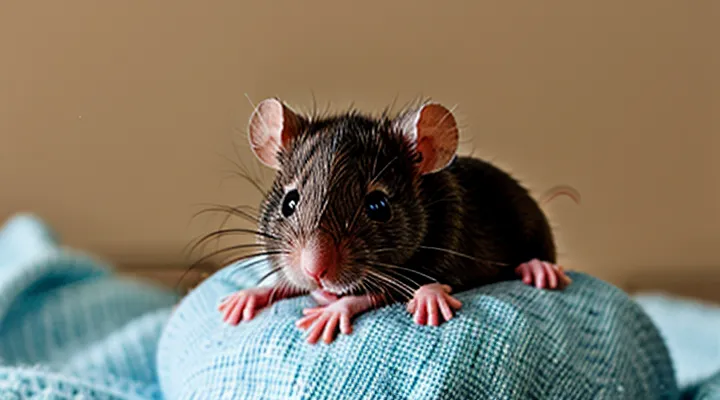
General Characteristics
Size and Weight
Newborn rats are diminutive mammals, typically measuring 3–4 cm from nose to the base of the tail at birth. Their body mass ranges from 1.5 g to 2.5 g, with most laboratory strains clustering around 2 g. Variations in size and weight reflect genetic background, litter size, and maternal nutrition; larger litters often produce lighter pups, while selective breeding can shift averages by up to 0.5 g.
Key measurements:
- Crown‑rump length: 30–40 mm
- Body weight: 1.5–2.5 g (average ≈ 2 g)
- Tail length (unfurred): 10–15 mm
- Ear pinna diameter: 2–3 mm
These dimensions establish baseline criteria for identifying healthy neonates and for comparing developmental progress across experimental groups.
Skin and Fur
Newborn rats possess thin, almost translucent skin that appears pink or reddish due to the underlying vasculature. The epidermis lacks the keratinization seen in adult rodents, making it delicate and vulnerable to dehydration. Sensory receptors are present but not fully functional, resulting in limited tactile response at birth.
The initial coat consists of a sparse, downy fur that emerges within the first 24 hours. This fur is soft, light‑colored, and loosely attached to the skin. As the pups mature, the following changes occur:
- Day 2‑4: Fur density increases, covering most of the body except the whisker pads and tail.
- Day 5‑7: Pigmentation becomes visible, matching the adult strain’s coat color.
- Day 10‑14: Guard hairs develop, providing insulation and protection.
The combination of fragile skin and developing fur characterizes the early external appearance of rat neonates.
Eyes and Ears
Newborn rats are born with eyelids sealed, giving the eyes a pink, translucent appearance. The cornea and iris are not yet differentiated, and no light response can be observed until the lids open around day 10‑12. At birth the ocular surface is covered by a thin membrane that protects the developing retina and lens. Vascularization of the eye is evident as a fine network of blood vessels visible through the eyelid skin.
The auditory structures are rudimentary. The external ear (pinna) is flat, skin‑folded, and lacks the characteristic triangular shape of the adult. The ear canal is narrow and partially occluded by a membranous plug that prevents sound entry until the canal expands during the first two weeks. The middle‑ear ossicles are present but not fully ossified, limiting acoustic transmission. Key features include:
- Closed eyelids with pinkish translucency; no visual response at birth.
- Flat, undeveloped pinna; narrow, partially blocked ear canal.
- Immature middle‑ear bones, reducing early hearing capability.
Limbs and Tail
Newborn rats possess four short, stout limbs that are proportionally larger than those of adult specimens. Each forelimb and hindlimb ends in five distinct digits, with the claws barely visible beneath the sparse, pinkish fur. The skin covering the paws is thin and translucent, allowing the underlying blood vessels to be seen. Muscular development is minimal; movement consists of uncoordinated twitches rather than purposeful locomotion.
The tail of a neonatal rat is relatively long, measuring approximately 2.5–3 cm, which is comparable to the body length. It is covered by a thin layer of fine hair that provides limited insulation. The tail lacks the pronounced taper seen in mature rats and remains relatively straight, serving primarily as a sensory organ rather than for balance. Key characteristics include:
- Length: 2.5–3 cm, roughly equal to body length
- Surface: sparse, fine hair; skin is delicate and pink
- Structure: cylindrical, untapered, low muscular tone
- Function: sensory detection, minimal role in locomotion
Developmental Stages and Changes
Neonatal Stage («Pinkies»)
Newborn rats, commonly called “pinkies,” represent the first post‑natal stage of development. At birth they measure approximately 1.5–2 cm in total length, including a tail that accounts for about one‑third of the body. Their skin is thin and translucent, allowing the underlying vasculature to give a pink hue, especially evident on the paws, ears, and snout. Fur is sparse, consisting of a few soft, fine hairs that will not fully develop until the second week of life.
Key physical traits of the neonatal stage include:
- Hairless body surface except for a few nascent whiskers near the snout.
- Pink, slightly wrinkled skin that is highly vulnerable to dehydration.
- Closed eyelids that open around post‑natal day 10.
- Undeveloped incisors; the oral cavity is adapted for suckling rather than chewing.
- Limited motor coordination; spontaneous movements are primarily twitching of limbs.
Internally, organ systems are immature but functional. The respiratory system operates with a higher respiratory rate (≈80–100 breaths per minute) to compensate for reduced alveolar surface area. The circulatory system relies on a patent ductus arteriosus, which closes within the first few days. Thermoregulation is inefficient; newborns depend on maternal warmth and nest insulation to maintain core temperature.
These characteristics define the “pinkie” phase and distinguish it from later developmental stages such as the weanling and adolescent periods.
Transitional Stage («Fuzzies»)
Newborn rat pups emerge completely hairless, their skin pink and translucent. Within the first 24 hours they enter a brief transitional period known colloquially as the “fuzzies” stage. During this interval the pups develop a fine, downy coat that covers most of the body but remains sparse compared to the dense adult fur.
Key attributes of the fuzzies stage include:
- Appearance: a soft, silvery‑gray pelage replaces the naked skin; the coat is thin enough to reveal underlying blood vessels.
- Timing: the downy hair appears between 12 and 48 hours after birth and persists until approximately day 4, when it is supplanted by thicker guard hairs.
- Sensory development: eyes remain closed, ears are still folded, and whiskers are absent; tactile sensitivity relies on the newly formed hair follicles.
- Mobility: pups are still entirely dependent on the dam for warmth and nutrition; the fuzzies provide minimal insulation but do not yet support self‑regulation of body temperature.
The transition from a naked neonate to a fuzzies pup marks the first morphological change in rat development. It prepares the animal for subsequent growth phases, during which the coat thickens, pigmentation emerges, and sensory structures mature.
Weanling Stage («Hoppers»)
During the weanling phase, commonly called the “hopper” stage, young rats exhibit a transition from the hairless newborn form to a more developed appearance. At approximately 14–21 days old, they possess a thin coat of fine fur that begins to darken, though the dorsal region may still appear lighter than the ventral side. Their eyes are fully opened, and ear pinnae are erect, giving a recognizable rodent silhouette.
Typical physical traits of hoppers include:
- Body length of 5–7 cm (excluding the tail) and a tail length comparable to the body.
- Weight ranging from 15 to 30 g, reflecting rapid growth.
- Soft, downy fur covering the entire body, with emerging whisker clusters.
- Visible incisors that are fully erupted, allowing the animal to gnaw solid food.
Behaviorally, hoppers display increased mobility, climbing small objects and exploring the cage environment. They begin to ingest solid chow alongside maternal milk, indicating the onset of dietary independence. These characteristics collectively define the visual and functional profile of rats in the weanling stage.
Comparisons with Other Rodent Pups
Mouse Pups
Mouse pups are tiny, hairless mammals that emerge from the womb weighing approximately 0.5–1 gram. Their bodies are elongated, with forelimbs and hindlimbs that appear as small, undeveloped pinches. The skin is thin and translucent, allowing underlying blood vessels to be faintly visible. Eyes remain sealed, and ear canals are closed, preventing auditory perception at birth.
Key physical traits of mouse neonates include:
- Length: 1.5–2 cm from snout to tail base.
- Weight: 0.5–1 g, increasing rapidly during the first week.
- Fur: Absent at birth; fine down appears within 2–3 days.
- Eyes: Closed, opening around day 12.
- Ears: Flat and hidden, becoming erect after the first week.
- Limbs: Limited mobility; forelimbs lack functional digits, hindlimbs are barely distinguishable.
These characteristics mirror those of newborn rats, which share a similarly hairless, pink appearance, sealed eyes, and underdeveloped limbs. Both species rely on maternal care for warmth, nutrition, and protection during the early post‑natal period. Rapid growth in the first two weeks results in the appearance of fur, the opening of eyes, and the acquisition of coordinated movement, marking the transition from a vulnerable neonate to a mobile juvenile.
Hamster Pups
Hamster pups emerge from the birth canal covered in a fine, pinkish fuzz that quickly dries to a softer, gray‑white coat. Their eyes remain sealed for the first 10‑14 days, and ears are flat against the head. Limbs are proportionally short, with tiny, claw‑free paws that allow limited movement within the nest. The tail is barely discernible, a short nub that does not extend beyond the body.
When comparing these traits to the appearance of newborn rats, several distinctions become evident:
- Coat texture – Hamster pups have a softer, less dense fur than the silky, darker pelage of newborn rats.
- Eye development – Both species keep eyes closed initially, but hamster pups typically open them slightly later.
- Ear shape – Hamster pups are born with flattened ears; newborn rats display more pronounced ear folds early on.
- Tail length – The rat’s tail is proportionally longer even at birth, whereas the hamster’s tail is minimal.
Nutrition for hamster pups relies exclusively on maternal milk, which is richer in fat than rat milk, supporting rapid weight gain during the first two weeks. By day 21, pups begin to explore the cage, displaying increased coordination and the emergence of adult coloration patterns.
Health and Care Considerations
Signs of Healthy Pups
Newborn rats are tiny, hair‑covered mammals that emerge with closed eyes, closed ears, and a pinkish, almost translucent skin. Their bodies measure roughly 2–3 cm in length and weigh between 5 and 7 g. At birth, the fur appears sparse and may be somewhat uneven, gradually becoming denser within the first days.
Key indicators of a healthy litter include:
- Uniform body temperature: Pups maintain a steady, warm temperature when cared for by the dam; cold or fluctuating skin suggests distress.
- Consistent weight gain: An increase of about 2–3 g per day during the first week reflects adequate nutrition and metabolic function.
- Clear, pink skin: Absence of lesions, discoloration, or excessive dryness signals proper circulation and skin health.
- Closed, intact eyes and ears: Eyes should remain sealed and ears undeformed; any premature opening or swelling warrants attention.
- Active suckling reflex: Prompt and vigorous attempts to latch onto the mother’s nipples indicate neurological integrity and hunger response.
- Steady breathing: Regular, unobstructed breaths without wheezing or rapid shallow respirations are essential for oxygen exchange.
- Normal posture: Pups should curl gently, with limbs flexed and no signs of tremors or rigidity.
Monitoring these criteria provides a reliable assessment of neonatal rat well‑being and guides timely intervention if abnormalities arise.
Common Issues in Newborn Rats
Newborn rats are hair‑covered, pink‑skinned neonates with closed eyes and ears that will open within a few days. Their bodies are proportionally large relative to their heads, and they rely entirely on maternal care for survival.
Common health and developmental problems observed in neonatal rodents include:
- Low birth weight – insufficient nutrition in utero leads to reduced size and impaired thermoregulation.
- Hypothermia – immature thermoregulatory mechanisms cause rapid heat loss when ambient temperature falls below the nest’s optimal range.
- Dehydration – limited fluid reserves and delayed suckling increase the risk of electrolyte imbalance.
- Respiratory distress – incomplete lung expansion may result in shallow breathing or cyanosis.
- Maternal neglect or cannibalism – stressed or inexperienced dams may reject or harm their litter.
- Infection – immature immune defenses make neonates susceptible to bacterial, fungal, or viral pathogens.
- Congenital anomalies – genetic mutations can produce skeletal, cardiac, or neurological defects that compromise viability.
Recognition of these issues enables timely intervention, such as temperature control, supplemental feeding, and hygiene measures, thereby improving survival rates in laboratory and breeding settings.