
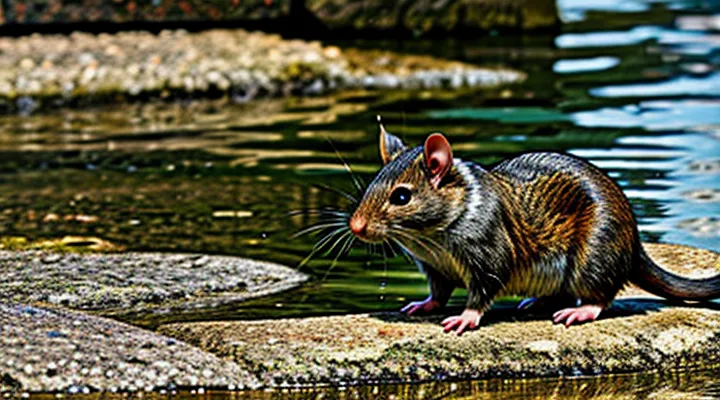
What Defines a «Water Rat»?
Aquatic Adaptations
Water rats, a group of semi‑aquatic rodents, possess a suite of morphological and physiological traits that enable efficient life in freshwater habitats. Their anatomy reflects a consistent shift away from terrestrial locomotion toward swimming efficiency and underwater endurance.
- Webbed hind feet increase surface area, generating thrust with each stroke.
- Dense, oil‑secreting fur repels water, maintaining body temperature despite prolonged immersion.
- Broad, laterally flattened tail functions as a rudder, providing precise steering and stability.
- Nostrils equipped with muscular flaps close tightly, preventing water entry during submersion.
- Lungs exhibit a higher capacity for oxygen storage, extending dive duration.
- Kidneys concentrate urine, reducing water loss while excreting excess salts absorbed from the environment.
Webbed feet translate muscular effort into rapid propulsion, allowing individuals to pursue prey or evade predators. The fur’s hydrophobic properties preserve a thin layer of air against the skin, which serves both as insulation and as a barrier to heat loss. The tail’s shape creates directional control, enabling swift changes in course without excessive energy expenditure. Closed nostrils and enhanced lung volume support extended underwater foraging, while renal efficiency conserves body fluids in habitats where water quality may fluctuate.
These adaptations illustrate convergent evolution among unrelated mammals that occupy similar aquatic niches, demonstrating how selective pressures shape comparable solutions across diverse lineages.
Habitat Preferences
Water rats, often referred to as semi‑aquatic rodents, favor environments where water and shelter intersect. Primary habitats include slow‑moving streams, marshes, and the margins of lakes where dense vegetation provides cover and foraging opportunities. These mammals select sites with abundant emergent plants such as reeds, cattails, and rushes, which support both food resources and material for nest construction.
Key habitat characteristics:
- Proximity to fresh water with depths ranging from a few centimeters to over one meter, enabling swimming and diving.
- Presence of stable banks or fallen logs that serve as launch points and escape routes.
- Substrate composed of soft soil or mud, facilitating burrow excavation and the creation of concealed nests.
- Moderate to cool temperatures, typical of temperate zones, which align with the species’ physiological tolerance.
- Low levels of human disturbance; areas with limited pollution and minimal shoreline development support higher population densities.
Geographically, water rats occupy regions across southern Europe, parts of North Africa, and extending into western Asia. Within these ranges, they are most abundant in river valleys and coastal wetlands where the combination of water flow, vegetation complexity, and undisturbed ground cover meets their ecological requirements.
Common Names and Scientific Classifications
True Water Rodents
True water rodents are mammals belonging to the order Rodentia that have evolved specific adaptations for a semi‑aquatic or fully aquatic lifestyle. These adaptations include webbed hind feet, water‑repellent fur, and specialized tail morphology that facilitates swimming and buoyancy control.
Key species classified as true water rodents are:
- Muskrat (Ondatra zibethicus) – inhabits North American wetlands; constructs dome‑shaped lodges from vegetation; feeds on aquatic plants and small invertebrates.
- Beaver (Castor spp.) – found across the Northern Hemisphere; builds dams and lodges using branches and mud; possesses large, flat tails that function as rudders.
- Water vole (Arvicola amphibius) – occupies European rivers and streams; burrows in riverbanks; exhibits dense, water‑resistant fur.
- Water shrew (Neomys fodiens) – although technically a shrew, it shares many morphological traits with rodents, such as a streamlined body and fringed hind feet.
Physiological traits common to these mammals include a high concentration of myoglobin in skeletal muscles, enabling prolonged submersion, and a specialized nasal valve that closes during underwater foraging. Dental structures remain rodent‑typical, with continuously growing incisors adapted for gnawing vegetation and constructing burrows or dams.
Ecological impact of true water rodents is evident in habitat engineering. Beavers create ponds that increase biodiversity, while muskrats and water voles contribute to shoreline stabilization through vegetation grazing and burrow construction. Their presence serves as an indicator of wetland health, reflecting water quality and availability of aquatic vegetation.
European Water Vole («Arvicola amphibius»)
The European water vole, Arvicola amphibius, is a semi‑aquatic rodent found throughout much of western and central Europe. It belongs to the family Cricetidae, subfamily Arvicolinae, and is closely related to other voles and lemmings. Adult size ranges from 12 to 22 cm in body length, with a tail that is short and hairless.
Habitats include riverbanks, streams, ponds, marshes, and lowland wetlands where dense vegetation provides cover and food. The species prefers areas with soft, water‑logged soil that facilitates burrowing and the construction of shallow run‑ways along the water’s edge. It feeds primarily on herbaceous plants, grasses, and aquatic shoots, consuming up to 15 % of its body weight each day.
Reproductive traits are characterized by a short gestation of about three weeks, multiple litters per year, and litter sizes of five to eight young. High reproductive rates enable rapid population growth when conditions are favorable, yet the species remains vulnerable to habitat loss, water pollution, and predation by introduced American mink.
Key facts:
- Scientific name: Arvicola amphibius
- Conservation status (IUCN): Least Concern, with regional declines noted
- Distinguishing features: brownish fur, blunt nose, partially webbed hind feet, and a tail that is less than one‑third of body length
- Primary threats: drainage of wetlands, agricultural runoff, and invasive predators
Understanding the biology and ecological requirements of the European water vole clarifies why it is commonly referred to as a “water rat” in popular literature, despite its distinct taxonomic placement among voles.
Australian Water Rat («Hydromys chrysogaster»)
The Australian water rat, Hydromys chrysogaster, is a semiaquatic rodent endemic to the eastern and southeastern coasts of Australia. It inhabits freshwater streams, rivers, and wetlands where water flow is moderate to swift, often seeking shelter among bankside vegetation and rock crevices.
Taxonomically, the species belongs to the family Muridae, subfamily Hydromyinae. Individuals measure 30–45 cm in head‑body length, with a tail of comparable length and a dense, water‑repellent fur that ranges from dark brown to black. Webbed hind feet and a flattened tail enhance swimming efficiency.
The distribution extends from Cape York Peninsula in Queensland through New South Wales to eastern Victoria. Populations are concentrated in high‑rainfall catchments and protected reserves, where water quality remains high and riparian cover is intact.
The species is primarily nocturnal, foraging in water and on banks. Diet consists of aquatic insects, crustaceans, small fish, and amphibian larvae. Predatory behavior includes diving and using whisker sensitivity to locate prey beneath the surface.
Reproductive cycles peak in the austral spring. Litters contain 2–4 young, born after a gestation period of approximately 30 days. Offspring remain in the natal burrow for 4–6 weeks before achieving independent swimming ability.
The International Union for Conservation of Nature classifies the Australian water rat as “Least Concern,” yet localized threats persist. Habitat degradation, water pollution, and introduced predators such as foxes and feral cats reduce population viability in fragmented waterways.
Key adaptations:
- Waterproof fur with oily secretions
- Fully webbed hind feet
- Muscular, laterally compressed tail
- Sensitive vibrissae for detecting prey vibrations
- Strong, curved claws for burrow excavation
Rodents Often Mistaken for «Water Rats»
The label “water rat” is applied to several semiaquatic rodents, leading to frequent misidentification. Researchers and wildlife managers encounter this ambiguity when recording species distribution, assessing habitat health, or implementing control measures.
- Muskrat (Ondatra zibethicus) – Large, brownish rodent native to North America; builds lodges from vegetation; tail flattened laterally for swimming.
- European water vole (Arvicola amphibius) – Stocky, brown-furred rodent found in riparian zones of Europe; tail short and hair‑covered; prefers banks with dense cover.
- Australian water rat (Hydromys chrysogaster) – Dark, sleek fur; webbed hind feet; inhabits freshwater streams and coastal lagoons of eastern Australia.
- Brown rat (Rattus norvegicus) – Common urban species that frequently occupies riverbanks and sewers; tail long and naked; not specialized for swimming but often observed near water.
Distinguishing features include tail morphology, fur density, and locomotor adaptations. Muskrats possess a laterally flattened tail and extensive webbing, whereas water voles have a short, fur‑covered tail and lack webbing. The Australian water rat exhibits fully webbed hind feet, a trait absent in the other listed species. Brown rats display a naked, cylindrical tail and minimal aquatic specialization. Accurate identification relies on these anatomical markers combined with geographic range and habitat preference.
Muskrats («Ondatra zibethicus»)
Muskrats (Ondatra zibethicus) belong to the family Cricetidae and are semi‑aquatic rodents native to North America. They occupy wetlands, marshes, ponds, and slow‑moving streams, where dense vegetation provides cover and food. Their range now extends across much of the United States, southern Canada, and introduced populations in Europe, Asia, and South America.
Adult muskrats measure 30–45 cm in body length, with a laterally flattened tail that functions as a rudder. Dense, water‑repellent fur protects against cold and moisture. They construct dome‑shaped lodges from plant material or burrow into bank margins, maintaining separate entrances for water and land access. Their diet consists primarily of aquatic vegetation—such as cattails, bulrushes, and water lilies—supplemented by small invertebrates when available.
- High reproductive rate: up to five litters per year, each with 4–8 young.
- Efficient swimmers: can remain submerged for up to 15 seconds while foraging.
- Ecosystem engineers: lodge building modifies water flow and creates habitats for other species.
- Economic impact: fur trade historically valuable; occasional crop damage in agricultural wetlands.
Muskrats influence wetland dynamics through grazing pressure and bioturbation, affecting plant community composition and water quality. Management practices focus on habitat modification and population control where they threaten crops or native biodiversity.
Nutria («Myocastor coypus»)
Nutria, commonly called coypu, is a large semi‑aquatic rodent often grouped with water‑dwelling rats.
The species belongs to the order Rodentia and the sole member of the family Myocastoridae. Its scientific designation is Myocastor coypus. Distinctive traits include a robust body up to 60 cm in length, a dense, water‑repellent coat ranging from brown to reddish‑black, a laterally flattened tail, and webbed hind feet adapted for swimming.
Native to the wetlands of South America, nutria have established feral populations in Europe, North America, Asia, and Africa after deliberate introductions for fur farming. They thrive in marshes, riverbanks, and irrigated fields where dense vegetation provides cover and food.
Diet consists primarily of aquatic and riparian plants; nutria consume grasses, reeds, and tuberous roots, often stripping vegetation to the water’s edge. They are chiefly nocturnal, construct extensive burrow systems with multiple entrances, and display social behavior within loosely organized groups.
Ecological consequences of nutria colonization include:
- Accelerated erosion of riverbanks due to extensive burrowing.
- Reduction of native plant communities, leading to loss of habitat for other wildlife.
- Damage to agricultural crops such as rice, sugarcane, and corn.
Management strategies employed across affected regions involve regulated trapping, habitat modification, and, where necessary, controlled culling to limit population growth and mitigate environmental damage.
Other Semi-Aquatic Rodents
Semi‑aquatic rodents occupy niches where land and water intersect, exploiting resources unavailable to strictly terrestrial or fully aquatic mammals. Their physiology combines dense fur, webbed feet, and specialized respiratory adaptations that enable prolonged submersion and efficient foraging in marshes, streams, and ponds.
- Muskrat (Ondatra zibethicus) – Builds dome‑shaped lodges from vegetation; tail flattened for propulsion; diet includes aquatic plants, small invertebrates, and carrion.
- Beaver (Castor canadensis, Castor fiber) – Constructs dams from branches and mud; large, paddle‑shaped tail provides steering; gnaws wood for both construction and nutrition.
- Capybara (Hydrochoerus hydrochaeris) – Largest living rodent; semi‑aquatic habits include grazing on grasses near water; eyes, ears, and nostrils positioned high on the head for visibility while submerged.
- Water vole (Arvicola amphibius) – Prefers riverbanks and wet meadows; tail covered with dense hair for insulation; feeds on aquatic and riparian vegetation.
- African water mouse (Nilopegamys plumbeus) – Small, nocturnal; exhibits partially webbed hind feet; consumes insects and small crustaceans in shallow water.
Adaptations common to these species include waterproof fur, reduced body mass for buoyancy, and sensory modifications such as vibrissae that detect water currents. These traits facilitate niche specialization, allowing coexistence with other mammals that lack comparable aquatic proficiency.
Ecological Roles and Impact
Role in Ecosystems
Aquatic rodents commonly referred to as water rats influence freshwater and riparian ecosystems through several mechanisms.
- Predation on invertebrates and small fish regulates population dynamics, preventing overabundance of prey species.
- Consumption of algae and detritus accelerates decomposition, enhancing nutrient turnover and supporting primary productivity.
- Burrowing activity stabilizes riverbanks, reduces erosion, and creates microhabitats for invertebrates and amphibians.
- Excretion of nitrogen‑rich waste supplies essential nutrients to surrounding vegetation, promoting growth of emergent plants.
- Serving as prey for birds of prey, otters, and larger mammals integrates them into higher trophic levels, sustaining predator populations.
Collectively, these functions contribute to ecosystem resilience, water quality maintenance, and biodiversity preservation.
Human-Wildlife Interactions
Aquatic rodents commonly referred to as water rats frequently encounter human activities along rivers, lakes, and coastal wetlands. Urban development, agricultural runoff, and recreational fishing create habitats that overlap with the species’ foraging and nesting areas. These overlaps generate direct and indirect interactions that influence both population dynamics and public health.
Typical interaction categories include:
- Habitat alteration caused by dam construction, shoreline modification, or flood‑control projects, which can reduce shelter availability and force rodents into residential zones.
- Food-source competition arising from waste management practices, where discarded organic material attracts rodents and increases contact with humans.
- Disease transmission potential, notably the spread of leptospirosis and hantavirus, linked to rodent urine, feces, or bites.
- Human‑induced mortality through trapping, vehicle collisions, or intentional removal during pest‑control operations.
- Conservation measures such as protected riparian buffers, which aim to maintain natural corridors and limit human encroachment.
Effective management relies on monitoring population trends, implementing waste‑reduction strategies, and educating communities about safe practices when encountering water‑dwelling rodents. Coordinated policies that balance ecosystem integrity with public safety reduce conflict and support the species’ long‑term viability.
Conservation Status and Threats
Aquatic rodents commonly referred to as water rats exhibit a range of conservation assessments. The Australian water rat (Hydromys chrysogaster) is listed as Least Concern by the IUCN, while the New Guinea water rat (Paraleptomys spp.) is Data Deficient, reflecting limited population information. Several Southeast Asian species, such as the giant water rat (Bunomys spp.), are classified as Near Threatened or Vulnerable due to shrinking habitats and targeted hunting.
Key threats to these semi‑aquatic mammals include:
- Habitat loss from agricultural expansion, dam construction, and urban development that reduces riparian vegetation and water quality.
- Pollution of freshwater systems with agrochemicals, heavy metals, and plastic debris, impairing foraging and breeding sites.
- Direct persecution through trapping and commercial exploitation for meat or fur.
- Introduction of invasive predators, notably feral cats and mustelids, which increase mortality of juveniles and adults.
- Climate‑induced alterations in water flow and temperature, leading to reduced prey availability and habitat fragmentation.
Conservation actions focus on protecting watershed integrity, enforcing anti‑poaching regulations, and monitoring population trends. Establishing protected corridors along rivers, restoring native vegetation, and implementing community education programs have proven effective in stabilizing local populations. Continued research into species distribution and genetic diversity supports adaptive management strategies aimed at mitigating identified threats.