
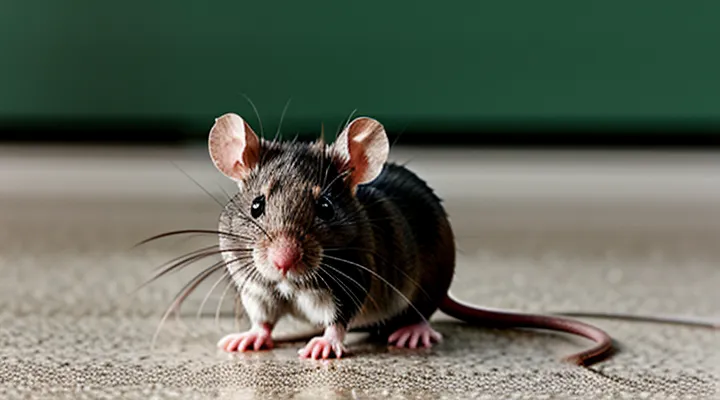
Understanding the Basics
Size and Body Shape
Overall Length
Mice typically measure 2 – 4 inches (5 – 10 cm) from nose to tail tip, while rats range from 7 – 10 inches (18 – 25 cm). The size gap remains consistent across common species: house mice stay under 4 inches, whereas Norway rats exceed 7 inches.
Key points for quick identification:
- Mouse length ≤ 4 in (≈ 10 cm)
- Rat length ≥ 7 in (≈ 18 cm)
When an animal falls between these limits, consider additional traits such as tail proportion and body robustness to confirm classification.
Proportion of Body to Head
The body‑to‑head ratio provides a reliable visual distinction between small rodents. Mice typically present a head that occupies roughly one‑third of the total body length, giving the animal a compact, rounded appearance. Rats display a proportionally smaller head, often about one‑fourth of the overall length, resulting in a longer, more elongated silhouette.
Key measurements:
- Mouse: head length ≈ 15 %–20 % of total length; body appears short and stout.
- Rat: head length ≈ 10 %–15 % of total length; body appears elongated with a pronounced torso.
When observing an unfamiliar specimen, compare the relative size of the cranium to the torso. A larger head relative to the body signals a mouse; a smaller head relative to a longer body signals a rat. This proportion, combined with other visual cues, enables quick and accurate identification.
Facial Features
Snout Shape
The snout provides one of the most reliable visual distinctions between a mouse and a rat. A mouse’s snout is short, triangular, and tapers sharply toward the tip, giving the animal a delicate, pointed appearance. In contrast, a rat’s snout is longer, broader, and more blunt, forming a rectangular or square profile that appears sturdier.
Key characteristics of snout shape:
- Length: mouse snout ≤ 1 cm; rat snout ≥ 2 cm.
- Width: mouse snout narrow, tapering; rat snout wide, maintaining consistent breadth.
- Profile: mouse snout forms a steep angle at the tip; rat snout presents a shallow, almost flat angle.
When observing a rodent, measuring the snout from the base of the whisker pads to the tip clarifies identification. A short, sharply pointed snout confirms a mouse, while a longer, flatter snout indicates a rat.
Ear Size and Shape
Ear size and shape provide a reliable visual distinction between mice and rats. Mice possess ears that are proportionally large, covering about one‑third of the head length, with a rounded outline and minimal fur on the outer surface. Rat ears are noticeably smaller relative to head size, typically oval, and often exhibit a thin fringe of hair along the edge.
- Mouse ears: large, round, hairless or sparsely haired; positioned high on the skull; visible ear canal opening.
- Rat ears: smaller, oval, may have a subtle hair fringe; set lower on the head; ear canal less conspicuous.
Eye Prominence
Eye prominence offers a reliable visual cue when separating mice from rats. Mice display relatively large, bulging eyes that dominate the facial profile, while rats have smaller, recessed eyes that sit deeper within the skull.
- Size ratio: In mice, eye diameter occupies roughly 30 % of head width; in rats, it accounts for about 15 %.
- Position: Mouse eyes sit near the top of the head, creating a “wide‑set” appearance; rat eyes are positioned lower, closer to the muzzle.
- Shape: Mouse eyes appear round and protruding; rat eyes are more oval and set within a flatter facial surface.
- Visibility: When viewed from the side, mouse eyes remain clearly visible even in low light; rat eyes may be partially obscured by surrounding fur and bone.
These characteristics enable quick identification in field observations, laboratory settings, or pest‑control scenarios without requiring detailed measurements. Recognizing eye prominence alongside other cues, such as tail length and body size, enhances accuracy in distinguishing the two species.
Tail Characteristics
Tail Length
Tail length provides a reliable visual cue when separating mice from rats. A mouse’s tail typically measures 75–100 % of its body length, giving a proportionally long, slender appearance. In contrast, a rat’s tail ranges from 50–70 % of its body length, appearing shorter and often thicker relative to the animal’s torso.
Key measurements:
- Mouse: body 2–4 inches; tail 1.5–4 inches, nearly equal in length.
- Rat: body 6–10 inches; tail 3–5 inches, noticeably shorter than the body.
Additional characteristics:
- Mouse tails are usually hairless, smooth, and may show a fine line of scales.
- Rat tails often have sparse fur patches, a coarser texture, and a broader diameter.
When observing a specimen, compare tail-to-body ratio first. A ratio approaching 1:1 indicates a mouse; a ratio well below 1:1 suggests a rat. This simple metric reduces misidentification in field or laboratory settings.
Tail Thickness
Mice possess tails that are noticeably slender and almost hairless, with a diameter that remains uniform along their length. Rat tails are considerably broader, often appearing cylindrical and covered with visible scales, giving a rough texture. The difference in thickness provides a quick visual indicator when identifying the two species.
- Mouse tail: thin, typically less than 0.2 cm in diameter, smooth surface, minimal scaling.
- Rat tail: thick, frequently exceeding 0.5 cm in diameter, pronounced scale rows, coarse feel.
Observing tail thickness alongside other characteristics such as body size and ear shape enables reliable separation of mice from rats in field or laboratory settings.
Hair on Tail
Mice possess a tail that is largely hairless, showing only a thin, sparse covering of fine hairs near the tip. The exposed skin appears pink or gray and feels smooth to the touch. In contrast, rats have a tail that is uniformly covered with coarse, dense hair along its entire length. The hair gives the rat’s tail a dull, matte appearance and a rough texture. This difference is reliable for quick identification: a mostly naked tail indicates a mouse; a fully hairy tail signals a rat.
Behavioral and Environmental Clues
Droppings Analysis
Size and Shape of Droppings
Droppings provide a reliable visual marker when determining whether a small rodent is a mouse or a rat. Mouse feces are typically 3‑6 mm long, 1‑2 mm wide, and exhibit a tapered, pointed tip. Their shape resembles a tiny grain of rice, and they often appear in clusters near food sources. Rat droppings are considerably larger, measuring 12‑20 mm in length and 3‑5 mm in width, with a blunt, more rectangular form. They tend to be scattered in irregular patterns along walls, behind appliances, or in concealed corners.
Key visual cues:
- Length: mouse ≈ 3‑6 mm; rat ≈ 12‑20 mm
- Width: mouse ≈ 1‑2 mm; rat ≈ 3‑5 mm
- Tip shape: mouse tapered; rat blunt
- Distribution: mouse clusters; rat scattered
These measurements enable quick identification without specialized equipment.
Quantity of Droppings
The number of fecal pellets left behind offers a direct clue for telling a mouse apart from a rat.
Mouse droppings are tiny, usually 1‑2 mm long, and an individual mouse deposits roughly five to ten pellets per night. In a confined area such as a kitchen cabinet or a small wall void, the total count seldom exceeds a few dozen over several days.
Rat droppings are markedly larger, 12‑18 mm in length, and a single rat produces twenty to thirty pellets each night. Because rats occupy larger foraging zones, a single square meter of floor or attic space can accumulate hundreds of pellets within a week.
To assess the species present, count the pellets in a standardized section (e.g., a 30 cm × 30 cm square) and compare the total to the typical ranges above. A low count of tiny pellets points to mouse activity; a high count of sizable pellets indicates rat presence.
Thus, the volume of droppings alone can differentiate the two rodents without additional equipment.
Nesting Habits
Location of Nests
Nesting sites provide a clear visual distinction between mice and rats.
Mice prefer compact, concealed locations that require minimal construction. Typical mouse nests are found:
- Inside wall cavities or ceiling voids
- Beneath kitchen appliances and furniture
- In pantry shelves or grain storage containers
- Near floor level, often tucked behind baseboards
Rats build larger, more permanent structures that accommodate their size and social habits. Common rat nests occur:
- In underground burrows, sewers, or drainage pipes
- Within basements, crawl spaces, or attic insulation
- Adjacent to water sources such as leaky pipes or drainage ditches
- In dense outdoor vegetation, debris piles, or abandoned structures
Observing these habitat preferences helps quickly separate the two species without invasive methods.
Materials Used in Nests
When identifying a small rodent, the composition of its nest provides a clear visual indicator.
Mice construct compact nests using lightweight, readily available items. Their structures often contain shredded paper, cotton fibers, dried grasses, and small pieces of fabric. The material selection reflects a preference for softness and ease of manipulation, resulting in nests that appear neatly woven and relatively small.
Rats build larger, sturdier nests with coarser components. Common materials include torn cardboard, insulation strips, dried leaves, twine, and bits of plastic. These elements create a bulkier, more rugged construction that can accommodate the animal’s greater size.
- Mouse nest materials: shredded paper, cotton, dried grass, fabric scraps.
- Rat nest materials: torn cardboard, insulation, dried leaves, twine, plastic fragments.
Activity Patterns
Nocturnal vs. Diurnal
Mice and rats differ markedly in their activity patterns, a factor that aids visual identification. Mice are primarily nocturnal; they emerge after dusk, seek shelter in dark crevices, and display heightened alertness during night hours. Rats, especially the common brown rat, tend toward crepuscular or diurnal habits, often foraging in the early morning and late afternoon when light levels rise.
These temporal preferences affect observable behavior and physical signs:
- Eye size and pupil dilation: Nocturnal mice possess relatively larger eyes and more pronounced pupil dilation to maximize low‑light vision. Diurnal rats have smaller, less dilated pupils suited for brighter conditions.
- Pelage coloration: Mice commonly exhibit muted, gray‑brown coats that blend with nighttime shadows. Rats frequently show richer, more varied hues—ranging from dark brown to black—that stand out under daylight.
- Body posture during activity: When active at night, mice adopt a crouched, low‑profile stance to reduce silhouette visibility. Rats moving in daylight often assume a more upright posture, exposing a longer tail and larger body.
Observing the time of activity alongside these visual cues provides a reliable, quick method for separating the two rodent species in field or domestic settings.
Sounds Produced
Mice emit high‑pitched squeaks that often rise above 10 kHz, sounding like rapid, thin chirps. The duration is brief, typically under a second, and the cadence may increase when the animal is alarmed. Rats produce deeper, lower‑frequency vocalizations, ranging from 2 kHz to 8 kHz. Their calls are gruff, sometimes described as chattering or squealing, and can last several seconds during social interaction or distress.
Key acoustic distinctions:
- Frequency: mouse squeaks >10 kHz; rat calls 2‑8 kHz.
- Pitch: mouse sounds sharp; rat sounds dull.
- Length: mouse bursts short; rat vocalizations longer.
- Pattern: mouse chirps irregular; rat chatter more rhythmic.
When observing a small rodent, listening for these characteristics can confirm visual identification. A high‑pitched, brief chirp signals a mouse, whereas a lower, sustained squeal indicates a rat.
Damage Assessment
Gnaw Marks on Surfaces
Gnaw marks provide reliable evidence when separating mouse activity from rat activity. Mice produce shallow, narrow incisions, typically 2–4 mm wide, with smooth edges that follow the grain of wood or the line of a plastic surface. Rats create broader, deeper grooves, often 6–12 mm wide, with rougher edges and occasional splintering of the material.
Key visual differences include:
- Width: mouse marks ≤ 4 mm; rat marks ≥ 6 mm.
- Depth: mouse marks shallow, seldom exceeding 1 mm; rat marks may reach 2–3 mm.
- Edge texture: mouse edges smooth, rat edges jagged or irregular.
- Pattern: mouse gnawing appears as parallel, evenly spaced lines; rat gnawing shows irregular, overlapping strokes.
- Location preference: mice favor interior corners, cabling, and small openings; rats target structural beams, baseboards, and larger gaps.
Assessing these characteristics on wood, plastic, or insulation allows accurate identification of the responsible rodent without additional signs.
Type of Food Damage
Rodents that invade homes differ markedly in the way they compromise stored food. Recognizing these patterns helps separate the smaller, agile species from the larger, more robust ones.
- Mice create tiny, irregular holes in packaging, often leaving the outer layer intact while gnawing through the inner seal. The damage appears as clean, circular cuts no larger than a quarter inch, typically clustered near corners or seams.
- Rats produce larger, jagged openings, up to half an inch or more, that often rupture the entire package. Their bite marks show uneven, tooth‑imprint edges and may extend across the surface, exposing the contents to contamination.
- Mice tend to nibble on soft, high‑carbohydrate items such as grains, cereals, and dried fruit, leaving scattered crumbs and partial consumption. The remnants are usually fine, with limited moisture exposure.
- Rats prefer bulkier, protein‑rich foods like meat, cheese, and pet kibble. Their feeding results in shredded portions, extensive droppings, and visible urine stains, which accelerate spoilage.
- Mice deposit droppings near the entry points of food sources, typically 1‑3 mm long, dark and smooth. Their presence indicates localized, low‑volume theft.
- Rat droppings are larger, 10‑20 mm, coarser, and often found in clusters throughout the storage area, signaling extensive foraging activity.
By matching the size, shape, and location of food damage to these characteristics, one can reliably infer whether the culprit is the smaller rodent or the larger counterpart.