
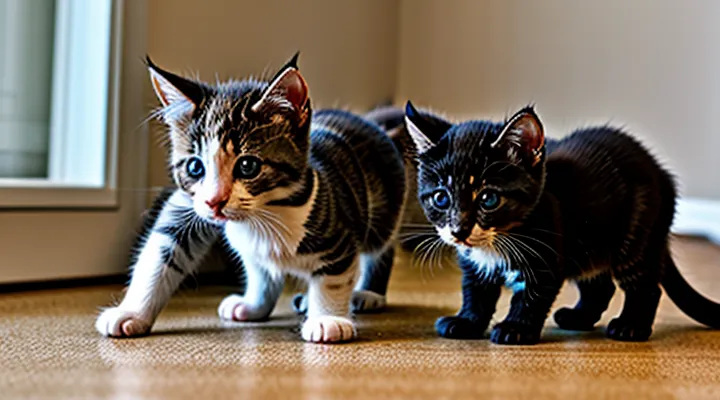
Genetic Predisposition for Hunting
Ancestral Roots and Survival
Kittens inherit a predatory framework that traces back to wild felids whose survival depended on small‑prey capture. Genetic programming supplies a reflexive pounce response: tactile stimulation of the whiskers triggers a rapid extension of the forelimbs, while visual tracking of rapid movement aligns the head and shoulders for optimal impact. This reflex is reinforced by neurochemical pathways that reward successful strikes, ensuring that the behavior becomes entrenched early in development.
Maternal influence accelerates skill acquisition. During the first weeks, queens expose offspring to live rodents or simulated prey, allowing kittens to observe prey escape patterns and to practice timing. The learning cycle follows a predictable sequence:
- Observation of adult hunting technique.
- Attempted pounce on stationary objects.
- Gradual transition to moving targets.
- Refinement of bite placement and release.
Each stage consolidates neural circuits associated with motor coordination, depth perception, and sensory integration. Failure to master these steps reduces individual fitness, as access to protein‑rich rodents directly affects growth rates and immune competence. Consequently, the ancestral imperative to secure prey drives both instinctual readiness and experiential refinement, producing a self‑sustaining loop that safeguards the species’ continuity.
Play as a Manifestation of Instinct
Kittens engage in spontaneous bouts of play that reflect innate predatory drives. The activity appears without external prompting, driven by internal neural circuits that activate when the animal encounters moving objects.
During play, kittens practice the sequence of actions required for successful capture: pounce, bite, and release. Repetitive execution refines muscle coordination, depth perception, and timing. Each successful attempt reinforces the motor pattern, making the behavior more efficient when a live prey item is encountered.
Observable play behaviors that map directly onto hunting technique include:
- Rapid, low‑to‑ground sprints that mimic the chase phase.
- Sudden lunges with forepaws extended, reproducing the strike posture.
- Gentle biting followed by release, teaching control of grip strength.
- Alternating ambush and pursuit, developing flexibility in attack strategy.
The cumulative effect of these instinct‑driven sessions is a calibrated predatory skill set. By the time kittens transition from toy objects to real rodents, the neural pathways governing detection, targeting, and capture are fully entrenched, enabling effective mouse hunting.
Early Learning Through Observation and Mimicry
Mother Cat's Role in Demonstrating Hunting Skills
Mother cats serve as the primary model for hunting behavior, allowing kittens to observe and imitate precise techniques. When a mother initiates a chase, she demonstrates stalking posture, silent movement, and timing of the pounce. Kittens watch the sequence, register the visual cues, and later replicate the actions during practice sessions.
Key elements of the mother’s instruction include:
- Stalking approach: low crouch, slow steps, tail alignment with the target.
- Pounce execution: rapid extension of forelimbs, coordinated bite, and secure grip.
- Kill bite placement: targeting the neck or spinal region to immobilize prey efficiently.
- Post‑capture handling: cleaning, dismembering, and feeding the offspring.
Repeated exposure to these demonstrations accelerates skill acquisition. Each successful observation reinforces neural pathways associated with predatory coordination, enabling kittens to transition from passive observers to competent hunters.
Sibling Interaction and Practice
Kittens raised with one or more littermates acquire hunting proficiency through continuous peer interaction. Older siblings demonstrate stalking, pouncing, and capture techniques; younger kittens replicate these movements during spontaneous play bouts. This observational learning accelerates the development of motor patterns essential for successful mouse pursuit.
Repeated practice sessions among siblings generate diverse scenarios that refine sensory integration. When a kitten chases a moving object while another intervenes, the participant must adjust timing, trajectory, and force. Such dynamic feedback sharpens visual tracking, auditory localization, and tactile response.
Sibling rivalry introduces competitive pressure that pushes each kitten toward higher precision. Successes are quickly reinforced, while missed attempts prompt immediate correction through peer feedback. The cycle of attempt, error, and adjustment builds a robust repertoire of hunting strategies.
Key elements of the learning process include:
- Modeling: Younger kittens imitate the posture and bite placement of older littermates.
- Co‑play: Simultaneous stalking of shared prey objects creates opportunities for role reversal and skill testing.
- Correction: Immediate peer response to failed attempts highlights alternative tactics.
- Repetition: Frequent, low‑stakes practice embeds neural pathways for rapid decision‑making during real hunts.
The collective environment produced by sibling interaction reduces the time required for a kitten to transition from playful swatting to effective mouse capture, ensuring that each individual reaches functional competence before independence.
Developing Motor Skills and Coordination
Stalking and Pouncing Techniques
Kittens acquire hunting proficiency through a sequence of motor and sensory refinements that culminate in effective stalking and pouncing. Early play bouts involve low‑intensity chases, which calibrate visual tracking and limb coordination. As the kitten matures, the following elements become pronounced:
- Stealth approach – the animal lowers its body, aligns its spine with the target, and minimizes limb movement to reduce visual and auditory cues.
- Distance assessment – binocular vision determines the optimal launch point, typically 1–2 body lengths from the prey.
- Muscle pre‑loading – hind‑leg muscles contract eccentrically, storing elastic energy for rapid extension.
- Launch execution – simultaneous extension of the hind legs and forward thrust of the forelimbs propel the kitten onto the target.
- Claw engagement – forepaws spread to secure the prey, while the tail provides balance during the airborne phase.
Successful execution depends on the integration of proprioceptive feedback and timing. Repeated exposure to moving objects refines neural pathways, enhancing predictive modeling of prey trajectories. Over time, the kitten transitions from reflexive swipes to deliberate ambushes, demonstrating the full spectrum of stalking and pouncing capabilities.
Refining Agility and Precision
Kittens improve their hunting efficiency by systematically sharpening agility and precision. Muscle fibers mature rapidly during the first twelve weeks, enabling faster acceleration and tighter contractions. Neural circuits governing balance and timing undergo synaptic strengthening as the animal practices coordinated movements.
Key mechanisms that drive refinement include:
- Pounce calibration – visual tracking of moving prey triggers a burst of hind‑leg power; repeated attempts adjust launch angle and distance.
- Mid‑air adjustment – vestibular feedback fine‑tunes body rotation, allowing the kitten to align its forepaws with the target trajectory.
- Contact precision – tactile receptors in the paw pads detect minute pressure changes, guiding the claw strike to the optimal point on the mouse’s body.
Environmental interaction accelerates these processes. Soft surfaces encourage exploratory jumps, while varied prey speeds force rapid adaptation of timing. Each successful capture reinforces motor patterns, whereas missed attempts generate corrective neural signals that reshape future responses.
The cumulative effect is a measurable rise in capture success, typically reaching 80 % by the end of the juvenile period. This performance gain reflects the convergence of muscular growth, sensory integration, and experiential learning, all essential for proficient predation.
The Role of Play in Skill Development
Toys as Prey Substitutes
Toys that imitate prey provide kittens with safe, repeatable opportunities to practice the motor patterns required for capturing live rodents. Early interaction with such objects triggers the predatory sequence—stalk, pounce, bite, and hold—allowing neural pathways to strengthen before exposure to actual mice.
Effective prey substitutes share several measurable traits:
- Size comparable to a house mouse (approximately 7–10 cm in length)
- Soft yet resistant texture that yields under bite pressure
- Audible or visual feedback (e.g., crinkling material or moving parts) that mimics startled movement
- Ability to be manipulated by the kitten’s forepaws and claws without causing injury
Progressive use of these toys accelerates skill acquisition. Initial sessions focus on chasing and pouncing; subsequent phases introduce grasping and immobilization drills. Consistent practice reduces hesitation, refines timing, and improves bite precision, resulting in higher capture success when kittens encounter real prey.
Simulating the Hunt
Simulating the hunt provides a controlled environment for observing how young felines develop predatory competence. Researchers replace live prey with moving targets that mimic mouse behavior, allowing precise measurement of timing, coordination, and learning curves without ethical concerns associated with live animals.
Key elements of an effective simulation include:
- Visual cues: Projected silhouettes or robotic models replicate the erratic motion patterns of rodents, triggering the kitten’s tracking system.
- Auditory signals: Playback of high‑frequency squeaks and rustling sounds reinforces the association between sound and prey movement.
- Tactile feedback: Soft, responsive surfaces deliver a subtle resistance when the kitten’s paws make contact, encouraging the development of grip strength and bite precision.
Experimental protocols typically involve repeated trials spaced over several weeks. Each session records latency to pounce, accuracy of strike, and adjustment of approach angle. Data are analyzed using statistical models that identify progressive improvements and isolate factors that accelerate skill acquisition.
Findings demonstrate that exposure to realistic, yet safe, prey simulations accelerates the transition from exploratory play to effective hunting behavior. The insights inform both veterinary training programs and the design of enrichment tools that support natural instinct development in domestic kittens.
Sensory Perception and Its Importance
Vision: Detecting Movement and Shape
Kittens are born with limited visual acuity; retinal ganglion cells begin to respond to light within the first week, while the ability to resolve moving objects emerges around ten days of age. During this period, synaptic connections in the primary visual cortex are refined by exposure to dynamic visual stimuli, establishing the neural substrate for motion detection.
Motion detection relies on direction‑selective retinal ganglion cells that fire preferentially when an object traverses the visual field. As the visual system matures, kittens exhibit increased contrast sensitivity and reduced latency in responding to moving patterns. Experimental recordings show that the peak firing rate to a moving stimulus reaches adult levels by four weeks, enabling rapid tracking of prey trajectories.
Shape recognition develops concurrently with motion sensitivity. Simple edge‑detecting cells in the visual cortex respond to oriented lines and contours, allowing kittens to distinguish the silhouette of a mouse from background vegetation. Depth perception, derived from binocular disparity and motion parallax, provides additional cues for judging the three‑dimensional form of potential prey.
The integration of motion and shape information guides the execution of a capture sequence:
- Detect lateral movement of a small object.
- Align visual focus on the object's contour.
- Estimate distance using binocular cues.
- Initiate a coordinated pounce timed to the object's velocity.
Behavioral studies confirm that kittens with delayed visual exposure exhibit slower pounce timing and higher miss rates, underscoring the dependence of hunting proficiency on early visual experience.
Hearing: Locating Prey
Kittens rely on acute auditory perception to detect the subtle sounds produced by small rodents. The inner ear of a domestic cat is adapted for high‑frequency detection, allowing kittens to hear rustling fur, footfalls on leaf litter, and the faint squeaks of a mouse hidden beneath debris. Sound localization follows a two‑step process: first, the brain compares the time difference between ears, then it evaluates the intensity disparity. This binaural analysis narrows the source to a cone-shaped area, guiding the kitten’s head orientation and subsequent pounce.
Key auditory mechanisms involved in prey detection:
- Interaural time difference (ITD): measures microsecond delays, critical for locating low‑frequency noises.
- Interaural level difference (ILD): assesses louder signals on the nearer ear, effective for high‑frequency sounds.
- Pinna shaping: the outer ear funnels sound and creates frequency‑specific cues that enhance vertical localization.
- Middle‑ear reflex: contracts the stapedius muscle to protect hearing while maintaining sensitivity to sudden movements.
During early development, kittens practice these skills through play. Repetitive exposure to moving toys that emit squeaks or rustling noises strengthens neural pathways in the auditory cortex. As the kitten matures, the latency between sound detection and motor response shortens, resulting in faster, more accurate strikes toward prey.
Scent: Tracking and Identification
Kittens rely on their highly developed olfactory system to locate potential prey. The nasal epithelium contains millions of receptors that detect volatile compounds released by rodents. When a mouse moves through a litter box or a crack in the floor, it leaves a trail of urine, feces, and skin secretions. These chemical signatures persist for several hours, providing a detectable map for a young cat.
During early play, mothers expose kittens to fresh scent tracks. The kittens practice following the gradient by moving their heads side‑to‑side, sampling air at each step. Repeated exposure sharpens the neural pathways that link odor intensity to spatial direction, allowing the animal to predict the prey’s location even when visual cues are limited.
Key elements of scent‑based hunting development include:
- Receptor maturation – gradual increase in the number of functional olfactory cells during the first eight weeks.
- Neural integration – strengthening of connections between the olfactory bulb and the motor cortex, enabling coordinated movement toward the source.
- Memory encoding – formation of associative memories that tie specific rodent odors to successful capture attempts.
- Social learning – observation of the mother’s tracking behavior, which reinforces pattern recognition and decision‑making speed.
As kittens mature, they transition from following external scent trails to generating internal representations of prey odor fields. This shift reduces reliance on continuous sniffing and supports rapid, stealthy approaches during the final strike. The combination of physiological growth and experiential training equips the young feline with a reliable mechanism for identifying and pursuing mouse prey.
From Play to Real-World Application
First Encounters with Live Prey
Kittens encounter moving prey for the first time during the early weeks of life, typically between three and five weeks of age. At this stage, their visual acuity sharpens enough to detect rapid motion, while auditory and tactile receptors become responsive to the vibrations and rustlings produced by small animals.
The initial response combines instinctive predatory drive with uncoordinated motor patterns. A kitten will lunge, miss, and quickly reset its posture, demonstrating the trial‑and‑error mechanism that refines timing and force. Repeated attempts generate neural pathways that link sensory cues to precise muscle activation.
Maternal behavior accelerates skill acquisition. The mother cat frequently presents captured insects or rodents to her kittens, allowing them to observe bite placement and body positioning. Passive observation, followed by active practice, reduces the number of failed attempts and shortens the learning curve.
Key developmental milestones observed during these early encounters include:
- Depth perception: emergence of binocular vision enabling accurate distance estimation.
- Pounce timing: synchronization of hind‑leg extension with fore‑leg reach.
- Grip strength: increase in jaw pressure sufficient to immobilize prey.
- Release control: ability to hold and manipulate prey without causing premature injury.
By eight weeks, most kittens exhibit consistent pouncing success, indicating that the foundational hunting circuitry has been established through direct interaction with live targets.
The Transition from Instinct to Skill
Kittens are born with a predatory instinct that triggers rapid eye‑blink responses, ear‑muscle contractions, and paw‑swipes when a moving object enters their visual field. This reflexive behavior provides the initial framework for hunting but lacks precision.
Sensory refinement follows the first weeks of life. Visual acuity improves from blurred outlines to detailed tracking of small, fast‑moving prey. Auditory discrimination sharpens, allowing kittens to locate rustling sounds beneath cover. Tactile feedback from paw pads and whisker contact informs the spatial relationship between the kitten and its target.
Practical experience converts raw reflexes into coordinated skill. Repeated encounters with live or simulated prey produce the following developmental sequence:
- Detection: Recognize movement through sight or sound.
- Approach: Adjust body posture, lower the center of gravity, and align the head.
- Stalk: Advance in short, silent steps while maintaining visual lock.
- Pounce: Calculate distance, launch, and extend forepaws at the moment of contact.
- Capture: Clamp jaws or paws to secure the mouse, then manipulate it with bite or grip.
Neural plasticity underlies this progression. Synaptic pathways linking visual, auditory, and motor cortices strengthen with each successful catch, while unsuccessful attempts prune ineffective patterns. Mother cats contribute by presenting dead prey, demonstrating bite placement, and tolerating early missteps, thereby accelerating the transition from instinctual reaction to deliberate technique.
Factors Influencing Hunting Success
Environment and Opportunity
Kittens develop hunting skills primarily through interaction with their surroundings. A cluttered space with varied textures—carpet, wood, and soft bedding—offers tactile cues that sharpen paw coordination. Open areas allow free sprinting, while narrow passages force precise maneuvering, both of which contribute to the refinement of strike timing.
Key environmental elements that influence skill acquisition include:
- Presence of live or simulated prey (e.g., moving toys, insects) that generate realistic motion patterns.
- Light conditions ranging from bright daylight to dim shadows, training visual tracking under different intensities.
- Auditory stimuli such as rustling sounds that cue the location of concealed targets.
- Temperature gradients that motivate activity; cooler zones encourage movement toward warmer, more active zones where prey may appear.
Opportunities arise when caretakers deliberately introduce these variables. Rotating toys, adjusting lighting, and periodically rearranging furniture create novel challenges, preventing habituation and encouraging adaptive problem‑solving. Consistent exposure to diverse scenarios accelerates the transition from reflexive swipes to deliberate captures.
Individual Kitten Personality and Drive
Kittens do not approach hunting with a uniform strategy; each animal’s temperament shapes the speed and effectiveness of acquiring mouse‑catching proficiency.
- Boldness – confident kittens initiate pursuit quickly, tolerate close contact with prey, and recover from failed attempts without hesitation.
- Curiosity – inquisitive individuals explore moving objects, increasing exposure to realistic prey simulations and refining motor patterns.
- Persistence – kittens that repeat unsuccessful grabs develop more accurate timing and stronger forelimb coordination.
- Fearfulness – anxious cats delay engagement, often requiring gradual desensitization before attempting capture.
- Social dependence – kittens that rely heavily on littermates may learn indirectly by observing peers, whereas solitary ones depend on self‑directed trial and error.
The internal drive that fuels these behaviors combines innate prey motivation with reinforcement sensitivity. High prey drive amplifies reward signals from successful captures, accelerating neural pathways linked to predatory sequences. Conversely, low drive reduces engagement frequency, extending the learning curve.
For caregivers seeking to nurture hunting competence, observation of each kitten’s dominant traits informs targeted enrichment:
- Present moving toys that match the kitten’s boldness level; bold cats benefit from rapid, erratic motion, while timid ones respond better to slower, predictable trajectories.
- Schedule short, repeatable play sessions to reinforce persistence, allowing the animal to experience multiple capture attempts within a controlled environment.
- Introduce a peer model when social dependence is evident; a proficient sibling can demonstrate technique, prompting observational learning.
By aligning training methods with individual personality profiles, the development of effective mouse‑hunting behavior becomes both measurable and efficient.