
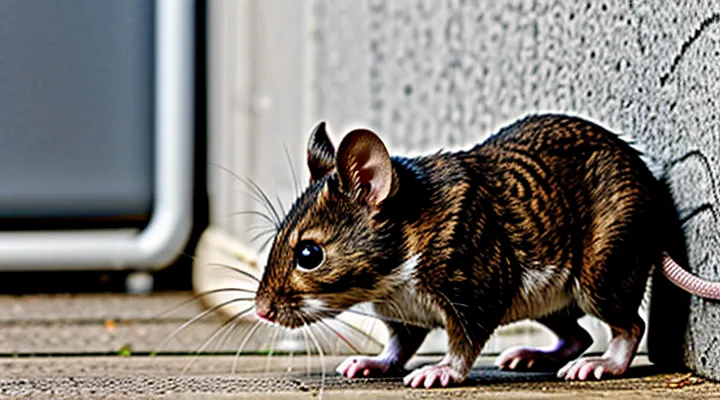
Unpacking the «Wall-Crawling» Myth
Understanding Mouse Anatomy
Mice possess a lightweight skeleton that reduces gravitational load, enabling rapid movement across vertical surfaces. Their vertebral column is highly flexible, allowing the body to conform to irregular textures while climbing.
The forelimbs feature elongated digits equipped with sharp, retractable claws. These claws dig into microscopic crevices, generating the friction needed for upward traction. Muscles attached to the scapula and humerus produce powerful grip forces relative to the animal’s size.
A specialized pad of dense fur covers the ventral surface of the paws. The fur’s micro‑scale structure increases surface area and creates a slight suction effect, assisting adhesion on smooth materials such as glass.
The tail functions as a dynamic counterbalance. Muscular control of the tail adjusts the center of mass, preventing tipping during rapid ascents or descents.
Sensory organs support wall navigation. Vibrissae (whiskers) detect minute changes in air flow and surface contours, while large, forward‑facing eyes provide depth perception essential for judging distances on vertical planes.
Key anatomical contributors to wall climbing:
- Flexible spine
- Sharp, retractable claws
- Fur‑covered paw pads
- Muscular, balancing tail
- Highly sensitive whiskers
- Acute visual depth perception
Collectively, these adaptations explain how mice can maneuver on walls despite the absence of true adhesive mechanisms. Their anatomy supplies the mechanical advantage required for sustained vertical locomotion.
The Role of Claws and Paws
Mice can ascend vertical surfaces, but the ability depends on the interaction of their claws and paws rather than any supernatural adhesion.
Claws are composed of hardened keratin and curve forward, allowing them to embed into microscopic irregularities on rough substrates. The sharp tip concentrates force into a small area, creating sufficient shear resistance for the animal to pull its body upward. On smooth surfaces, the lack of micro‑grooves reduces the effectiveness of this anchoring mechanism, limiting upward traction.
Paws contribute through textured pads and muscular control. The pads contain a dense network of papillae that increase surface contact and generate friction when compressed. Sensory receptors in the pads provide real‑time feedback, enabling the mouse to adjust limb placement and pressure dynamically. Muscles in the fore‑ and hind‑limbs coordinate to shift weight and maintain balance during vertical locomotion.
Key functions of claws and paws:
- Claw curvature: penetrates surface irregularities, creates anchor points.
- Keratin hardness: resists wear, sustains grip under load.
- Pad papillae: expands contact area, raises friction coefficient.
- Sensory feedback: guides precise foot placement, prevents slippage.
- Muscular coordination: synchronizes limb movement, supports body weight.
The combined action of sharp, forward‑curved claws and friction‑enhancing paw pads enables mice to climb many vertical obstacles, especially those with rough textures. On perfectly smooth walls, the mechanical limits of these structures prevent sustained crawling, dispelling the notion that mice possess an inherent ability to adhere to any wall.
Factors Influencing Wall Climbing
Surface Texture and Material
Mice can ascend vertical surfaces when the material provides sufficient friction or micro‑structures for their claws and pads to engage. Smooth, non‑porous substrates such as glass or polished metal offer negligible resistance; claws slip and the animal cannot generate the necessary grip. Conversely, rough or fibrous textures increase contact points, allowing the claws to catch irregularities and the foot pads to conform to surface undulations.
Key factors influencing wall‑crawling capability:
- Surface roughness – sand‑paper grade, stucco, or textured paint creates micro‑grooves that mice exploit.
- Porosity – plaster, drywall, and untreated wood absorb slight moisture, enhancing adhesion.
- Material hardness – softer materials deform under claw pressure, enlarging the bite area and improving traction.
- Moisture level – damp surfaces reduce static friction, sometimes facilitating movement, but excess wetness can cause slippage.
Experimental observations show that mice readily climb drywall, untreated plywood, and corrugated cardboard, while they avoid polished metal plates and glazed tiles. The presence of minute protrusions or fibers is decisive; even a thin layer of dust can impair grip.
In practical terms, environments with rough, porous walls enable mice to navigate vertically, whereas sleek, hard finishes act as effective barriers. Understanding these material properties informs pest‑control strategies and building design aimed at limiting rodent access.
Gravity and Body Weight
Mice can ascend vertical surfaces because their low body weight reduces the gravitational force that must be countered by adhesion. Weight equals mass multiplied by the acceleration due to gravity (≈9.81 m s⁻²). A typical adult mouse weighs about 20 g, producing a downward force of roughly 0.20 N. This force is far smaller than that experienced by larger mammals, allowing relatively modest adhesive structures to hold the animal against gravity.
The adhesive mechanisms employed by mice include sharp claws that penetrate microscopic surface irregularities and specialized pads that generate friction through elastic deformation. The required frictional force equals the product of the normal force (the mouse’s weight) and the coefficient of friction between the pad material and the substrate. With a normal force of 0.20 N and a friction coefficient as low as 0.3, the necessary frictional force is only 0.06 N, well within the capacity of mouse claws and pads.
Key quantitative facts:
- Average mouse mass: 15–25 g.
- Corresponding weight: 0.15–0.25 N.
- Typical coefficient of friction for mouse pads on common surfaces: 0.2–0.5.
- Minimum frictional force needed for vertical adhesion: 0.03–0.13 N.
These numbers demonstrate that gravity imposes a modest load on a mouse, and the animal’s anatomical adaptations provide sufficient counterforce to enable wall climbing.
Environmental Conditions
Mice are capable of climbing vertical surfaces, but their performance depends heavily on surrounding conditions. Moisture levels, temperature, surface texture, and illumination each influence the effectiveness of their adhesive pads and grip strength.
- Humidity: Elevated humidity softens fur and enhances the adhesion of the tiny pads on mouse feet, allowing better contact with smooth walls. Low humidity reduces pad flexibility, limiting ascent.
- Temperature: Moderate ambient temperatures (20‑25 °C) maintain optimal muscle function. Extreme cold stiffens limbs, while excessive heat can cause fatigue, both impairing climbing ability.
- Surface texture: Rough or porous materials provide micro‑grooves that mice can hook onto, facilitating upward movement. Completely smooth surfaces, such as polished glass, offer insufficient footholds unless moisture creates a thin film.
- Lighting: Dim environments encourage exploratory climbing, whereas bright light can trigger avoidance behavior, decreasing the likelihood of wall traversal.
These factors interact; for example, a humid, cool room with textured walls creates the most favorable scenario for mice to navigate vertical planes. Conversely, a dry, warm, and uniformly smooth environment markedly reduces their capacity to crawl on walls.
Beyond Walls: Other Climbing Abilities
Scaling Vertical Objects
Mice possess several adaptations that enable them to ascend vertical surfaces. Their lightweight bodies reduce the force required to lift themselves, while the pads on their hind feet contain fine, flexible hairs (setae) that increase surface contact and generate friction. The forepaws, equipped with sharp claws, provide anchorage points and assist in pulling the animal upward.
Key physiological factors include:
- Muscular strength relative to body mass, allowing rapid, coordinated limb movements.
- Tactile sensitivity in the whiskers and foot pads, which detects micro‑variations in texture and adjusts grip.
- Flexible spine, facilitating the “bridge” posture that distributes weight across multiple contact points.
Behaviorally, mice exhibit exploratory climbing when searching for food, shelter, or escape routes. They preferentially choose surfaces with roughness or micro‑grooves, as smoother materials offer insufficient traction. Laboratory observations confirm that mice can scale walls up to 1.5 meters high when provided with adequate grip.
In natural settings, vertical climbing contributes to predator avoidance and access to elevated nesting sites. The combination of anatomical features and active locomotor strategies explains the observed ability of mice to navigate walls and other steep structures.
Navigating Rough Surfaces
Mice possess a suite of anatomical and behavioral traits that enable efficient movement across irregular substrates. Their paws feature sharp, curved claws that can dig into crevices, while the surrounding plantar pads provide a flexible cushion that conforms to uneven textures. Muscular coordination between fore‑ and hind‑limbs generates precise grip adjustments, allowing rapid shifts in body weight as the surface changes.
Sensory feedback plays a critical role. Dense mechanoreceptors in the paw pads detect minute variations in texture, transmitting real‑time data to the central nervous system. This input triggers immediate modifications in stride length, foot placement, and traction force. Vision and whisker input supplement tactile information, especially when navigating vertical or overhanging rough surfaces.
Key mechanisms supporting rough‑surface navigation include:
- Curved claws that anchor into fissures and protrusions.
- Highly compliant plantar pads that distribute pressure and adapt to surface irregularities.
- Strong, fast‑twitch muscle fibers that generate quick, forceful contractions for sudden grip changes.
- Integrated sensory network (mechanoreceptors, whiskers, vision) that continuously monitors surface conditions.
- Agile spinal and limb coordination that maintains balance during rapid directional shifts.
Collectively, these adaptations explain why mice can traverse and even ascend textured walls, a capability often misinterpreted as “crawling” when it is, in fact, a coordinated exploitation of their specialized morphology and sensory systems.
When and Why Mice Climb
Seeking Food and Water
Mice demonstrate extraordinary agility when searching for sustenance, employing vertical surfaces to reach hidden resources. Their adhesive footpads, equipped with microscopic hairs, generate sufficient friction to support rapid upward movement, allowing access to ceiling‑mounted food trays, wall cracks, and plumbing fixtures. Muscular coordination and a flexible spine enable swift changes in direction, facilitating efficient exploration of three‑dimensional environments.
Key behaviors that enhance food and water acquisition include:
- Climbing to elevated storage – Mice ascend walls to infiltrate pantry shelves, grain bins, and kitchen cabinets, where higher placement reduces competition with ground‑dwelling insects.
- Exploiting moisture sources – Vertical pipes, drip trays, and condensation on walls provide reliable water, especially in arid conditions; mice can navigate these structures to maintain hydration.
- Utilizing scent trails – Olfactory cues guide mice along vertical routes, directing them toward recent spills or discarded scraps that settle on surfaces.
- Rapid descent and escape – After securing nourishment, mice employ controlled falls or reverse climbing to retreat quickly, minimizing exposure to predators.
These adaptations illustrate that vertical locomotion is not a novelty but a fundamental component of murine foraging strategy, directly influencing survival in both natural habitats and human dwellings.
Escaping Predators
Mice evade predators through rapid, multidirectional movement, sensory acuity, and environmental exploitation. Their small size permits entry into narrow crevices, while powerful hind limbs generate bursts of speed that outpace many hunting species. Vision and whisker‑based tactile perception detect threats at a distance, triggering immediate flight responses.
Physical adaptations enhance escape efficiency:
- Climbing ability – specialized toe pads and flexible joints allow mice to ascend vertical surfaces, including rough walls, providing alternative routes away from ground‑based predators.
- Jumping capacity – hind‑leg musculature produces vertical leaps up to 30 cm, facilitating sudden changes in elevation.
- Burrowing skill – incisors and forelimb strength create tunnels that serve as refuges and hidden pathways.
Predator types that mice commonly confront include owls, snakes, cats, and feral dogs. Each imposes distinct selective pressures, prompting mice to adopt specific defensive tactics:
- Aerial hunters – mice seek low‑lying cover and use wall climbing to reach overhead ledges inaccessible to birds.
- Ground predators – rapid sprinting and zigzag patterns disrupt pursuit trajectories.
- Ambush predators – heightened whisker sensitivity detects subtle air currents, prompting immediate retreat into burrows.
The combination of agile locomotion, wall‑climbing proficiency, and acute sensory detection constitutes the primary defense framework that enables mice to survive in environments populated by diverse predators.
Finding Shelter
Mice exploit vertical surfaces to reach concealed locations that provide protection from predators and environmental extremes. Their adhesive pads and flexible spine enable rapid ascent of smooth walls, allowing entry into narrow crevices, behind appliances, and within building insulation. These entry points often remain inaccessible to larger animals, creating a reliable refuge network throughout residential and commercial structures.
Key shelter strategies include:
- Occupying voids behind drywall where moisture levels are stable.
- Nesting inside attic insulation that offers thermal regulation.
- Using gaps beneath floorboards to evade disturbance.
- Establishing burrows in stored grain or organic debris where food and cover coincide.
The selection of a shelter site depends on three primary criteria: low light exposure, limited airflow, and proximity to food sources. Mice assess these factors through tactile vibration sensing and olfactory cues, rapidly relocating if conditions deteriorate. Their ability to cling to vertical surfaces shortens the distance between exterior entry points and optimal hideouts, enhancing survival odds in both urban and rural environments.
Evidence and Observations
Scientific Studies and Research
Scientific investigations have examined the capacity of rodents to adhere to vertical surfaces, focusing on anatomical, physiological, and behavioral factors. Researchers measured the adhesive forces generated by mouse footpads using micro‑force transducers, finding that maximum static friction rarely exceeds 0.3 N per paw, insufficient to support body weight on a smooth vertical plane.
Neurophysiological studies recorded motor‑cortex activity in mice navigating inclined platforms. Electrophysiological data showed increased firing rates in the vestibular nuclei when the slope approached 45°, but no activation patterns indicative of specialized climbing circuitry.
Behavioral experiments employed transparent walls coated with varying textures. In trials with roughened surfaces (grain size ≈ 200 µm), mice successfully traversed upward distances up to 15 cm, relying on claw interlocking rather than adhesive pads. Smooth glass walls yielded zero successful ascents across 30 trials, confirming the absence of true wall‑crawling ability.
Comparative analyses of species with known climbing proficiency (e.g., squirrels, certain geckos) highlighted distinct morphological adaptations—enlarged toe pads, lamellar setae, and enhanced flexor musculature—that mice lack. Morphometric data revealed mouse hind‑foot pads average 2.5 mm², far smaller than the adhesive structures of documented climbers.
Collectively, empirical evidence indicates that mice cannot crawl on vertical, non‑textured surfaces. Their limited grip relies on mechanical interlock with irregularities rather than adhesive mechanisms, disproving the notion of inherent wall‑climbing capability.
Anecdotal Accounts
Mice have been observed scaling vertical surfaces in a variety of settings, often reported by observers who witness the behavior in homes, laboratories, and field studies. These accounts provide practical insight into the species’ climbing capabilities and highlight conditions that facilitate wall traversal.
- A homeowner in a New England suburb described a mouse moving across a painted drywall panel while searching for food. The mouse used its hind limbs to push upward, maintaining contact with the textured surface.
- Laboratory technicians at a university research facility recorded a mouse climbing a smooth Plexiglas wall during a maze experiment. The animal employed rapid, alternating fore‑ and hind‑foot movements, gripping the surface with adhesive pads on its foot pads.
- A field biologist working in a grain storage building observed a mouse navigating a concrete wall coated with a thin layer of dust. The mouse’s claws engaged micro‑imperfections in the coating, allowing upward progress.
- An amateur videographer posted footage of a mouse ascending a plastered interior wall in a historic house. The video showed the mouse pausing to reposition its tail for balance before continuing upward.
Common elements across these reports include textured or slightly rough surfaces, the presence of a foothold for claws, and the use of tail assistance for stability. The anecdotes collectively demonstrate that mice can climb walls when surface conditions provide adequate grip, confirming their reputation as agile climbers.
Preventing Mouse Infestations
Sealing Entry Points
Mice are capable of climbing rough, vertical surfaces, but smooth walls offer little traction. Their primary route into homes is through openings that bypass the need for vertical movement.
Sealing entry points removes the pathways mice exploit, reducing the likelihood of interior sightings and limiting any perceived wall‑crawling activity.
- Inspect the building envelope for gaps larger than ¼ inch. Common locations include:
- Gaps around utility pipes and cables
- Cracks in foundation walls and basement slabs
- Openings under doors and windows
- Holes in vent covers and exhaust fans
- Apply appropriate materials:
- Conduct periodic reviews after renovations or seasonal changes to verify that seals remain intact.
Effective sealing blocks access routes, prevents mice from entering interior spaces, and eliminates the conditions that could be misinterpreted as wall‑crawling behavior.
Maintaining Cleanliness
Maintaining a clean environment reduces the opportunities for rodents to explore vertical surfaces. Food debris, grease, and moisture create scent trails that attract mice, encouraging them to investigate walls in search of sustenance. When these attractants are eliminated, the incentive for rodents to climb diminishes.
Effective cleanliness practices include:
- Removing all food waste from countertops and floors immediately after use.
- Storing pantry items in sealed containers to prevent odor leakage.
- Regularly wiping down surfaces with disinfectant to eradicate residue.
- Vacuuming corners, baseboards, and behind appliances to capture droppings and hair that can serve as markers.
- Repairing spills promptly to avoid moisture accumulation that supports bacterial growth.
A systematic cleaning schedule supports these actions. Daily tasks focus on surface sanitation and waste disposal; weekly tasks address deep cleaning of hard‑to‑reach areas such as wall junctions and vent openings. Consistency prevents the buildup of attractants that might otherwise prompt mice to test their climbing abilities.
By limiting food sources and eliminating scent cues, cleanliness directly lowers the probability that rodents will attempt to traverse walls, thereby reducing the likelihood of wall‑crawling incidents.
Professional Pest Control
Professional pest control services address the misconception that rodents can traverse vertical surfaces as easily as insects. Mice possess limited adhesive ability; their paws lack the specialized pads found in climbing species. Consequently, they rely on structural gaps, cables, and pipes to move between levels rather than scaling smooth walls.
Effective control strategies focus on eliminating pathways and reducing attractants. Practitioners implement the following measures:
- Conduct thorough inspections to locate entry points, including foundation cracks, vent openings, and utility penetrations.
- Seal identified gaps with steel wool, caulk, or metal flashing to prevent ingress.
- Install traps and bait stations in strategic locations, prioritizing concealed routes and high-traffic zones.
- Apply rodent‑resistant materials, such as concrete or metal shelving, in areas prone to infestation.
- Provide client education on sanitation practices that diminish food sources and shelter.
By targeting the actual mechanisms mice use to navigate buildings, pest control professionals reduce reliance on ineffective wall‑climbing myths and achieve long‑term population suppression.