
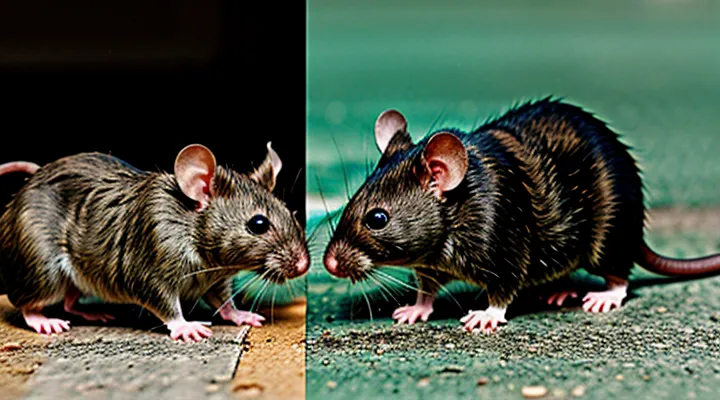
Understanding Rodent Identification
General Overview of Rodent Diversity
Rodents represent the most diverse mammalian order, encompassing over 2,300 species across 29 families. Their adaptive radiation produces a wide range of body sizes, fur textures, cranial structures, and locomotor specializations. Commonly encountered members—such as the brown rat (Rattus norvegicus) and the house mouse (Mus musculus)—illustrate the spectrum of morphological variation within the group.
Key morphological contrasts between these two species include:
- Body length: rats typically exceed 20 cm, mice range 6–10 cm.
- Tail proportion: rat tails approach body length; mouse tails are proportionally longer relative to body size.
- Ear size: mouse ears are large relative to head, rat ears are smaller and less conspicuous.
- Fur coloration: rats display broader color palettes, often brown or black; mice commonly exhibit gray or light brown tones.
- Skull shape: rat skulls are robust with a pronounced snout; mouse skulls are slender with a subtle rostrum.
Understanding these representative differences clarifies how rodent diversity manifests in observable traits, providing a framework for identifying species and assessing ecological roles.
Why Distinguish Rats from Mice?
Rats and mice may appear similar to the casual observer, yet precise identification matters for scientific accuracy, effective pest management, and appropriate veterinary treatment. Misidentifying one for the other can lead to incorrect dosage calculations, flawed experimental data, and inefficient control strategies.
- Research protocols require species‑specific data; physiological responses, lifespan, and genetic markers differ markedly between rats and mice, influencing study outcomes.
- Disease transmission patterns vary; rodents serve as vectors for distinct pathogens, and surveillance programs depend on accurate species reporting.
- Legal frameworks often differentiate between the two in licensing, import restrictions, and wildlife protection statutes; compliance hinges on correct classification.
- Control measures such as bait formulation, trap size, and placement are optimized for the target rodent’s size and behavior, reducing waste and non‑target impacts.
- Ecological assessments rely on population density and habitat use; rats typically occupy larger burrows and exhibit different foraging ranges compared to mice, affecting ecosystem modeling.
Overall, distinguishing rats from mice ensures that interventions are scientifically sound, legally compliant, and environmentally responsible.
Key Physical Distinctions
Size and Body Proportions
Overall Body Length
Rats possess a markedly longer torso than mice. The head‑to‑body measurement for adult Norway rats typically falls between 18 cm and 20 cm, while the common house mouse ranges from 6 cm to 10 cm. This disparity remains consistent across most laboratory and wild strains, with larger rat species (e.g., black rats) reaching up to 22 cm and dwarf mouse varieties rarely exceeding 5 cm.
- Rats: 18–22 cm (head‑to‑body)
- Mice: 6–10 cm (head‑to‑body)
Tail length is excluded from these figures, ensuring a direct comparison of the core body segment. The proportional difference influences locomotion, habitat use, and predator avoidance, but the metric itself provides a clear, quantifiable distinction between the two rodent groups.
Relative Head Size
Rats have proportionally larger heads than mice. The skull of a rat occupies a greater fraction of the body length, giving a broader, more robust cranial profile. In mice, the head is relatively small, with a slender snout and tighter integration with the neck musculature.
Key comparative points:
- Skull-to-body ratio: Rat skull length is about 30 % of total body length; mouse skull length is roughly 25 %.
- Width: Rat cranial width exceeds mouse width by 10–15 %, contributing to a bulkier appearance.
- Facial structure: Rats display a blunt, rounded muzzle; mice possess a pointed, tapered nose.
- Ear placement: Larger rat heads position ears slightly lower on the skull, while mouse ears sit higher relative to the head’s size.
These measurements provide reliable visual cues for distinguishing the two species in field observations and laboratory settings.
Tail Length and Thickness
Rats possess tails that are proportionally longer than those of mice. A typical brown rat tail measures 18–25 cm, roughly equal to its body length, while a common house mouse tail averages 7–10 cm, about half the body length. The rat’s tail often extends beyond the hindquarters, providing balance for climbing and swimming; the mouse’s shorter tail supports agility in confined spaces.
Tail girth also distinguishes the two species. Rat tails are thick, with a diameter of 0.6–1.2 cm, and display a relatively uniform, smooth surface. Mouse tails are slender, measuring 0.2–0.4 cm in diameter, and feature a fine, hair‑sparse covering that may appear slightly scaly. These dimensional differences affect heat regulation, locomotion, and tactile perception, allowing each rodent to thrive in its ecological niche.
Head and Facial Features
Ear Size and Shape
Rats possess larger, more rounded ears that extend noticeably beyond the head’s outline, providing a broader surface area for sound capture. Mice display smaller, triangular ears that sit close to the skull, with a reduced auditory surface.
- Rat ear length: typically 2–2.5 cm, width up to 1.5 cm; shape approximates an oval.
- Mouse ear length: generally 1–1.2 cm, width around 0.5 cm; shape forms a sharp triangle.
- Fur coverage: rat ears are sparsely furred, exposing more skin; mouse ears retain dense hair, obscuring the margin.
- Mobility: both species can rotate ears, but rats achieve a wider angular range (approximately 180°) compared to mice (about 150°).
These dimensions and forms constitute reliable visual markers for distinguishing the two rodents in field observations and laboratory settings.
Snout Morphology
Snout morphology provides a reliable criterion for separating rats from mice. The shape, length, and proportion of the rostral region differ markedly between the two genera, reflecting adaptations to distinct feeding strategies and sensory demands.
Rats possess a comparatively long, robust snout. The nasal bones extend forward, creating a blunt, rectangular profile when viewed laterally. The palate is broad, and the interorbital distance is relatively narrow, giving the snout a sturdy appearance suited for gnawing larger food items. Whisker (vibrissae) placement follows a dense, evenly spaced pattern along the dorsal surface, supporting tactile exploration of complex environments.
Mice exhibit a short, delicate snout. The nasal bones are reduced, producing a pointed, triangular silhouette. The palate is narrow, and the interorbital space is wider, resulting in a more tapered rostrum that facilitates precise manipulation of tiny seeds and insects. Whiskers are sparser and arranged in a more pronounced, forward‑projecting arc, enhancing fine‑scale detection.
Key morphological distinctions:
- Length: rat snout > mouse snout (by ~30–40 % of skull length)
- Profile: rat – blunt, rectangular; mouse – pointed, triangular
- Palate width: rat – broad; mouse – narrow
- Interorbital distance: rat – narrow; mouse – wide
- Vibrissae density: rat – dense, uniform; mouse – sparser, forward‑oriented
These attributes allow rapid visual identification and support functional interpretations of each species’ ecological niche.
Eye Prominence
Eye prominence provides a reliable visual cue for separating rats from mice. Rats possess larger, more protruding eyes that extend noticeably beyond the orbital rim, while mice display smaller, less conspicuous ocular bulges that sit closer to the skull surface.
Key distinctions include:
- Relative size: Rat eyes occupy a greater proportion of the head width; mouse eyes represent a smaller fraction.
- Orbital depth: The orbital cavity in rats is deeper, allowing the globe to sit farther forward.
- Eyelid morphology: Rats have a single, thin eyelid with a subtle fringe; mice feature a double-layered lid with a more pronounced fringe.
- Visual field: The outward position of rat eyes yields a broader peripheral range, whereas mouse eyes create a narrower field of view.
These anatomical variations reflect divergent ecological adaptations, with rats favoring enhanced low‑light detection and mice relying on a compact skull structure for agility.
Fur Characteristics
Texture and Coloration
Rats and mice exhibit distinct fur textures that aid identification. Rat fur is coarser, with a denser undercoat that provides a plush feel. Mouse fur is finer, smoother, and typically less voluminous, giving a silkier surface to the skin.
-
Rats:
- Coarse guard hairs interspersed with thick underhair.
- Slightly oily sheen that enhances durability.
-
Mice:
- Soft, fine guard hairs and a thin underlayer.
- Minimal oil, resulting in a matte appearance.
Coloration also differs markedly. Rats commonly display darker, uniform shades ranging from brown to black, with occasional dorsal stripes in specific breeds. Mice present a broader palette, including light gray, white, brown, and spotted patterns, often with contrasting ventral coloration.
-
Rats:
- Predominantly solid dark tones.
- Limited pattern variation; occasional dorsal stripe.
-
Mice:
- Wide range of hues, from pale to deep brown.
- Frequent ventral‑dorsal contrast and spotted markings.
These textural and chromatic characteristics provide reliable criteria for distinguishing the two species in field and laboratory settings.
Hair Length
Rats possess a dense coat of short, coarse fur that lies close to the skin. The hair length typically measures 2‑4 mm on the back and is even shorter on the belly, providing a sleek silhouette.
Mice display finer, longer hair, especially on the dorsal surface where individual strands reach 5‑7 mm. The ventral fur remains short, but the overall appearance is fluffier due to the finer texture.
Key points:
- Rat fur: short, coarse, uniform across body.
- Mouse fur: longer on back, finer, creates a softer outline.
- Variation: laboratory strains may have slightly altered lengths, but the general pattern remains consistent across wild and domestic populations.
Foot and Paw Structure
Relative Foot Size
Rats possess noticeably larger hind feet than mice. The average rat hind foot measures 2.5–3.0 cm in length, while a typical mouse foot ranges from 1.0–1.5 cm. This size disparity reflects the overall body mass difference: rats weigh 200–500 g, whereas mice weigh 15–30 g.
Key aspects of relative foot size:
- Surface area: Rat feet provide a broader contact surface, enhancing stability on uneven terrain. Mouse feet, being smaller, allow for finer maneuverability in tight spaces.
- Digit length: Rat digits are proportionally longer, supporting greater grip strength. Mouse digits are shorter, facilitating rapid, precise movements.
- Pad thickness: Rats have thicker plantar pads, offering cushioning for heavier loads. Mice have thinner pads, reducing weight and improving agility.
These characteristics influence locomotor behavior, habitat preference, and predator avoidance strategies in each species.
Claw Appearance
Rats and mice exhibit distinct claw characteristics that aid identification and reflect differing ecological adaptations.
-
Rats possess relatively long, robust claws measuring 2–3 mm in adult specimens. The claws are slightly curved, with a broad, flattened tip that supports digging and climbing on coarse surfaces. The keratin sheath appears dark brown to black, and the nail plate is clearly visible against the pale foot pad.
-
Mice display shorter claws, typically 1–1.5 mm in length. The curvature is more pronounced, creating a delicate, hooked tip suited for gripping fine substrates such as grain and fabric. The keratin coating is lighter, ranging from pale gray to faint brown, often blending with the surrounding fur. The nail plate is less conspicuous, partially hidden by dense foot fur.
The shape of the claw base also differs: rats have a wider, more squared base that connects to a thicker digit, while mice feature a narrower, tapered base aligning with their slender digits. These variations influence locomotion; rat claws provide greater traction on rugged terrain, whereas mouse claws enhance precision on smooth or vertical surfaces.
Behavioral and Habitat Clues (Brief Mention of Visual Indicators)
Movement Patterns
Rats and mice exhibit distinct locomotor behaviors that aid identification when visual cues are ambiguous. Their body proportions, limb length, and tail flexibility translate into observable differences in speed, gait, and maneuverability.
- Speed: Rats achieve higher top speeds (up to 8 km/h) over short bursts, while mice sustain velocities around 6 km/h for longer periods.
- Gait pattern: Rats employ a more pronounced trot, lifting both hind limbs simultaneously, producing a smoother, less jittery motion. Mice favor a rapid, alternating footfall pattern, resulting in a quick, erratic stride.
- Turning radius: Rats navigate tighter curves with a broader base of support, allowing stable cornering. Mice display sharper, tighter turns but with reduced stability, often resorting to sudden direction changes.
- Climbing ability: Rats use strong forelimbs and a longer, prehensile tail to ascend vertical surfaces efficiently. Mice rely on lighter bodies and shorter tails, climbing primarily on inclined planes rather than vertical walls.
- Burrowing behavior: Rats dig extensive tunnels with systematic excavation, moving soil outward in a uniform fashion. Mice create shallower, irregular burrows, frequently relocating soil in small, scattered piles.
These locomotor characteristics reflect adaptations to differing ecological niches and provide reliable criteria for distinguishing the two rodents in field observations and laboratory settings.
Nesting Habits (Visual Aspects)
Rats construct nests that are visibly larger than those of mice, often reaching 20 cm in diameter and several centimeters deep. The bulk of a rat nest consists of thick layers of shredded paper, fabric, or insulation, creating a dense, mound‑like appearance. Mouse nests are smaller, usually under 10 cm across, and consist of fine, loosely packed fibers such as cotton, dried grass, or soft plastic. The compactness of rat nests produces a darker, more uniform silhouette, whereas mouse nests appear lighter and more open.
- Material thickness – Rat nests contain multiple, tightly pressed layers; mouse nests display a single, loosely woven layer.
- Shape regularity – Rat nests form rounded, dome‑shaped structures; mouse nests tend toward irregular, flattened piles.
- Location visibility – Rat nests are commonly hidden in deep burrows or concealed behind walls, leaving only a small entrance opening; mouse nests are frequently found in surface cavities, under furniture, or in ceiling voids, making the nest edges more observable.
- Color contrast – The dense composition of rat nests absorbs more light, producing a muted gray‑brown tone; mouse nests reflect ambient light, appearing pale beige or gray.
- Peripheral signs – Rat nests often exhibit surrounding gnaw marks and accumulated droppings, creating a distinct, gritty perimeter; mouse nests show fewer peripheral disturbances, with occasional fine hair strands extending outward.
These visual characteristics enable reliable identification of the species responsible for a given nest, supporting effective pest assessment and management.