
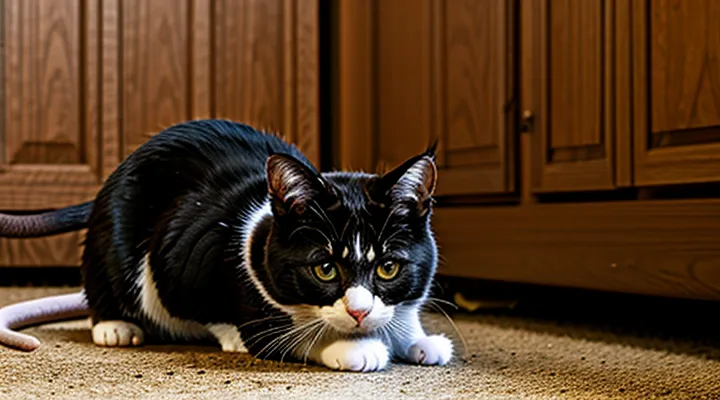
The Instinct to Hunt
Predatory Behavior in Domestic Cats
Domestic cats retain a hunting drive inherited from their wild ancestors. This drive manifests in a sequence of behaviors that include stalking, pouncing, and immobilizing small animals such as rodents. The sequence begins with visual detection; cats rely on acute motion perception to locate moving prey. Once identified, they adopt a low, crouched posture, minimizing body silhouette and reducing noise. A rapid acceleration follows, delivering a bite to the neck or spinal region, which typically results in immediate incapacitation.
After capture, many cats engage in a series of post‑kill actions:
- Killing bite – a precise bite to the throat or base of the skull.
- Shaking or tossing – a motion that may further disable the prey.
- Mouth handling – chewing or tearing, which varies among individuals.
Some domestic cats consume the prey, while others discard it. Consumption depends on factors such as hunger level, indoor versus outdoor lifestyle, and previous exposure to human-provided food. Studies show that well‑fed indoor cats still perform the hunting sequence, indicating that the behavior is driven by instinct rather than nutritional need.
Environmental influences shape the expression of predatory behavior. Outdoor access increases encounter rates with rodents, leading to higher kill frequencies. Conversely, indoor environments limit opportunities, often resulting in play behaviors that mimic hunting. Training and enrichment—such as interactive toys that simulate prey movement—can channel the instinct toward safe outlets, reducing accidental harm to real animals.
Overall, predatory behavior in domestic cats is a genetically programmed pattern that persists regardless of the animal’s diet or living conditions. The behavior includes detection, pursuit, kill, and optional consumption, with variations governed by individual experience and environmental context.
Genetic Roots of Hunting
Feline predatory behavior originates from a conserved set of genes that regulate neural circuits for stalking, pouncing, and capture. Comparative genomics reveals that domestic cats retain the same allelic variants found in wild species such as Felis silvestris and Felis lybica, which encode receptors for dopamine, serotonin, and vasopressin pathways linked to motivation and reward during hunting.
Key genetic components include:
- PRL‑related loci: Modulate visual processing and depth perception essential for tracking fast‑moving rodents.
- GRM5 and GRM7: Encode metabotropic glutamate receptors that enhance motor coordination and reflex speed.
- AVPR1A: Influences social attachment but also heightens arousal in response to moving prey silhouettes.
- MAOA polymorphisms: Adjust aggression thresholds, allowing swift transition from observation to attack.
Epigenetic studies demonstrate that early exposure to live prey triggers methylation changes in the FOXP2 promoter, reinforcing predatory instincts across generations. These modifications persist despite selective breeding for reduced aggression, indicating a robust genetic backbone that underlies the instinct to hunt mice.
Domestication has introduced alleles associated with reduced fear of humans, yet the core hunting circuitry remains active. Gene‑editing experiments in murine models confirm that disruption of PRL or GRM5 abolishes pursuit behavior, while restoration reestablishes the full predatory sequence. Consequently, the genetic architecture of feline hunting persists as a primary driver of prey capture, regardless of environmental conditioning.
Learned Behaviors and Mother Influence
Domestic and feral felines frequently encounter rodents, yet predation outcomes vary. Research shows that a cat’s decision to kill, consume, or abandon a mouse depends largely on behaviors acquired through experience rather than instinct alone.
- Kittens observe mother’s technique for stalking, pouncing, and immobilizing prey.
- Repeated exposure to live rodents refines motor patterns and timing.
- Successful captures reinforce the act, while failed attempts diminish future attempts.
Maternal influence extends beyond technique. Mother cats control the early diet of kittens, often providing pre‑killed prey before allowing independent hunting. This practice shapes dietary preferences and reduces the likelihood that an adult cat will ingest a captured mouse. Early habituation to handling dead rodents teaches kittens to release rather than eat live prey, a behavior that persists into adulthood.
Environmental factors intersect with learned habits. Cats raised in households with regular feeding schedules display lower motivation to consume captured rodents, whereas those reliant on hunting for sustenance exhibit higher consumption rates. Consequently, the prevalence of learned hunting skills and maternal teaching directly determines whether a cat will treat a mouse as food or simply as a target.
The Hunt: Stalking and Capturing Prey
Sensory Advantages: Sight, Sound, and Smell
Cats rely on a triad of acute senses to locate, capture, and ingest small rodents. Each modality contributes uniquely to the predator‑prey dynamic, ensuring efficient detection and rapid response.
Vision provides high‑contrast detection in low‑light environments. Felines possess a large number of rod cells, a reflective tapetum lucidum, and a wide field of view, allowing them to discern the rapid, erratic movements of mice even at dusk or dawn. Their ability to focus on motion rather than static objects reduces false alarms and directs attention precisely to potential prey.
Auditory sensitivity complements visual cues. Cats detect frequencies up to 64 kHz, far beyond human hearing. This range captures the faint rustle of a mouse’s footfalls and the subtle vibrations of its breathing. The pinna can rotate independently, pinpointing sound sources within a few degrees, which guides the cat’s approach path without visual confirmation.
Olfaction supplies a chemical map of the environment. The feline olfactory epithelium contains millions of receptors that identify mouse scent markers, urine trails, and pheromones. Smell persists where sight and sound are obstructed, such as under debris or within narrow burrows, enabling cats to locate hidden prey and assess its freshness before consumption.
The integration of these senses yields a coordinated hunting strategy:
- Rapid visual identification of motion in dim light.
- Precise auditory localization of subtle sounds.
- Chemical confirmation of prey presence and condition.
Together, these advantages increase capture success rates and influence the decision to eat the caught rodent. When sensory data indicate a viable, uninjured target, the cat proceeds to kill and ingest; if the prey appears diseased or compromised, the cat may release it, conserving energy for healthier meals. This sensory framework underpins the feline’s capacity to both hunt and consume mice.
Stalking Techniques
Cats employ a precise sequence of movements when targeting small rodents. The initial phase involves silent positioning, where the feline lowers its body, aligns the spine, and fixes the eyes on the prey. This posture minimizes visual and auditory cues, allowing the cat to remain undetected until the optimal moment.
The next stage is incremental advancement. Muscles contract in short, controlled bursts, producing a low‑amplitude gait known as the “step‑and‑pause” pattern. Each pause provides an opportunity to reassess distance and angle, ensuring the trajectory stays within striking range. The cat’s whiskers detect minute air currents, refining the path toward the mouse.
When the distance reaches approximately 30–50 cm, the cat initiates the final lunge. Hind limbs generate explosive force, while forepaws extend to grasp the target. Simultaneously, the tail stabilizes the body, preventing overshoot. The rapid closure of the jaws secures the prey before it can escape.
Key components of feline stalking include:
- Visual fixation on the target’s movement.
- Low‑profile body alignment to reduce silhouette.
- Incremental, pause‑based approach to maintain flexibility.
- Tactile feedback from whiskers for spatial accuracy.
- Tail‑mediated balance during the high‑speed strike.
The Kill Bite: Instinct and Precision
The kill bite represents the final phase of a cat’s predatory sequence, delivering a rapid, targeted strike to the prey’s vital structures. Muscular contraction in the jaw reaches peak force within milliseconds, concentrating pressure on the cervical vertebrae or spinal cord. This precision eliminates prolonged struggle, conserving energy and reducing the risk of injury from defensive movements.
Neurological control underlies the bite’s accuracy. Sensory receptors in the whiskers and facial skin map distance and angle, allowing the cat to adjust jaw placement in real time. Motor neurons synchronize the temporalis and masseter muscles, producing a bite force that can exceed 30 psi in domestic felines and surpass 100 psi in larger wild species.
Key anatomical features supporting the kill bite include:
- Skull morphology: A short, broad rostrum provides leverage; the sagittal crest anchors strong temporalis muscles.
- Dental arrangement: Canines are elongated and curved, optimized for puncturing soft tissue and penetrating bone.
- Mandibular joint: A hinge‑type articulation permits swift opening and closing, enhancing strike speed.
Behaviorally, the bite follows a sequence of stalking, pouncing, and immobilization. Once the mouse is secured, the cat applies a single, decisive bite to the neck or spine, instantly disrupting neural transmission. Evidence from high‑speed video analysis shows that the bite duration rarely exceeds 0.05 seconds, confirming the efficiency of the action.
The kill bite also influences post‑capture handling. By incapacitating the prey rapidly, the cat minimizes exposure to potential parasites and reduces the need for prolonged chewing, which can be energetically costly. Consequently, the bite serves both as a lethal mechanism and as a preparatory step for consumption when the cat chooses to eat the captured mouse.
To Eat or Not to Eat: Factors Influencing Consumption
Hunger and Nutritional Needs
Cats experience a physiological drive to secure energy and nutrients, which translates into hunting behavior toward small rodents. The act of capturing and consuming a mouse directly addresses the animal’s caloric requirement and supplies essential dietary components.
Protein constitutes the primary macronutrient for felines; a mouse provides roughly 20 %–25 % protein by weight, delivering the amino acids necessary for muscle maintenance and tissue repair. Fat supplies a concentrated energy source, with a typical mouse containing 5 %–10 % lipid material rich in omega‑6 and omega‑3 fatty acids.
Essential micronutrients are also present in prey. A mouse delivers:
- Taurine, an obligate amino acid for cardiac and retinal health.
- Arginine, critical for ammonia detoxification.
- Vitamin A, required for vision and immune function.
- B‑complex vitamins, supporting metabolic pathways.
- Minerals such as calcium, phosphorus, and iron, contributing to skeletal integrity and oxygen transport.
When hunger persists, the instinct to chase rodents intensifies, ensuring that the cat’s intake meets the aforementioned nutritional profile. Commercial diets aim to replicate these values, but live prey remains a biologically complete source of the nutrients cats evolved to depend upon.
Prey Size and Digestibility
Feline predators encounter a wide range of prey dimensions, from tiny insects to medium‑sized rodents. The size of a captured animal directly influences the cat’s decision to ingest, partially swallow, or abandon the kill. Small prey, such as house mice weighing 15–25 g, fit comfortably within a cat’s oral cavity, allowing complete consumption without excessive chewing. Larger rodents, including rats up to 300 g, often exceed the gape limit, prompting cats to bite off manageable sections or discard indigestible parts.
Digestibility depends on tissue composition. Muscle and organ flesh contain high protein and fat levels, which cats metabolize efficiently. Bone, cartilage, and fur present lower digestibility; excessive skeletal material can cause gastrointestinal obstruction. Cats possess strong gastric acids capable of breaking down soft tissues within 12–24 hours, but mineralized structures require prolonged exposure and may remain partially intact in feces.
Key factors that determine whether a cat will fully eat a captured rodent:
- Prey mass relative to cat size – prey exceeding 10 % of the cat’s body weight is often partially consumed.
- Proportion of edible soft tissue – high muscle‑to‑bone ratio increases likelihood of complete ingestion.
- Presence of defensive spines or thick fur – may deter consumption due to increased handling time.
- Nutritional state of the cat – well‑fed individuals may reject surplus or difficult prey, while hungry cats are more inclined to attempt full consumption.
Overall, prey size sets mechanical limits on ingestion, while tissue composition governs digestive efficiency. Cats preferentially consume portions that maximize nutrient intake and minimize risk of blockage or injury.
Environmental Factors
Environmental conditions shape feline predation on rodents. Urban settings limit hunting opportunities; dense human activity reduces mouse visibility and increases reliance on commercial food. Rural and semi‑wild areas provide abundant prey, encouraging natural hunting behavior.
Seasonal temperature fluctuations affect metabolic demand. Cold periods elevate energy requirements, prompting cats to consume more captured mice. Warm months lower demand, often resulting in reduced consumption despite successful captures.
Prey density directly influences predation rates. High mouse populations increase encounter frequency, leading to higher ingestion rates. Sparse populations lower encounter frequency, causing cats to abandon hunting in favor of stored food.
Habitat complexity determines hunting success. Dense vegetation, litter, and underground burrows protect mice, decreasing capture likelihood. Open spaces with minimal cover facilitate stalking and capture.
Human-provided nutrition modifies dietary choices. Regular feeding of dry or wet food satisfies caloric needs, diminishing motivation to kill and eat rodents. In households where food is scarce, cats revert to opportunistic hunting.
Health status impacts predatory behavior. Illness or injury reduces agility, lowering capture success and subsequent consumption. Conversely, healthy individuals exhibit higher hunting efficiency.
These factors interact, producing variable outcomes in feline predation on mice across different environments.
Learned Preferences and Aversions
Domestic cats exhibit variable responses to rodent prey that extend beyond instinctual drive. Repeated encounters shape attraction or avoidance through associative learning, reinforcement, and sensory conditioning.
Positive reinforcement occurs when successful capture yields nutritional reward, sharpening predatory focus on specific mouse species. Observation of conspecifics hunting can transmit technique and target selection, allowing inexperienced individuals to adopt established preferences. Sensory cues—sound of movement, scent of urine, or visual pattern of fur coloration—become salient predictors of edible prey after repeated validation.
Factors influencing learned preferences include:
- Frequency of successful captures of a particular rodent type
- Presence of human-provided food that reduces reliance on hunting
- Early exposure to specific prey during kittenhood
- Genetic predisposition toward certain hunting styles
Aversions develop when encounters produce negative outcomes. Painful injuries from defensive rodents, unpalatable taste, or conditioning through human intervention (e.g., punishment for hunting) generate avoidance. Chronic exposure to rodent‑borne parasites can also suppress interest, as physiological feedback discourages further pursuit.
Understanding these learned behaviors assists caretakers in managing indoor cats, reducing unwanted predation, and informing conservation strategies that mitigate impact on wild rodent populations.
The «Play» Aspect of Predation
Cats often engage with small rodents in a manner that resembles play, yet the behavior serves multiple functions beyond mere entertainment. The sequence typically begins with a cautious approach, followed by a series of pounces, pauses, and gentle bites that allow the predator to assess the prey’s movements and reflexes. These actions are repeated even when the prey is not immediately lethal, indicating a learning process embedded in the predatory routine.
Observations of domestic and wild felines reveal consistent patterns:
- Repeated stalking and pouncing without immediate consumption.
- Use of forepaws to bat, toss, or immobilize the mouse.
- Brief periods of restraint interspersed with release, allowing the prey to recover briefly.
- Gradual escalation of bite force as the cat refines its grip.
These patterns correspond with neurological studies that link play-like predation to the development of motor skills and sensory integration. Dopaminergic pathways activate during the chase, reinforcing successful capture techniques while preserving the prey’s life long enough to provide feedback on escape strategies. This feedback loop enhances hunting efficiency in future encounters.
The “play” component also influences social dynamics within feline groups. Juvenile cats that practice with live rodents acquire proficiency faster than those restricted to artificial toys. Adult cats that retain playful predation may exhibit reduced aggression toward conspecifics, as the outlet for instinctual drive is satisfied through controlled interactions with prey.
In summary, the playful aspect of feline predation operates as a training mechanism, a neurological reward system, and a social regulator, all of which contribute to the predator’s overall competence without necessarily resulting in immediate consumption.
The Role of Prey in a Cat’s Diet
Wild Felines vs. Domestic Cats
Felines possess a highly developed predatory system that drives them to capture small mammals, including rodents. Wild species such as the European wildcat, the African lynx, and the bobcat routinely hunt mice as part of their natural diet. Domestic cats retain the same anatomical and neurological mechanisms, but their hunting behavior is moderated by human-provided food and indoor confinement.
- Hunting drive – Wild felids exhibit constant foraging activity; domestic cats display intermittent bursts of predation, especially when allowed outdoors.
- Diet composition – In the wild, rodents can constitute up to 30 % of caloric intake; in owned cats, mouse consumption typically accounts for less than 5 % of total nutrition.
- Environmental exposure – Wild habitats provide abundant, unsheltered prey; domestic environments limit encounter rates, though garden access raises capture frequency.
- Prey handling – Both groups employ a bite to the neck, yet wild cats often kill larger prey with a single strike, whereas domestic cats may play with smaller mice before killing.
- Impact on rodent populations – Wild felids contribute significantly to local mouse mortality; domestic cats affect suburban mouse numbers modestly, with the effect varying by outdoor access.
Overall, the instinct to seize rodents persists across all felids, but the magnitude of consumption diverges sharply between free‑ranging predators and housebound companions.
Nutritional Value of Mice and Other Small Prey
Mice supply domestic cats with a compact source of protein, fat, and essential micronutrients. A typical adult house mouse (≈20 g) contains approximately 70 % water, 20 % protein, 5 % fat, and 5 % ash, delivering about 100 kcal per specimen. The protein profile includes all nine essential amino acids, notably taurine, which felines cannot synthesize in sufficient quantities. Fatty acids are primarily composed of linoleic and arachidonic acids, both required for skin health and visual function. Minerals such as calcium, phosphorus, magnesium, and trace elements (iron, zinc, copper) are present in proportions that support skeletal development and enzymatic activity.
Other small prey contribute comparable but variable nutrient packages:
- Field voles: higher fat content (≈8 % of body mass), providing additional energy reserves.
- Songbirds: richer in polyunsaturated fatty acids, especially omega‑3 DHA, beneficial for neural development.
- Insects (e.g., crickets): abundant chitin, which offers dietary fiber and stimulates gastrointestinal motility; also contain vitamin B12 and high‑quality protein.
Overall, the caloric density of these prey items ranges from 90 to 130 kcal per 20‑gram portion, aligning with the average daily energy requirement of an adult indoor cat (≈200–250 kcal). The combined macronutrient and micronutrient profile of mice and similar organisms satisfies the dietary needs of obligate carnivores without supplemental formulations, provided the prey is free from parasites and environmental contaminants.
Risks Associated with Consuming Prey
Cats that capture and ingest rodents expose themselves to several health hazards. Pathogens commonly carried by mice include Salmonella, E. coli, and Campylobacter; ingestion can trigger gastrointestinal upset or systemic infection. Parasites such as Toxoplasma gondii, tapeworms (Taenia spp.), and rodent‑borne fleas may transfer to the feline host, leading to chronic illness, anemia, or allergic reactions.
Rodent prey can also contain environmental toxins. Pesticide residues, heavy metals, and rodent‑specific anticoagulants persist in tissue and may accumulate in a cat’s system, potentially causing hepatic or renal dysfunction. Physical injury is another concern: sharp bones or teeth can damage the cat’s oral cavity, esophagus, or gastrointestinal tract, resulting in perforation or obstruction.
Nutritional considerations further affect risk. Wild prey provides protein but lacks balanced micronutrients; reliance on occasional rodent meals may produce deficiencies in taurine, vitamin A, or essential fatty acids, compromising vision, immune response, and coat health.
Key risks summarized:
- Bacterial and viral infections (e.g., Salmonella, Toxoplasma)
- Internal parasites and ectoparasites
- Toxicant exposure (pesticides, heavy metals, rodent poisons)
- Mechanical injury from bones or teeth
- Nutritional imbalance when prey constitutes a primary food source
Veterinary guidance recommends regular deworming, vaccination, and monitoring for signs of illness after a cat consumes a rodent. Preventive measures reduce the probability of severe health outcomes associated with this natural behavior.
Human Intervention and Its Impact
Feeding Practices and Their Effect on Hunting
Domestic cats exhibit a wide range of feeding regimens, each influencing their propensity to hunt rodents. When cats receive balanced, protein‑rich commercial diets, they tend to display reduced hunting drive because nutritional needs are satisfied without the need for active prey capture. Conversely, diets that are low in protein or lack appropriate texture can increase motivation to seek live prey, as the animal attempts to compensate for deficiencies.
Feeding frequency also shapes hunting behavior. Cats offered multiple small meals throughout the day experience steadier blood glucose levels, which correlates with fewer spontaneous hunting episodes. In contrast, cats fed once daily often experience hunger peaks that trigger predatory instincts during periods of inactivity.
Environmental enrichment interacts with diet to modify predation rates. Providing toys that simulate prey movement, scratching posts, and elevated perches can channel predatory energy into play rather than actual capture. When enrichment is absent, even well‑fed cats may resort to hunting as a form of stimulation.
Key effects of feeding practices on rodent predation:
- High‑protein, moisture‑rich diets → lower hunting frequency.
- Infrequent or calorie‑restricted feeding → increased drive to capture prey.
- Lack of environmental enrichment → higher likelihood of actual killing.
- Regular, measured feeding schedules → stable behavior, reduced predatory incidents.
Owners seeking to minimize rodent casualties should prioritize nutritionally complete meals, distribute food in several portions, and incorporate enrichment devices that satisfy the cat’s instinctual hunting sequence without resulting in live capture.
Pest Control and Cat-Prey Dynamics
Domestic felines serve as natural regulators of rodent populations, reducing the need for chemical interventions in residential and agricultural settings. Their predatory instincts trigger hunting behavior that often results in the capture and consumption of mice, thereby limiting reproductive cycles and colony expansion.
The effectiveness of cats as biological control agents depends on several variables:
- Age and health of the cat, which influence hunting proficiency.
- Availability of alternative food sources; well‑fed cats may hunt less frequently.
- Environmental complexity, such as shelter density, which affects rodent concealment.
- Species of rodent; smaller, more agile mice present a higher challenge than larger pest species.
Research indicates that free‑roaming cats contribute to measurable declines in local mouse densities, yet the impact varies with regional ecosystem dynamics. In densely populated urban areas, cat predation can suppress outbreaks that would otherwise require pesticide application.
Integrating felines into pest‑management plans requires careful assessment of animal welfare, potential wildlife conflicts, and local regulations. When managed responsibly, cat predation offers a cost‑effective, environmentally benign component of comprehensive rodent control strategies.
Understanding and Managing Predatory Behavior
Cats exhibit innate predatory instincts that drive them to chase, capture, and often kill small rodents. This behavior stems from evolutionary pressures that shaped hunting skills for survival and is expressed even in well‑fed domestic cats. The act of killing does not always result in consumption; many felines release prey after a brief encounter.
Understanding the biological drivers behind feline predation helps owners differentiate between instinctual hunting and aggression. Key factors include visual motion detection, auditory cues, and the cat’s play drive, all of which trigger the predatory sequence: stalk, pounce, bite, and kill. Hormonal fluctuations, particularly during mating season, can intensify these responses.
Effective management reduces unwanted kills while respecting the cat’s nature. Strategies include:
- Providing regular interactive play sessions using wand toys to satisfy hunting urges.
- Offering puzzle feeders that mimic prey capture and encourage problem‑solving.
- Installing physical barriers, such as window screens and cat‑proof fences, to limit outdoor access.
- Using scent deterrents (e.g., citrus or commercial repellents) around areas where rodents are present.
- Training with positive reinforcement to redirect attention from live prey to toys.
Monitoring a cat’s behavior and adjusting environmental enrichment can lower predation rates without compromising the animal’s wellbeing.