
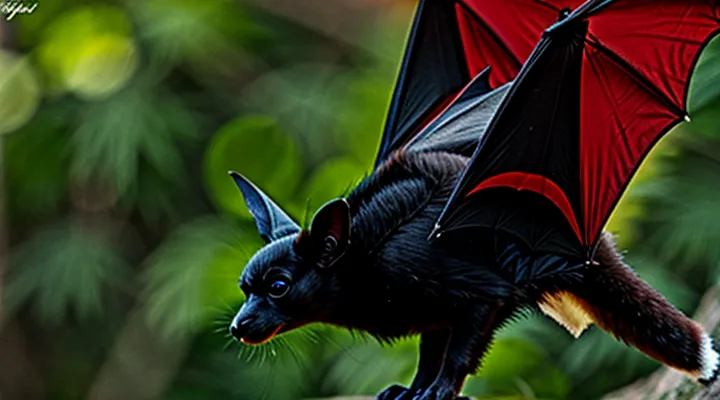
Diversity of Bat Species
Megabats (Fruit Bats)
Megabats, commonly called fruit bats, belong to the family Pteropodidae and represent the largest extant bats. Their wingspan ranges from 30 cm in small species to over 1.5 m in the giant golden‑crowned flying fox, making them the most visually striking members of chiropteran diversity. Unlike many insect‑eating relatives, megabats rely on a diet of ripe fruit, nectar, and pollen, which influences their facial morphology, dentition, and eye development.
These mammals exhibit a keen sense of sight and color perception, traits reflected in high‑resolution photographs that capture vivid fur patterns and distinctive facial markings. Their nocturnal foraging behavior often results in images taken at twilight, when the contrast between illuminated eyes and dark wing membranes is most pronounced.
- « Pteropus vampyrus » – giant flying fox; Southeast Asian rainforests; dark brown fur with a light‑colored head; photographs emphasize its expansive wingspan.
- « Rousettus aegyptiacus » – Egyptian fruit bat; North African savannas and caves; reddish‑brown coat; images highlight its rounded ears and short muzzle.
- « Eidolon helvum » – straw‑colored fruit bat; sub‑Saharan Africa; pale gray‑brown fur; visual records often show large colonies roosting on trees.
- « Pteralopex pulchra » – New Caledonia blossom bat; endemic to New Caledonia; glossy black fur with a metallic sheen; photography focuses on its sleek silhouette.
- « Hypsignathus monstrosus » – hammerhead bat; Central African wetlands; striking facial crest resembling a hammer; pictures capture its unique cranial structure.
Conservation assessments indicate that habitat loss, hunting, and disease pose significant risks to many megabat populations. Protection measures include the establishment of forest reserves, regulation of hunting quotas, and monitoring of viral spillover potential. High‑quality visual documentation supports identification, public awareness, and scientific research, reinforcing the role of imagery in preserving these large‑bodied pollinators and seed dispersers.
Microbats (Echolocating Bats)
Microbats represent the majority of bat diversity, characterized by small body size and sophisticated echolocation abilities. These mammals emit ultrasonic pulses, receive the returning echoes, and construct three‑dimensional representations of their surroundings to locate prey and avoid obstacles.
Echolocation operates at frequencies ranging from 20 kHz to 150 kHz, allowing detection of insects as small as a few millimeters. Pulse duration and repetition rate adjust dynamically according to flight speed and target distance, providing precise ranging and target discrimination.
Prominent groups within this assemblage include:
- «Myotis» species, such as the greater mouse‑eared bat, noted for high‑frequency calls and temperate‑zone distribution.
- «Pipistrellus» species, exemplified by the common pipistrelle, which occupies urban and rural habitats across Europe and Asia.
- «Rhinolophus» species, the horseshoe bats, distinguished by a noseleaf structure that focuses emitted sound.
- «Eptesicus» species, including the serotine bat, which favors open woodland and roosts in buildings.
- «Nyctalus» species, the noctule bats, recognized for long migratory movements and high‑altitude foraging.
Geographically, microbats inhabit all continents except Antarctica, occupying forests, caves, deserts, and anthropogenic structures. Seasonal migrations occur in temperate regions, while tropical species often display year‑round activity.
Conservation assessments reveal that habitat loss, pesticide exposure, and wind‑energy development threaten numerous microbat populations. International agreements and national protection measures target roost preservation, pesticide regulation, and impact mitigation at wind‑farm sites to sustain these ecologically essential insect predators.
Notable Bat Species
Vampire Bats
Vampire bats belong to the subfamily Desmodontinae within the leaf‑nose bat family. Their defining characteristic is exclusive hematophagy, feeding on the blood of mammals and birds.
- Common vampire bat (Desmodus rotundus) – widespread in Central and South America.
- Hairy‑legged vampire bat (Diaemus youngi) – inhabits humid lowland forests of Central America and northern South America.
- White‑winged vampire bat (Diaemus spp.) – restricted to the Amazon basin and adjacent regions.
Geographic range extends from southern Mexico through the Caribbean to northern Argentina. Roosting sites include caves, hollow trees, and human structures; colonies may number from a few individuals to several hundred.
Sensory adaptations comprise infrared‑detecting pits on the nose, enabling precise location of warm‑blooded hosts. Saliva contains the anticoagulant desmoteplase, preventing clotting during feeding.
Reproduction follows a delayed‑fertilization pattern. Females store sperm after mating, ovulate once annually, and typically give birth to a single offspring after a gestation of 190 days. Pups receive extensive maternal care for up to three months.
Population trends show decline in fragmented habitats and regions with intensive pesticide use. Conservation measures emphasize protection of roost sites, monitoring of disease transmission, and regulation of hunting pressures.
Pallid Bat
The «Pallid Bat» (scientific name «Antrozous pallidus») belongs to the family Vespertilionidae and is the sole species of its genus.
Adult individuals exhibit a robust build, wingspan ranging from 30 to 38 cm, and a distinctive pale gray‑brown pelage that contrasts with darker facial markings. The ears are large, rounded, and equipped with a well‑developed tragus, facilitating precise echolocation.
Geographic distribution extends across the southwestern United States, northern Mexico, and isolated populations in the Great Basin. Preferred habitats include arid deserts, chaparral, and rocky canyons where suitable roosting sites—such as caves, abandoned mines, and hollow trees—are available.
Feeding behavior is insectivorous; the bat captures moths, beetles, and orthopterans during crepuscular and nocturnal foraging flights. Flight patterns are agile, allowing pursuit of prey close to the ground.
Conservation assessment classifies the species as Least Concern, yet localized threats—habitat fragmentation, disturbance of roost sites, and pesticide exposure—warrant monitoring.
Key facts:
- Taxonomy: «Antrozous pallidus», family Vespertilionidae
- Size: wingspan 30–38 cm, weight 15–30 g
- Range: southwestern U.S., northern Mexico, Great Basin
- Habitat: deserts, chaparral, rocky outcrops, caves
- Diet: nocturnal insects, primarily moths and beetles
- Status: Least Concern, potential regional pressures
Greater Horseshoe Bat
The Greater Horseshoe Bat (Rhinolophus ferrumequinum) is a medium‑sized European bat distinguished by a prominent horseshoe‑shaped noseleaf that aids in echolocation. Its fur ranges from brown to gray, with a lighter underside and a wingspan of 30–35 cm. The species inhabits a variety of environments, including deciduous forests, agricultural landscapes, and limestone caves, where colonies roost in crevices or abandoned structures.
Key characteristics:
- Noseleaf: complex, forward‑projecting structure facilitating precise ultrasonic calls.
- Size: head‑body length 5.5–7.5 cm; weight 15–30 g.
- Diet: primarily insects such as moths, beetles, and flies captured in open air.
- Distribution: widespread across Europe, extending into parts of North Africa and western Asia.
Conservation status is listed as “Least Concern” by the IUCN, yet regional populations face pressures from habitat loss, pesticide use, and disturbance of roost sites. Effective measures include protecting wintering caves, preserving foraging habitats, and monitoring colony health through acoustic surveys.
Photographic documentation typically emphasizes:
- Close‑up of the noseleaf for species identification.
- Full‑body images displaying dorsal coloration and wing morphology.
- Habitat shots illustrating roosting sites within caves or old buildings.
Accurate identification relies on morphological details and acoustic signatures, both essential for research, monitoring, and public awareness of this distinctive bat species.
Common Pipistrelle
The Common Pipistrelle, scientific name Pipistrellus pipistrellus, belongs to the family Vespertilionidae and is one of the most widely distributed European bats.
Physical characteristics include a fore‑arm length of 30–38 mm, a wingspan of 190–250 mm, and a body mass of 3–8 g. Dorsal fur ranges from brown‑gray to reddish‑brown, while ventral fur is lighter. The tragus is short and pointed, a feature that distinguishes it from closely related species.
Geographic range extends from the British Isles and Scandinavia to the Mediterranean basin, eastward through the Balkans to western Siberia. Preferred roosts are crevices in buildings, tree cavities, and bat boxes. Urban environments are regularly inhabited, with colonies often found in attics and bridges.
Key aspects of ecology:
- Echolocation calls peak at 45 kHz, enabling detection of small insects in cluttered habitats.
- Diet consists primarily of dipterans, moths, and small beetles captured during continuous foraging flights at dusk.
- Breeding occurs in spring; females give birth to a single pup after a gestation period of 50–60 days.
The International Union for Conservation of Nature classifies the species as Least Concern, reflecting its stable population trend. Primary threats include habitat loss due to building renovations, pesticide exposure, and disturbance of roost sites. Conservation measures focus on preserving roosting structures, installing bat boxes, and monitoring population dynamics through acoustic surveys.
Flying Foxes
Flying foxes belong to the genus Pteropus, the largest group of megabats. They are classified within the family Pteropodidae, order Chiroptera, and exhibit a distinctive head‑and‑neck morphology that separates them from microbats.
These mammals inhabit tropical and subtropical regions of Africa, Asia, Australia, and numerous Pacific islands. Their distribution extends from the rainforests of Southeast Asia to the savannas of East Africa, reflecting adaptability to diverse habitats.
Body size ranges from a wingspan of 0.8 m in smaller species to over 1.5 m in the giant flying fox. Fur coloration varies from dark brown to gray, while a characteristic facial mask of lighter fur accentuates the eyes. Wing membranes are thin, enabling sustained, efficient flight.
Diet consists primarily of ripe fruit, nectar, and pollen. Consumption of figs, mangoes, and banana blossoms facilitates seed dispersal and pollination across extensive distances, linking forest regeneration processes.
Reproduction follows a seasonal pattern; females typically give birth to a single offspring after a gestation period of four to six months. Pups are nursed for up to twelve weeks, during which they cling to the mother’s fur.
Many populations face habitat loss, hunting pressure, and disease outbreaks such as white‑nose syndrome. Conservation assessments list several species as vulnerable or endangered, prompting protective legislation and habitat restoration initiatives.
Prominent flying‑fox species, frequently featured in photographic collections, include:
- «Pteropus giganteus» – Indian flying fox
- «Pteropus vampyrus» – large flying fox
- «Pteropus poliocephalus» – grey‑headed flying fox
- «Pteropus niger» – Mauritian flying fox
- «Pteropus alecto» – black‑flying fox
Each entry is accompanied by high‑resolution images that illustrate distinctive morphological traits and regional habitats.
Bat Habitats and Distribution
Global Distribution Patterns
Bats occupy every continent except Antarctica, inhabiting a range of ecosystems from tropical rainforests to arid deserts. Their presence correlates with climate stability, insect abundance, and availability of roosting sites such as caves, tree hollows, and human structures.
- Africa: high species richness in equatorial forests; several megabats dominate savanna and woodland edges.
- Asia: extensive diversity in Southeast Asian islands; temperate zones host numerous insectivorous species.
- Americas: Neotropical regions contain the greatest number of species; North America supports both migratory and resident populations.
- Oceania: limited to islands with suitable limestone formations; many endemics exhibit island-specific adaptations.
- Europe: primarily temperate insectivores; southern peninsulas host Mediterranean specialists.
Tropical zones concentrate the majority of bat taxa, reflecting the correlation between warm temperatures and year‑round prey availability. Temperate regions exhibit seasonal migration, with species moving to lower latitudes during winter months. High‑altitude environments support a reduced but distinct assemblage adapted to cooler temperatures and reduced oxygen levels.
Distribution is shaped by climatic gradients, vegetation type, and the spatial arrangement of roosting habitats. Anthropogenic alterations—deforestation, urban expansion, and cave disturbance—modify traditional patterns, often leading to range contraction or local extirpation.
Understanding global distribution informs conservation planning, guiding the allocation of resources toward biodiversity hotspots and critical roosting sites. Effective management requires integration of habitat preservation, climate resilience strategies, and monitoring of population trends across all regions.
Preferred Habitats
Bats exhibit distinct habitat preferences that aid in accurate identification and visual documentation. Understanding where each species commonly roosts or forages enhances the utility of photographic records and naming conventions.
Typical environments include caves, tree hollows, abandoned structures, and water‑adjacent foliage. Preference often aligns with climatic conditions, prey availability, and roost protection.
- «Caves and mines» – species such as the greater horseshoe bat and the common bent‑wing rely on stable temperature and darkness.
- «Tree cavities and bark crevices» – the brown long‑eared bat and the European free‑tailed bat favor mature forests with abundant deadwood.
- «Attics, bridges, and tunnels» – the common pipistrelle and the noctule adapt to urban and suburban settings, exploiting artificial roosts.
- «Water‑bordering vegetation» – the barbastelle and the pond bat select riparian zones where insects concentrate.
Selection criteria encompass microclimate stability, predator avoidance, and proximity to feeding grounds. Species with high roost fidelity may demonstrate limited geographic range, whereas generalist bats exploit diverse structures, reflecting ecological flexibility.
Bat Conservation Status
Threats to Bat Populations
Bats face a range of pressures that reduce population sizes and hinder recovery. Habitat loss, driven by urban expansion, agricultural conversion, and deforestation, removes roosting sites and foraging grounds essential for survival. Climate change alters insect availability and disrupts migration patterns, increasing mortality during extreme weather events.
Key threats include:
- Deforestation and land‑use change eliminating natural roosts and feeding areas.
- Wind‑energy installations causing fatal collisions, particularly for migratory species.
- Pesticide exposure reducing prey abundance and inducing toxic effects.
- White‑nose syndrome, a fungal disease spreading across continents and causing rapid colony declines.
- Disturbance of caves and mines through tourism, vandalism, or mining activities, leading to abandonment of critical hibernacula.
Effective mitigation requires coordinated conservation actions, such as protecting roosting habitats, regulating pesticide application, monitoring disease spread, and implementing wildlife‑friendly turbine designs.
Conservation Efforts
Photographic documentation and precise identification of bat taxa provide essential data for conservation programs. High‑resolution images paired with validated scientific names enable accurate population assessments, habitat suitability modeling, and detection of cryptic species.
Conservation actions rely on several coordinated measures:
- Protection of roosting sites through legal designations and physical barriers.
- Long‑term monitoring using standardized visual and acoustic surveys.
- Community outreach that distributes identification guides and encourages citizen reporting.
- Enforcement of regulations that limit disturbance of foraging habitats and control pesticide use.
- Research initiatives that investigate disease dynamics, genetic diversity, and climate resilience.
The availability of verified photographs accelerates field verification, reduces misidentification, and supports rapid response to emerging threats. Consistent nomenclature across databases ensures interoperability among regional and global monitoring networks.
International partnerships, such as the Bat Conservation International coalition and the European Bat Conservation Network, allocate funding for equipment, training, and habitat restoration. Collaborative projects frequently publish findings in open‑access repositories, facilitating knowledge transfer to policymakers and land managers.
«Effective conservation depends on the integration of visual records and taxonomic clarity to safeguard bat diversity worldwide».
Fascinating Bat Adaptations
Echolocation Explained
Echolocation is a biological sonar system used by most bat families to navigate, locate prey, and differentiate among habitats. Sound pulses generated in the larynx travel through the nasal or oral openings, then reflect off objects. The returning echoes are processed by the auditory cortex, allowing precise distance and size estimation.
Key characteristics of bat echolocation:
- Frequency range typically spans 20 kHz to 200 kHz, varying by species and hunting strategy.
- Pulse duration ranges from 1 ms in open‑space foragers to 5 ms in cluttered environments.
- Call structure includes a steep frequency‑modulated (FM) component for fine resolution and a constant‑frequency (CF) component for detecting motion.
The acoustic profile of each species serves as an identifier, complementing visual records. Photographic archives paired with call libraries enable accurate classification, especially for cryptic species lacking distinctive markings. Researchers compare recorded call parameters with reference databases to confirm species identity, reducing reliance on physical capture.
Environmental factors influence call design. Open‑air hunters emit high‑intensity, narrow‑band calls to maximize range, whereas forest dwellers produce broadband, low‑intensity calls to avoid clutter. Seasonal shifts may cause temporary alterations in call frequency, reflecting changes in prey availability and ambient temperature.
Understanding echolocation mechanisms supports conservation efforts. Monitoring acoustic activity provides population trends without disturbing roosting sites. Integration of sound analysis with visual documentation creates a comprehensive resource for taxonomic studies and public education.
Unique Wing Structures
Bats exhibit a remarkable diversity of wing constructions that directly influence flight performance, ecological niche, and foraging strategy. The wing consists of a thin membrane (patagium) stretched over elongated forearm bones, with additional extensions covering the hind limbs and tail. Variation in the shape, size, and attachment points of the membrane creates distinct aerodynamic profiles.
Key structural adaptations include:
- Narrow, elongated wings – found in species such as the Mexican free‑tailed bat, these wings provide high aspect ratios, enabling rapid, sustained flight in open airspace.
- Broad, short wings – characteristic of many forest‑dwelling bats, the increased surface area enhances lift at low speeds, facilitating agile maneuvering among dense vegetation.
- Leaf‑shaped membranes – present in certain nectar‑feeding bats, the expanded distal portion forms a flap that generates lift while hovering, supporting precise feeding on flowers.
- Reduced or absent tail membranes – observed in some insectivorous bats, this modification improves aerial agility by reducing drag during rapid turns.
Morphological differences extend to the digit count and length. Species with elongated fourth and fifth fingers achieve greater wing span, while those with shorter digits present compact wing geometry. The presence of a calcar, a cartilaginous spur supporting the tail membrane, varies among taxa, influencing stability during flight.
Photographic documentation paired with scientific nomenclature highlights these adaptations, allowing visual comparison across families. Accurate identification of wing traits contributes to taxonomic classification, ecological research, and conservation planning.