
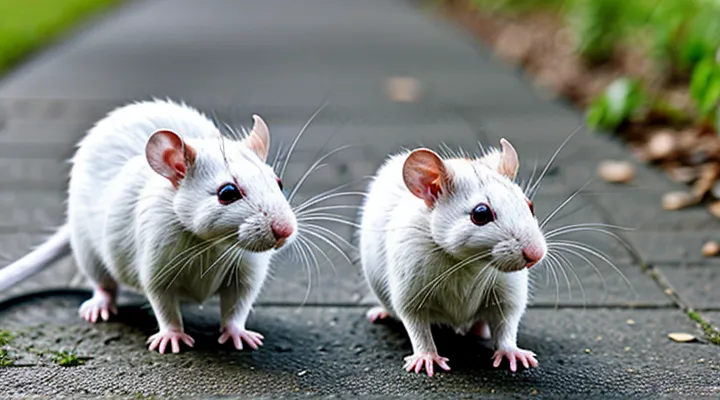
The Distinctive Appearance: Albino Rats
Genetic Basis of Albinism
Albinism in mammals originates from disruptions in melanin synthesis pathways. The primary genetic cause is loss‑of‑function mutations in the TYR gene, which encodes tyrosinase, the enzyme that catalyzes the first steps of pigment production. Additional contributors include OCA2, TYRP1, and SLC45A2, each affecting melanosome maturation or substrate transport. When any of these genes is non‑functional, melanocytes cannot produce sufficient melanin, resulting in white fur and pink‑to‑red ocular tissue.
In laboratory rats, the albino phenotype frequently displays vivid red eyes because the lack of pigment in the iris allows blood vessels to show through. This visual characteristic fuels a longstanding belief that such animals are blind. Genetic evidence disproves the notion: albino rodents retain functional retinal circuitry, but the absence of retinal pigment epithelium reduces light absorption, leading to heightened photophobia and impaired visual acuity. The reduced visual performance stems from developmental anomalies rather than complete loss of sight.
Key genetic points:
- TYR mutations: most common cause; often nonsense or frameshift variants.
- OCA2 variants: influence melanosomal pH, modulating residual pigmentation.
- TYRP1 and SLC45A2: affect enzymatic stability and melanosomal transport.
- Homozygous recessive inheritance: both alleles must carry pathogenic variants for the albino phenotype to manifest.
Understanding the molecular basis clarifies why white rats with red eyes are not universally blind, but experience specific visual deficits linked to pigment deficiency. This insight separates myth from measurable genetic and physiological effects.
Pigmentation and Eye Color Explained
Pigmentation determines the color of fur and ocular media in rodents. Melanin, the primary pigment, is synthesized by melanocytes through a biochemical cascade involving tyrosinase. Reduced melanin production yields a white coat, while residual pigment in the iris can appear as a vivid red hue because the underlying blood vessels become visible through the translucent iris tissue.
Eye color in mammals reflects the amount and distribution of melanin in the iris stroma and the anterior layer of the eye. The following factors influence this appearance:
- Melanin concentration: High levels produce brown or black irises; low levels result in amber, blue, or red eyes.
- Genetic mutations: Alleles that impair melanogenesis (e.g., albinism) reduce pigment throughout the body, including the eye.
- Structural transparency: In the absence of pigment, the iris permits light transmission, revealing the choroidal blood supply and creating a reddish tint.
- Species‑specific ocular anatomy: Certain rodents possess a thin, lightly pigmented iris that accentuates the red coloration when overall melanin is scarce.
The myth linking albino rats with red eyes to blindness stems from a misunderstanding of visual function. Vision relies on retinal photoreceptors, optic nerve integrity, and cortical processing, not solely on iris pigmentation. Albino rodents often exhibit normal visual acuity; however, they may display heightened light sensitivity due to the lack of ocular pigment that normally absorbs stray photons. This photophobia can be mistaken for impaired sight, reinforcing the legend.
In summary, white fur combined with red eyes results from diminished melanin and anatomical transparency, while visual capability remains largely independent of iris coloration.
The Common Misconception: Blindness
Understanding Rodent Vision
Rodents possess a visual system adapted to low‑light environments. Their retinas contain a high proportion of rod cells, which provide sensitivity to dim illumination but limit the ability to resolve fine detail. Cone cells are present in smaller numbers, granting limited color discrimination, primarily in the short‑wavelength (blue‑green) range.
The characteristic red glow observed in albino rats results from a reflective layer behind the retina, known as the tapetum lucidum. Light that passes through the photoreceptor layer is reflected back, increasing photon capture and producing the red appearance when illuminated. This anatomical feature does not indicate an absence of sight.
Behavioral studies demonstrate that white laboratory rats navigate mazes, avoid obstacles, and respond to visual cues similarly to pigmented strains. Tests measuring optokinetic responses reveal tracking of moving patterns, confirming functional vision. Electrophysiological recordings show normal retinal activity when exposed to light stimuli.
Key points about rodent vision:
- High rod density → strong scotopic (night) vision.
- Limited cone density → reduced visual acuity and color range.
- Tapetum lucidum → enhanced light sensitivity, responsible for red eye shine.
- Empirical evidence → albino rats exhibit normal visual behaviors and neural responses.
Consequently, the belief that albino rats with red eyes are blind lacks scientific support. Their visual capacity, though different from that of diurnal mammals, is sufficient for typical environmental interactions and experimental tasks.
Adaptation of Albino Rodents to Light
Albino rodents, often depicted as white rats with striking red irises, are frequently assumed to be blind. Scientific observation confirms functional vision, yet the absence of melanin forces distinct physiological adjustments.
The lack of ocular pigment reduces light absorption in the retina, causing increased photon scatter. To compensate, albino specimens exhibit:
- Elevated rod photoreceptor density, enhancing sensitivity to low‑intensity illumination.
- Enlarged pupils that remain dilated for extended periods, maximizing retinal exposure.
- Thicker outer nuclear layer, providing additional photoreceptor support.
Behaviorally, these animals demonstrate consistent avoidance of bright environments. Activity peaks during twilight or under artificial dim lighting, reducing retinal stress while exploiting their heightened scotopic acuity. Shelter selection favors shadowed burrows and densely vegetated zones, reinforcing exposure control.
From an evolutionary perspective, the genetic mutation responsible for albinism persists despite visual drawbacks because it co‑occurs with traits such as reduced predation visibility and altered thermoregulation. The trade‑off between pigment loss and visual adaptation illustrates a stable equilibrium within populations that occupy nocturnal or subterranean niches.
The Science Behind Red Eyes
Absence of Pigment in the Iris
The striking red eyes of albino laboratory rats result from a complete lack of melanin in the iris. Without pigment, light penetrates the posterior chamber and reflects off the highly vascularized retina, producing the characteristic blood‑red appearance. This optical phenomenon is often misinterpreted as an indicator of visual impairment, yet numerous studies confirm that albino rats retain functional photoreceptor pathways comparable to pigmented strains.
Genetically, albinism arises from mutations in the tyrosinase gene, which halts melanin synthesis during embryonic development. The resulting hypopigmented ocular structures include the iris, retinal pigment epithelium, and choroid. Although reduced retinal pigment can increase light scattering and susceptibility to photic damage, visual acuity tests (optokinetic tracking, visual water maze) demonstrate that albino rats perform similarly to pigmented controls when housed under controlled lighting.
The myth linking red‑eyed albino rats to blindness persists because the red coloration visually suggests an abnormal condition. In reality, the absence of iris pigment merely alters eye coloration and light transmission; it does not inherently compromise the neural circuitry required for sight. Proper experimental design—ensuring adequate illumination and protecting against retinal overstimulation—prevents any functional deficits that might otherwise be attributed to pigment loss.
Visibility of Retinal Blood Vessels
White rats that exhibit red irises lack ocular pigment, which makes the underlying retinal vasculature readily observable through the pupil. The absence of melanin in the choroid and retinal pigment epithelium reduces light absorption, allowing blood vessels to appear as distinct red lines against the transparent fundus. This optical property does not impair visual function; electrophysiological tests confirm normal retinal responses in these animals.
The visibility of retinal vessels serves as a reliable indicator of pigment deficiency rather than a sign of sensory loss. Comparative studies show that pigmented strains conceal vasculature behind melanin layers, while albino strains expose the same structures without compromising acuity. Genetic knockout models that eliminate melanin synthesis produce identical ocular appearances, confirming the direct link between pigment absence and vessel exposure.
Key points:
- Red-eyed rats lack melanin in ocular tissues.
- Transparent fundus reveals retinal blood vessels.
- Visual performance remains within normal ranges, as measured by optokinetic and electroretinographic assessments.
Impact of Albinism on Rat Behavior and Health
Light Sensitivity and Photophobia
Light sensitivity, or photophobia, describes an abnormal discomfort or pain triggered by visual stimuli that would not affect a typical visual system. In albino rodents possessing a pronounced red ocular hue, the condition arises from the absence of melanin in the retinal pigment epithelium, which normally absorbs excess photons and reduces stray light scatter. Without this protective pigment, incoming light reaches photoreceptor cells with increased intensity, overwhelming neural processing pathways and producing a sharp aversive response.
Physiological studies demonstrate that the retinal ganglion cells of these animals exhibit heightened firing rates when exposed to luminance levels as low as 5 cd/m², a threshold far below that of pigmented counterparts. The overexposure leads to rapid adaptation, causing temporary visual blur and, in extreme cases, retinal stress that manifests as involuntary squinting or head withdrawal. The observed behaviors include:
- Immediate cessation of locomotion upon illumination rise.
- Preference for dimly lit or shaded environments.
- Reduced exploratory activity during daylight cycles.
Behavioral assays confirm that the animals do not lack visual perception; instead, they actively avoid bright conditions to mitigate discomfort. This avoidance pattern fuels the common misconception that the red-eyed phenotype equates to blindness. The myth persists because the animals’ reluctance to engage with illuminated spaces mimics an inability to see, while objective measurements reveal intact visual acuity under controlled low‑light settings.
Consequently, the legend surrounding these red‑eyed white rodents misinterprets photophobia for total visual loss. Understanding the underlying photic hypersensitivity clarifies that the animals retain functional vision, albeit constrained by an exaggerated response to light intensity.
Behavioral Adjustments in Albino Rats
Albino rats, characterized by a white coat and pink‑red irises, are frequently linked to a misconception that they are blind. Empirical studies demonstrate that visual acuity in these animals is comparable to pigmented strains; the myth arises from the pronounced retinal pigmentation loss, not from functional blindness.
The loss of pigmentation triggers compensatory enhancements in non‑visual senses. Tactile exploration through whisker contact intensifies, allowing precise surface discrimination. Olfactory sensitivity increases, facilitating odor‑guided foraging and social interaction. Auditory processing shows heightened threshold detection, supporting spatial orientation in low‑light environments.
Locomotor patterns reflect reliance on somatosensory input. Albino rats exhibit slower initial movement when introduced to novel arenas, followed by increased wall‑following behavior (thigmotaxis) to maintain constant whisker contact. Turning angles become more acute, and path curvature tightens, indicating precise edge detection through vibrissae.
Learning tasks reveal adaptation to sensory constraints. In maze experiments, albino subjects achieve comparable success rates to pigmented controls when navigation cues are odor‑based rather than visual. Memory retention improves when reward locations are paired with distinctive scents, underscoring the shift toward olfactory cue integration.
Key behavioral adjustments:
- Enhanced whisker‑mediated tactile exploration
- Elevated olfactory discrimination thresholds
- Improved auditory detection of low‑frequency sounds
- Increased thigmotactic navigation in unfamiliar spaces
- Preference for odor‑guided learning over visual cues
These modifications illustrate the plasticity of albino rats’ sensory and motor systems, providing a factual basis that counters the prevailing myth of inherent blindness.
Breeding and Care of Albino Rats
Historical Significance in Research
The legend concerning white rodents with crimson eyes and alleged blindness emerged in early 20th‑century laboratory reports. Researchers documented an unusual ocular phenotype that was mistakenly linked to visual impairment. Contemporary accounts attributed the red irises to a genetic mutation, yet misinterpreted the lack of visual testing as evidence of blindness. This misconception shaped experimental design, prompting investigators to avoid using the strain for vision studies and to focus on genetics and pigmentation instead.
Historical records show that the myth influenced funding allocations. Grants earmarked for sensory research were redirected toward molecular analyses of melanin pathways. The resulting data clarified the genetic basis of the red‑eye trait, disproving the blindness claim and establishing the strain as a valuable model for pigment biology. The episode also highlighted the need for rigorous phenotypic verification before drawing functional conclusions.
Key outcomes of the episode include:
- Standardization of ocular assessment protocols in rodent colonies.
- Integration of the strain into studies of neurodevelopmental disorders unrelated to vision.
- Revision of textbook entries to reflect accurate phenotype–function relationships.
The episode serves as a cautionary example for modern investigators, illustrating how anecdotal observations can divert scientific inquiry and affect resource distribution.
Specific Care Requirements
White rats exhibiting red irises are often linked to a persistent legend that they are blind. Scientific observation confirms normal visual function; however, their distinctive pigmentation demands precise husbandry to prevent stress and health complications.
- Provide a balanced diet rich in protein (20‑25 % of calories) and low in simple sugars; supplement with fresh vegetables and occasional fruit.
- Maintain ambient lighting at 300–500 lux, avoiding direct glare that can cause ocular irritation.
- House each animal in a solid‑bottom cage with a minimum floor space of 0.5 m²; include nesting material and a dark retreat to mimic natural hiding spots.
- Monitor coat condition weekly; any whitening or patchy fur may signal nutritional deficiency or dermatological issues.
- Conduct quarterly ophthalmic examinations to verify clear corneas and retinal health, documenting pupil response and lens clarity.
- Limit handling sessions to 5‑10 minutes, using gentle restraint to reduce stress‑induced cataract risk.
- Ensure ventilation rates of at least 15 air changes per hour; stale air contributes to respiratory infections that can affect ocular tissues.
Adhering to these protocols supports the well‑being of red‑eyed albino rats and dispels misconceptions about their sight.
Dispelling Other Myths About Albino Animals
Albinism Across Species
Albinism is a hereditary disorder characterized by the absence or severe reduction of melanin in skin, hair, and ocular tissues. The condition appears in mammals, birds, reptiles, amphibians, and fish, demonstrating a broad phylogenetic distribution.
Ocular manifestations include hypopigmented irises that appear red or pink due to visible blood vessels, and a lack of pigment in the retinal pigment epithelium. These features cause heightened sensitivity to light, involuntary eye movements, and, in some cases, diminished visual acuity. The degree of impairment varies widely among individuals and species.
- Mammals: Albino rats and mice display red irises and may experience photophobia, yet most retain functional vision sufficient for navigation and foraging.
- Birds: Albino pigeons exhibit pinkish eyes and can fly competently, though they avoid bright environments.
- Reptiles: Albino corn snakes show translucent eyes; studies report normal hunting behavior despite increased glare.
- Amphibians: Albino frogs possess red eyes and demonstrate standard predator‑avoidance responses.
- Fish: Albino zebrafish have clear eyes and maintain normal schooling patterns, with only modest reductions in contrast detection.
The legend that white rats with crimson eyes are blind stems from the conspicuous eye coloration and the animals’ tendency to seek darkness. Empirical observations contradict this narrative: most albino rodents demonstrate adequate visual performance, though they prefer dim lighting to mitigate discomfort.
Consequently, albinism across taxa does not equate to total loss of sight. The myth of blind, red‑eyed rodents reflects a superficial interpretation of ocular pigmentation rather than a universal physiological outcome.
Evolutionary Perspectives on Albinism
Albinism, defined by the absence of melanin pigment, occurs across vertebrates and invertebrates. In mammals, the mutation typically disrupts the TYR gene, halting the enzymatic conversion of tyrosine to melanin. The resulting lack of coloration produces white fur and pink or red ocular tissue, a phenotype that underlies the popular belief that albino rodents are blind.
From an evolutionary standpoint, albinism presents both disadvantages and occasional advantages. The primary costs include heightened susceptibility to ultraviolet radiation, reduced camouflage, and visual impairments stemming from abnormal retinal development. These factors generally lower survival rates in natural habitats where predation and environmental exposure are intense.
Conversely, certain conditions can mitigate the fitness loss:
- Low‑light environments – reduced reliance on visual cues lessens the impact of retinal defects.
- Human‑mediated settings – laboratory colonies and pet trade provide protection from predators and UV exposure.
- Genetic drift – small, isolated populations may fix the albino allele despite its deleterious effects.
The myth linking white, red‑eyed rats to blindness persists because albino individuals exhibit diminished visual acuity, yet they retain functional vision sufficient for navigation and foraging. Evolutionary analysis clarifies that while albinism compromises specific adaptive traits, it does not universally render the animal blind, and its prevalence in captive populations reflects artificial selection rather than natural advantage.