
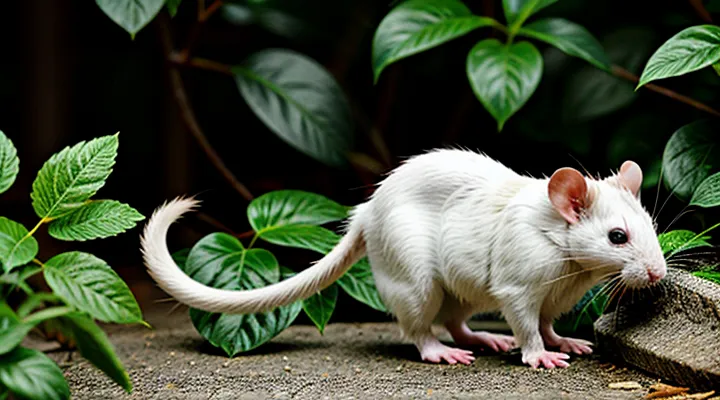
The Allure of Unique White Rat Coats
Beyond the Common: Why Rare Colorations Matter
Genetics Behind Uncommon Traits
Rare coat coloration in laboratory white rats is documented through high‑resolution imagery that captures phenotypes far beyond the standard albino appearance. These photographs provide visual evidence for underlying genetic variations that produce atypical pigmentation patterns.
The most common deviation from the classic albino phenotype results from loss‑of‑function mutations in the tyrosinase gene (TYR). Tyrosinase catalyzes the first step of melanin synthesis; its inactivity eliminates eumelanin and pheomelanin, yielding a pure white coat. Additional rare phenotypes arise from mutations that affect melanin transport, distribution, or synthesis:
- KIT – mutations disrupt melanocyte migration, producing piebald patches.
- MITF – alterations impair melanocyte development, leading to leucistic individuals with reduced pigment but retained eye color.
- MC1R – variants shift melanin type toward pheomelanin, generating reddish or cream‑toned fur.
- SLC45A2 and OCA2 – partial loss of function yields diluted pigmentation and mottled patterns.
Inheritance follows Mendelian principles. Autosomal recessive alleles, such as those in TYR, require homozygosity for phenotype expression, while some KIT and MITF mutations display incomplete dominance, producing graded patch sizes across generations. Homozygous carriers of recessive alleles often appear phenotypically normal but serve as reservoirs for rare coloration when paired.
Breeding programs exploit these genetic mechanisms to generate and maintain lines with distinct pigment traits. Controlled matings between carriers allow researchers to predict offspring phenotypes, verify genotype‑phenotype correlations, and assess penetrance under varied environmental conditions.
Understanding the genetic architecture of uncommon coat colors enhances the utility of white rats as model organisms. Distinct pigmentation markers facilitate individual identification, reduce handling errors, and provide visual cues for studying gene expression, developmental pathways, and disease models linked to melanocyte biology.
The Role of Breeders in Developing Novel Hues
Breeders identify spontaneous pigment mutations in white laboratory rats through systematic observation of litters and detailed photographic records. When a novel hue appears, they isolate the affected individuals, confirm heritability by breeding them with standard‑colored mates, and document the phenotypic outcome across generations.
The breeding program proceeds with controlled matings that maximize the expression of the desired coloration while preserving overall health. Techniques include:
- Pairing carriers of recessive alleles to increase homozygosity.
- Implementing backcrosses to eliminate unwanted traits.
- Monitoring offspring for consistency of the new pigment pattern.
Data collected from each generation—photographs, genetic markers, and health assessments—are compiled into a reference archive. This archive supports researchers seeking models for dermatological studies, genetic counseling, and comparative biology.
Collaboration with academic institutions ensures that novel color strains are validated, ethically sourced, and made available for scientific use under standardized conditions.
Exploring Extraordinary White Rat Colorations
«Albino»: More Than Just White
Red-Eyed Whites (REW)
Red‑Eyed Whites (REW) are a distinct color morph of laboratory white rats, characterized by a pink or albino‑type coat combined with striking ruby‑red irises. The phenotype results from a homozygous mutation in the r allele, which blocks melanin synthesis in the retinal pigment epithelium while leaving the coat depigmented. Because the mutation is recessive, REW individuals appear only when both parents carry the allele, making the morph relatively uncommon in commercial colonies.
Photographic documentation of REW rats requires attention to lighting and background contrast. The red iris reflects light differently from the typical black or pink eyes of standard albinos, producing a vivid focal point that can be lost in overexposed images. Recommended practices include:
- Use soft, diffused lighting to minimize glare on the cornea.
- Position a neutral gray or black backdrop to accentuate the red eyes against the pale fur.
- Capture images at a shutter speed of 1/125 s or faster to prevent motion blur, as REW rats are often more active when startled.
- Employ a macro lens with a minimum focal length of 90 mm to render fine details of the iris and whisker pattern.
Breeders maintain REW lines through carefully controlled matings. A typical breeding scheme involves:
- Selecting carrier (heterozygous) individuals from a larger white‑rat population.
- Pairing carriers to produce litters with an expected 25 % REW offspring, based on Mendelian inheritance.
- Identifying REW pups at three weeks of age by iris coloration, then separating them to preserve line purity.
The rarity of REW rats contributes to their demand among researchers studying ocular genetics and among hobbyists seeking unique visual subjects. High‑resolution photographs serve both scientific documentation and educational outreach, illustrating the phenotypic expression of the r mutation and providing reference material for identification in mixed colonies.
Pink-Eyed Whites (PEW)
Pink‑Eyed Whites (PEW) represent a distinct phenotype among laboratory and hobbyist white rats, characterized by a pure white coat and vivid pink irises. The pink eye results from the complete lack of melanin in the retinal pigment epithelium, a condition linked to the recessive c (albino) allele combined with the h (hypopigmentation) modifier. This genetic configuration eliminates melanin production throughout the body, producing the stark contrast that makes PEW individuals a focal point for photographic documentation of uncommon coloration.
The visual impact of PEW subjects stems from several factors. First, the absence of pigment permits unobstructed illumination of facial features, enhancing texture detail in high‑resolution images. Second, the pink iris reflects a broader spectrum of light than the typical red‑brown eyes of standard albinos, creating a unique chromatic effect under controlled lighting. Third, the uniform coat eliminates background noise in macro photography, allowing emphasis on skeletal structure and whisker arrangement.
Breeders prioritize three objectives when producing PEW specimens:
- Maintain homozygosity for the c allele while introducing the h modifier to ensure consistent pink‑eye expression.
- Avoid inbreeding coefficients above 0.125 to reduce the incidence of hereditary defects associated with extreme depigmentation.
- Document lineage with pedigree charts that record each generation’s phenotypic outcome, facilitating reproducibility.
Photographers capture PEW rats using the following technical guidelines:
- Employ diffused softbox lighting at 5,500 K to highlight the translucency of the coat without causing glare on the iris.
- Set aperture between f/2.8 and f/4 to achieve shallow depth of field, isolating the eyes as the focal point.
- Use a macro lens with a minimum 1:1 reproduction ratio; supplement with focus stacking software to retain sharpness across the entire skull profile.
Health considerations specific to PEW individuals include increased sensitivity to ultraviolet exposure due to the lack of ocular melanin, necessitating filtered lighting during handling and imaging. Auditory and olfactory functions remain typical; however, routine ophthalmic examinations are recommended to monitor for corneal dryness and cataract formation, conditions more prevalent in fully depigmented rodents.
Overall, Pink‑Eyed Whites provide a rare visual subject for scientific illustration and artistic photography, embodying a convergence of genetics, aesthetic appeal, and precise imaging methodology.
Non-Albino White Varieties
«Himalayan» and «Siamese»: Temperature-Sensitive Pigmentation
Photographic documentation of white laboratory rats occasionally reveals coat patterns that deviate from the standard albino appearance. Two such patterns—commonly referred to as “Himalayan” and “Siamese”—exhibit pigmentation that depends on temperature.
The underlying mechanism is a single‑gene mutation affecting the enzyme tyrosinase, which catalyzes melanin synthesis. The mutant enzyme retains activity only at temperatures below approximately 30 °C; at higher core temperatures it denatures, preventing pigment formation.
Resulting phenotype:
- Dark pigmentation appears on extremities (ears, nose, tail, paws) where surface temperature falls below the enzyme’s functional threshold.
- The remainder of the body remains white because internal temperature exceeds the threshold.
- In colder environments, the pigmented areas expand, producing a deeper, more extensive coloration.
Ambient temperature directly modulates the expression of these points. Raising a rat in a cool room intensifies the dark areas, while a warm environment reduces or eliminates them. This temperature sensitivity permits experimental manipulation of coat color by adjusting housing conditions.
For breeders and researchers, the traits serve as visual markers of genotype. They enable rapid identification of carriers, facilitate controlled mating schemes, and provide a model for studying thermolabile enzymes and pigment disorders in mammals.
«Dalmatian» and «Patched»: Distinctive Markings
White rats exhibiting atypical coat coloration attract attention from geneticists and breeders because they reveal the expression of rare pigment genes. Two patterns dominate the visual record: the “Dalmatian” type and the “Patched” type.
The Dalmatian pattern consists of a white base coat overlaid with numerous, evenly spaced black or dark brown spots. Spot size ranges from a few millimeters to several centimeters, and the distribution follows a random yet balanced arrangement across the body, limbs, and tail. The phenotype results from a dominant allele that interferes with melanin suppression, allowing pigment cells to develop in isolated clusters. Breeding records show a Mendelian inheritance ratio of approximately 3:1 when a heterozygous carrier mates with a normal white rat.
The Patched pattern presents a white background interrupted by irregularly shaped, solid patches of color. Patches may appear on the dorsal surface, flanks, or hindquarters, often merging to form larger colored areas. This phenotype is linked to a recessive mutation that reduces the activity of the agouti signaling protein, causing localized melanin production. Homozygous individuals display the full patchwork, while heterozygotes typically retain the plain white coat.
Key distinctions:
- Spot regularity: Dalmatian – discrete, round spots; Patched – amorphous, contiguous patches.
- Genetic control: Dalmatian – dominant allele; Patched – recessive mutation.
- Inheritance ratio: Dalmatian – 3:1 (dominant); Patched – 1:4 (recessive homozygote).
Photographic documentation underscores the rarity of both patterns in laboratory and pet populations, providing valuable material for studies of coat‑color genetics and selective breeding strategies.
Extremely Rare and Emerging Colorations
«Shadow»: The Elusive Grayish-White
The gray‑white morph known as “Shadow” appears in laboratory white rats as a subtle dilution of the typical albino coat. Pigmentation studies link the trait to a hypomorphic allele of the Tyrosinase gene, which reduces melanin synthesis without eliminating it entirely. The resulting fur exhibits a uniform, light‑gray hue with occasional faint, off‑white patches on the ventral surface.
Distinctive visual markers include:
- A consistent silvery sheen across the dorsal fur
- Slightly darker shading along the whisker pads and ear edges
- Minimal contrast between the hair shaft and the underlying skin, giving a matte appearance
Photographic capture of “Shadow” demands controlled lighting to avoid overexposure of the low‑contrast coat. Soft, diffused illumination paired with a neutral background enhances the visibility of the subtle gray tone. Macro lenses set at low aperture values reveal the fine texture of the fur, while a color‑balanced white balance preserves the true hue.
Breeding records show that the phenotype emerges in less than 0.5 % of colonies maintained for standard albino strains. The low incidence reflects both the rarity of the underlying mutation and selective pressures favoring the classic white phenotype in research settings. Documentation of “Shadow” specimens contributes valuable data for genetic mapping projects and expands the visual archive of uncommon rat coloration.
Experimental and Future Color Mutations
The documentation of atypical pigment patterns in laboratory rodents provides a visual foundation for experimental approaches aimed at expanding the color palette of these animals. High‑resolution imagery captures phenotypic outcomes of targeted genetic modifications, serving as a reference for researchers designing new mutation strategies.
Current experiments rely on precise genome‑editing tools, selective breeding, and chemical mutagenesis. Key techniques include:
- CRISPR‑Cas9 insertion of melanogenesis genes from other species, producing novel hues such as teal or amber.
- Knock‑out of the tyrosinase gene combined with transgenic expression of pigment‑synthesizing enzymes, yielding translucent or iridescent coats.
- Application of epigenetic modifiers to alter expression levels of existing pigment pathways, generating gradient or mottled patterns.
Future directions anticipate the creation of customizable color schemes through multiplexed editing, enabling simultaneous manipulation of multiple pigment genes. Predictive modeling will guide the selection of gene combinations that produce stable, non‑deleterious phenotypes. Integration of synthetic biology platforms may introduce entirely new pigment molecules, expanding the visual spectrum beyond naturally occurring rodent colors.