
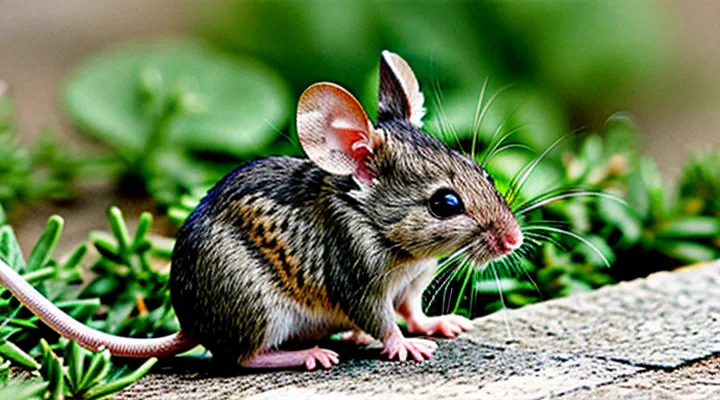
General Appearance and Size
Body Shape and Proportions
Head and Snout Characteristics
The head of a mouse is compact, rounded, and proportionally large relative to its body. The skull exhibits a smooth contour without pronounced crests, supporting a short, blunt snout that tapers slightly toward the tip. Eyes are positioned laterally, providing a wide field of vision; they are small, dark, and lack eyelids. Ears are prominent, hair‑free, and sit on the upper sides of the head, each measuring roughly one‑third of the head’s length.
Key features of the snout and surrounding structures include:
- Nasal region: a short, triangular muzzle with a soft, pinkish skin surface; the tip houses the nostrils, which are small and widely spaced.
- Vibrissae: long, stiff whiskers emerging from the rostral side of the snout; they are highly sensitive and arranged in organized rows.
- Mouth: a modestly sized oral opening equipped with sharp incisors that extend forward beyond the upper lip.
- Dental formula: one pair of upper and lower incisors, continuously growing and coated with enamel on the front surface.
The overall configuration of head and snout enables precise tactile sensing, efficient foraging, and rapid response to environmental cues.
Tail: Length and Covering
Mice possess tails that vary in proportion to body size, typically extending from 75 % to 110 % of the head‑body length. In common house mice (Mus musculus), the tail measures approximately 7–10 cm, while larger species such as the deer mouse (Peromyscus maniculatus) can reach 12–15 cm. The length provides balance during rapid locomotion and assists in thermoregulation.
The external surface of the tail is covered by a sparse layer of fine hairs interspersed with specialized epidermal cells. The hairs are shorter and less dense than the dorsal fur, creating a smooth, slightly glossy appearance. Beneath the hair layer, the skin displays a thin, keratinized epidermis that lacks the thick, protective scales found in reptiles. The ventral side often exhibits a lighter coloration, reflecting reduced pigmentation in the underlying tissue.
Key characteristics:
- Length: 75–110 % of body length; 7–15 cm across common species.
- Covering: Sparse, fine hairs; thin keratinized epidermis; smooth texture.
- Function: Enhances agility, aids heat dissipation, supports sensory perception through vibrissal receptors at the tip.
Fur: Color and Texture
Common Color Variations
Mice exhibit a limited but distinct palette of coat colors that aid identification and reflect genetic lineage. The most frequently encountered hues include:
- White – often associated with laboratory strains; pure, unpigmented fur.
- Brown – ranging from light tan to deep chocolate; common in wild populations.
- Black – solid, glossy pelage; less prevalent but observable in certain breeds.
- Gray – medium to dark shades; typical of many field mice.
- Agouti – mixed pattern of light and dark hairs forming a banded appearance; characteristic of many wild species.
- Spotted or piebald – irregular patches of contrasting colors; result of specific genetic mutations.
Geographic distribution influences the prevalence of each variant; for example, brown and agouti coats dominate in temperate regions, while white and black appear more often in controlled breeding environments. The underlying genetics involve alleles at loci such as C (color), A (agouti), and P (piebald), which interact to produce the observed spectrum. Understanding these color patterns enhances species identification and informs research on hereditary traits.
Distinctive Markings
Mice display a range of markings that aid identification and differentiate species. The dorsal surface typically bears a uniform coat, but many individuals possess a darker stripe running along the spine, known as a dorsal stripe. Ventral fur is lighter, often white or pale gray, providing contrast with the back. Ear edges may feature small patches of pigment, and the whisker pads frequently exhibit a subtle mottling. Tail coloration varies; some mice have a uniformly pale tail, while others show a darker band near the tip.
Common distinctive markings include:
- Dorsal stripe, ranging from faint gray to pronounced black
- Ventral pallor, usually white or light gray
- Ear spot, a small dark patch on the outer rim
- Tail band, a darker segment toward the distal end
- Facial mask, a darker area surrounding the eyes and nose in certain species
These characteristics remain consistent across adult specimens, with minor variation due to age, habitat, and genetic lineage.
Sensory Organs
Eyes: Size and Placement
Mice possess relatively large eyes for their head size, typically measuring 4–6 mm in diameter. The ocular globes sit laterally on the skull, positioned near the front of the head but offset toward the sides, granting a wide field of vision that exceeds 200 degrees horizontally. This lateral placement creates a small binocular overlap of approximately 30–40 degrees, sufficient for depth perception during foraging and navigation.
Key characteristics of mouse eyes include:
- Size proportion: Eye diameter accounts for roughly 15 % of skull width.
- Placement: Eyes are set forward of the mid‑line, aligned with the nasal bones, and slightly above the cheekbones.
- Orientation: The visual axes are angled outward, maximizing peripheral detection of predators.
- Adaptation: Large, laterally placed eyes enhance low‑light sensitivity, supporting nocturnal activity.
Overall, the combination of modest eye size and strategic lateral positioning equips mice with a broad visual panorama while preserving enough binocular vision for precise handling of objects and obstacles.
Ears: Shape and Mobility
Mouse ears are small, rounded structures positioned laterally on the skull, typically measuring 5–7 mm in length for adult house mice. The outer surface, covered by fine fur, forms a smooth, convex contour that tapers slightly toward the base. The cartilage framework gives the ear its resilience, allowing it to maintain shape while remaining flexible.
Mobility is achieved through three paired muscles—anterior, posterior, and superior auricular muscles—that attach to the ear cartilage. Contraction of these muscles can rotate the ear up to 90 degrees, enabling rapid orientation toward acoustic stimuli. This movement occurs without shifting the skull, preserving the mouse’s balance during locomotion.
Key functional attributes of mouse ears include:
- Acoustic funneling: The cup‑shaped pinna directs sound waves toward the external auditory canal, enhancing sensitivity to high‑frequency tones.
- Thermoregulation: Rich vascular networks within the ear tissue dissipate heat, contributing to body temperature control.
- Communication: Ear positioning conveys social signals; flattened ears often indicate aggression, while erect ears suggest alertness.
Whiskers: Function and Arrangement
Whiskers, or vibrissae, are specialized tactile hairs that extend the mouse’s sensory field beyond its body. Each whisker is anchored in a deep follicle richly supplied with nerves, allowing rapid transmission of mechanical stimuli to the central nervous system.
Functionally, whiskers serve three primary purposes:
- Detecting airflow and subtle pressure changes, which informs navigation in dark or confined spaces.
- Mapping surface textures and object contours during exploration or foraging.
- Assisting in spatial orientation by providing distance measurements to obstacles and prey.
Arrangement follows a precise pattern. On the head, four symmetrical rows—external, internal, supranasal, and genal—run forward from the nose toward the cheeks. Each row contains whiskers of increasing length from posterior to anterior, creating a staggered grid that maximizes coverage. Additional vibrissae appear on the upper lip (mystacial), the eyebrows (supraorbital), and the body, though these are shorter and fewer in number. This organized distribution ensures that a mouse can construct a detailed three‑dimensional representation of its environment with minimal visual input.
Limbs and Movement
Paws: Structure and Digits
A mouse’s fore and hind paws are compact, fur‑covered structures adapted for climbing, digging, and manipulating food. The pads consist of a central plantar surface surrounded by a thin layer of keratinized skin that provides traction on smooth surfaces. Muscles and tendons attach directly to the metacarpal and metatarsal bones, allowing precise movement of each digit.
- Five digits on each forepaw, four on each hind paw.
- Digits terminate in sharp, curved ungual phalanges that function as miniature claws.
- Each digit is supported by a single phalangeal bone except the thumb (forelimb) and big toe (hindlimb), which possess two.
- Digital pads contain dense sensory receptors that detect texture and vibration.
- Tendon sheaths run along the underside of each digit, enabling rapid retraction and extension during locomotion.
The overall arrangement provides a balance of strength and dexterity, essential for navigating narrow passages and handling objects as small as seeds.
Gait and Agility
Mice move with a rapid, alternating quadrupedal gait that maximizes speed and maneuverability. Each fore‑ and hind‑foot contacts the ground in a precise sequence, producing a stride frequency of 10–12 steps per second. The resulting locomotion enables bursts of 6–8 mph over short distances, sufficient to outrun many predators.
The animal’s elongated body and flexible spine allow extreme torsional motion. This flexibility permits tight turns within a radius of a few centimeters, essential for navigating cluttered environments. Muscular control of the tail provides dynamic balance; the tail acts as a counter‑weight, stabilizing the mouse during rapid acceleration, abrupt stops, and vertical climbing.
Key anatomical features that support agility include:
- Plantigrade foot pads with dense, abrasive keratin, providing traction on varied surfaces.
- Long, slender digits equipped with retractable claws, facilitating grip on smooth or uneven substrates.
- Reduced limb inertia, allowing swift limb repositioning without excessive energy expenditure.
- Highly responsive proprioceptive feedback, mediated by abundant mechanoreceptors in the whiskers and foot pads, enabling immediate adjustment to obstacles.
Collectively, these characteristics produce a gait that is both swift and adaptable, allowing mice to exploit narrow burrows, climb vertical structures, and maintain stability while executing complex, rapid movements.
Variations Among Species
House Mouse (Mus musculus)
The house mouse (Mus musculus) is a small rodent measuring 6–10 cm in head‑body length, with a tail roughly equal to or slightly longer than the body. Adults weigh between 12 and 30 g, exhibiting a compact, streamlined form adapted for rapid movement through narrow spaces.
Fur is short, dense, and typically ranges from light brown to gray, occasionally displaying a pinkish hue on the ventral surface. The dorsal coat may contain a faint dorsal stripe, while the underbelly remains pale. Ears are large relative to skull size, thin, and hairless, providing acute auditory perception. Whiskers (vibrissae) are long, stiff, and positioned symmetrically on the snout, serving as tactile sensors.
Key external characteristics:
- Head: Rounded with a pointed snout, small eyes, and a pair of prominent, hair‑free ears.
- Limbs: Four legs with five toes on the forefeet and four on the hind feet; digits end in sharp, curved claws for climbing and digging.
- Tail: Bare, scaly, and flexible; length typically 7–12 cm, aiding balance during agile locomotion.
- Fur coloration: Dorsal brown‑gray, ventral pale; occasional albino individuals exhibit white fur, pink eyes, and a pink tail.
Skeleton structure is lightweight yet robust, featuring a flexible spine that permits swift, serpentine motion. The overall morphology enables the house mouse to thrive in diverse habitats, from human dwellings to agricultural fields.
Deer Mouse (Peromyscus maniculatus)
The deer mouse (Peromyscus maniculatus) is a small rodent measuring 7–10 cm in body length, with a tail nearly equal to or slightly longer than the body. Weight ranges from 10 to 30 g, reflecting seasonal variation and age.
- Fur: soft, dense, gray‑brown on the dorsal side, transitioning to a lighter, often white, ventral surface.
- Tail: bicolored, dark dorsally and paler ventrally; sparsely haired, providing balance during arboreal movement.
- Ears: rounded, proportionally large, covered with fine hair; coloration matches dorsal fur.
- Eyes: relatively large, dark, positioned laterally for a wide field of view.
- Feet: elongated, equipped with five toes on each hind foot, each bearing a small claw; pads are hairless, enhancing grip on vegetation and bark.
The skull exhibits a narrow rostrum and well‑developed auditory bullae, supporting acute hearing. Dental formula is 1.0.0.3/1.0.0.3, with sharp incisors adapted for gnawing seeds and insects. Seasonal pelage changes may darken in winter, providing camouflage against snow‑covered habitats. Overall, the deer mouse’s morphology balances terrestrial foraging with occasional climbing, reflected in its streamlined body, agile tail, and sensory adaptations.
Other Notable Species
Mice possess a compact body, pointed snout, large ears, and a hair‑covered tail. Several other small mammals share similar traits yet display distinct physical variations that merit attention.
- Hamster – Body length ranges from 8 to 18 cm; stocky build with a rounded back, short tail concealed by fur, cheek pouches extending to the shoulders, and prominent, thickened cheek muscles. Fur colors include golden, brown, and black.
- Gerbil – Length of 10–15 cm; slender torso, long hind legs adapted for jumping, a tail that tapers to a point and often features a tuft of hair. Ears are proportionally larger than those of a mouse, and coloration varies from sand‑gray to reddish‑brown.
- Vole – Size between 6 and 12 cm; robust neck, short tail barely visible beyond the fur, and a blunt, rounded nose. Fur is dense, typically brown or gray, and the hind feet are shorter than those of a mouse, reducing leaping ability.
- Field mouse (Apodemus) – Body measures 7–10 cm; tail longer than the head‑body length, covered in sparse hair. Ears are relatively large, and the dorsal coat displays a mix of brown, black, and reddish tones, while the ventral side remains pale.
- Shrew – Length of 5–10 cm; elongated snout, reduced eyes, and a tail that may be hairless or sparsely haired. Fur is uniformly dark, and the skull exhibits a high degree of dentition specialization for insect consumption.
Each species presents a unique combination of size, tail morphology, ear proportion, and fur characteristics, providing a comparative framework for understanding the physical attributes of the common house mouse.
Distinguishing Features from Similar Rodents
Mouse vs. Rat
Mice are markedly smaller than rats, typically measuring 2–4 inches (5–10 cm) in body length, while rats range from 7–10 inches (18–25 cm). Their tails differ proportionally: a mouse tail is about the same length as its body and often covered with fine hair; a rat tail is longer than the body, sparsely haired, and appears thicker.
- Ears: Mice possess large, rounded ears relative to head size; rat ears are smaller, more oval, and sit lower on the skull.
- Snout: The mouse’s snout is short and blunt; the rat’s snout extends farther forward, giving a more pointed appearance.
- Fur: Mouse fur is soft, dense, and may display a variety of colors (gray, brown, white, black). Rat fur is coarser, usually darker, and less varied.
- Feet and claws: Mice have delicate feet with tiny claws adapted for climbing; rats have robust feet with stronger claws suited for digging and climbing.
Overall, size, tail proportion, ear shape, snout length, fur texture, and foot structure provide reliable visual criteria for distinguishing a mouse from a rat.
Mouse vs. Vole
Mice are small rodents with a compact body length of 6–10 cm, a tail equal to or slightly shorter than the body, and a weight of 15–30 g. Their fur is fine, typically gray or brown, and the ears are large relative to the head, lacking visible fur on the outer surface. The snout is pointed, and the whiskers are long and stiff, extending from the rostral region. Feet are equipped with sharp claws for climbing, and the hind limbs are proportionally longer, facilitating rapid bursts of movement.
Voles share a similar size range but differ in several key physical traits. Their bodies are stockier, with a length of 8–12 cm and a weight of 30–70 g. The tail is short, often less than half the body length, and is sparsely furred. Fur coloration tends toward brown or reddish tones, denser and coarser than that of a mouse. Ears are small and concealed by fur, giving a blunt appearance. The snout is blunter, and whiskers are shorter. Feet are broader, adapted for digging rather than climbing, and the hind limbs are less elongated.
Comparative points
- Tail length: mouse – long, roughly body‑equal; vole – short, < 50 % of body.
- Ear visibility: mouse – prominent, hairless; vole – hidden, fur‑covered.
- Fur texture: mouse – fine, soft; vole – coarse, dense.
- Snout shape: mouse – pointed; vole – blunt.
- Foot structure: mouse – sharp claws, longer hind limbs; vole – broader pads, shorter hind limbs.
- Weight range: mouse – 15–30 g; vole – 30–70 g.
These distinctions enable reliable identification of each species in field observations and laboratory settings.