
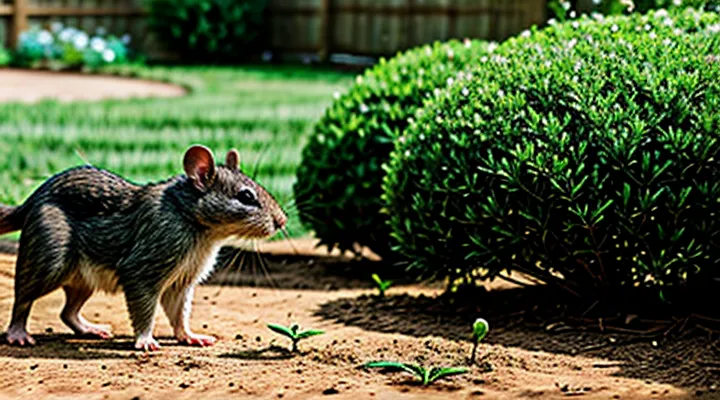
Identifying the Ground Rat
Physical Characteristics
Size and Shape
Ground rats that appear in garden settings are small mammals with a compact, low‑profile build. Adult individuals typically reach a body length of 15–20 cm (6–8 in) measured from the snout to the base of the tail. The tail itself adds another 5–7 cm (2–3 in). Overall weight ranges from 80 g to 150 g (0.18–0.33 lb), placing the animal in the lower end of the rodent size spectrum.
The body shape is characterized by a flattened torso that hugs the ground, facilitating movement through dense vegetation and underbrush. Limbs are short and sturdy, ending in clawed paws adapted for digging and rapid sprinting. Ears are rounded, positioned low on the head, and covered with fine fur that reduces exposure to debris. The tail is short, tapered, and often concealed beneath the fur when the animal is stationary. Fur coloration varies from brown‑gray to reddish‑brown, providing camouflage against soil and leaf litter.
Key dimensions:
- Head‑to‑body length: 15–20 cm (6–8 in)
- Tail length: 5–7 cm (2–3 in)
- Weight: 80–150 g (0.18–0.33 lb)
- Ear height: 1.5–2 cm (0.6–0.8 in)
- Hind‑foot length: 2–3 cm (0.8–1.2 in)
These measurements and the streamlined silhouette enable ground rats to navigate garden environments efficiently, making them recognizable in photographs and field observations.
Fur Color and Texture
Ground rats in garden settings display a range of fur hues that blend with soil and vegetation. The dorsal coat typically ranges from light brown to reddish‑gray, providing camouflage against loam and leaf litter. Ventral fur is usually paler, often creamy or whitish, creating a subtle contrast that reduces visibility from predators viewing from below. Seasonal molts may introduce a slightly darker tone in winter, while summer coats can appear more muted, matching the drier ground.
The fur texture combines two distinct layers. The outer guard hairs are coarse, stiff, and slightly raised, forming a protective barrier against debris and moisture. Beneath them, a dense undercoat of soft, fine hairs offers insulation and a smooth feel when the animal is handled. This dual‑layer structure enables the ground rat to maintain body temperature while navigating the rough garden substrate without excessive friction.
Tail Description
Ground rats in garden habitats possess tails that are markedly short and robust, typically measuring 4–7 cm in length, which is less than half the body length. The dorsal surface displays a dense, coarse fur coat ranging from gray‑brown to reddish‑brown, matching the surrounding soil and leaf litter for camouflage. The ventral side is lighter, often pale gray, and the fur lies flat against the skin, reducing drag while the animal moves through vegetation.
Key characteristics of the tail include:
- Structure: Muscular vertebral column with a flattened cross‑section, providing stability during rapid burrowing and quick directional changes.
- Fur pattern: Uniform short hairs on the upper surface; the underside may have sparse, finer hairs that facilitate heat dissipation.
- Coloration: Uniformly muted tones that blend with the garden floor; occasional faint striping aligns with the animal’s dorsal stripe pattern.
- Function: Serves primarily as a balance organ, assisting in swift lateral movements and aiding in the execution of tight turns while foraging among dense foliage.
The tail’s limited length and sturdy build distinguish ground rats from arboreal rodents, whose tails are typically longer and prehensile. This morphology reflects an adaptation to a subterranean and ground‑level lifestyle, where agility and concealment are paramount.
Ear and Eye Features
Ground rats in garden settings display distinct ear structures that aid in detecting predators and locating food. The ears are small, rounded, and positioned low on the head, partially covered by short, coarse fur that matches the body’s brown‑gray tone. Cartilage provides flexibility, allowing the pinnae to swivel toward faint sounds. The external auditory canal is narrow, ending in a simple, dark‑colored opening.
- Size: approximately 1–1.5 cm in length.
- Shape: rounded, slightly flattened on the outer edge.
- Fur coverage: short, blending with body coloration.
- Mobility: able to pivot up to 90° horizontally.
Eye characteristics complement the auditory system, offering a wide field of view essential for spotting movement among foliage. The eyes are relatively large for the head size, dark brown with a glossy cornea. Pupils are vertical slits that contract sharply in bright light, expanding to maximize light intake at dusk. Placement on the sides of the head provides binocular overlap for depth perception while maintaining peripheral awareness.
- Size: about 0.6–0.8 cm in diameter.
- Shape: round with a slight oval elongation.
- Color: deep brown, reflecting minimal light.
- Pupil: vertical slit, responsive to illumination changes.
- Position: lateral, granting a wide visual field.
Distinguishing from Other Pests
Ground Rat vs. Mouse
Ground rats, commonly referred to as voles or field mice, are small rodents that spend most of their lives at ground level. Their bodies measure 3–5 cm in head‑body length, with a short, hairless tail roughly one‑third that length. Fur is dense, brown to gray, and blends with soil and leaf litter. Ears are minute, hidden in the fur, and eyes are small, positioned laterally.
House mice are slightly larger, with head‑body lengths of 6–9 cm and a tail equal to or longer than the body. Their fur is finer, ranging from light gray to brown, and the tail is furred and flexible. Ears are prominent, visible above the fur, and eyes are proportionally larger, giving a more conspicuous appearance.
Key distinctions for garden observation:
- Size: ground rat ≈ 3–5 cm; house mouse ≈ 6–9 cm.
- Tail: short, hairless in ground rat; long, furred in house mouse.
- Ears: concealed in ground rat; prominent in house mouse.
- Fur texture: dense and coarse in ground rat; fine and smoother in house mouse.
- Coloration: uniform brown/gray in ground rat; more varied, often with a lighter belly in house mouse.
Ground rats create shallow burrow entrances surrounded by loose soil, often near dense vegetation. Their foraging tracks consist of narrow, straight runways through grass. House mice favor concealed pathways along walls, fences, or under debris, leaving irregular, wider trails.
Photographic identification relies on the visible tail length, ear size, and overall body proportions. A short, almost invisible tail and buried ears indicate a ground rat, while a long, mobile tail and exposed ears confirm a house mouse.
Ground Rat vs. Vole
In garden ecosystems the small rodent commonly referred to as a ground rat is frequently mistaken for a vole. Accurate identification relies on observable anatomical and behavioral traits.
Ground rats exhibit a body length of 10–15 cm, a tail equal to or longer than the torso, and relatively large, rounded ears that protrude from dense brown‑gray fur. Their hind feet are proportionally longer, supporting agile climbing on low vegetation. Voles, by contrast, measure 6–9 cm in body length, possess a short, hairless tail, and have small, hidden ears covered by thick fur. Their feet are stout, adapted for digging rather than climbing.
Behavioral evidence further separates the species. Ground rats construct shallow, branching burrow systems with multiple entrances near the surface; their activity is predominantly nocturnal, leaving fresh, crescent‑shaped chew marks on garden stems. Voles produce deep, straight tunnels ending in a single, conspicuous entrance, and they gnaw at roots and tubers, creating characteristic crescent‑shaped feeding pits. Footprint patterns differ: ground rats leave elongated prints with visible toe pads, while vole prints appear as compact, four‑toed imprints lacking distinct pads.
Photographic identification emphasizes posture and tail visibility. Images of ground rats show a raised tail and upright stance when startled; fur appears glossy under daylight. Vole photographs display a low, crouched posture with the tail concealed beneath the body; fur often appears matte due to frequent soil contact.
Key distinguishing features
- Size: ground rat ≈ 10–15 cm; vole ≈ 6–9 cm.
- Tail: long, visible, covered in fur (ground rat); short, hairless, hidden (vole).
- Ears: large, exposed (ground rat); small, obscured (vole).
- Burrow type: shallow, branching network (ground rat); deep, single‑entrance tunnel (vole).
- Footprints: elongated with visible pads (ground rat); compact, pad‑less (vole).
Recognizing these differences enables precise documentation of garden rodent populations and informs targeted management strategies.
Ground Rat vs. Squirrel
Ground rats and squirrels are the two most frequently observed rodents in cultivated plots, each displaying distinct morphological traits that aid rapid identification.
The ground rat measures 10–15 cm in body length, with a short, hairless tail about half the body length. Its fur is dense, ranging from gray‑brown to reddish‑brown, and the dorsal stripe is often faint. Ears are small, rounded, and lie close to the head. The animal moves low to the ground, using its powerful forelimbs to dig burrows and forage among low vegetation.
Squirrels are larger, typically 20–25 cm in body length, and possess a long, bushy tail exceeding the body length. Their fur varies from gray to reddish or black, often with a contrasting ventral side. Ears are prominent, triangular, and positioned high on the skull. Squirrels climb vertical structures, displaying agile leaps and a characteristic upright posture when alert.
Key differences:
- Size: ground rat ≈ 10–15 cm; squirrel ≈ 20–25 cm.
- Tail: ground rat short, hairless; squirrel long, bushy.
- Fur coloration: ground rat uniform gray‑brown; squirrel variable with distinct dorsal‑ventral contrast.
- Ear placement: ground rat low, small; squirrel high, large.
- Locomotion: ground rat ground‑bound, burrowing; squirrel arboreal, climbing.
These attributes enable precise visual discrimination between the two species during garden observations.
Common Habitats and Behaviors
Where Ground Rats Live
Burrows and Tunnels
Ground rats create extensive underground networks that shape garden soil. Their burrows consist of a primary entrance, a main tunnel, and several side chambers. The primary entrance is a shallow, round opening, typically 2–4 cm in diameter, surrounded by a loose mound of displaced earth. The main tunnel runs straight for 30–150 cm before branching into smaller passages that may be as narrow as 1 cm. Side chambers serve as nesting sites, food storage, and escape routes; they are lined with dry vegetation and soft soil.
Key characteristics of these tunnels include:
- Depth: Most tunnels remain within the top 15 cm of soil, where moisture and temperature are optimal for the animals.
- Orientation: Entrances often face south‑west to maximize warmth and sunlight exposure.
- Soil displacement: Visible mounds of fresh soil, termed “rat hills,” appear around each opening, indicating recent activity.
- Vegetation impact: Roots intersecting tunnels may be girdled, leading to wilting or death of nearby plants.
Identifying burrow systems in a garden requires observing the following signs:
- Fresh soil mounds with a clean, unweathered appearance.
- Thin, linear depressions extending from the mound, suggesting tunnel pathways.
- Freshly chewed plant material or shredded leaves near entrances.
- Increased soil aeration and occasional pockets of dry, loose earth.
Managing burrow activity involves either physical barriers—such as mesh screens placed over entrances—or habitat modification, like reducing dense ground cover that shelters the rodents. Understanding the structure and function of ground rat tunnels enables precise assessment of their influence on garden health and informs targeted control measures.
Preferred Garden Spots
Ground rats favor garden locations that provide shelter, moisture, and easy access to food. Their selection criteria are based on micro‑habitat conditions rather than random movement.
- Dense low‑lying vegetation such as thyme, clover, or creeping lettuce, which offers concealment from predators and a cool microclimate.
- Mulch layers, compost piles, or leaf litter that retain humidity and create soft burrowing media.
- Areas adjacent to water features—drip lines, irrigation runoff zones, or damp borders—where soil remains consistently moist.
- Perimeter zones near fence lines, garden beds, or vegetable rows that contain root systems and seed heads, supplying both cover and nourishment.
- Structures that incorporate gaps or crevices, including garden arches, wooden crates, or overturned pots, which serve as temporary nesting sites.
These spots concentrate the resources ground rats need for foraging, thermoregulation, and reproduction, resulting in higher activity levels and more frequent sightings in those garden sectors.
Nocturnal vs. Diurnal Habits
Ground rats that inhabit garden ecosystems display distinct activity patterns that influence when they are observed and captured in photographs. Their behavior divides primarily into two categories: nocturnal and diurnal. Understanding these cycles helps distinguish the circumstances under which each type appears in visual records.
Nocturnal individuals become active after sunset, foraging on seeds, tubers, and soft-bodied insects. Their eyes exhibit a pronounced tapetum lucidum, creating a reflective sheen in night‑time images. Movements are typically rapid and erratic, reducing the likelihood of prolonged exposure to daylight. Consequently, night‑vision or infrared photography often yields clearer depictions of these specimens.
Diurnal counterparts emerge at dawn, maintaining activity throughout daylight hours. They feed on surface vegetation, fallen fruits, and occasionally small invertebrates. Daylight photographs capture their fur coloration with high fidelity, revealing subtle patterning that may be obscured in low‑light conditions. Their slower, more deliberate locomotion facilitates longer exposure times without motion blur.
Key differences:
- Active period: night vs. day
- Visual cues: eye shine and contrast in low light vs. true coloration in bright light
- Behavioral tempo: rapid, evasive movements vs. measured, exploratory pacing
- Photographic technique: infrared or flash‑free night shots vs. standard daylight imaging
Recognizing whether a ground rat is nocturnal or diurnal enables accurate interpretation of garden photographs and informs appropriate observation strategies.
Diet and Feeding Patterns
Garden Plant Preferences
Ground rats, commonly observed scurrying across garden beds, exhibit selective feeding habits that influence plant health and garden composition. Their foraging patterns focus on tender foliage, seed heads, and root zones where moisture accumulates, creating a predictable impact on vegetation.
- Young lettuce, spinach, and other leafy greens
- Seedlings of carrots, radishes, and beets
- Fruiting bodies of strawberries and raspberries
- Low‑lying herbs such as mint, parsley, and cilantro
- Bulbous plants with exposed crowns, e.g., onions and garlic
Plants with tough, fibrous stems, high tannin content, or strong aromatic oils tend to repel ground rats. Examples include rosemary, sage, lavender, and thistles. Incorporating these species along perimeter rows creates a natural barrier that reduces intrusion into central planting zones.
Effective management combines preferred‑plant monitoring with strategic placement of repellent species. Regular inspection of vulnerable seedlings, prompt removal of damaged foliage, and maintenance of dry soil conditions diminish the likelihood of extensive feeding. Adjusting crop rotation to avoid consecutive planting of highly attractive species further limits population buildup.
Other Food Sources
Ground rats supplement their primary herbivorous intake with a variety of alternative foods that appear regularly in cultivated spaces. These secondary items influence foraging patterns and can affect garden health.
- Seeds and grains – dropped from cereal plants, sunflowers, and ornamental grasses; high in carbohydrates and readily accessible on the soil surface.
- Fruits and berries – ripened strawberries, raspberries, and fallen cherries provide sugars and vitamins; rats often harvest fallen pieces before birds or insects reach them.
- Invertebrates – earthworms, beetle larvae, and soft-bodied insects supply protein and moisture; activity spikes after rain when soil organisms surface.
- Fungi – mycelial mats and mushroom caps emerging in moist, shaded zones contribute essential nutrients and aid digestion.
- Compost and organic waste – decomposing kitchen scraps and garden trimmings attract rats seeking both nutrients and shelter.
- Plant debris – wilted leaves, dead stems, and mulch layers offer hidden food sources and protective cover.
Seasonal shifts dictate the prominence of each category. Early spring emphasizes emerging insects and fresh seedlings; summer sees a surge in fruit and seed availability; autumn introduces abundant fallen fruit, nuts, and mature mushroom growth; winter forces reliance on stored seeds and compost remnants.
Access to these supplementary foods can increase ground rat population density, intensify burrowing activity, and elevate the risk of plant damage. Managing alternative food sources—by promptly removing fallen fruit, securing compost bins, and reducing mulch thickness—helps limit the attraction of these rodents to garden areas.
Signs of Infestation
Droppings and Tracks
Droppings left by a garden ground rat are small, dark, and cylindrical, typically 0.5–0.8 cm in length. The exterior is glossy, while the interior contains a moist, crumbly core that may emit a faint, musky odor when disturbed. Fresh specimens appear black; older ones fade to brownish‑gray as exposure to air and sunlight progresses. Presence of undigested seed husks or insect exoskeleton fragments within the droppings can indicate the animal’s recent diet.
Tracks provide additional confirmation. The footprints are four‑toed, each toe ending in a blunt claw, forming a compact oval shape about 1 cm wide. Stride length averages 2–3 cm, with a distinctive alternating pattern that creates a shallow, parallel line across soft soil or mulch. The pressure marks often reveal a slight drag from the tail, leaving a faint, linear smear behind the hind feet. Identification checklist:
- Dark, cylindrical droppings, 0.5–0.8 cm long
- Glossy exterior, moist interior, faint musky smell
- Four‑toed, blunt‑clawed footprints, ~1 cm wide
- Stride length 2–3 cm, parallel track lines
- Tail drag trace accompanying hind footprints
These characteristics together allow reliable detection of a ground rat’s activity in garden environments.
Gnaw Marks and Damage
Ground rats leave unmistakable evidence in garden beds, fences, and storage structures. Their incisors create clean, crescent‑shaped bites that remove material in a single, swift motion. The edges of the cuts are smooth rather than ragged, reflecting the animal’s efficient chewing technique.
Typical damage includes:
- Partial removal of vegetable leaves, leaving a hole with a crisp, straight margin.
- Chewed stems that appear hollowed out, often with a slight discoloration near the bite site.
- Nibbled wooden slats or plastic mulch, showing shallow, evenly spaced grooves.
- Severed seedling roots, exposing the plant’s base and causing rapid wilting.
These signs differentiate ground rat activity from insect feeding, which usually produces irregular, ragged holes and frass. Recognizing the pattern of gnaw marks enables timely intervention to protect crops and garden infrastructure.
Burrow Entrances
Burrow entrances are the most reliable indicator of a ground rat’s presence in a garden. They appear as small, circular or oval openings ranging from 2 cm to 6 cm in diameter, often rimmed with loose soil or shredded plant material. The edges may be slightly raised, forming a shallow lip that helps the animal maintain a stable tunnel entrance.
Typical locations include:
- Under dense groundcover such as clover, moss, or low‑lying herbs where concealment is maximized.
- Along the base of vegetable rows, especially near lettuce, carrots, and radishes, which provide easy access to food.
- Adjacent to irrigation lines or damp patches, where moisture softens the soil and eases excavation.
Additional characteristics:
- Fresh entrances exhibit crisp, undisturbed soil with visible whisker marks or fresh droppings nearby.
- Older openings may be partially collapsed, covered with leaf litter, or show a network of secondary holes leading to a larger tunnel system.
- The interior of a functional burrow often contains a compacted tunnel floor, occasional gnawed root fragments, and a faint scent of urine that can be detected with close proximity.
Identifying these features enables swift documentation of ground rat activity and informs targeted management strategies.
Visual Guide to Ground Rats
Photo Gallery: Typical Appearances
Adult Ground Rat Images
Adult ground rats captured in garden settings display a consistent set of visual traits that aid identification. The fur is typically coarse, ranging from light brown to dark gray, with a distinct dorsal stripe that may appear slightly darker than the surrounding coat. Body length measures between 15 cm and 20 cm, while the tail adds an additional 10 cm to 12 cm, often covered with sparse hair and ending in a dark tip. Eyes are small and dark, positioned laterally, providing a wide field of vision; ears are rounded and lie close to the head, barely visible beneath the fur.
Key details observable in photographs:
- Head‑to‑body proportions: head constitutes roughly one‑quarter of total length, with a blunt snout.
- Limbs: short, sturdy forelimbs equipped with sharp claws for digging; hind limbs longer, supporting agile movement across soil and vegetation.
- Tail: semi‑naked, flexible, used for balance when navigating low vegetation.
- Color pattern: dorsal stripe, lighter ventral side, occasional speckling near the hindquarters.
- Habitat background: images often include garden soil, leaf litter, or low‑lying plants, providing context for the animal’s natural environment.
Photographic composition that enhances clarity includes a shallow depth of field to isolate the rat from surrounding foliage, natural lighting to reveal fur texture, and a side‑angle view that captures both the profile and the tail curvature. These visual cues collectively form a reliable reference for recognizing adult ground rats in garden ecosystems.
Juvenile Ground Rat Images
Juvenile ground rats captured in garden settings display a compact body, soft fur, and proportionally large ears. Coat coloration ranges from pale gray to light brown, often with faint dorsal striping that fades toward the ventral side. Eyes appear glossy and dark, while whiskers extend outward, aiding navigation through low vegetation.
Photographs typically employ natural daylight to preserve true color balance. Low angles emphasize the animal’s interaction with leaf litter, stems, and soil. Depth of field is adjusted to keep the rat sharply in focus while gently blurring surrounding foliage, highlighting the subject without distracting background details.
- Head: rounded, with a slightly flattened snout.
- Ears: erect, covering one‑third of head length.
- Fur: dense, short; dorsal hairs may show subtle banding.
- Tail: slender, shorter than body length, often concealed under foliage.
- Limbs: short, muscular; hind feet equipped with small, curved claws for digging.
In garden environments, juveniles frequent moist soil near compost piles, under stone walls, and within dense herbaceous cover. Their activity peaks at dawn and dusk, when they forage for seeds, insects, and soft plant material. Images recorded during these periods reveal heightened alertness and rapid movement, providing clear evidence of early developmental behavior.
Photo Gallery: Distinguishing Features
Close-ups of Head and Paws
Close‑up images reveal a compact skull with a rounded dorsal surface and a short, blunt snout. The nasal region is covered in fine, pale fur that blends with the surrounding soil coloration. Large, dark eyes dominate the facial front, providing a broad field of vision; each eye is encircled by a thin rim of darker pigment. Prominent, rounded ears sit low on the head, edged with sparse hairs that dampen sound. Whiskers extend laterally from the rostral area, each tactile filament measuring 1–2 cm, aiding navigation among leaf litter.
The forepaws exhibit a robust structure suited for digging. Each paw contains five digit pads, each pad bearing a dense layer of keratinized skin that resists abrasion. Claws are short, slightly curved, and darkened at the tips, enabling the animal to displace soil and root material efficiently. The pad surface displays a subtle pattern of ridges that increase friction against moist garden substrates. Hind paws mirror the forepaws in size but possess a longer fifth digit, which assists in balance when the rat climbs low vegetation.
Tail Length Comparison
Ground rats, commonly seen scurrying among garden beds, display tail lengths that aid in species identification and behavior interpretation. Typical tail length ranges from 5 cm in the smallest field vole (Microtus agrestis) to 12 cm in the larger wood mouse (Apodemus sylvaticus). Tail proportion relative to body length varies: shorter tails (≈30 % of body length) suggest burrowing adaptation, while longer tails (≈45–55 % of body length) indicate greater balance requirements for climbing vegetation.
Key comparative data:
- Field vole: tail 4.5–6 cm; 28–32 % of total length; dense, short hair.
- Common garden rat (Rattus norvegicus): tail 10–12 cm; 38–42 % of total length; sparsely haired, slightly tapered.
- Wood mouse: tail 9–12 cm; 45–55 % of total length; scaled, relatively flexible.
- House mouse (Mus musculus): tail 7–9 cm; 40–45 % of total length; smooth, hairless ventral surface.
Longer tails often correlate with increased agility in dense foliage, enabling rapid directional changes. Shorter tails improve maneuverability within tight burrow systems, reducing the risk of entanglement. Photographic evidence from garden observations confirms that individuals with tails exceeding 10 cm frequently occupy elevated plant structures, whereas those under 6 cm remain near ground cover and root zones.
Photo Gallery: Damage and Signs
Images of Plant Damage
Ground rats in garden settings are often identified through characteristic visual cues captured in photographs. These images illustrate the animal’s size, fur coloration, and posture, providing a reliable reference for gardeners who encounter unexplained foliage injury.
Typical damage caused by ground rats includes:
- Chewed leaf margins with ragged edges.
- Small, circular holes punched through tender stems.
- Gnawed roots exposed near the soil surface.
- Scattered seed pods missing or partially consumed.
Photographic evidence of these injury patterns enables precise diagnosis and informs targeted control measures. By comparing observed damage with documented visuals, growers can differentiate ground‑rat activity from that of insects, rodents, or environmental stress, ensuring appropriate intervention.
Images of Burrow Entrances
Images of burrow entrances provide the most reliable visual cue for identifying ground rats in a garden setting. Photographs typically capture a shallow, circular opening in the soil, often ranging from 2 cm to 5 cm in diameter. The surrounding soil is usually loose and slightly raised, forming a subtle berm that distinguishes the entrance from the surrounding ground. Frequently, the entrance is positioned near low vegetation, mulch, or stone pathways, where rodents seek shelter and easy access to food sources.
Key visual elements observable in the photographs:
- Circular or oval aperture with smooth edges
- Slightly elevated rim of excavated soil
- Presence of fresh soil displacement or loose debris
- Proximity to plant roots, leaf litter, or garden debris
- Absence of visible plant material within the opening, indicating recent use
These characteristics, consistently documented across multiple images, enable precise recognition of ground rat burrows and support accurate assessment of their presence in cultivated areas.