
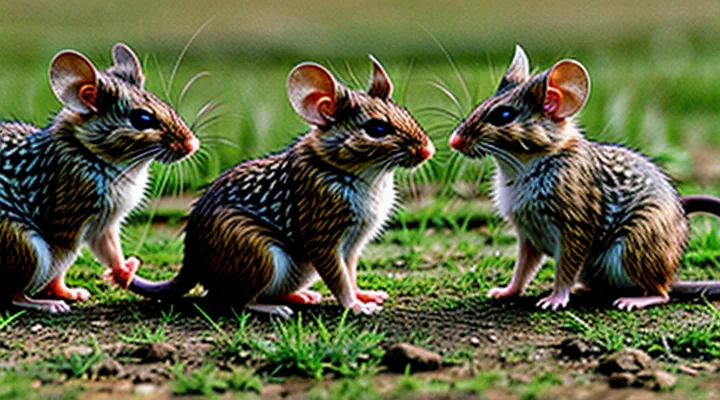
Understanding Field Mice
General Characteristics
Physical Traits
Field mouse populations exhibit a range of physical characteristics that distinguish individual species and adapt them to diverse habitats.
Body size varies from 6 cm to 12 cm head‑body length, with weight between 10 g and 25 g. Smaller forms, such as the western meadow mouse, display compact builds, while larger species, like the steppe field mouse, possess elongated bodies.
Fur texture and coloration reflect environmental demands. Common patterns include:
- Dorsal pelage: brown, gray, or reddish tones with speckled or uniform shading.
- Ventral fur: lighter, often white or pale gray, providing counter‑shading.
- Seasonal molt: denser, longer guard hairs in winter, shorter coats in summer.
Tail morphology contributes to balance and thermoregulation. Length typically matches or exceeds head‑body length; some species have tufted tips, others present naked, scaly surfaces.
Ears are proportionally large, ranging from 1 cm to 1.5 cm, with thin membranes that facilitate heat dissipation. Auditory bullae are well‑developed, enhancing low‑frequency detection.
Cranial features include a robust skull, pronounced zygomatic arches, and a dental formula of 1/1 incisors, none of the other teeth, all hypsodont and continuously growing. Enamel coloration ranges from yellowish to orange, indicating dietary mineral content.
Limbs are slender, equipped with five toes on each foot; hind feet often bear elongated metatarsals for agile jumping. Claws are sharp, enabling burrowing and foraging in dense vegetation.
These traits collectively define the morphological diversity among field mouse species, supporting their ecological success across temperate and semi‑arid regions.
Habitat Preferences
Field mice exhibit distinct habitat preferences that reflect adaptations to local environmental conditions. Each taxon occupies niches defined by vegetation structure, soil composition, and human disturbance levels.
Open grasslands and cultivated fields provide abundant seed resources and ground cover. Species favoring these habitats select areas with dense herbaceous growth, moderate moisture, and minimal woody debris. Soil texture influences burrow stability; loamy or sandy substrates support extensive tunnel networks, while heavy clay impedes excavation.
Shrub-dominated margins and hedgerows attract mice that require vertical concealment and nesting sites. These rodents exploit dense thickets for protection from predators and foraging on insects and berries. Proximity to water bodies enhances humidity, benefiting species with higher moisture requirements.
Semi-arid steppe zones host mice adapted to sparse vegetation and extreme temperature fluctuations. Preference for open, dry ground accompanies physiological mechanisms for water conservation and thermoregulation. Burrow depth in these areas typically exceeds that of populations in mesic environments, providing thermal buffering.
The following list summarizes habitat attributes associated with each major field mouse group:
- Grassland specialists – dense herbaceous cover, loamy soils, moderate precipitation.
- Agricultural field occupants – crop residues, irrigated soils, seasonal vegetation cycles.
- Shrubland dwellers – thick hedgerows, mixed leaf litter, adjacent water sources.
- Steppe-adapted forms – sparse plant cover, sandy or rocky soils, low humidity.
Understanding these preferences informs conservation planning and pest management by linking species distribution to measurable habitat parameters.
Ecological Role
Field mice encompass a range of species inhabiting temperate grasslands, agricultural fields, and forest edges. Their abundance and behavioral flexibility allow them to integrate tightly into local ecosystems, influencing energy flow and material cycles.
As primary consumers, these rodents feed on seeds, grains, and invertebrates. Their foraging reduces seed banks, alters plant community composition, and facilitates the spread of opportunistic vegetation through selective consumption. Burrowing activity mixes organic matter into the upper soil layers, enhancing aeration, water infiltration, and nutrient turnover.
Predatory birds, snakes, and small carnivores depend on field mice for a substantial portion of their diet. Fluctuations in mouse populations directly affect predator reproductive success and territorial dynamics, thereby shaping higher‑trophic‑level structures.
Field mice serve as intermediate hosts for several zoonotic pathogens, including hantaviruses and tick‑borne bacteria. Their role in pathogen maintenance influences disease prevalence in both wildlife and human populations, informing epidemiological monitoring and control strategies.
Key ecological functions:
- Seed predation and dispersal that modulate plant succession.
- Soil disturbance that improves physical and chemical soil properties.
- Provision of biomass for a diverse suite of predators.
- Reservoir capacity for vector‑borne and direct‑transmission diseases.
Common Varieties of Field Mice
Wood Mouse («Apodemus sylvaticus»)
Geographic Distribution
Field mice comprise several distinct species that occupy a wide range of habitats across the Northern Hemisphere. Their presence spans temperate grasslands, agricultural fields, forest edges, and mountainous zones, reflecting adaptation to diverse ecological conditions.
Key geographic zones and representative taxa include:
- Western Europe – wood mouse (Apodemus sylvaticus) dominates mixed woodlands and hedgerows.
- Eastern Europe and Siberia – striped field mouse (Apodemus agrarius) inhabits steppe and floodplain areas.
- North America – meadow vole (Microtus pennsylvanicus) and prairie vole (Microtus ochrogaster) are common in prairies and riparian corridors.
- East Asia – Korean field mouse (Apodemus peninsulae) occurs in forest‑steppe mosaics of Korea and northeastern China.
- Northern Scandinavia – tundra vole (Microtus oeconomus) occupies subarctic peatlands and coastal marshes.
Distribution patterns are shaped primarily by climate gradients, soil moisture, and vegetation structure. Cold‑adapted species concentrate at higher latitudes and elevations, while moisture‑dependent taxa favor lowland floodplains and irrigated fields. Human‑altered landscapes, such as cultivated fields and urban green spaces, extend the range of opportunistic species, leading to localized overlaps where multiple taxa coexist.
Isolated mountain ranges and river valleys often act as barriers, resulting in genetically distinct populations even within the same nominal species. Conversely, continuous plains facilitate gene flow across broad areas, maintaining homogeneity among widespread forms.
Dietary Habits
Field mice exhibit diverse feeding strategies that reflect their ecological niches. Across the range of species commonly found in open habitats, diets consist primarily of seeds, grains, and plant material, supplemented by insects and other invertebrates during periods of high protein demand.
Key dietary components include:
- Seeds and grains: wheat, barley, rye, and native grass seeds provide carbohydrates and essential fatty acids.
- Vegetative matter: tender shoots, leaves, and buds supply fiber and micronutrients.
- Invertebrates: beetles, larvae, and spiders contribute amino acids crucial for reproduction and growth.
- Fungi and spores: occasional consumption of mushroom caps and mycelial fragments adds additional nutrients.
Seasonal variation drives shifts in intake. In spring, fresh vegetation dominates; summer sees increased insect predation; autumn emphasizes seed storage; winter reliance on cached grains and stored plant material intensifies.
Physiological adaptations support this flexible diet. Sharp incisors enable continuous gnawing of hard seeds, while a high metabolic rate permits rapid processing of protein-rich prey. Digestive enzyme profiles adjust to carbohydrate or protein loads, optimizing nutrient extraction.
Population density influences foraging behavior. High-density groups exhibit increased competition, leading to expanded diet breadth and opportunistic scavenging. Conversely, low-density populations concentrate on preferred high-energy foods, reducing exposure to predators.
Overall, field mouse dietary habits demonstrate a balance between resource availability, energetic requirements, and environmental pressures, ensuring survival across varied temperate ecosystems.
Reproductive Cycle
Field mouse populations exhibit seasonal breeding patterns driven by photoperiod and temperature. Reproductive activity peaks during the spring and early summer months when daylight length increases, while activity declines in winter when conditions become unfavorable.
Estrous cycles in these rodents are brief, typically lasting 3–5 days. Hormonal fluctuations of estrogen and progesterone coordinate the transition from proestrus to estrus, ovulation, and luteal phases. Species inhabiting temperate zones display shorter cycles compared with those in milder climates, reflecting adaptation to shorter breeding windows.
Gestation lasts 19–23 days, depending on species size and environmental pressure. Litters range from 3 to 9 pups, with larger litters common in species occupying open habitats where predation risk is higher. Neonates are altricial, opening eyes and developing fur within 10 days, and achieve independent foraging ability by 3 weeks.
Post‑natal growth proceeds rapidly; weaning occurs at 21–28 days, after which juveniles attain sexual maturity at 6–10 weeks. Early maturation enables multiple breeding cycles within a single season, enhancing population turnover.
Key reproductive parameters across field mouse taxa
- Estrous cycle length: 3–5 days
- Gestation period: 19–23 days
- Litter size: 3–9 pups
- Weaning age: 21–28 days
- Age at sexual maturity: 6–10 weeks
These metrics illustrate how reproductive timing and output vary among different field mouse species to maximize survival in fluctuating environments.
Striped Field Mouse («Apodemus agrarius»)
Distinctive Markings
Field mice exhibit a range of pelage patterns that aid species identification and ecological research. Distinctive markings include dorsal stripes, ventral coloration, tail banding, and facial patches, each varying among taxa.
- Striped dorsum – prominent in the woodland mouse (Apodemus sylvaticus), where a dark central stripe runs the length of the back, flanked by lighter flanks.
- Bicolored tail – characteristic of the meadow vole (Microtus pennsylvanicus), featuring a dark dorsal half and a pale ventral half.
- Facial mask – observed in the northern grasshopper mouse (Onychomys leucogaster), with a contrasting dark mask surrounding the eyes and nose.
- Ventral spotting – typical of the southern red-backed mouse (Myodes gapperi), displaying irregular white spots on a reddish-brown belly.
These markings serve as reliable field markers, supporting accurate taxonomic classification and informing habitat preference analyses.
Behavior Patterns
Field mice exhibit distinct foraging strategies adapted to habitat structure. Species inhabiting open grasslands prioritize rapid, linear movements to exploit dispersed seed patches, while those in dense underbrush employ zig‑zag paths and frequent pauses to navigate obstacles and avoid predators.
Social organization varies among taxa. Some populations form loose aggregations during the breeding season, establishing temporary territories marked by scent deposits. Others maintain solitary ranges, defending exclusive burrow systems and exhibiting low tolerance for intruders.
Reproductive behavior follows seasonal cues. Photoperiod length triggers hormonal changes that initiate mating activity, leading to synchronized litters. Females typically construct nests using shredded vegetation, then allocate maternal care through frequent grooming and thermoregulation.
Communication relies on multimodal signals. Auditory calls serve as alarm warnings, characterized by sharp, high‑frequency bursts that propagate efficiently through vegetation. Chemical cues, deposited on cheek glands, convey individual identity and reproductive status to conspecifics.
Predator avoidance incorporates both innate and learned components. Immediate responses include freezing, rapid sprint bursts, and utilization of pre‑existing escape tunnels. Long‑term adaptations involve altered activity periods, shifting nocturnal foraging to later hours when predator activity declines.
Yellow-necked Mouse («Apodemus flavicollis»)
Identifying Features
Field rodents exhibit a range of morphological and ecological traits that enable reliable discrimination among species. Accurate identification relies on measurable characteristics rather than anecdotal description.
- Body length: adult size varies from 70 mm in the smallest forms to over 130 mm in larger taxa.
- Fur coloration: dorsal pelage ranges from uniform gray‑brown to distinct reddish or black‑speckled patterns; ventral fur is typically lighter.
- Tail proportion: tail length may equal or exceed body length; a sparsely haired, scaly tail indicates one group, whereas a fully furred tail suggests another.
- Ear size and shape: proportionally large, naked ears signal species adapted to open habitats; smaller, fur‑covered ears associate with forest‑dwelling forms.
- Skull morphology: variations in rostrum length, zygomatic arch robustness, and molar cusp arrangement provide definitive taxonomic markers.
- Hind‑foot dimensions: elongated hind feet with well‑developed metatarsals correlate with jumping ability; shorter feet correspond to burrowing specialists.
- Dental formula: the presence of a single pair of premolars versus two pairs distinguishes specific lineages.
- Habitat preference: some varieties occupy grasslands and agricultural fields, others favor woodland edges or riparian zones; these ecological niches often align with distinct morphological suites.
- Behavioral traits: nocturnal activity patterns, foraging strategies (seed‑collecting versus insectivorous), and social structure (solitary versus colonial) further differentiate groups.
Combining these metrics yields a robust framework for distinguishing among the diverse field mouse taxa encountered across temperate regions.
Preferred Environments
Field mice occupy a range of habitats that reflect their physiological adaptations and foraging strategies. Species that favor open grasslands typically nest in shallow burrows beneath dense herbaceous cover, where vegetation provides both concealment from predators and a steady supply of seeds. Moisture‑rich meadows support populations that exploit abundant insect prey, constructing nests in tussocks or beneath fallen logs to maintain stable microclimates.
- Temperate deciduous forests: ground litter and leaf‑filled crevices offer shelter and access to fallen nuts and arthropods.
- Agricultural fields: crop residues and irrigation ditches create temporary refuges, especially during planting and harvest cycles.
- Riparian zones: proximity to water sources sustains higher humidity, benefiting species that require moist soil for nesting and foraging on aquatic invertebrates.
- Shrub‑dominated scrublands: dense thickets provide protection from aerial predators and support seed caches.
Altitudinal gradients influence habitat selection as well. At higher elevations, cooler temperatures and shorter growing seasons limit food availability, prompting some field mouse taxa to specialize in alpine meadows where they store seeds for winter use. Conversely, lowland coastal dunes host mice that tolerate sandy substrates and sparse vegetation, relying on wind‑blown detritus and occasional marine invertebrates.
Overall, each field mouse type demonstrates a clear preference for environments that balance shelter, food resources, and microclimatic stability, ensuring reproductive success and population persistence.
Other Notable Species
Harvest Mouse («Micromys minutus»)
The harvest mouse (Micromys minutus) represents one of the smallest members of the rodent assemblage commonly found in grassland and agricultural landscapes. Taxonomically, it belongs to the family Muridae, subfamily Murinae, and is the sole species of the genus Micromys. Its native range extends across much of Europe and parts of Asia, occupying temperate zones from the British Isles to Siberia.
Morphologically, the species is distinguished by a head‑body length of 5–7 cm, a tail of comparable length, and a weight of 2–5 g. The fur is brownish‑gray on the dorsal surface and pale on the ventral side, with a conspicuous white stripe along each flank. Large, rounded ears and a pointed snout aid in auditory and olfactory detection of prey.
Ecologically, the harvest mouse prefers tall, dense vegetation such as cereal crops, reed beds, and meadow grasses. It constructs spherical nests from woven grasses, typically anchored to the stems of host plants. The animal is primarily nocturnal, foraging on seeds, insects, and other small invertebrates. Seasonal movements are limited; individuals may shift to higher vegetation during winter to maintain insulation.
Reproductive parameters include:
- Breeding season from April to October.
- Average litter size of 4–7 pups.
- Gestation period of approximately 19–21 days.
- Weaning occurs at 3 weeks, with sexual maturity reached by the end of the first summer.
Population assessments indicate that the species is classified as Least Concern by the IUCN, yet local declines have been recorded in intensively farmed regions where pesticide use and habitat fragmentation reduce available nesting sites. Conservation measures focus on preserving field margins, maintaining low‑intensity agriculture, and limiting chemical inputs to sustain viable populations.
Common Vole («Microtus arvalis»)
The common vole, Microtus arvalis, represents a principal member of the diverse group of small rodents inhabiting agricultural and meadow ecosystems across Europe and western Asia. Adults measure 10–13 cm in body length, with a short, densely furred tail of 2–4 cm. Weight ranges from 30 to 80 g, reflecting seasonal fluctuations in food availability.
Morphologically, the species exhibits a brown to gray dorsal coat, a lighter ventral surface, and small, rounded ears lacking external markings. Dental formula 1.0.0.3/1.0.0.3 provides continuously growing incisors adapted for gnawing grasses, sedges, and tender shoots. Reproductive capacity is high; females can produce up to five litters per year, each comprising 4–8 offspring after a gestation of 21 days.
Ecologically, the common vole functions as a primary consumer of herbaceous vegetation, influencing plant community composition through selective grazing. Population densities can exceed 1,000 individuals per hectare in favorable conditions, leading to measurable impacts on crop yields and pasture quality. Predators such as owls, foxes, and mustelids rely on vole abundance for sustenance, establishing the rodent as a key link in trophic networks.
Key identification points:
- Body length: 10–13 cm; tail: 2–4 cm
- Weight: 30–80 g
- Dorsal coloration: brown‑gray; ventral: pale
- Dental formula: 1.0.0.3/1.0.0.3
- Breeding: up to five litters annually, 4–8 young per litter
Understanding the biology and ecological role of Microtus arvalis contributes to comprehensive knowledge of field rodent diversity and informs management practices in agricultural landscapes.
Impact on Ecosystems and Agriculture
Agricultural Pests
Crop Damage
Field rodents constitute a significant source of agricultural loss, with multiple species occupying distinct ecological niches that intersect crop production zones. Their presence in cultivated fields leads to direct and indirect damage that reduces marketable yield and increases post‑harvest costs.
Direct damage mechanisms include:
- Consumption of seeds, seedlings, and mature plant parts, resulting in immediate loss of biomass.
- Gnawing of stems, roots, and protective structures, compromising plant stability and water transport.
- Creation of entry points for pathogens through bite wounds, facilitating secondary infections.
- Contamination of harvests with droppings, fur, and nesting material, lowering product quality and requiring additional cleaning.
Economic assessments indicate that infestations can lower yields by 5 % to 30 % depending on crop type and mouse density, translating into annual losses exceeding billions of dollars in major grain‑producing regions. Damage severity correlates with population peaks driven by favorable weather, abundant food sources, and reduced predation pressure.
Effective mitigation relies on integrated monitoring and control:
- Regular field scouting to quantify rodent activity and identify hotspots.
- Habitat modification, such as removal of field margins and cover that provide shelter.
- Deployment of mechanical barriers and traps calibrated to target species size.
- Strategic use of rodenticides in accordance with safety regulations to limit non‑target impacts.
Understanding the specific feeding habits and reproductive cycles of each field mouse type enables precise timing of interventions, thereby minimizing crop damage while preserving ecological balance.
Disease Transmission
Field mice encompass several species that serve as natural reservoirs for a range of zoonotic agents. Their small size, high reproductive rates, and close contact with human environments facilitate pathogen maintenance and spread.
Common zoonotic agents associated with field mice include:
- Hantaviruses, causing hemorrhagic fever with renal syndrome;
- Borrelia burgdorferi, the bacterium responsible for Lyme disease, transmitted via Ixodes ticks that feed on rodents;
- Yersinia pestis, the plague bacterium, maintained in flea‑rodent cycles;
- Salmonella enterica, leading to gastroenteritis through contaminated food;
- Various helminths (e.g., Trichinella spiralis) and protozoa (e.g., Toxoplasma gondii) that complete part of their life cycles in rodent hosts.
Transmission pathways operate through:
- Direct contact with saliva, urine, or feces; aerosolization of dried excreta can deliver hantavirus particles to the respiratory tract;
- Ectoparasite vectors such as fleas, ticks, and mites that acquire pathogens while feeding and subsequently infect humans or domestic animals;
- Indirect contamination of grain stores, water sources, and household surfaces, providing a route for bacterial and parasitic agents.
Species‑specific patterns affect disease risk. For example:
- The common meadow vole (Microtus pennsylvanicus) frequently harbors hantavirus strains in North America;
- Wood mice (Apodemus sylvaticus) are primary hosts for tick‑borne Borrelia species in Europe;
- Bank voles (Myodes glareolus) exhibit high prevalence of Puumala virus, a hantavirus subtype.
Public‑health measures focus on surveillance, habitat modification, and population control. Strategies include:
- Regular trapping and testing of rodent populations to monitor pathogen prevalence;
- Securing food storage, sealing building entry points, and maintaining clean perimeters to reduce rodent access;
- Targeted rodent‑control programs using bait stations and integrated pest‑management practices;
- Education of at‑risk communities about proper handling of wild rodents and avoidance of aerosolized excreta.
These actions reduce the probability of spillover events and limit the impact of rodent‑borne diseases on human populations.
Role as Prey
Predators of Field Mice
Field mice are subject to extensive predation across their habitats. Avian hunters dominate daytime pressure. Hawks, particularly the red-tailed and Cooper’s, seize mice in open fields; owls, such as the barn and tawny species, exploit nocturnal activity; kestrels hover low to capture individuals on the ground. Mammalian predators impose year‑round threat. Red foxes chase and ambush mice in both cultivated and wild areas; mustelids—including weasels, ferrets, and mink—enter burrows to extract prey; feral and domestic cats hunt opportunistically near human settlements. Reptilian predators add a further dimension. Viperid and colubrid snakes locate mice by scent and heat, striking from concealed positions; larger lizards, like the common skink, occasionally consume juvenile mice. Aquatic and semi‑aquatic predators, such as raccoons and otters, target mice near water sources. Invertebrate predation is limited but includes large centipedes and ground beetles that attack larvae and small individuals. The combined effect of these predators regulates mouse populations, influences behavior, and shapes community dynamics.