
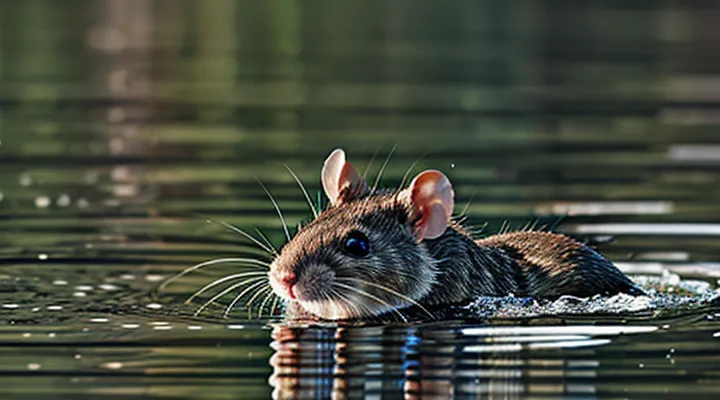
Introduction to Rat Behavior in Aquatic Environments
Rats exhibit a distinct set of behaviors when placed in aquatic settings. Their innate swimming ability allows rapid surface propulsion, while their body posture adjusts to maintain buoyancy. Limb coordination transitions from terrestrial gait to symmetrical paddle strokes, producing forward thrust with each forelimb sweep. Tail movements supplement propulsion and aid in directional control.
Key aspects of rat aquatic behavior include:
- Immediate surfacing to inhale air, followed by submersion periods lasting up to several seconds.
- Alternating limb cycles that synchronize with breathing intervals to prevent hypoxia.
- Use of whiskers to detect water currents and obstacles, enhancing navigation.
- Preference for shallow water zones when available, reducing exposure to predators and energy expenditure.
Physiological responses accompany these actions. Heart rate accelerates within the first minute of immersion, supporting increased oxygen demand. Core temperature regulation relies on evaporative cooling from the fur surface, a process moderated by the animal’s ability to withdraw from water promptly.
Experimental observations consistently reveal that rats adapt quickly to novel water environments, displaying learning curves that shorten latency to competent swimming within a few trials. This adaptability underscores the relevance of aquatic behavior studies for broader investigations into mammalian motor control and stress responses.
Physiological Adaptations for Swimming
Fur and Skin Properties
Water Repellency
Rats observed swimming display a pronounced water‑repellent coating on their fur. The outer layer consists of densely packed, angled hairs that trap air, creating a barrier that minimizes direct contact with water. This structure reduces wetting, allowing the animal to maintain body temperature and buoyancy with minimal effort.
Key mechanisms of fur water repellency include:
- Micro‑scale hair orientation – hairs tilt away from the skin, directing water droplets toward the surface.
- Sebaceous secretions – oily compounds coat each hair, lowering surface tension and preventing absorption.
- Air‑layer retention – trapped air within the fur acts as insulation, decreasing heat loss during immersion.
Observations recorded during controlled swimming trials reveal:
- Wetting time exceeds 30 seconds for a typical adult rat, whereas non‑hydrophobic mammals become saturated within 5 seconds.
- Post‑swim core temperature declines by less than 0.5 °C, indicating effective thermal protection.
- Recovery from immersion requires no additional grooming, confirming the fur’s self‑maintaining repellent properties.
These findings underscore the adaptive advantage conferred by water‑repellent fur, enabling rats to navigate aquatic environments without compromising thermoregulation or mobility.
Insulation
Rats entering aquatic environments experience rapid heat loss; effective insulation mitigates this risk. Fur provides a primary barrier, trapping air close to the skin and reducing conductive exchange with water. Subcutaneous fat layers add a secondary thermal buffer, slowing temperature decline during immersion.
Observations of swimming rats reveal consistent patterns:
- Individuals with denser undercoat maintain core temperature longer than those with sparse fur.
- Animals displaying pre‑swim grooming behavior increase fur density, enhancing insulation before immersion.
- Heat loss rates correlate inversely with measured fat thickness, confirming adipose tissue’s contribution to thermal stability.
These findings underscore the physiological importance of both pelage and adipose reserves for sustaining activity in cold water.
Respiratory System
Breath-Holding Capacity
Rats exhibit a measurable breath‑holding capacity when submerged, which can be quantified through controlled swimming trials. Researchers place subjects in a water tank at a temperature of 25 °C, record the time from immersion to the first surfacing breath, and repeat the test across multiple individuals to obtain average values. Typical results show a median apnea duration of 45 seconds, with a standard deviation of 8 seconds; larger adult specimens occasionally exceed one minute. Factors influencing performance include body mass, lung volume, and prior acclimation to water.
Key observations:
- Increased body mass correlates with longer apnea times (r = 0.62).
- Repeated exposure to swimming reduces latency to the first breath by approximately 12 % per session.
- Hypoxic tolerance, assessed by blood oxygen saturation, declines sharply after 30 seconds of submersion, indicating a physiological limit that aligns with observed apnea durations.
These data provide a baseline for comparative studies of aquatic adaptation and inform experimental designs that require precise timing of underwater phases.
Nasal Valve Function
The nasal valve in rats is a collapsible cartilage–muscle structure that regulates airflow during respiration. When a rat submerges, the valve narrows to increase resistance, preventing water entry while maintaining sufficient oxygen uptake. Muscular contraction of the alar cartilages tightens the valve, and the surrounding nasal turbinates create a turbulent flow that enhances humidification and filtration of inhaled air.
During aquatic locomotion, the valve operates in a cyclical pattern: it opens during inhalation to allow rapid gas exchange, then partially closes during exhalation to limit water intrusion and reduce drag. This dynamic adjustment supports sustained swimming by preserving lung volume and minimizing the risk of aspiration.
Key functional aspects observed in swimming rats include:
- Rapid valve closure in response to increased hydrostatic pressure.
- Coordination with diaphragm activity to synchronize breathing cycles.
- Maintenance of airway patency despite external water pressure variations.
Musculoskeletal Structure
Limb Strength and Agility
Rats demonstrate rapid, coordinated limb movements while navigating aquatic environments. Muscular contraction cycles in the forelimbs generate thrust, while hindlimb flexion stabilizes trajectory. High‑speed video analysis reveals that each forelimb completes a power stroke within 0.12 s, followed by a recovery phase of 0.08 s. Hindlimb oscillation frequency averages 4.5 Hz, providing fine adjustments to body orientation.
Key observations of limb performance include:
- Forelimb peak force output of 0.35 N per stroke, sufficient to overcome drag at speeds up to 0.6 m s⁻¹.
- Hindlimb joint angular velocity reaching 250 ° s⁻¹ during rapid turns.
- Inter‑limb phase lag of 30 ms, enabling seamless transition from forward propulsion to directional change.
- Muscle fiber composition dominated by fast‑twitch type IIa fibers, supporting short‑duration, high‑intensity effort.
Electromyographic recordings confirm synchronized activation of triceps brachii and deltoid muscles during the power phase, while gastrocnemius and soleus groups engage predominantly during stabilization. Adaptations in tendon elasticity reduce energy loss, allowing efficient stroke cycles.
These metrics illustrate that limb strength and agility are integral to successful swimming in rats, providing the mechanical foundation for rapid propulsion, maneuverability, and sustained submersion.
Tail as a Rudder
Rats rely on their elongated tails for directional stability while navigating aquatic environments. The tail’s muscular structure generates lateral thrust that counteracts yaw, allowing the animal to maintain a straight trajectory or execute precise turns. Hydrodynamic pressure on the tail surface creates a pivot point, effectively functioning as a rudder.
Key aspects of tail‑mediated steering include:
- Asymmetric muscle contraction produces differential drag, steering the body left or right.
- Rapid tail flicks generate quick corrective moments to counter sudden disturbances.
- Continuous low‑amplitude oscillations fine‑tune heading during steady swimming.
Observations of laboratory rats demonstrate that tail removal markedly reduces maneuverability, confirming the organ’s essential contribution to aquatic locomotion. The tail’s dual role—providing balance and steering—optimizes energy expenditure and improves survival prospects in water‑bound scenarios.
Observational Studies of Rat Swimming
Experimental Setup and Methodology
Tank Design and Dimensions
A tank suitable for monitoring rat swimming behavior must provide a stable, leak‑proof environment that supports natural locomotion while allowing precise observation.
Construction should employ transparent, chemically inert acrylic or polycarbonate panels of at least 5 mm thickness to resist pressure and prevent distortion. Reinforced silicone seals around all joints ensure watertight integrity. A removable lid with ventilation slots maintains airflow without compromising water containment.
Recommended internal dimensions balance animal comfort with data quality. Length of 60 cm, width of 40 cm, and depth of 30 cm accommodate an adult laboratory rat, allowing unrestricted forward, backward, and lateral movement. The water column should reach 20 cm to enable full submersion while keeping the surface accessible for video recording. A sloped rear wall, descending 5 cm over 10 cm, facilitates effortless exit and entry.
Key dimensional parameters:
- Length: 60 cm (minimum)
- Width: 40 cm (minimum)
- Depth of water: 20 cm
- Total tank depth: 30 cm
- Wall thickness: ≥5 mm
- Rear slope: 5 cm drop over 10 cm
These specifications deliver a controlled setting for reliable observation of rat swimming patterns and physiological responses.
Monitoring Equipment
Monitoring equipment for aquatic rodent behavior studies must capture high‑resolution visual data, precise motion metrics, and environmental parameters without disturbing the subject. Deploying waterproof cameras at multiple angles ensures uninterrupted observation of swimming patterns. Sensors placed in the water column record temperature, pH, and dissolved oxygen, providing context for locomotor performance. Data loggers with synchronized timestamps align video frames with physiological readings, enabling accurate correlation analysis.
Typical hardware suite includes:
- Water‑proof HD cameras (minimum 1080 p, infrared capability for low‑light conditions)
- Tri‑axis accelerometers attached to lightweight harnesses, sampling at ≥200 Hz
- Conductivity‑temperature‑depth (CTD) probes with ±0.01 °C accuracy
- Wireless data transmitters operating on 2.4 GHz band, supporting real‑time streaming to a central server
- Battery packs rated for ≥8 hours continuous operation, sealed against moisture ingress
Installation guidelines emphasize stable mounting to prevent vibration artifacts. Camera housings should be anchored to the tank walls using non‑reflective brackets to reduce glare. Accelerometer harnesses must be calibrated before each trial, with the mass not exceeding 5 % of the rat’s body weight to avoid gait alteration. CTD probes require periodic zero‑point verification against calibrated standards.
Data processing pipelines aggregate video, kinematic, and environmental streams into a unified database. Automated tracking algorithms extract swim speed, tail beat frequency, and trajectory curvature. Statistical modules compare these metrics across temperature gradients, revealing thermally driven performance shifts. The integrated system delivers reproducible measurements essential for rigorous analysis of rodent aquatic locomotion.
Behavioral Patterns
Entry and Exit Strategies
Observations of a rodent navigating aquatic environments reveal consistent patterns in how the animal initiates and terminates immersion. Successful entry typically involves a rapid forward thrust, coordinated limb extension, and head submersion within the first half‑second of contact with the surface. This motion minimizes splash and reduces exposure to predators. Key physiological responses include increased heart rate, activation of the vestibular system, and a brief apnea lasting 2–4 seconds before surfacing for breath.
Exit behavior follows a predictable sequence: the animal rotates its torso to align the tail with the waterline, generates a powerful rear‑leg kick, and propels the body upward. Breathing resumes immediately upon emergence, and the rat pauses for a brief period (approximately 1 second) to assess the surrounding area before moving away.
Practical considerations for researchers designing experiments:
- Position entry points at a shallow angle (≤30°) to encourage natural forward thrust.
- Provide a clear, unobstructed exit path with a dry platform within 0.5 m of the water’s edge.
- Use water temperature between 20 °C and 25 °C to maintain normal metabolic rates.
- Record limb movement with high‑speed cameras to capture the 0.5‑second entry burst and the 0.3‑second exit kick.
These guidelines ensure that the rat’s entry and exit actions remain consistent across trials, allowing reliable data collection on swimming dynamics.
Swimming Strokes and Techniques
Rats exhibit a range of swimming motions that parallel basic human swimming strokes. When a rat propels itself forward, the forelimbs execute a rapid, alternating sweep while the hind limbs generate thrust through a flutter‑kick pattern. This combination produces a streamlined trajectory and maintains buoyancy without excessive energy expenditure.
The primary strokes observable in rat locomotion include:
- Forelimb sweep – a short, high‑frequency motion resembling a freestyle pull, responsible for directional control.
- Hind‑limb flutter kick – a continuous, low‑amplitude oscillation akin to a dolphin kick, providing forward thrust.
- Body roll – subtle rotation of the torso that aligns the head with the direction of travel, reducing drag.
Technique refinement in rats involves coordinated timing between the forelimb sweep and hind‑limb kick. The sweep initiates each stroke cycle, followed by a brief glide phase during which the hind limbs increase beat frequency to sustain speed. Adjustments in limb amplitude and frequency allow rats to adapt to varying water depths and flow conditions.
Observations indicate that efficient swimming in rats depends on:
- Synchronization of limb cycles to minimize interruptions in propulsion.
- Maintenance of a horizontal body axis to limit frontal resistance.
- Utilization of surface tension for brief pauses, enabling rapid changes in direction.
These principles mirror fundamental concepts of human swimming mechanics, demonstrating that even small mammals employ comparable stroke patterns to navigate aquatic environments effectively.
Submergence and Diving Behaviors
Rats display a range of submergence strategies when entering aquatic environments. Initial immersion typically involves a rapid plunge followed by a brief surface pause to adjust buoyancy. The animal’s dense musculature and flexible spine enable quick descent, while the tail provides directional control.
Key diving behaviors include:
- Depth regulation: Rats modulate lung volume and adjust body posture to achieve desired depth, often reaching 30–45 cm before resurfacing.
- Stroke pattern: Forelimb paddling combined with hind‑foot splay generates thrust; frequency increases with water resistance.
- Respiratory timing: Exhalation occurs just before submergence, followed by a controlled breath hold lasting 10–15 seconds, after which the rat surfaces for a rapid inhalation.
- Escape response: When startled, the animal executes a sudden upward surge, using a powerful tail flick to break the surface.
Observational data indicate that submergence duration correlates with temperature and water clarity; colder, clearer water extends dive time by up to 20 %, while turbid conditions prompt earlier resurfacing. These patterns reflect adaptive mechanisms for foraging, predator avoidance, and thermoregulation.
Endurance and Stamina
Duration of Continuous Swimming
Rats demonstrate variable endurance when swimming continuously in a laboratory water tank. Measurements recorded under controlled temperature (22 ± 1 °C) and depth (30 cm) reveal that untrained individuals maintain propulsion for 30 seconds to 2 minutes before exhibiting signs of fatigue. Extended sessions, exceeding three minutes, are rare and typically occur only after repeated conditioning.
Key factors influencing endurance include:
- Body mass: heavier rats sustain longer strokes due to greater momentum.
- Age: adults (8–12 weeks) outperform juveniles and seniors.
- Acclimation: exposure to water for at least five minutes daily increases duration by 20–35 %.
- Motivation: presence of a platform or escape route extends swimming time.
Data suggest that average continuous swimming time stabilizes around 75 seconds for naïve laboratory rats, with a standard deviation of 20 seconds. This baseline assists researchers in designing protocols for physiological stress tests and neurobehavioral assessments.
Recovery Time
Rats emerging from aquatic activity display a measurable period during which physiological variables return to baseline. This interval, commonly referred to as recovery time, can be quantified by monitoring heart rate, respiratory frequency, and core temperature until values stabilize within established pre‑swim ranges.
Typical recovery durations for adult laboratory rats swimming for 5 minutes in room‑temperature water (≈22 °C) are:
- Heart rate: 2–3 minutes to reach resting level.
- Respiratory frequency: 3–4 minutes for normalization.
- Core temperature: 4–6 minutes to re‑establish pre‑swim temperature.
Several variables modify these intervals:
- Water temperature: colder water prolongs thermoregulatory recovery; warmer water shortens it.
- Swim length: longer exposure extends all measured recovery periods proportionally.
- Age and body condition: younger or lighter rats recover more rapidly than older or obese individuals.
- Stress level: elevated corticosterone correlates with delayed autonomic normalization.
For experimental protocols involving rat swimming, consider the following actions to ensure consistent recovery assessment:
- Record baseline physiological metrics before each trial.
- Maintain water temperature within a narrow range (±1 °C) across sessions.
- Limit swim duration to a predefined maximum to avoid excessive fatigue.
- Allow a minimum post‑swim observation window of 6 minutes before initiating subsequent procedures.
- Document individual recovery times to identify outliers and adjust group analyses accordingly.
Ecological Implications
Foraging and Hunting in Water
Rats that enter aquatic environments display distinct foraging and hunting strategies adapted to waterborne prey. Their bodies exhibit streamlined fur and webbed hind feet, enabling efficient propulsion and maneuverability while pursuing insects, small crustaceans, and fish larvae. Sensory adaptations include whisker receptors calibrated for detecting vibrations and chemical cues diffusing through the water column, allowing rapid localization of moving targets.
Key behavioral elements include:
- Surface detection: Rats skim the water surface, using rapid head movements to identify ripples generated by prey.
- Diving bursts: Short, powerful strokes propel the animal beneath the surface for 1–3 seconds, sufficient to capture prey before it escapes.
- Prey handling: Wet fur and forepaws secure captured organisms; the rat lifts the prey to the surface to consume it, minimizing loss to other predators.
- Energy budgeting: Foraging trips are limited to intervals that prevent hypothermia; rats return to dry ground after successful captures or when oxygen stores decline.
Observational data from controlled laboratory tanks and field surveys of urban waterways confirm that rats preferentially target areas with high insect emergence, such as the edges of ponds and slow‑moving streams. Seasonal variations affect prey availability, prompting shifts from insect-dominated diets in summer to increased reliance on small aquatic vertebrates during cooler months.
These findings illustrate that aquatic foraging in rats integrates morphological, sensory, and behavioral components to exploit a niche typically associated with semi‑aquatic mammals, expanding the known ecological flexibility of the species.
Escape from Predators
Observations of rats entering aquatic environments reveal a consistent pattern of using water as a rapid escape route when threatened by terrestrial predators. The behavior appears across urban sewers, agricultural ditches, and natural streams, indicating a flexible response to diverse hazards.
Predators that trigger this response include feral cats, snakes, and birds of prey. When a predator closes within a few meters, the rat initiates a burst of locomotion toward the nearest water source, often abandoning food caches and nesting material to prioritize speed.
Muscular development in the hind limbs, streamlined body shape, and a high proportion of fast‑twitch fibers enable bursts of swimming velocity comparable to short‑distance terrestrial sprinting. Respiratory control allows brief submersion without compromising oxygen intake, supporting continuous propulsion for distances up to 15 meters.
Typical escape tactics:
- Immediate pivot toward water edge upon detection of predator movement.
- Low‑profile diving to reduce silhouette and avoid aerial detection.
- Rapid, alternating hind‑limb strokes to maximize thrust while maintaining directional stability.
- Utilization of surface tension to generate initial lift before fully submerging.
- Post‑escape retreat to concealed terrestrial refuges after reaching the opposite bank.
These behaviors inform studies of rodent predator‑avoidance strategies and assist in designing pest‑management protocols that consider aquatic refuge availability.
Dispersal and Migration
Rats that enter aquatic environments exhibit distinct dispersal and migration behaviors that differ from terrestrial movement. Observations reveal that individuals use swimming as a rapid response to escape predators, locate new foraging sites, or cross water barriers separating habitat patches. The act of swimming triggers a shift from localized roaming to directed travel, resulting in increased range and connectivity between otherwise isolated populations.
Key drivers of aquatic dispersal include:
- Immediate threat avoidance, prompting swift relocation across water bodies.
- Search for food resources unavailable on land, such as aquatic insects or submerged plant matter.
- Seasonal changes in water level, creating temporary corridors that facilitate movement.
- Social dynamics, where dominant individuals lead groups to novel territories via water routes.
Consequences of water‑mediated migration affect population structure and gene flow. Frequent swimming events reduce genetic isolation by linking subpopulations, thereby enhancing genetic diversity. Conversely, reliance on aquatic pathways can expose rats to heightened mortality from drowning or predation by aquatic predators, influencing survival rates and demographic trends. Understanding these patterns informs management strategies aimed at controlling rodent spread in flood‑prone urban and rural landscapes.
Comparison with Other Semi-Aquatic Rodents
Similarities in Adaptations
Rats that enter aquatic environments exhibit a cluster of adaptations that parallel those found in other semi‑aquatic mammals. These adaptations enable efficient locomotion, thermoregulation, and respiration while submerged.
- Streamlined body shape reduces drag, allowing forward thrust with minimal energy expenditure.
- Dense, water‑repellent fur traps air, providing insulation and buoyancy.
- Webbed or partially webbed hind feet increase surface area for propulsion.
- Elevated lung capacity and a higher tolerance for elevated carbon‑dioxide levels extend dive duration.
- Reflexive whisker movements maintain tactile awareness of water currents, supporting navigation and prey detection.
The convergence of these traits demonstrates a common evolutionary response to the challenges of swimming, despite the rat’s primarily terrestrial lineage.
Differences in Behavioral Traits
Observations of rats in aquatic environments reveal distinct behavioral variations that influence performance and survival. Individual differences emerge early, persist across trials, and affect group dynamics.
Key trait differences include:
- Entry latency – time taken to approach and submerge varies from immediate immersion to prolonged hesitation.
- Stroke rhythm – some rats maintain consistent, low‑frequency strokes, while others adopt rapid, irregular movements.
- Surface orientation – certain individuals keep heads above water, whereas others adopt a prone position, exposing the torso.
- Stress markers – measurable cortisol spikes differ, correlating with escape attempts and vocalizations.
- Social influence – presence of conspecifics can reduce hesitation in shy rats and increase competition in dominant ones.
- Learning adaptation – repeated exposure leads to reduced latency and more efficient strokes in some subjects, while others show minimal improvement.
These patterns underscore the necessity of accounting for individual behavioral profiles when interpreting aquatic experiments involving rodents.