
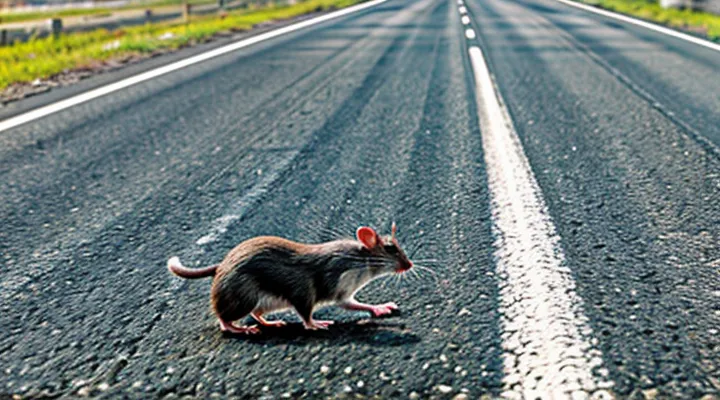
«The Enigmatic Journey of Rodents»
«Unraveling the Mystery: Why Rats Brave the Pavement»
«Instinctual Drives and Environmental Pressures»
Rats venture onto open pathways primarily because innate survival mechanisms compel them to explore beyond burrow confines. The drive to locate food, secure shelter, and expand territorial range activates neural circuits linked to foraging and risk assessment. When these circuits detect potential resources across a surface, the animal initiates crossing behavior despite exposure to predators and traffic.
Environmental pressures intensify this tendency. Urban landscapes present fragmented habitats, forcing rats to navigate between isolated green patches, waste sites, and water sources. Seasonal fluctuations in temperature and food availability further heighten the urgency to move. Human activity creates both obstacles and opportunities: discarded garbage offers high‑calorie meals, while vehicle flow imposes a temporal window that rats learn to exploit.
Key factors influencing road‑crossing decisions:
- Resource gradients – concentration of edible waste on the opposite side.
- Predator avoidance – crossing to escape cats, owls, or aggressive conspecifics.
- Population density – overcrowding prompts dispersal to reduce competition.
- Light and vibration cues – nocturnal activity aligns with reduced traffic noise.
The combined effect of instinctual imperatives and anthropogenic changes produces a predictable pattern: rats assess risk, calculate potential gain, and cross when the benefit outweighs the danger.
«The Allure of the Other Side: Food, Shelter, Mates»
Rats navigate streets to access the opposite curb when it offers superior resources. The decision to cross is driven by measurable benefits rather than random movement.
- Food: Waste bins, discarded produce, and compost piles present higher caloric returns than nearby sources.
- Shelter: Cracks, drainage systems, and vegetation on the far side provide protection from predators and environmental extremes.
- Mates: Dense populations on the other side increase encounter rates, enhancing reproductive success.
These incentives shape movement patterns that influence urban pest distribution. Effective management must consider the spatial arrangement of waste containers, structural gaps, and habitat patches to disrupt the attraction and reduce crossing frequency.
«Survival Strategies: Calculated Risks or Desperate Measures?»
Rats that move across paved surfaces face a combination of predation pressure, food scarcity, and habitat fragmentation. Crossing a road offers direct access to new foraging patches, shelter opportunities, and breeding sites that are otherwise isolated by human infrastructure.
Survival tactics observed in these movements fall into two categories:
- Calculated risk-taking – rats assess traffic flow, time crossings to periods of reduced vehicle density, and select routes with visual cover. This behavior reduces exposure to lethal encounters while maximizing resource acquisition.
- Desperate measures – individuals forced by overcrowding, depleted food stores, or sudden predator presence cross without regard for traffic patterns, resulting in higher mortality but occasionally securing critical short‑term gains.
Physiological stress markers rise during road traversal, indicating that the decision to cross is weighted against immediate survival needs. Behavioral experiments show that rats increase exploratory speed and reduce pause duration when external pressures intensify, confirming a shift from strategic to opportunistic crossing.
Overall, the decision matrix for road crossing balances the probability of reaching essential resources against the likelihood of injury. When environmental conditions permit, rats employ deliberate timing and route selection; under acute stress, they resort to rapid, less discriminating movements that reflect desperation.
«Understanding Rat Behavior in Urban Landscapes»
«Navigating Human-Dominated Environments»
«Sensory Perception: How Rats Perceive Roads and Traffic»
Rats rely on a combination of sensory systems to evaluate the hazards presented by paved surfaces and moving vehicles. Their whisker array (vibrissae) detects air currents and surface vibrations, allowing rapid identification of approaching wheels or vibrations transmitted through the pavement. The auditory system captures low‑frequency engine noise and high‑frequency tire squeal, providing early warning of oncoming traffic. Vision is limited by low light sensitivity, yet the retina contains a high density of rod cells, enabling detection of sudden changes in contrast, such as headlights or shadows cast by vehicles. Olfactory receptors sense chemical cues from exhaust fumes and oil residues, which can indicate the presence of a road and the proximity of motorized traffic.
Key aspects of rat sensory processing:
- Tactile feedback: Vibrissae transmit minute pressure changes, facilitating precise distance estimation.
- Auditory cues: Frequency analysis distinguishes between ambient urban sounds and the distinct acoustic signature of approaching cars.
- Visual detection: Motion-sensitive retinal pathways trigger escape responses when rapid luminance shifts occur.
- Chemical sensing: Olfactory detection of hydrocarbons and heat signatures informs risk assessment and route selection.
Integration of these modalities occurs in the brainstem and hypothalamic circuits, producing a coordinated escape response. When sensory input exceeds a threshold—such as a sudden vibration coupled with a loud engine roar—motor neurons initiate rapid locomotion across the roadway. This multimodal perception enables rats to navigate complex traffic environments with remarkable efficiency.
«Adaptation and Learning: Overcoming Obstacles»
Rats frequently negotiate paved pathways, a behavior that directly influences their ability to locate food, escape predators, and access shelter. Their movements across these surfaces are not random; they result from evolved sensory systems that detect vibrations, visual cues, and chemical signals, allowing rapid assessment of potential danger.
Adaptation manifests in several physiological and behavioral traits. Highly developed whisker arrays capture minute air currents, while acute vision distinguishes moving vehicles from static objects. Muscle coordination enables swift, low‑profile sprints that reduce exposure time on exposed ground.
Learning reinforces successful crossing tactics. Individual rats retain memory of safe intervals between traffic flows, adjusting departure times accordingly. Observational learning spreads optimal routes through colony networks, as newcomers follow experienced members to known crossing points. Positive outcomes—reaching food sources or nesting sites—strengthen the neural pathways governing these actions.
Rats overcome obstacles through a combination of strategies:
- Timing crossings to coincide with reduced vehicle speed or traffic gaps.
- Selecting routes with minimal lighting, which lowers detection by predators.
- Utilizing natural cover, such as vegetation or roadside debris, to mask movement.
- Modifying gait to navigate uneven surfaces, thereby maintaining balance and speed.
These adaptive and learned responses illustrate how rodents transform a hazardous environment into a navigable corridor, ensuring survival despite constant threats.
«Population Dynamics and Crossing Frequency»
Rodent road‑crossing activity correlates directly with fluctuations in local population size. When breeding cycles produce a surge in individuals, the probability that any given animal encounters a paved surface rises proportionally. Field surveys in metropolitan districts report a 1.8‑fold increase in crossing events during peak reproductive months compared with off‑peak periods.
High population density intensifies competition for food and shelter, prompting individuals to expand their foraging range. Expanded ranges intersect transportation corridors more frequently, elevating crossing counts. Empirical models that incorporate density‑dependent dispersal predict crossing frequency (C) as C = k · N^α, where N represents local abundance, k is a habitat‑specific coefficient, and α ranges between 0.9 and 1.2 for urban rat assemblages.
Age structure exerts a measurable effect. Juvenile rats, accounting for roughly 30 % of the cohort in spring, display higher mobility and lower risk aversion, resulting in crossing rates up to 45 % greater than adult counterparts. Male individuals, particularly during the mating season, increase road use to locate receptive females, further amplifying overall traffic presence.
Seasonal resource availability modulates crossing behavior. Periods of food scarcity force rats to traverse longer distances to reach waste sites or agricultural fields, thereby increasing interaction with road networks. Conversely, abundant refuse bins near sidewalks reduce the need for extensive movement, lowering crossing incidents.
Urban landscape features shape the relationship between population dynamics and road usage. Elements that facilitate safe passage—such as vegetated medians, culverts, or underpasses—can decouple density from crossing frequency by providing alternative routes. In contrast, fragmented habitats and high‑traffic arteries amplify exposure, especially for dense populations.
Key determinants of crossing frequency
- Local population density (primary driver)
- Proportion of juveniles within the cohort
- Seasonal mating activity of males
- Availability of food resources near roadways
- Presence or absence of mitigation structures
Understanding these variables enables targeted management strategies that reduce rodent‑vehicle conflicts while accounting for the inherent ecological processes governing rat populations.
«Ecological Implications of Road Crossing»
«Impact on Rat Populations»
Road‑crossing behavior directly influences rat population structure. Crossing events create pathways between otherwise isolated groups, allowing individuals to access new food sources, shelter, and breeding opportunities. The resulting movement reshapes local densities and alters demographic trends.
Key impacts include:
- Increased mortality: vehicle collisions remove a measurable portion of individuals, reducing short‑term numbers.
- Enhanced gene flow: survivors introduce genetic material into adjacent colonies, decreasing inbreeding risk.
- Expanded spatial distribution: successful crossings expand the range of colonies, facilitating colonization of vacant habitats.
- Altered predator‑prey dynamics: displaced rats encounter novel predators, shifting survival rates.
- Disease transmission: movement across roads spreads pathogens between distinct populations, affecting overall health status.
«Disease Transmission and Public Health Concerns»
Rats frequently move across streets while searching for food, shelter, or mates. This mobility brings them into close contact with human environments, creating pathways for pathogens to travel between wildlife, domestic animals, and people.
The most significant health risks stem from the pathogens rats commonly carry:
- Bacterial agents: Salmonella spp., Leptospira spp., and Yersinia pestis can be transmitted through contaminated water, soil, or direct contact with rat urine and feces.
- Viral agents: Hantavirus and Seoul virus spread via aerosolized rodent excreta, posing severe respiratory threats.
- Parasitic agents: Tapeworms (Hymenolepis spp.) and mites (Sarcoptes) may infest humans after accidental ingestion or skin contact.
Transmission routes linked to road crossings include:
- Environmental contamination: Rats leaving droppings on sidewalks, curbside gutters, and storm drains introduce pathogens into runoff that reaches residential water supplies.
- Direct contact: Pedestrians or vehicle occupants may encounter rats or their waste while navigating urban thoroughfares, especially in areas lacking proper waste management.
- Secondary vectors: Insects attracted to rat waste can acquire pathogens and subsequently bite humans, extending the infection chain.
Public health implications demand coordinated interventions:
- Surveillance: Routine testing of rodent populations in high‑traffic zones identifies emerging strains and guides response strategies.
- Sanitation: Prompt removal of garbage and sealing of entry points reduce attractants that draw rats onto roadways.
- Education: Informing the public about proper hand hygiene after outdoor activities and discouraging feeding of wildlife limits exposure.
By addressing the ecological drivers of rat movement across streets, health authorities can interrupt the transmission cycle and protect community health.
«Interactions with Other Wildlife»
Rats traverse roadways primarily to access food sources, nesting sites, and territorial corridors that are separated by traffic. While moving across pavement, they encounter a range of other animals, each influencing rat behavior and survival.
- Predatory birds, such as hawks and owls, exploit the open visibility of road surfaces to spot and ambush rats. Rats respond by increasing vigilance, employing rapid, erratic sprint patterns to reduce capture risk.
- Small carnivores, including foxes and feral cats, use roads as hunting grounds because prey movement is constrained. Rats often adopt a “wait‑and‑dash” strategy, pausing near cover before crossing to minimize exposure.
- Invertebrate scavengers, like beetles and ants, are attracted to rat carcasses or droppings left on road edges. These insects facilitate decomposition and can indirectly affect rat populations by altering local nutrient cycles.
- Larger herbivores, such as deer, may inadvertently create pathways that rats exploit. When deer move across roads, they disturb vegetation, exposing seeds and insects that provide supplemental food for rats.
Competition for limited resources also shapes rat interactions. When multiple species converge on the same waste deposits near roadways, rats display aggressive displacement behaviors, securing priority access through scent marking and physical confrontation.
Overall, rat road crossings represent a dynamic interface where predation pressure, competition, and opportunistic feeding converge, dictating movement patterns and influencing broader ecological relationships across the traffic corridor.