
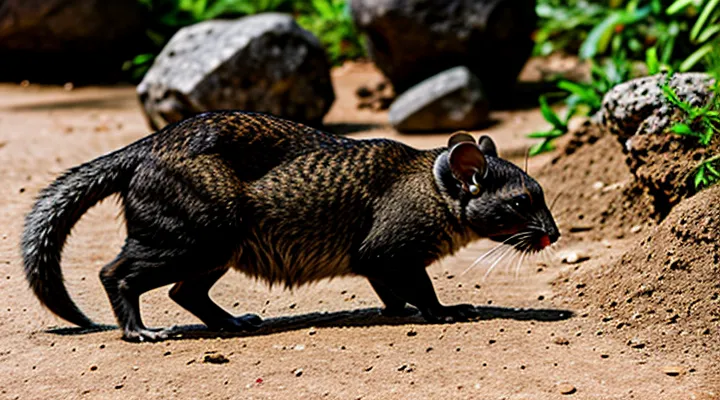
Discovery and Taxonomy
Initial Identification
The Laos rock rat was first recognized as a distinct species in 2005 during a biodiversity survey of the Khammouan limestone karsts in central Laos. Researchers from the French National Museum of Natural History and the University of Kansas collected several specimens from rocky outcrops and cave entrances, noting morphological traits that did not match any known murid rodents.
Key diagnostic characteristics identified at the time include:
- A robust, laterally compressed skull with a pronounced sagittal crest.
- Dense, coarse fur exhibiting a gray‑brown dorsal coloration and a lighter ventral side.
- Large, rounded ears lacking prominent pinnae hair.
- Hind feet with elongated fourth digits adapted for climbing on steep rock surfaces.
- Dental formula of 1.0.0.3/1.0.0.3, with molars bearing distinctive cusp patterns.
The initial specimens were deposited in the Museum National d'Histoire Naturelle (MNHN) and the Smithsonian Institution, providing reference material for subsequent taxonomic work. Molecular analysis of mitochondrial DNA later confirmed the species’ placement within the family Muridae, establishing it as the sole member of the genus Laonastes.
Reclassification as a «Living Fossil»
The Laos rock rat, a murid discovered in 2005 in the limestone karsts of northern Laos, exhibits a combination of primitive and derived traits that prompted a reassessment of its taxonomic position. Initial classification placed the species within the family Muridae, yet morphological analysis revealed features characteristic of the extinct family Diatomyidae, known only from Eocene fossils.
Reclassification as a “living fossil” rests on several lines of evidence. The species possesses a hystricognathous jaw, a dental formula with retained premolars, and a robust skull morphology that parallel fossil diatomyids. Molecular phylogenetics confirm a deep divergence from extant murids, estimating a split of approximately 45 million years. The limited geographic range and specialized rocky habitat further support the notion of evolutionary stasis.
- Primitive cranial structure consistent with Eocene diatomyids
- Retention of ancestral dental characters absent in modern murids
- Genetic divergence indicating an ancient lineage exceeding 40 Myr
- Habitat specificity that limits exposure to selective pressures driving rapid change
The designation underscores the species’ significance for understanding rodent evolution, biogeography, and the persistence of archaic lineages in isolated environments. Conservation measures become imperative, as the loss of this taxon would eliminate a direct link to a lineage thought extinct for tens of millions of years.
Physical Characteristics
General Appearance
Size and Weight
The Laos rock rat measures approximately 12 – 13 cm from snout to the base of the tail. Its tail adds another 11 – 12 cm, resulting in a total length near 24 cm. Adult individuals typically weigh between 55 g and 70 g, with slight variation linked to age and sex.
- Head‑body length: 12–13 cm
- Tail length: 11–12 cm
- Body mass: 55–70 g
These dimensions place the species among the smaller murid rodents, reflecting its adaptation to rocky limestone habitats.
Fur Coloration
The Laos rock rat exhibits a distinctive fur palette that aids identification and reflects its ecological adaptations. Dorsal pelage is predominantly a warm, reddish‑brown shade, interspersed with coarse, darker guard hairs that create a subtle, speckled appearance. The ventral side presents a lighter, creamy‑tan coloration, contrasting sharply with the darker back and providing a visual cue for predator detection from below.
Key aspects of the fur coloration include:
- Base hue: Reddish‑brown on the back, transitioning to a muted gray‑brown on the flanks.
- Guard hair pattern: Darker, thicker hairs overlay the base, forming a mottled texture.
- Ventral contrast: Creamy‑tan to off‑white underparts, extending to the throat and belly.
- Seasonal variation: Slight fading of the dorsal hue during the wet season, while the ventral color remains stable.
- Age‑related changes: Juveniles display a paler overall tone, with the characteristic reddish‑brown developing fully by sexual maturity.
These color characteristics are consistent across the species’ known range in northern Laos, providing reliable markers for field researchers and taxonomists.
Distinctive Anatomical Features
Skull and Dental Structure
The skull of the Laos rock rat exhibits a compact, robust construction adapted to its fossorial lifestyle. The cranium is relatively short, with a pronounced occipital region that supports strong neck muscles. The facial bones are fused, forming a solid rostrum that protects the incisors during digging. The zygomatic arches are broad, providing attachment sites for powerful masticatory muscles, while the palate is vaulted, allowing space for an expanded nasal cavity. The auditory bullae are enlarged, suggesting acute hearing capabilities.
Dental morphology reflects a diet of hard seeds and roots. The species possesses a hystricomorph dentition pattern characterized by ever‑growing incisors and reduced cheek teeth. The dental formula can be summarized as:
- Incisors: 1/1
- Canines: 0/0
- Premolars: 0/0
- Molars: 3/3
Incisors are curved, enamel‑rich on the labial surface, and display open roots that continuously erupt. Molars are brachydont, with low crowns and complex occlusal surfaces suited for grinding. Enamel thickness varies along the tooth axis, providing resistance to wear while maintaining sharp cutting edges. The mandible is stout, with a deep coronoid process that accommodates large temporalis muscles, reinforcing bite force during gnawing.
Limbs and Tail
The Laos rock rat possesses robust forelimbs and hindlimbs adapted for climbing and navigating rugged terrain. Each limb ends in sharp, retractable claws that provide secure grip on rock surfaces and tree bark. Muscular development is pronounced, allowing rapid ascent and precise maneuvering across steep inclines.
Key characteristics of the tail include:
- Length roughly equal to body size, providing balance during vertical movement.
- Covered with dense, slightly scaly fur that reduces friction against surfaces.
- Flexible vertebral column enabling swift lateral adjustments and support while the animal hangs or pivots.
Overall, the limb and tail morphology supports an agile, arboreal lifestyle in the limestone karst environments where the species is endemic.
Habitat and Distribution
Geographic Range
The Laos rock rat occupies a highly restricted distribution confined to central and northern Laos. Confirmed records come from isolated limestone karst formations, where the species persists in rocky outcrops and adjacent forest patches.
- Khammouane Province: Phou Hin Bun karst complex, elevations 300–550 m.
- Xieng Khouang Province: Nam Et-Phou Louey National Protected Area, elevations 400–650 m.
- Houaphanh Province: Vieng Phouka karst region, elevations 350–600 m.
All known sites lie within the Annamite Range, within a narrow climatic envelope characterized by moderate rainfall and a subtropical monsoon pattern. The species has not been documented outside these karst habitats, indicating an endemic range limited to specific geological formations in Laos.
Preferred Environment
The Laos rock rat inhabits rugged karst landscapes characterized by extensive limestone formations. Populations concentrate on steep cliffs and fissures where shelter and foraging opportunities converge. Soil depth is minimal, and vegetation is limited to hardy, drought‑tolerant species that grow in crevices.
Typical environmental parameters include:
- Elevation: 500–1,200 m above sea level.
- Substrate: weathered limestone, boulder fields, and talus slopes.
- Climate: tropical monsoon with pronounced wet and dry seasons; average annual rainfall 1,200–1,800 mm.
- Temperature: night‑time lows around 15 °C, daytime highs reaching 28 °C.
- Vegetation: sparse scrub, mosses, and lichens that colonize rock surfaces.
The species exploits narrow ledges and underground cavities for nesting, relying on the thermal stability of the rock mass. Proximity to freshwater streams enhances insect prey availability, supporting the rat’s omnivorous diet. Human disturbance is minimal in these remote habitats, preserving the ecological conditions essential for the species’ survival.
Behavior and Ecology
Diet
The Laos rock rat consumes a varied diet that reflects its opportunistic foraging strategy. Primary components include:
- Seeds and grains harvested from low‑lying fields and riverbanks.
- Fresh fruits such as figs, mangoes, and wild berries, especially during the rainy season.
- Invertebrates, notably beetles, termites, and earthworms, accessed through soil excavation and bark stripping.
- Occasional plant material, including young shoots, leaf litter, and fungal mycelia.
Seasonal shifts influence intake proportions; dry periods see increased reliance on seeds and insects, while the wet season expands fruit consumption. Food is typically gathered during crepuscular activity, with the animal storing excess seeds in burrow chambers for later use. Nutrient balance is maintained through the combination of carbohydrate‑rich plant matter and protein‑dense arthropods, supporting reproductive output and rapid growth rates.
Reproduction
The Laos rock rat (Laonastes aenigmamus) exhibits a reproductive strategy typical of small, forest-dwelling rodents. Females reach sexual maturity at approximately six months of age, enabling the species to generate multiple generations within a single year under favorable conditions.
Breeding occurs primarily during the rainy season, when food availability peaks. Gestation lasts 28–30 days, after which litters of two to three offspring are born. Neonates are altricial, attaining independence after 30–35 days of maternal care. Females can produce up to three litters annually, depending on habitat quality and climatic factors.
Key reproductive parameters:
- Sexual maturity: ~6 months (both sexes)
- Breeding season: rainy months (May–October)
- Gestation period: 28–30 days
- Litter size: 2–3 pups
- Weaning age: 30–35 days
- Potential litters per year: up to 3
Reproductive output directly influences population dynamics, especially in fragmented habitats where reduced food resources can limit litter size and breeding frequency. Understanding these parameters assists in assessing the species’ resilience to environmental pressures and guides conservation management plans.
Nocturnal Activity
The Laos rock rat (Laonastes aenigmamus) conducts the majority of its foraging and social interactions during the dark hours. Activity peaks shortly after sunset and declines before dawn, aligning with the crepuscular window when temperature and humidity are optimal for movement on limestone outcrops.
Key aspects of its nocturnal behavior include:
- Sensory adaptation: enlarged eyes and highly sensitive vibrissae enable precise navigation on rugged terrain in low‑light conditions.
- Foraging strategy: individuals browse on mosses, lichens, and fallen seeds, exploiting food resources that are less contested at night.
- Territorial movement: nightly patrols cover a radius of 30–50 m from a central burrow, allowing individuals to locate mates and assess rival presence while minimizing exposure to diurnal predators.
- Thermoregulation: reduced ambient temperatures after dusk lower metabolic demand, facilitating prolonged activity without excessive water loss.
Field observations in the Khammouane karst region show a consistent pattern of nocturnal emergence, with 85 % of recorded individuals active between 1900 and 0300 h. Radio‑telemetry data indicate that individuals return to their refuges before sunrise, where they remain inactive for the daylight period. This temporal niche reduces competition with sympatric diurnal rodents and limits predation risk from visual hunters such as raptors.