
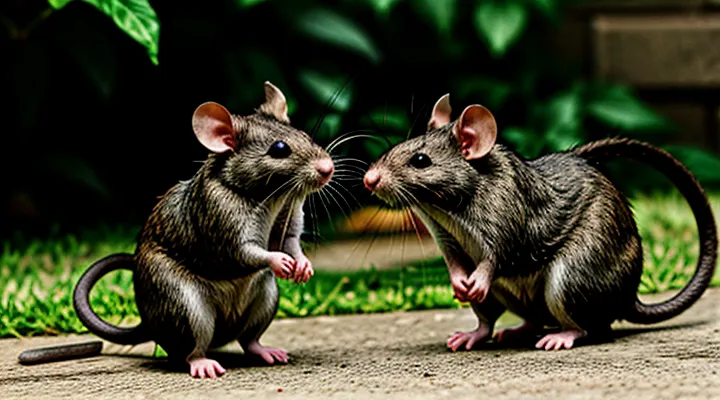
The Enigmatic World of Rat Communication
Unraveling the Myth: Do Rats Truly Laugh?
The Concept of Laughter in Animals
Laughter, defined as a spontaneous vocal or physiological response to positive stimulation, occurs across several animal taxa. Evidence demonstrates that non‑human species produce distinct sounds and behaviors comparable to human laughter during play, social interaction, or relief from stress.
Key observations include:
- Rats emit high‑frequency ultrasonic chirps when engaged in tickling or rough‑and‑tumble play; these calls increase in frequency and intensity with the animal’s arousal level. Studies describe the phenomenon as «Rats emit 50‑kHz ultrasonic vocalizations when tickled», indicating a laughter‑like response.
- Chimpanzees produce panting bursts and vocalizations during tickling and cooperative activities, accompanied by relaxed facial expressions.
- Dogs display rapid exhalations and body tremors while engaged in playful chase, a pattern linked to positive affect.
- Dolphins generate burst‑pulse vocalizations during social games, suggesting a shared acoustic signature of mirth.
Criteria for classifying a response as laughter typically involve:
- Spontaneity, without external prompting beyond the playful stimulus.
- Involuntary production, reflected in consistent acoustic structures across individuals.
- Association with increased heart‑rate variability and reduced cortisol levels, indicating a positive emotional state.
Research methodologies combine acoustic analysis, physiological monitoring, and ethological observation. Playback experiments reveal that conspecifics respond to recorded laughter‑like calls by approaching the source, supporting a communicative function. Simultaneous measurement of heart rate and hormone levels validates the affective component of the response.
Understanding laughter in animals clarifies the evolutionary origins of humor, highlighting its role in social cohesion and stress mitigation. Comparative data suggest that the capacity for laughter predates human language, serving as a fundamental mechanism for group bonding across mammals and some avian species.
Defining Laughter: Human vs. Animal Perspectives
Laughter denotes a rapid series of vocalizations accompanied by facial muscle activity that signals a positive affective state. In humans, the phenomenon integrates respiratory control, laryngeal vibration, and synchronized facial expressions such as the elevation of the mouth corners. Neurological substrates involve the limbic system, the prefrontal cortex, and brainstem nuclei that coordinate motor output. Social function emerges from the capacity of laughter to synchronize group dynamics, reinforce bonds, and convey information about intent.
In non‑human mammals, comparable behaviors appear as short, high‑frequency chirps, squeaks, or chuckles that arise in specific contexts. Research on rodents demonstrates that ultrasonic vocalizations increase during play and are modulated by reward pathways analogous to those activated in human mirth. Primates produce panting or chuckling sounds during grooming or social play, suggesting a shared evolutionary origin. Avian species exhibit rapid beak‑clicking that fulfills a similar communicative role, although the acoustic structure differs markedly from mammalian laughter.
Key criteria distinguishing human and animal laughter include:
- Acoustic pattern: Frequency range, duration, and harmonic structure.
- Physiological coordination: Involvement of respiratory and facial musculature.
- Contextual triggers: Play, tickling, social bonding, or stress relief.
- Emotional valence: Presence of positive affect confirmed by neurochemical markers.
- Contagiousness: Propensity to induce similar vocalizations in conspecifics.
Comparative analysis reveals overlapping mechanisms, particularly in the activation of reward circuits and the use of vocal signals to reinforce social cohesion. Differences arise chiefly in linguistic complexity and the degree of voluntary control over the vocal apparatus. The convergence of these features supports the view that laughter, while species‑specific in expression, rests on a common biological foundation.
The Science Behind Rat Vocalizations
Ultrasonic Chirps: More Than Just Squeaks
The Discovery of 50-kHz Calls
The discovery of ultrasonic vocalizations around 50 kHz marked a turning point in understanding rodent communication. Researchers identified these calls while recording rats exposed to mild tactile stimulation, such as gentle tickling. The emissions were brief, frequency‑modulated bursts detectable only with specialized microphones.
Experimental observations revealed consistent patterns:
- Calls increased dramatically during social play and after rewarding stimuli.
- Emission frequency peaked at 50 kHz, with durations of 30–100 ms.
- Playback of recorded calls induced approach behavior in conspecifics.
Neurophysiological measurements showed activation of brain regions linked to positive affect, including the nucleus accumbens and the ventral tegmental area. Pharmacological blockade of dopamine receptors reduced call production, indicating a dopaminergic component.
The acoustic profile and contextual triggers resemble human laughter, prompting the description of 50‑kHz vocalizations as “laugh‑like” signals. Nevertheless, scholars caution against direct equivalence, emphasizing species‑specific emotional expression and the absence of conscious self‑awareness in rodents. The evidence supports the view that these ultrasonic calls constitute a robust indicator of pleasurable states, thereby informing the broader debate on animal laughter.
Analyzing the Context of These Vocalizations
Rats emit a range of ultrasonic vocalizations that differ in frequency, duration, and pattern. During social interactions, these sounds appear in three distinct situations: play, mild stress, and reward anticipation. Each scenario triggers a characteristic acoustic signature, allowing researchers to separate laughter‑like calls from alarm calls.
- Playful bouts generate short, broadband chirps with a rapid rise‑fall contour.
- Mild stress produces longer, tonal whistles that maintain a steady frequency.
- Anticipation of food or novel objects elicits a series of repetitive, high‑frequency clicks.
Neurophysiological recordings show that the auditory cortex responds selectively to the playful chirps, indicating a positive affective state. Simultaneous measurements of heart rate and cortisol levels reveal a decrease during these calls, contrasting with the elevated stress markers observed during alarm vocalizations. This physiological pattern supports the interpretation of the calls as expressions of enjoyment rather than mere communication of danger.
The distinction between laughter‑like and distress vocalizations clarifies the functional role of rat ultrasonic sounds. Understanding these differences refines models of mammalian affect and informs experimental designs that rely on behavioral readouts. Future work should map the neural circuitry underlying each call type and test cross‑species parallels in affective communication.
Play Behavior and Affiliative Interactions
Tickling Experiments and Positive Reinforcement
Tickling experiments provide the primary evidence for laughter‑like behavior in laboratory rodents. Researchers restrain a rat on a table, then gently stroke the ventral neck and belly with a soft brush. The animal typically responds with rapid 50‑kHz ultrasonic vocalizations (USVs) and spontaneous chirping, a pattern absent during neutral handling. These vocalizations increase in frequency and duration when the stimulus is repeated, indicating a positive affective state.
Positive reinforcement amplifies the response. After each tickling bout, the rat receives a small food reward or a brief access to a running wheel. The reinforcement schedule follows a variable‑ratio pattern, which maximizes the likelihood of repeated USV emission. Over successive sessions, rats exhibit shorter latency to vocalize and higher overall call rates, demonstrating that the behavior is not merely reflexive but conditioned by reward.
Key observations from the protocol:
- 50‑kHz USVs emerge within seconds of tactile stimulation.
- Reinforced rats produce up to three times more calls than non‑reinforced controls.
- Call amplitude and bandwidth expand with repeated pairing of tickling and reward.
- Withdrawal of reinforcement leads to a gradual decline in vocalization frequency, confirming the role of positive reinforcement in maintaining the response.
The combination of gentle tactile stimulus and systematic reward delivery establishes a reliable paradigm for studying affective communication in rodents. The data support the hypothesis that rats possess a laughter‑like vocal expression, observable through controlled tickling and reinforced conditioning. «Rats emit 50‑kHz ultrasonic vocalizations when tickled», a finding replicated across multiple laboratories, reinforces the conclusion that these calls represent a positive emotional state comparable to human laughter.
Evidence of Emotional Contagion
Rats emit ultrasonic vocalisations that resemble human laughter during play, a phenomenon documented in controlled laboratory observations. Researchers have recorded these sounds at frequencies between 50 kHz and 70 kHz, noting increased occurrence when rats engage in reciprocal chasing and tickling. The acoustic pattern aligns with a specific “chirp” structure, distinguished from distress calls by its rhythmic, short‑duration bursts.
Evidence of emotional contagion emerges when a rat exposed to a conspecific’s laughter‑like chirps subsequently displays heightened engagement in play behaviour. Key findings include:
- Playback of recorded chirps triggers immediate approach and increased locomotor activity in naïve rats, indicating an automatic affective response.
- Simultaneous video‑audio monitoring shows synchronized whisker movements and facial expressions among group members after exposure to the vocalisation.
- Pharmacological blockade of dopamine receptors diminishes the contagion effect, suggesting a neurochemical basis for shared positive affect.
These results demonstrate that rats not only produce laughter‑analogous sounds but also transmit the associated emotional state to peers, supporting the existence of contagious positive affect in rodent social interactions.
Implications and Future Research
Understanding Animal Emotion and Cognition
Bridging the Gap: Interspecies Emotional Recognition
Recent investigations have examined acoustic emissions produced by laboratory rats during play and social interaction. High‑frequency chirps, often termed “ultrasonic vocalizations,” appear in situations that humans label as pleasurable. Comparative analysis demonstrates measurable parallels between these sounds and human laughter, suggesting a shared affective substrate across species.
Neuroscientific recordings reveal activation of brain regions associated with positive affect in both rodents and primates when such vocalizations occur. Hormonal assays show concurrent rises in oxytocin and dopamine, reinforcing the hypothesis that emotional states can be recognized beyond taxonomic boundaries. These findings provide a concrete framework for interpreting animal affect without anthropomorphic bias.
Key implications for interspecies emotional recognition include:
- Validation of ultrasonic vocalizations as reliable indicators of positive affect in rodents.
- Expansion of behavioral paradigms to incorporate cross‑species affective markers.
- Enhancement of welfare protocols by integrating acoustic monitoring for early detection of stress or contentment.
- Advancement of translational models that align rodent affective responses with human emotional research.
Collectively, the evidence narrows the perceptual divide between humans and rodents, establishing a scientifically grounded pathway for acknowledging emotional experiences across diverse taxa.
Ethical Considerations in Animal Studies
Research on the possibility that rodents produce laughter-like sounds raises several ethical issues that must be addressed before experimental procedures commence.
Animal welfare standards require that any study involving rats provide clear justification for the use of live subjects, demonstrate that the research question cannot be answered through non‑animal methods, and incorporate measures to minimize pain, stress, and distress.
Regulatory compliance mandates approval from an institutional animal care and use committee (IACUC) or equivalent body. Review panels evaluate the scientific merit of the hypothesis, the adequacy of experimental design, and the availability of refinement strategies such as environmental enrichment, analgesia, and humane endpoints.
Transparency obligations include detailed reporting of housing conditions, handling protocols, and criteria for terminating experiments. Publication of negative results and methodological limitations contributes to reproducibility and reduces unnecessary duplication of animal work.
Ethical scrutiny also encompasses public perception. Claims about animal emotions can influence societal attitudes toward research funding and animal protection legislation. Researchers bear responsibility for accurate communication, avoiding sensationalism that could mislead non‑specialist audiences.
Key considerations:
- Scientific necessity: evidence that the question cannot be resolved with in‑silico models or cell cultures.
- Minimization of harm: use of the lowest number of animals compatible with statistical power, implementation of analgesics, and provision of enriched environments.
- Humane endpoints: predefined criteria for cessation of exposure when signs of excessive distress appear.
- Oversight: regular audits by independent ethics committees and compliance with national and international guidelines.
- Data integrity: comprehensive documentation of experimental variables, including acoustic recording settings and behavioral scoring methods.
Adherence to these principles ensures that investigations into rat vocalizations proceed with respect for animal rights while maintaining scientific credibility.
Potential Applications in Neuroscience
Modeling Human Affective Disorders
Rats exhibit ultrasonic vocalizations that share acoustic features with human laughter, providing a measurable proxy for affective states in non‑human mammals. These signals enable researchers to construct animal models that reflect the neurobiological substrates of mood disorders, facilitating the translation of findings to human conditions.
Key advantages of using rodent vocalizations for affective modeling include:
- Quantifiable emission patterns that correlate with reward‑related brain activity.
- Sensitivity to pharmacological agents that modify emotional processing, allowing rapid assessment of therapeutic efficacy.
- Compatibility with genetic manipulation techniques, supporting the investigation of hereditary factors in mood dysregulation.
Integrating ultrasonic vocalization analysis with established behavioral assays (e.g., sucrose preference, forced swim) yields multidimensional datasets. Such integration improves the discrimination between depressive‑like and anxiety‑like phenotypes, enhancing the precision of diagnostic criteria in preclinical studies.
The convergence of rat vocalization research and affective disorder modeling advances the understanding of emotional circuitry. By aligning observable animal responses with human emotional markers, the approach bridges gaps between basic neuroscience and clinical psychiatry, supporting the development of targeted interventions.
Exploring Brain Mechanisms of Joy
Research on rodent vocalizations has revealed patterns that resemble human laughter, prompting investigation into the neural substrates of positive affect in mammals. The focus shifts from behavioral observation to the circuitry that generates joy‑related signals.
Key structures implicated in reward and mirth include:
- Nucleus accumbens, especially the shell region, where dopamine release correlates with pleasurable stimuli.
- Ventral tegmental area, providing dopaminergic input to the forebrain.
- Prefrontal cortex, integrating sensory cues and modulating emotional expression.
- Amygdala, processing affective valence of tactile interaction.
- Periaqueductal gray, coordinating vocal output linked to positive states.
Neurochemical dynamics feature rapid dopamine surges, serotonin modulation, and activation of endogenous opioid pathways. These messengers converge on the listed nuclei, shaping the experience of joy and the production of ultrasonic vocalizations.
Experimental evidence derives from tickling protocols that elicit high‑frequency calls, electrophysiological recordings showing increased firing rates in the nucleus accumbens, and functional imaging indicating synchronized activity across the reward network. One study reported that “tickling‑induced calls are accompanied by a three‑fold rise in dopamine concentration within the ventral striatum” («Tickling‑induced calls are accompanied by a three‑fold rise in dopamine concentration within the ventral striatum»).
The convergence of behavioral, electrophysiological, and neurochemical data supports a model in which joy in rodents engages a conserved reward circuit. Understanding this circuitry clarifies the biological basis of laughter‑like behavior and informs comparative studies of affect across species.