
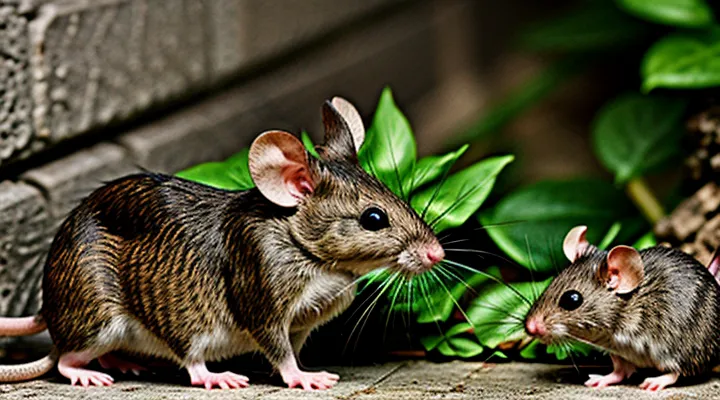
Visual Identification: Key Differences Between Mice and Rats
Size and Body Shape
Overall Body Size
Overall body size offers a reliable visual cue for separating the two rodents. A typical house mouse measures 6–10 cm from nose to the base of the tail, with an additional tail length of 5–9 cm; total length rarely exceeds 20 cm. Body mass ranges from 15 to 30 g.
A common Norway rat reaches 20–25 cm from nose to the base of the tail, plus a tail of similar or slightly longer length, resulting in a total length of 30–40 cm. Body mass falls between 250 and 300 g, occasionally exceeding 500 g in mature individuals.
Key comparative points:
- Length (nose‑to‑base): mouse ≈ 6–10 cm; rat ≈ 20–25 cm.
- Tail proportion: mouse tail roughly equal to body length; rat tail equal to or longer than body length.
- Weight: mouse ≈ 15–30 g; rat ≈ 250–300 g.
These dimensional differences enable rapid visual discrimination without the need for close inspection.
Body Proportions: Head-to-Body Ratio
Body proportions provide a reliable visual cue for separating small rodents from larger ones. The head‑to‑body ratio differs markedly between the two species, allowing quick identification without detailed measurement tools.
- Mice exhibit a head length that accounts for roughly 20 %–25 % of the total body length. The relatively large head compared with a short torso creates a compact silhouette.
- Rats display a head length of about 12 %–15 % of the total body length. A longer torso and proportionally smaller head produce an elongated appearance.
When observing an unfamiliar specimen, measure the distance from the tip of the nose to the back of the skull, then compare it to the distance from the base of the skull to the base of the tail. A ratio closer to 1:4 indicates a mouse, whereas a ratio near 1:6 suggests a rat. This proportional distinction remains consistent across adult individuals of each species, regardless of coat color or fur texture.
Snout Shape
Snout shape provides a reliable visual cue for separating mouse and rat specimens.
Mice possess a narrow, elongated snout that tapers to a sharp point. The profile appears almost triangular, with the rostral edge forming a distinct angle. This configuration supports the animal’s ability to navigate tight spaces and probe small crevices.
Rats display a broader, more robust snout. The tip is blunt rather than pointed, giving the head a square‑ish silhouette when viewed from the side. The increased width accommodates stronger jaw muscles and a larger oral cavity.
Key distinguishing features:
- Length‑to‑width ratio: mouse snout ≈ 3 : 1; rat snout ≈ 2 : 1.
- Tip shape: mouse = sharp; rat = rounded.
- Profile outline: mouse = triangular; rat = rectangular.
Observing these characteristics alongside other morphological markers enables accurate identification without ambiguity.
Distinctive Physical Features
Ears: Size and Hairiness
Ears provide a reliable visual cue for separating small rodents.
Mice possess ears that are proportionally larger than the head, extending close to the eye line. Rats display smaller ears relative to head size, often positioned lower on the skull.
Hair coverage differs noticeably. The outer surface of a mouse ear is smooth, lacking noticeable fur. In contrast, a rat ear is covered with a thin layer of hair that can be felt when touched.
Key characteristics:
- Proportional size: mouse ear ≈ 1 cm, reaching near the eyes; rat ear ≈ 0.5 cm, set lower.
- Hairiness: mouse ear smooth, no visible hair; rat ear with fine hair on the pinna.
Observing these traits enables quick identification without handling the animal.
Tail: Length, Thickness, and Hair Covering
The tail provides a reliable visual cue for separating small rodents from larger ones.
Mice possess tails that are proportionally long relative to body size, often extending to the same length as the head‑body measurement. The tail surface is slender, with a diameter noticeably less than that of a rat’s tail. Fine, sparse hairs cover the entire length, giving a smooth appearance.
Rats display tails that are shorter in proportion to their bodies, typically reaching only two‑thirds of the head‑body length. The tail is robust, with a diameter that approaches half the width of the body. Hair is limited to the distal tip; the majority of the tail is naked and may exhibit a slightly scaly texture.
Key comparative points:
- Length – mouse: tail ≈ body length; rat: tail ≈ 0.6 × body length.
- Thickness – mouse: thin, uniform; rat: thick, tapering toward the tip.
- Hair covering – mouse: uniformly fine hairs; rat: hair restricted to the tip, otherwise bare.
Observing these characteristics enables accurate identification without additional equipment.
Feet: Size and Appearance
Feet provide reliable visual cues when comparing small rodents. Mice possess noticeably smaller feet relative to body length; each hind foot measures approximately 10‑12 mm, while rats exhibit hind feet ranging from 20‑25 mm. The size disparity reflects overall body mass differences and aids rapid identification in the field.
The plantar surface of a mouse foot displays a smooth, hair‑less pad with a subtle pink hue, whereas a rat’s pad appears broader, darker, and often covered with a thin layer of coarse hair. This contrast becomes evident when the animal is observed from a side angle or when the foot contacts a surface.
Toe count remains consistent—both species have five toes on each hind foot—but the spacing between toes varies. Mice feature tightly clustered toes with minimal interdigital space, creating a compact appearance. Rats present wider toe separation, producing a more splayed foot profile.
Claw morphology further distinguishes the two. Mouse claws are short, curved, and barely protrude beyond the toe tips. Rat claws are longer, more pronounced, and extend visibly beyond the toe tips, contributing to a sturdier grip.
Key visual markers:
- Hind foot length: mouse ≈ 10‑12 mm; rat ≈ 20‑25 mm.
- Pad texture: mouse smooth and hair‑less; rat broader, darker, lightly haired.
- Toe spacing: mouse compact; rat splayed.
- Claw length: mouse short; rat prominent.
Observing these characteristics enables accurate differentiation without reliance on additional anatomical features.
Fur: Color and Texture
Fur color provides a reliable visual cue. Mice typically display a uniform, light‑brown to gray coat that may appear almost silvery on the under‑belly. Rats often possess a coarser, darker pelage, ranging from deep brown to black, with a noticeable contrast between the dorsal and ventral surfaces. The dorsal fur of a rat may show a reddish‑brown hue in some breeds, while the mouse’s dorsal coloration remains consistently muted.
Texture differences further aid identification. Mouse fur is fine, soft, and lies close to the skin, giving a sleek appearance. Rat fur is thicker, coarser, and stands away from the body, creating a more rugged look. These textural traits affect tactile perception: a mouse feels smooth and delicate under gentle pressure, whereas a rat feels rough and dense.
Key distinguishing points:
- Color: light, uniform (mouse) vs. dark, variable (rat)
- Texture: fine, soft (mouse) vs. coarse, thick (rat)
- Dorsal‑ventral contrast: minimal (mouse) vs. pronounced (rat)
Observing these fur characteristics enables accurate visual separation of the two rodents.
Behavioral Cues (Observable Appearance)
Droppings: Size and Shape
Droppings provide a reliable visual cue for separating mouse activity from rat activity. Mouse feces are typically about 2–4 mm in length, roughly the size of a grain of rice, and display a uniform, cylindrical shape with tapered ends. Rat feces range from 6 mm to 12 mm, comparable to a small bean, and often exhibit a slightly flattened profile with blunt or rounded ends.
Key characteristics of the two types of droppings are:
- Length: mouse – 2–4 mm; rat – 6–12 mm.
- Shape: mouse – slender, pointed; rat – broader, blunt.
- Color consistency: mouse – dark brown to black, consistent throughout; rat – darker core with a lighter outer rim, especially when fresh.
When examining a potential infestation, locate droppings along runways, near food sources, and in concealed corners. A cluster of small, tapered pellets indicates mouse presence, whereas larger, blunt pellets signal rat activity. Recording the size and shape of droppings enables accurate identification without reliance on additional visual traits.
Nesting Habits: Materials and Location (Observable)
Nesting habits provide reliable visual cues for separating small rodents. Observers can assess the composition of nests and the sites where they are built to differentiate between the two species.
Typical nest materials differ markedly:
- Soft fibers such as shredded paper, cotton, or fabric are common in the smaller species’ constructions.
- Coarser items like shredded cardboard, dried plant matter, or small twigs dominate the larger species’ nests.
Preferred nesting locations also vary:
- Compact, concealed spaces near floor level—under appliances, inside cabinets, or within wall voids—are characteristic of the smaller rodent.
- Larger, open burrows or nests situated in basements, attics, or outdoor debris piles indicate the presence of the larger counterpart.
Movement: Gait and Speed
Movement provides reliable visual cues for separating a mouse from a rat. Small rodents exhibit distinct locomotion patterns that reflect body size, limb proportion, and muscular development.
Mice typically display a rapid, high‑frequency gait. Their steps are short, with a cadence that can exceed 10 steps per second on flat surfaces. The tail often flicks in synchrony with each stride, aiding balance during swift, erratic bursts. Acceleration is immediate, allowing mice to cover short distances quickly before pausing.
Rats move with a slower, more deliberate stride. Step length is longer, and the overall cadence ranges between 5 and 7 steps per second. The tail remains relatively stable, serving as a counterbalance rather than a rhythmic element. Rats achieve higher sustained speeds over longer runs, maintaining momentum with fewer pauses.
Key observable differences:
- Step frequency: mouse > rat
- Stride length: rat > mouse
- Tail motion: flicking in mouse, steady in rat
- Acceleration: abrupt in mouse, gradual in rat
When observing an unknown specimen, focus on the rhythm of footfalls, the amplitude of tail movement, and the duration of continuous travel. These locomotor traits, combined with size and fur characteristics, allow precise identification without reliance on additional equipment.
Why Accurate Identification Matters
Health Risks and Disease Transmission
Accurate visual identification of small rodents allows public‑health officials and pest‑management professionals to evaluate disease threats with precision. Distinguishing a mouse from a rat by size, tail length, ear shape, and fur texture provides the first step in assessing which pathogens are likely present in a given infestation.
Common health hazards linked to each species include:
- Mice – hantavirus, salmonellosis, leptospirosis, Lymphocytic choriomeningitis virus (LCMV).
- Rats – plague (Yersinia pestis), leptospirosis, hantavirus (primarily Seoul virus), rat‑borne rickettsiae, and various helminths.
Transmission pathways differ subtly between the two groups. Mice frequently contaminate food stores and surfaces with urine and droppings, creating aerosolized particles that convey hantavirus. Rats, owing to their larger size and more aggressive foraging behavior, often spread pathogens through bite wounds, ectoparasites such as fleas and mites, and extensive gnawing of infrastructure, which facilitates bacterial entry into water supplies.
Correct species identification informs control strategies. Targeted bait formulations, trap sizing, and placement techniques depend on the rodent’s physical characteristics. Moreover, risk communication to occupants can be tailored: mouse‑related warnings emphasize aerosol exposure, while rat‑related alerts focus on bite prevention and vector control. Implementing species‑specific measures reduces the likelihood of disease transmission and limits public‑health impacts.
Property Damage and Infestation Management
Rodent infestations generate structural damage, contaminated food supplies, and increased risk of disease transmission. Accurate visual identification of the species informs targeted control measures and reduces unnecessary property loss.
Key visual distinctions include:
- Body length: mice typically measure 2‑4 inches (5‑10 cm) without the tail; rats range from 6‑9 inches (15‑23 cm).
- Tail proportion: mouse tail approximates body length and appears thin; rat tail exceeds body length and is thicker.
- Ear size: mouse ears are large relative to head; rat ears are modest.
- Snout shape: mouse exhibits a pointed snout; rat presents a blunter profile.
- Fur texture: mouse fur is softer, often gray or brown; rat fur is coarser, commonly brown or black.
Effective infestation management follows a structured protocol:
- Conduct a thorough inspection to locate signs of activity and confirm species based on the visual criteria.
- Seal identified entry points using durable materials such as steel mesh or concrete.
- Deploy species‑specific traps or bait stations, placing them along established pathways.
- Implement sanitation practices that eliminate food and water sources, thereby reducing attraction.
- Establish a monitoring schedule to assess trap success and detect new intrusion signs, adjusting control tactics as needed.
Effective Pest Control Strategies
Distinguishing a mouse from a rat relies on observable traits such as body size, tail length, ear proportion, and head shape. Mice typically measure up to 4 inches in body length, possess a tail equal to or slightly longer than the body, and have proportionally larger ears. Rats exceed 7 inches, display a shorter tail relative to body length, and feature a broader, blunter head.
Accurate identification informs the selection of pest‑control measures. Strategies that address both species focus on preventing entry, reducing attractants, and applying targeted removal techniques.
- Seal openings larger than ¼ inch; rodents exploit gaps around pipes, vents, and foundation cracks.
- Eliminate food sources by storing grains in airtight containers, promptly cleaning spills, and securing garbage in sealed bins.
- Maintain vegetation away from building foundations; dense foliage offers shelter and nesting sites.
- Deploy snap traps or multi‑catch devices sized for the target rodent; mouse traps require smaller chambers, while rat traps accommodate larger bodies.
- Use bait stations with anticoagulant or non‑anticoagulant formulations; place stations along established runways, avoiding direct contact with non‑target animals.
- Conduct regular monitoring through inspection of droppings, gnaw marks, and burrow activity; adjust control actions based on observed species.
Integrating identification with these measures reduces infestation severity and limits collateral impact on non‑target wildlife. Continuous evaluation ensures that control tactics remain effective as rodent populations evolve.