
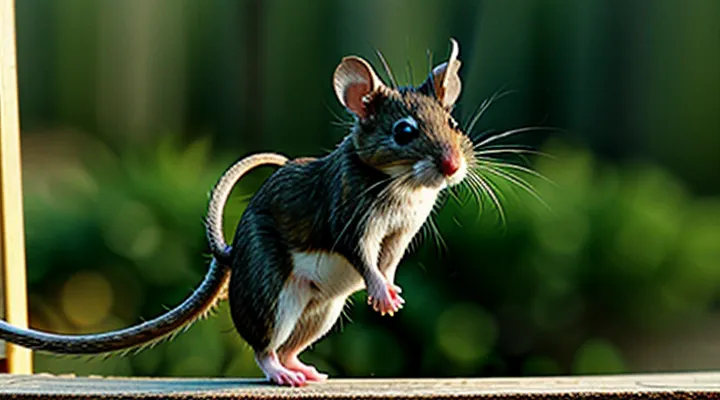
The Mechanics of a Mouse Jump
Anatomy for Leaping
Mice achieve remarkable vertical displacement thanks to a suite of specialized anatomical adaptations.
The hindlimb musculature dominates the leap. Large, fast‑twitch fibers in the gastrocnemius and soleus generate rapid, powerful contractions. The quadriceps femoris adds additional thrust, while the hamstrings control limb extension and stabilize the landing.
Skeletal structure supports the force output. The femur and tibia are elongated relative to body size, providing a longer lever arm for muscle attachment. A pronounced calcaneal tendon stores elastic energy during the crouch phase, releasing it explosively at take‑off.
Joint mechanics contribute to the motion envelope. The hip joint exhibits a wide range of flexion, allowing deep crouching. The ankle joint’s plantarflexion angle exceeds that of many other rodents, increasing the launch angle and height.
Additional features enhance performance:
- Tail act as a counter‑balance, adjusting the center of mass mid‑air.
- Lightweight skull and thorax reduce overall body mass, lowering the required lift.
- Highly efficient respiratory system supplies oxygen quickly during repeated jumps.
Together, these muscular, skeletal, and biomechanical traits enable mice to clear distances several times their body length in a single hop.
Factors Influencing Jump Height
Mice achieve vertical leaps that exceed their body length, yet the height they reach varies according to several physiological and environmental variables.
Muscle architecture dominates performance. A high proportion of fast‑twitch fibers supplies rapid force generation, while optimal pennation angles and tendon elasticity store and release energy during the take‑off phase. Limb morphology also matters; longer hind‑limb segments increase the lever arm, allowing greater propulsion for a given muscle contraction.
Body composition influences the power‑to‑weight ratio. Lower body mass reduces gravitational load, whereas excess adipose tissue diminishes acceleration. Age and health status affect both muscle quality and neuromuscular coordination; younger, healthy individuals display superior jump height compared with older or diseased specimens.
External conditions modify the effective output. Cooler ambient temperatures decrease muscle contractility, leading to shorter hops. Surface compliance alters energy return; firm substrates enable maximal force transmission, whereas soft or uneven ground absorbs impact and limits lift. Genetic factors determine baseline fiber type distribution and skeletal proportions, establishing inherent limits on vertical performance.
Key determinants can be summarized:
- Fast‑twitch muscle fiber proportion
- Hind‑limb length and joint leverage
- Body mass relative to muscle power
- Age‑related muscle integrity
- Health and nutritional status
- Ambient temperature
- Substrate firmness and texture
- Genetic makeup of skeletal‑muscular system
Understanding how each element interacts provides a comprehensive explanation for the observed range of mouse jump heights.
Typical Jump Heights for Common Mouse Species
House Mouse
The common house mouse (Mus musculus) measures 2–3 inches (5–8 cm) in body length and weighs 0.5–1 ounce (15–30 g). Its hind‑limb musculature and elastic tendon structures enable vertical jumps of approximately 12 inches (30 cm), roughly four times its body length. Horizontal leaps can reach 24–30 inches (60–75 cm), equivalent to six–nine body lengths.
Key measurements:
- Vertical jump: 10–12 inches (25–30 cm) under normal conditions; up to 15 inches (38 cm) when startled.
- Horizontal distance: 24–30 inches (60–75 cm) on level ground; longer when launching from an elevated perch.
- Take‑off speed: 2.5–3.0 m s⁻¹, generated by rapid contraction of the gastrocnemius and soleus muscles.
- Recovery time: 0.2–0.3 seconds from impulse to landing, allowing repeated jumps in quick succession.
Performance varies with age, health, and surface texture. Younger mice exhibit higher elasticity in tendons, producing slightly greater lift. Rough or slippery substrates reduce traction, lowering achievable height. Environmental cues such as predator presence or food scent trigger maximal effort, pushing jumps toward the upper limits of the recorded range.
These capabilities allow house mice to navigate complex indoor environments, clear gaps between floorboards, and escape through narrow openings. Understanding their jump mechanics informs pest‑control strategies, such as designing barriers that exceed typical vertical reach while minimizing horizontal gaps.
Deer Mouse
Deer mice (Peromyscus maniculatus) are among the most agile small mammals in North America. Their anatomy enables vertical jumps that regularly exceed 30 cm (12 in), a height equivalent to roughly ten times their body length.
Measured leaps in laboratory settings show peak vertical displacements of 35–40 cm (14–16 in) when mice are startled. Horizontal bounds reach 60–80 cm (24–31 in) in a single stride, allowing rapid movement across open ground.
Key contributors to this performance include:
- Long hind‑limb muscles that generate high power output.
- A flexible, prehensile tail that stabilizes the body during take‑off and landing.
- Lightweight skeletal structure that minimizes inertia.
These capabilities enable deer mice to evade aerial predators, cross gaps between vegetation, and access food sources on elevated surfaces such as low branches and rocks.
When compared with other rodent species:
- House mouse (Mus musculus) – typical vertical jump 15–20 cm (6–8 in).
- Meadow vole (Microtus pennsylvanicus) – vertical jump 10–12 cm (4–5 in).
- Kangaroo rat (Dipodomys spp.) – vertical jump up to 70 cm (28 in), but considerably larger body size.
The deer mouse’s jumping proficiency places it near the upper range for its size class, reflecting evolutionary pressure to navigate complex, predator‑rich habitats.
Other Mouse Species
Mice are not a single uniform group; dozens of species display distinct jumping performance that expands the range of vertical capabilities observed in laboratory‑bred house mice. Comparative data reveal that body size, hind‑limb morphology, and habitat preferences drive differences in leap height among species.
- Deer mouse (Peromyscus maniculatus): can launch approximately 15 cm (6 in) upward, surpassing the average domestic mouse by 30 percent.
- White‑footed mouse (Peromyscus leucopus): reaches about 12 cm (4.7 in) in a single hop, reflecting adaptations to forest floor litter.
- African pygmy mouse (Mus minutoides): despite a mass under 5 g, achieves jumps of roughly 8 cm (3.1 in), illustrating high power‑to‑weight ratios.
- Wood mouse (Apodemus sylvaticus): routinely clears obstacles up to 20 cm (7.9 in), a response to dense undergrowth and vertical shafts.
- Spiny mouse (Acomys cahirinus): records vertical leaps of 18 cm (7.1 in), aided by elongated hind limbs and flexible spines.
These figures demonstrate that jumping ability varies widely across the mouse clade, with some wild species exceeding the modest vertical range of common laboratory strains. Understanding inter‑species differences informs biomechanical research and improves the selection of appropriate models for studies of locomotion and neuromuscular control.
What Does This Mean for Pest Control?
Overcoming Obstacles
Mice can launch themselves vertically up to 30 cm (approximately 12 inches) and clear horizontal gaps of similar size. Laboratory measurements indicate a take‑off speed near 1.5 m s⁻¹, generated by rapid extension of the hind‑limb muscles. These figures exceed the animal’s body length by more than tenfold, demonstrating a power‑to‑weight ratio comparable to that of small birds.
The ability to jump high and far enables mice to negotiate cluttered environments. When a burrow entrance is blocked by debris, a mouse can clear the obstacle without detouring. In open fields, vertical jumps allow escape over low vegetation and fence rails, reducing exposure to predators. Horizontal leaps let individuals cross gaps between objects, maintaining access to food sources and nesting sites.
Key aspects of obstacle negotiation:
- Force generation: Hind‑limb muscle fibers contract concentrically within 50 ms, producing peak power output of 150 W kg⁻¹.
- Energy storage: Elastic tendons store kinetic energy during the crouch phase, releasing it at take‑off to augment thrust.
- Sensory integration: Whisker feedback and visual cues coordinate jump timing, ensuring accurate clearance of irregular surfaces.
Understanding mouse jumping mechanics informs the design of miniature robots that must traverse uneven terrain. Replicating the rapid muscle‑tendon cycle yields devices capable of overcoming obstacles with minimal power consumption.
Entry Points and Vulnerabilities
Mice achieve remarkable vertical leaps despite a body length of only a few centimeters. The primary entry point for this motion lies in the powerful gastrocnemius and soleus muscles of the hind limbs, which contract explosively to generate thrust. Tendon elasticity stores energy during the crouch phase, releasing it at take‑off to propel the animal upward. Neural pathways from the lumbar spinal cord coordinate timing, ensuring rapid activation of motor units. These biomechanical components collectively determine the maximum height a mouse can clear, typically ranging from 30 to 50 cm in laboratory observations.
Vulnerabilities that limit jumping performance include:
- Musculoskeletal injuries such as tendon strain or hind‑limb fractures, which reduce force output.
- Neurological impairments affecting motor coordination, for example peripheral neuropathy.
- Environmental obstacles that restrict the crouch depth, diminishing stored elastic energy.
- Predatory attacks targeting the hind limbs, compromising muscle integrity.
- Age‑related muscle atrophy, leading to weaker contractions and lower jump heights.
Understanding the interaction between entry mechanisms and these weaknesses informs both experimental design and pest‑control strategies, allowing predictions of how alterations in habitat or health status will impact a mouse’s ability to escape vertical challenges.
Prevention Strategies Based on Jumping Ability
Mice can launch themselves up to 12 inches (30 cm) vertically, a capability that lets them bypass many conventional barriers. Their agility creates specific challenges for food‑storage facilities, laboratories, and residential spaces, where containment and sanitation depend on limiting access routes.
- Seal all openings larger than ¼ inch (6 mm); use steel wool, silicone caulk, or metal mesh to block potential launch points.
- Install smooth, low‑profile baseboards and trim; avoid gaps where a mouse could gain foothold for a jump.
- Place traps and bait stations on the ground, not on elevated surfaces, because vertical reach reduces the likelihood of a mouse escaping after a successful capture.
- Use floor‑level barriers such as copper or aluminum strips; the conductive surface deters rodents from gaining traction needed for a leap.
- Maintain a clutter‑free environment; remove stacked items that could serve as stepping stones to higher surfaces.
Understanding the vertical range of mice allows targeted reinforcement of vulnerable zones. By eliminating launch pads and securing entryways below the measured jump height, facilities reduce the probability of intrusion and limit the spread of contaminants.
Dispelling Myths About Mouse Jumping
Common Misconceptions
Mice are often imagined as either feeble jumpers or as miniature athletes capable of extraordinary leaps. Both extremes misrepresent observed performance.
-
Myth: A mouse can clear a distance equal to its body length in a single hop.
Fact: Laboratory measurements show typical horizontal jumps reach 15–20 cm, roughly half the animal’s body length, with occasional bursts up to 30 cm in optimal conditions. -
Myth: Mice routinely jump over obstacles taller than 10 cm.
Fact: Vertical clearance rarely exceeds 5 cm; attempts beyond this height result in loss of traction and immediate descent. -
Myth: All mouse species share identical jumping limits.
Fact: Species with longer hind‑limb musculature, such as the deer mouse, achieve higher jumps than smaller, more compact varieties like the house mouse. -
Myth: Jumping ability remains constant regardless of age or health.
Fact: Young juveniles display reduced power, while mature adults peak in muscular strength; senescent individuals experience a measurable decline in both height and distance. -
Myth: Environmental factors have negligible impact on jump performance.
Fact: Surface texture, temperature, and humidity alter grip and muscle efficiency, producing up to a 20 % variation in recorded jumps.
Clarifying these misconceptions aligns public perception with empirical data, ensuring accurate understanding of rodent locomotion and its ecological implications.
Realistic Expectations
Mice are capable of vertical jumps that exceed their body length, but realistic expectations must be grounded in measured performance rather than anecdotal exaggeration. Laboratory observations indicate that a typical adult house mouse (Mus musculus) can clear a vertical distance of 15–20 cm (approximately 6–8 inches) when motivated to escape a threat or reach a food source. Larger specimens, such as the field mouse (Apodemus sylvaticus), may achieve jumps up to 25 cm (10 inches) under optimal conditions.
- Minimum reliable jump: 12 cm (≈ 5 in)
- Average reliable jump: 17 cm (≈ 6.5 in)
- Upper realistic limit: 25 cm (≈ 10 in)
These figures reflect jumps performed on solid, non‑slippery surfaces with a clear landing zone. Several variables modify the outcome:
- Muscle strength: Younger, well‑nourished mice exhibit stronger hind‑limb contraction, increasing jump height.
- Surface texture: Rough substrates provide better traction, allowing higher propulsion.
- Motivation: Escape responses produce maximal effort; routine locomotion yields lower jumps.
- Body condition: Overweight individuals experience reduced lift due to excess mass.
Consequently, expectations should align with the average range of 15–20 cm for healthy, motivated mice. Claims of jumps exceeding 30 cm lack empirical support and typically arise from misinterpretation of experimental setups or from extrapolation across species with larger hind‑limb proportions. Accurate assessment relies on controlled observation and acknowledgment of the biological limits outlined above.
Comparative Analysis: Mice vs. Other Pests
Rats
Rats belong to the same family as mice and share a muscular hind‑limb structure that enables powerful leaps. Laboratory measurements show that an adult Norway rat (Rattus norvegicus) can achieve a vertical jump of approximately 30 cm (12 in) when startled, equivalent to about one‑third of its body length. In horizontal motion, the same species can clear gaps up to 45 cm (18 in) in a single bound.
Key data on rat jumping ability:
- Maximum vertical leap: 30 cm (12 in) for a 300‑g adult.
- Maximum horizontal distance: 45 cm (18 in) under optimal conditions.
- Muscle fiber composition: predominance of fast‑twitch fibers in the gastrocnemius and soleus, providing rapid force generation.
- Environmental triggers: sudden acoustic or tactile stimuli provoke the longest jumps; routine locomotion involves shorter, repetitive hops.
Compared with mice, rats display lower relative jump heights because of greater mass and longer limb leverage. Mice, weighing 20‑30 g, can reach vertical heights of 50 cm (20 in) or more, representing a larger proportion of body length. Nevertheless, rats compensate with stronger absolute force output, allowing them to negotiate larger obstacles in urban and laboratory settings.
Understanding rat locomotor performance informs pest‑control strategies, cage design, and biomechanical research. The documented jump metrics provide a reliable baseline for evaluating rodent agility across species.
Squirrels
Squirrels demonstrate remarkable vertical and horizontal leaping performance, often surpassing that of common house mice. Adult gray squirrels can launch themselves up to 1.5 meters (5 feet) vertically and cover distances of 2–3 meters (6–10 feet) in a single bound. These measurements stem from powerful hind‑limb musculature and a flexible spine that stores elastic energy during the crouch phase and releases it explosively.
Key factors influencing squirrel jump capacity:
- Muscle fiber composition: predominance of fast‑twitch fibers enables rapid force generation.
- Tail function: acts as a stabilizer, allowing precise aerial adjustments.
- Limb morphology: elongated tarsal bones increase leverage, enhancing thrust.
Comparative data illustrate that mice typically achieve vertical jumps of 0.2–0.3 meters (8–12 inches), far below squirrel performance. The disparity reflects differences in body mass, limb length, and ecological demands; squirrels require extended reach to navigate arboreal environments, whereas mice rely on quick, low‑profile movements.
Environmental observations confirm that squirrels exploit their jumping ability for predator evasion, foraging across canopy gaps, and accessing food caches positioned on elevated branches. The consistency of these behaviors across species such as the red squirrel (Sciurus vulgaris) and the eastern gray squirrel (Sciurus carolinensis) underscores a shared evolutionary adaptation for agile locomotion.
Other Rodents
Mice can clear obstacles up to 12 cm in a single bound, a performance that places them among the most agile small mammals. Several other rodent species exceed or fall short of this benchmark, illustrating the diversity of locomotor strategies within the order Rodentia.
- Jerboas: Desert-adapted jerboas launch themselves vertically as high as 30 cm, using elongated hind limbs to achieve rapid, spring‑like leaps that aid in predator evasion.
- Ground squirrels: Species such as the California ground squirrel routinely jump 20–25 cm, combining powerful hind‑leg muscles with a flexible spine to negotiate rocky terrain.
- Capybaras: The world’s largest rodent exhibits modest jumping ability, typically reaching 10 cm; its mass limits vertical propulsion despite strong forelimb muscles.
- Norway rats: Urban rats can vault approximately 15 cm, surpassing mice by a small margin thanks to robust hind‑leg musculature and a low center of gravity.
- Prairie dogs: These social rodents clear gaps of 12–18 cm, employing a coordinated hop that facilitates quick movement through burrow networks.
The variation in jump height correlates with habitat demands, body size, and limb morphology. Species inhabiting open or predator‑rich environments tend to develop greater vertical thrust, while larger, semi‑aquatic rodents prioritize other locomotor traits. Understanding these comparative capabilities refines predictions about how mouse jumping performance fits within the broader spectrum of rodent biomechanics.
Training and Adaptability of Mouse Jumping
Learned Behavior
Mice develop jumping proficiency through repeated exposure to obstacles and variable terrain. When a mouse repeatedly encounters a gap, it refines muscle coordination and timing, resulting in progressively higher leaps. This adaptation relies on sensory feedback from whiskers and paws, which informs the central nervous system about distance and surface texture.
Key aspects of learned jumping behavior include:
- Trial‑and‑error practice – initial attempts often miss the target; successful jumps are reinforced by the reward of reaching food or shelter.
- Observational learning – juveniles watching adult conspecifics negotiate vertical challenges replicate successful techniques.
- Environmental conditioning – regular movement through cluttered habitats strengthens proprioceptive accuracy, allowing mice to anticipate required launch force.
Neural plasticity underlies these changes. Synaptic strengthening in motor cortex and cerebellum occurs after each successful jump, encoding the precise motor pattern needed for higher trajectories. Over time, the mouse’s jump height stabilizes at a level that balances energy expenditure with the demands of its surroundings.
Consequently, mouse jumping ability is not solely innate; it is augmented by experience, social cues, and habitat complexity, producing measurable increases in vertical performance across individuals that engage in consistent practice.
Environmental Influences
Mice display remarkable vertical leaping capacity, yet the height they achieve varies markedly with external conditions. Temperature directly affects muscle contractility; optimal performance occurs within the 20‑30 °C range, while colder environments reduce fiber tension and lower jump height by up to 30 %. Humidity influences grip on substrates; high moisture levels diminish friction on smooth surfaces, causing shorter launches, whereas moderate humidity preserves traction.
Surface composition determines energy transfer. Soft bedding absorbs impact, limiting force generation, whereas hard, textured floors allow mice to push off with maximal efficiency, often reaching heights of 30–40 cm. Light intensity alters visual perception and reaction speed; bright illumination improves spatial awareness, resulting in more precise take‑off angles, while dim settings increase hesitation and reduce vertical distance.
Predator presence triggers acute stress responses that elevate adrenaline, temporarily boosting muscular output. In controlled experiments, exposure to predator scent increased average jump height by 12 % within five minutes, after which performance declined as fatigue set in. Altitude affects oxygen availability; at elevations above 2,000 m, reduced atmospheric pressure leads to lower aerobic capacity, decreasing sustained jumping ability.
Nutritional status provides the biochemical foundation for power output. Diets rich in protein and essential fatty acids correlate with larger muscle fibers and higher peak forces, whereas caloric restriction diminishes muscle mass and reduces jump height by roughly 15 %. Age and health status also modulate performance: juvenile mice achieve greater relative leaps due to lighter body mass, while geriatric individuals experience a gradual decline in explosive strength.
Key environmental factors influencing mouse leaping:
- Ambient temperature (optimal 20‑30 °C)
- Relative humidity (moderate levels maintain traction)
- Surface hardness and texture (hard, rough surfaces maximize height)
- Light level (adequate illumination improves precision)
- Predator cues (short‑term adrenaline surge)
- Altitude (high elevations lower oxygen, reducing endurance)
- Nutrient composition (protein‑rich diets enhance muscle power)
- Age and physiological condition (younger, healthier mice jump higher)
Understanding these variables enables accurate prediction of mouse vertical performance across diverse habitats and experimental setups.