
Understanding Ground Rats
What are Ground Rats?
Differentiating Ground Rats from Other Pests
Ground rats, often called voles, are small mammals that frequently appear in cultivated beds. Correct identification prevents unnecessary treatment of non‑target organisms and protects beneficial fauna.
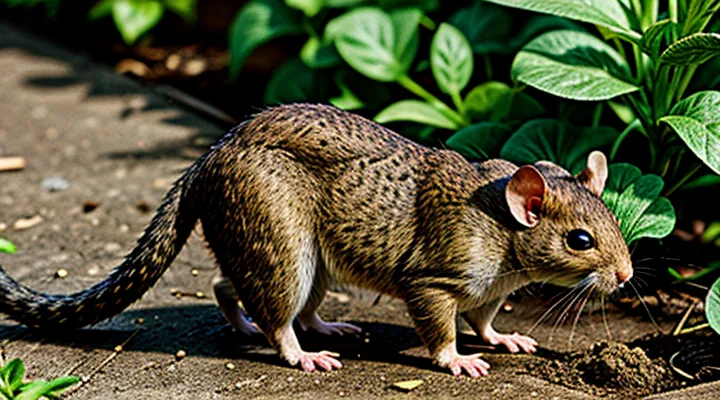
Typical physical traits distinguish ground rats from insects, mollusks, and larger rodents. Adults measure 10–15 cm in body length, possess a short, hairless tail that is roughly one‑third the body length, and have rounded ears that lie flat against the head. Fur ranges from brown to gray, with a slightly lighter ventral side. Unlike house mice, ground rats lack a pointed snout and have a more compact, stocky build.
Behavioral indicators further separate ground rats from other garden pests. They are primarily crepuscular, leaving surface runways that appear as shallow, single‑track paths in moist soil. Burrow entrances are circular, often lined with loose soil, and may feature a small mound of excavated material. Damage manifests as uniform, crescent‑shaped bite marks on tender shoots, whereas insects leave irregular holes or chewed edges, and slugs produce ragged, gelatinous trails.
Key distinguishing features:
- Body length: 10–15 cm (ground rats) vs. <5 cm for most insects.
- Tail: short, hairless, ≤ 30 % of body length; rodents such as house mice have longer, furred tails.
- Ears: flat, inconspicuous; insects lack external ears, slugs have none.
- Runway pattern: single, smooth tracks; beetle tracks are multiple, intersecting.
- Burrow entrance: circular, soil‑lined; slug slime trails are moist, not excavated.
- Feeding damage: clean, round bites; caterpillars create ragged leaf edges, snails leave slime‑covered holes.
Common Species of Ground Rats
Ground-dwelling rodents that frequently appear in cultivated plots include several well‑documented species. Recognizing each species relies on a combination of size, pelage, tail morphology, and ear characteristics.
- Common Vole (Microtus arvalis) – body length 10–15 cm, short tail (1–2 cm), dense brown‑grey fur, small rounded ears, blunt snout. Often creates surface runways and shallow burrow mounds.
- Field Mouse (Apodemus sylvaticus) – body length 8–10 cm, tail length comparable to body, reddish‑brown dorsal coat with a lighter belly, relatively large ears, pointed nose. Leaves irregular gnaw marks on seedlings.
- Woodrat (Neotoma spp.) – body length 12–20 cm, long hairy tail, coarse brown to black fur, pronounced whiskers, large ears. Constructs extensive nests from plant debris, sometimes visible near fence lines.
- Harvest Mouse (Micromys minutus) – body length 5–7 cm, tail longer than body, silky grey‑brown fur, tiny ears, delicate build. Often found nesting in tall grasses or cereal heads.
- House Mouse (Mus musculus) – body length 7–10 cm, tail slightly longer than body, grey‑brown fur, prominent ears, pointed snout. Occasionally occupies ground spaces beneath garden structures.
Identification proceeds by measuring overall length, comparing tail‑to‑body ratios, and observing fur coloration patterns. Ear size and shape further differentiate species; voles possess reduced ears, while mice display relatively larger, more mobile ears. Tail characteristics—short and hairless for voles, long and furred for woodrats—provide rapid visual cues. Combining these morphological markers with habitat clues, such as the presence of runways, nesting material, or feeding damage, enables reliable species determination in garden environments.
Recognizing Ground Rats: Key Appearance Indicators
Size and Body Shape
Adult Ground Rat Size
Adult ground rats typically measure 10‑15 cm (4‑6 in) from nose to the base of the tail, with the tail adding another 5‑8 cm (2‑3 in). Body mass ranges from 30 g to 80 g, depending on species, sex, and seasonal food availability.
Key dimensions include:
- Head‑body length: 10‑15 cm
- Tail length: 5‑8 cm
- Shoulder height: 4‑6 cm
- Weight: 30‑80 g
Size varies among common garden species. For instance, the European ground rat averages 12 cm body length and 45 g, while the larger Asian variant can reach 15 cm and 70 g. Juveniles are roughly half the size of mature individuals, attaining full dimensions after the third molt. Seasonal growth spikes occur in spring when abundant insects and seeds provide extra nutrition.
Juvenile Ground Rat Characteristics
Juvenile ground rats in garden environments display a distinct set of physical traits that separate them from mature individuals and other small mammals. Their bodies measure 8–12 cm in head‑body length, noticeably shorter than adult lengths of 15–20 cm. Fur is soft, uniformly light brown to grayish‑tan, lacking the darker dorsal stripe common in adults. The under‑coat is pale, often almost white, providing a clear contrast with the dorsal surface.
Key identification points include:
- Tail: Short, 30–40 % of body length, covered with sparse hairs; tail coloration matches the dorsal fur but appears slightly paler.
- Ears: Small, rounded, and proportionally larger relative to head size than in adults; ears are covered with fine fur and lack the prominent pink skin seen in older rats.
- Eyes: Large, dark, and positioned slightly forward, giving a more pronounced, alert appearance.
- Feet: Five toes per foot, each ending in a small, blunt claw; pads are pinkish and more visible due to reduced fur coverage.
- Whiskers: Long, stiff, extending well beyond the snout, aiding navigation through dense vegetation.
Behaviorally, juveniles remain close to burrow entrances, preferring shallow cover such as leaf litter or low‑lying grass. They exhibit rapid, erratic movements when threatened, contrasting with the steadier gait of adults. Feeding habits focus on soft seeds, seedlings, and insect larvae, reflecting their limited chewing ability. Observing these characteristics enables reliable differentiation of young ground rats from both mature conspecifics and sympatric rodent species within garden habitats.
Fur Color and Texture
Regional Variations in Fur
Ground rats that inhabit gardens display distinct fur characteristics depending on geographic location. In temperate zones of northern Europe, the dorsal coat tends toward a dense, ash‑gray coloration with a subtle brown undertone, providing camouflage among moist soil and leaf litter. The ventral fur is typically lighter, ranging from creamy white to pale buff, which reduces visibility when the animal moves close to the ground surface.
In Mediterranean climates, individuals exhibit a coarser, sandy‑brown pelage on the back, often interspersed with darker speckles that mimic the dry, sun‑bleached earth. The undercoat is thinner, reflecting the higher ambient temperatures and lower humidity of the region.
Populations found in arid southwestern regions possess a markedly short, reddish‑orange dorsal fur that blends with reddish soil and sparse vegetation. The fur density is reduced to facilitate heat dissipation, while the ventral side remains pale, aiding concealment among light‑colored stones.
Subtropical eastern areas show a richer, dark‑brown to chestnut dorsal coat, with a glossy texture that resists moisture accumulation during frequent rainfalls. The belly fur is a muted gray, offering contrast that disrupts the animal’s outline against dense undergrowth.
Key factors influencing these variations include:
- Soil color and composition
- Ambient temperature and humidity
- Predation pressure from local avian and reptilian species
- Seasonal shedding cycles aligned with regional climate patterns
Understanding these regional fur adaptations assists in accurate field identification of garden-dwelling ground rats and informs ecological assessments of their habitats.
Seasonal Changes in Appearance
Ground rats in garden habitats display distinct visual characteristics that shift with the seasons. In spring, newly molted individuals exhibit a lighter, silvery‑gray dorsal coat, while the ventral side remains pale cream. Their eyes appear clearer, and whisker length increases as they grow after winter dormancy.
During summer, the dorsal fur deepens to a rich brown with occasional reddish undertones, providing camouflage among mature foliage. The ventral fur may acquire a faint yellowish tint from soil contact. Tail length remains proportionate to body size, but the scale pattern becomes more pronounced, aiding in species verification.
Autumn brings a gradual fading of the summer hue; the dorsal coat lightens to a muted brown‑gray, and the ventral side may develop a subtle orange hue from accumulated organic matter. Ear edges often show a thin layer of darker hair, distinguishing this period from the preceding months.
Winter individuals are characterized by a uniform, dull gray coat that blends with leaf litter and bare soil. The fur appears shorter and denser, reducing heat loss. Tail scales become more compact, and the overall body mass may decrease due to reduced food availability.
Key visual markers across seasons:
- Dorsal coat color: silvery‑gray (spring) → rich brown (summer) → muted brown‑gray (autumn) → dull gray (winter)
- Ventral coloration: cream (spring) → faint yellow (summer) → orange tint (autumn) → uniform gray (winter)
- Whisker length: longest in spring, modest in summer and autumn, reduced in winter
- Tail scale definition: increasingly compact from summer to winter
Recognizing these seasonal patterns enables accurate identification of ground rats throughout the garden year.
Distinctive Facial Features
Ear Shape and Size
Ear morphology provides reliable cues for distinguishing garden‑dwelling ground rats from other small mammals. The ears are typically small, flattened against the skull, and covered with fine hair that reduces visibility. In most species the ear pinna measures less than half the length of the head, often ranging from 4 mm to 8 mm in adult specimens.
The shape of the ear follows a consistent pattern: a short, rounded apex merges smoothly into the side of the head, lacking a pronounced external rim. The cartilage is thin, allowing the ear to lie close to the body, which minimizes heat loss and protects against soil abrasion. The inner surface is lined with fine fur that obscures the auditory canal, a feature uncommon in arboreal rodents.
Key variations among common garden ground rats:
- European vole (Microtus arvalis): ear length 5–6 mm, rounded tip, heavily furred exterior.
- Meadow vole (Microtus pennsylvanicus): ear length 6–7 mm, slightly more pointed tip, sparse fur.
- Southern red‑backed vole (Myodes gapperi): ear length 4–5 mm, very flat against the skull, densely furred.
When inspecting a captured or observed specimen, position the animal gently to expose the lateral head region. Measure the ear from the base of the cartilage to the tip; compare the dimension to the head length, which should exceed twice the ear length. Note the degree of fur coverage and the curvature of the pinna, as these attributes differentiate species within garden habitats.
Accurate assessment of ear shape and size, combined with other morphological traits, enables precise identification of ground rats that inhabit cultivated plots.
Eye Placement and Color
Ground rats that inhabit garden environments display distinct ocular characteristics that aid rapid identification in the field. The eyes are situated on the sides of the head, providing a wide field of view essential for detecting predators and locating food. Each eye aligns with the sagittal plane at approximately the mid‑level of the skull, allowing simultaneous monitoring of ground level and low vegetation. The lateral placement creates a binocular overlap of roughly 30–40 degrees, sufficient for depth perception when navigating burrows or assessing seed patches.
Eye color varies among common garden species and reflects both genetic factors and physiological condition:
- Dark brown to black: typical of mature individuals of Rattus norvegicus and Rattus rattus; pigment density increases with age.
- Light amber or yellowish: observed in juveniles and in individuals exposed to low‑light habitats; reduced melanin gives a translucent appearance.
- Red or pinkish hue: indicates blood vessel visibility through a thin sclera, often seen in stressed or diseased specimens.
Color shifts may also occur seasonally, as melanin production responds to changes in ambient light and diet. Consistent documentation of eye placement and hue supports accurate species differentiation and informs pest‑management decisions.
Snout and Whisker Characteristics
Ground rats display a compact, blunt snout that tapers slightly toward the tip. The nose is covered with fine, moist skin and a pale to pink hue, often matching the surrounding fur color. Length varies among species: typical brown rats (Rattus norvegicus) have a snout measuring 12–15 mm, while roof rats (Rattus rattus) exhibit a slightly shorter 10–13 mm profile. The rostral region bears a subtle ridge that assists in digging and root foraging.
Whiskers, or vibrissae, extend laterally from the rostral area and serve as primary tactile sensors. Key characteristics include:
- Length: 15–20 mm in brown rats, 12–16 mm in roof rats.
- Arrangement: Four prominent rows on each side, with the outermost row positioned near the cheekbone.
- Thickness: Approximately 0.3 mm, providing sufficient rigidity for environmental probing.
- Color: Typically dark brown to black, contrasting with lighter facial fur.
The combination of snout dimensions and whisker pattern provides reliable criteria for field identification. Measurements taken with calipers and visual assessment of whisker placement enable rapid differentiation between common garden-dwelling rat species.
Tail Morphology
Tail Length Relative to Body
The tail length of garden-dwelling rodents provides a reliable metric for distinguishing species and assessing maturity. In most common garden rats, the tail measures between 70 % and 110 % of the head‑body length. Species with proportionally longer tails—such as the meadow vole—typically exhibit a ratio near 100 % or slightly higher, while the Norway rat displays a shorter tail, often around 70 % of the body length.
Key identification points related to tail proportion:
- Ratio of tail to head‑body length: - ≥ 1.0 → species with elongated tails (e.g., meadow vole, woodrat) - ≈ 0.8 → species with moderate tails (e.g., Norway rat) - ≤ 0.7 → species with notably short tails (e.g., certain subspecies of house mouse)
- Scale and hair density: - Long, sparsely haired tails indicate arboreal or semi‑arboreal habits. - Short, densely furred tails suggest burrowing behavior.
- Coloration patterns: - Uniformly dark tails often accompany nocturnal foragers. - Bicolored tails, lighter ventrally, are typical of ground‑surface dwellers.
Tail length remains consistent within a species but may vary with age; juveniles possess relatively shorter tails that approach adult proportions as growth progresses. Accurate measurement—using a calibrated ruler from the base of the tail to the tip—combined with the ratios above, enables precise identification of garden rodents without reliance on external characteristics.
Hairiness of the Tail
Hairiness of the tail provides a reliable visual cue for distinguishing garden‑dwelling ground rats. The dorsal surface of the tail typically bears a uniform coat of fine, pliable hairs, while the ventral side may appear less covered or nearly naked. This contrast assists observers in separating rodent species that share similar body size and coloration.
Key characteristics of tail hairiness include:
- Length of hair relative to tail diameter, usually 0.5–1 mm in common species; longer hairs indicate larger taxa.
- Density, measured as hairs per square millimeter; dense coverage creates a matte appearance, whereas sparse hair results in a glossy sheen.
- Coloration, ranging from pale gray to brown; darker hairs often match the dorsal coat, lighter hairs may blend with ventral fur.
- Presence of a distinct terminal tuft; some species terminate the tail with a short, stiff brush of hairs, while others end in a naked tip.
When examining a specimen, note the hair length, density, and coloration on both dorsal and ventral sides. Compare these observations with documented patterns for known garden ground rat species to confirm identification.
Identifying Ground Rat Activity and Signs
Tracks and Footprints
Distinguishing Ground Rat Tracks
Ground rats that forage in cultivated beds leave distinctive impressions that differ from those of mice, voles, or insect larvae. Recognizing these marks enables accurate assessment of rodent activity and informs targeted management.
Key attributes of ground‑rat tracks:
- Size: footprints range from 12 mm to 18 mm in length; width typically measures 8 mm to 12 mm.
- Toe arrangement: four visible toes; the outer toes are slightly splayed, creating a broad, oval shape.
- Claw marks: shallow, parallel scratches appear behind each toe, often forming a faint “V” pointing toward the animal’s direction of travel.
- Heel pad: a rounded, darkened area occupies the rear of the print, distinguishable from the lighter central pad of mouse tracks.
- Stride: spacing between successive prints averages 30 mm to 45 mm, reflecting the species’ longer legs and more deliberate gait.
- Depth: impressions are shallow but retain a clear edge, especially in moist soil or soft mulch.
Comparison with similar species clarifies identification:
- House mouse: footprints under 10 mm, three visible toes, prominent central pad, and tighter stride (15 mm–20 mm).
- Vole: similar size but exhibits five toes, noticeable claw marks that form a fan shape, and a tighter, more erratic pattern.
- Shrew: very small prints (5 mm–7 mm), five toes, and a pronounced, pointed heel.
Practical guidelines for confirming ground‑rat presence:
- Locate a series of consistent prints along a single line; irregular, scattered marks suggest multiple species.
- Examine the substrate: moist, loamy soil preserves toe and claw detail better than dry sand.
- Use a magnifying lens to verify the four‑toe configuration and heel‑pad curvature.
- Record stride length and compare with the ranges listed above; deviations indicate a different animal.
Accurate track interpretation provides reliable evidence of garden‑dwelling ground rats, supporting effective control measures without unnecessary disturbance.
Typical Gait Patterns
Ground rats that inhabit garden environments display a distinctive set of locomotor patterns that aid in species identification and behavioral assessment. Their quadrupedal stance produces a regular, alternating footfall sequence: left forelimb, right forelimb, left hindlimb, right hindlimb. This rhythm persists across most movement modes, providing a baseline for observation.
When moving at low speed, the animals employ a walking gait characterized by a prolonged stance phase for each foot and minimal aerial time. Transition to a faster trot introduces a diagonal pairing of limbs—left forelimb with right hindlimb and vice versa—while maintaining ground contact for at least two feet at all times. In escape situations, a rapid gallop emerges, marked by a brief suspension phase where all limbs leave the substrate, followed by a rebound that generates a bounding motion.
Typical gait patterns can be summarized as follows:
- Walking: steady, four‑foot contact; low stride frequency; minimal tail sway.
- Trotting: diagonal limb coordination; moderate stride length; increased tail lift for balance.
- Galloping/Bounding: brief aerial phase; high stride frequency; pronounced tail thrust.
Substrate composition influences gait execution. Loose, moist soil reduces traction, prompting a wider foot placement and shorter strides, while compacted ground encourages longer strides and higher speeds. Dense vegetation forces a low‑profile movement, often resulting in a crouched posture and reduced stride length to navigate obstacles.
Observers can differentiate species by noting gait nuances: larger ground rats tend to exhibit a longer stride and a smoother transition between trot and gallop, whereas smaller specimens display rapid, short‑step movements with frequent pauses. Tail posture during locomotion—horizontal during walking, elevated during trotting, and sharply arched during galloping—offers additional diagnostic cues.
Droppings and Excrement
Size and Shape of Droppings
Droppings provide a reliable indicator for distinguishing garden-dwelling ground rats from other small mammals. Their dimensions and form reflect species‑specific digestive anatomy and diet, enabling precise field identification.
Typical measurements fall within a narrow range:
- Length: 6 mm to 9 mm (0.24 in–0.35 in).
- Width: 2 mm to 3 mm (0.08 in–0.12 in).
- Thickness: 1 mm to 1.5 mm (0.04 in–0.06 in).
The shape is cylindrical to slightly spindle‑shaped, with blunt ends and a smooth surface. Individual pellets are distinct, not fused, and often exhibit a dark brown to black coloration. Occasionally a faint oily sheen appears, reflecting the high fat content of the rodents’ diet. Consistent size and the characteristic tapered profile differentiate these droppings from those of voles, mice, or insectivores, which tend to be smaller, more irregular, or softer in texture.
Location of Dropping Accumulations
Ground rats leave droppings in predictable zones that aid detection and control. Their fecal deposits concentrate where the animals move, feed, or shelter.
- At the entrance of burrow systems, often on the soil surface directly beside the opening.
- Beneath low‑lying foliage, especially lettuce, spinach, and other leafy greens that provide cover.
- Along garden pathways and edging stones, where rats traverse between feeding sites.
- In mulch layers and compost piles, where organic material attracts foraging activity.
- Near stored garden produce, such as root vegetables and fruit bins, where food residues are present.
- Under overturned pots, rocks, and garden furniture that create sheltered microhabitats.
The accumulation pattern reflects the rats’ preference for humid, concealed environments and proximity to food sources. Identifying these clusters enables precise placement of monitoring devices and targeted treatment.
Burrow Systems and Entrances
Characteristics of Ground Rat Burrows
Ground rats construct burrow systems that reflect their need for shelter, food storage, and predator avoidance. Entrances are typically 3–5 cm in diameter, circular or oval, and may be concealed by vegetation or soil mounds. The opening often leads to a shallow tunnel that descends 10–30 cm before branching.
Key structural elements include:
- Primary tunnel: straight or gently curved, lined with compacted soil to prevent collapse.
- Side chambers: 5–12 cm wide, used for nesting, food caching, and waste deposition; walls are reinforced with plant fibers.
- Escape routes: secondary exits positioned at varying angles, providing rapid egress when threatened.
- Soil displacement: piles of loose earth, known as “spoil heaps,” accumulate near entrances; the amount indicates burrow activity level.
Burrow placement favors well‑drained, loamy soils with moderate moisture. Proximity to dense ground cover offers camouflage, while adjacent root systems supply structural support. Seasonal variations affect depth: deeper tunnels develop during colder months to maintain stable temperatures.
Identifying signs of active burrows includes fresh spoil heaps, visible tail tracks, and fresh soil linings. Abandoned systems exhibit hardened tunnels, reduced spoil accumulation, and increased vegetation encroachment.
Entrance Hole Dimensions and Location
Ground rats create entrance holes that serve as both shelter and foraging portals. The openings typically measure between 2 cm and 4 cm in diameter; larger individuals may expand holes to 5 cm. Depth ranges from 10 cm to 30 cm, with the deepest sections reaching the water table in moist soils.
Key placement characteristics include:
- Proximity to dense vegetation: holes are most often found at the base of low‑lying plants, grasses, or ground cover that provides cover from predators.
- Soil moisture: entrances appear in damp, loamy soil where excavation is easier, avoiding compacted or overly dry patches.
- Orientation: openings face away from prevailing winds and direct sunlight, reducing exposure and maintaining a stable microclimate inside the burrow.
- Spacing: individual holes are spaced 30 cm to 1 m apart along linear runs, forming a network that connects to deeper tunnels and nesting chambers.
Recognizing these dimensions and locations aids in distinguishing ground rat activity from that of other small mammals, facilitating accurate identification and targeted management in garden ecosystems.
Damage to Plants and Property
Types of Plant Damage
Ground rats that inhabit garden soils cause distinct forms of plant injury. Recognizing each type of damage assists gardeners in confirming rodent activity and selecting appropriate control measures.
- Root gnawing – tunnels intersect taproots and fibrous systems, leaving exposed, chewed sections that wilt and die. Damage often appears as irregular holes at the base of seedlings or mature plants.
- Stem girdling – rodents chew around thin stems, disrupting vascular flow. Symptoms include sudden wilting of foliage above the girdled point while lower sections remain healthy.
- Seed and fruit consumption – exposed seeds on the soil surface or fallen fruit are stripped of kernels or pulp, reducing germination rates and harvest yields.
- Leaf chewing – occasional surface feeding creates ragged edges or holes on lower leaves, especially on plants near burrow entrances.
- Trampling and soil compaction – repeated passage of rodents through beds compresses soil, limiting root expansion and water infiltration, leading to stunted growth.
- Burrow undermining – extensive tunnel networks weaken root anchorage, causing plants to topple or develop shallow root systems.
Each damage pattern correlates with specific rodent behavior. Identifying the precise injury type enables targeted remediation, such as bait placement near active tunnels, protective barriers around vulnerable stems, or soil aeration to counter compaction.
Gnaw Marks on Structures and Roots
Gnaw marks provide reliable evidence of ground‑rat activity in garden environments. Their presence on wooden fences, irrigation pipes, and garden furniture indicates foraging and nesting behavior, while marks on plant roots reveal underground feeding.
On above‑ground structures, ground rats produce clean, crescent‑shaped bites roughly 5–10 mm wide. The edges are smooth, with parallel tooth impressions that do not splinter wood. Plastic and thin‑walled metal exhibit shallow, evenly spaced gouges, often accompanied by displaced material that forms a small pile of chew debris.
Root damage appears as concentric rings of missing tissue, usually 2–4 mm deep. The cuts are uniform, lacking the irregular raggedness typical of insect larvae. Roots may show a clear line of separation where the rat’s incisors have severed the vascular tissue, sometimes exposing a white, fibrous core.
Key identification cues:
- Bite width consistent with 5–10 mm rodent incisors.
- Smooth, parallel tooth marks without splintering.
- Uniform depth and spacing on both wood and root surfaces.
- Presence of chew debris or small piles of displaced material.
- Absence of frass or silk, which distinguishes rat activity from insect infestation.
Observing these characteristics enables precise confirmation of ground‑rat presence and informs targeted control measures.