
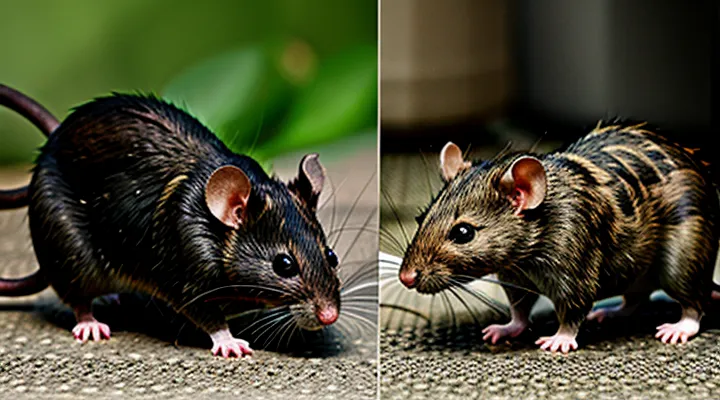
Introduction to Rodent Identification
General Distinctions
Common Misconceptions
Rats and mice are often mistaken for one another, yet their external characteristics differ markedly. Misunderstandings persist despite abundant scientific documentation.
- Size assumption: Many believe all rodents of this group share similar dimensions. In reality, rats typically exceed 200 g and reach body lengths of 20 cm, while mice usually weigh under 30 g and measure about 7‑10 cm.
- Tail description: The notion that both species possess equally long, hairless tails is inaccurate. Rat tails are thicker, shorter relative to body length, and display sparse fur; mouse tails are proportionally longer, finer, and largely naked.
- Ear proportion: It is common to think ear size is comparable. Rats have relatively small, rounded ears, whereas mice feature large, prominent ears that dominate the head silhouette.
- Color uniformity: Some assume uniform coat colors across species. Rats exhibit a broader spectrum, including black, brown, and albino variants, while mice are predominantly gray, brown, or white, with fewer pigment patterns.
- Foot structure: The belief that foot morphology is identical is false. Rat hind feet show robust, blunt toes adapted for digging, whereas mouse hind feet are slender with elongated digits suited for climbing.
These corrections clarify the external distinctions that separate the two rodents, eliminating prevalent myths and supporting accurate identification in research and pest management contexts.
Importance of Accurate Identification
Accurate identification of rats and mice is fundamental for scientific reliability. Misclassification introduces systematic error, distorts data interpretation, and compromises reproducibility. Researchers relying on species‑specific traits—such as size, fur coloration, tail length, and ear shape—must verify identity before experimental design, data collection, and analysis.
- Laboratory models: disease pathways, pharmacokinetics, and behavioral assays differ markedly between the two rodents; using the wrong species yields invalid conclusions.
- Regulatory compliance: animal welfare guidelines and institutional protocols require species‑specific housing, enrichment, and dosing; errors can lead to violations and loss of funding.
- Pest management: control strategies target morphological and behavioral characteristics; incorrect identification reduces efficacy and increases economic loss.
Ethical accountability also depends on correct species designation. Institutional review boards assess justification and humane endpoints based on the animal’s biology; inaccurate labeling undermines ethical review and may cause unnecessary suffering.
Physical Characteristics
Size and Body Shape
Head and Snout Proportions
Rats and mice can be distinguished by the relative dimensions of their crania and rostra. The rat’s head occupies a larger fraction of total body length than the mouse’s, with a skull that is broader and more robust. Typical adult rat skull length ranges from 25 to 30 mm, whereas mouse skull length averages 15 to 20 mm. Consequently, the head‑to‑body ratio in rats is approximately 0.25, compared with 0.20 in mice.
The snout, or rostrum, exhibits clear proportional differences. In rats, the rostral segment extends roughly 12–14 mm and represents about 40 % of total skull length. Mouse rostra are shorter, measuring 8–10 mm and comprising roughly 45 % of skull length. Although the mouse’s rostrum occupies a higher percentage of its skull, the absolute length remains smaller, giving rats a more elongated facial profile.
Key comparative metrics:
- Skull length: rat ≈ 25–30 mm; mouse ≈ 15–20 mm.
- Rostrum length: rat ≈ 12–14 mm; mouse ≈ 8–10 mm.
- Head‑to‑body ratio: rat ≈ 0.25; mouse ≈ 0.20.
- Rostrum‑to‑skull proportion: rat ≈ 0.40; mouse ≈ 0.45.
These dimensional contrasts contribute to species‑specific feeding mechanics and sensory field coverage, reinforcing the usefulness of head and snout proportions as reliable external identifiers.
Torso and Tail Length Ratio
Rats and mice differ markedly in the proportion of torso length to tail length, a reliable characteristic for visual identification. In the common laboratory rat (Rattus norvegicus), torso length averages 9–12 cm while tail length ranges from 18 to 25 cm, producing a torso‑to‑tail ratio of approximately 1:2. In the house mouse (Mus musculus), torso length averages 6–9 cm and tail length 6–10 cm, yielding a ratio close to 1:1.
-
Rat (Rattus spp.)
• Torso: 9–12 cm
• Tail: 18–25 cm
• Ratio ≈ 0.5 -
Mouse (Mus spp.)
• Torso: 6–9 cm
• Tail: 6–10 cm
• Ratio ≈ 0.9–1.0
These ratios remain consistent across sexes and are only modestly affected by strain or age. A higher tail‑to‑torso proportion signals a rat, whereas a near‑equal proportion indicates a mouse. Accurate measurement of these dimensions assists researchers and field biologists in distinguishing the two rodent groups without genetic analysis.
Ears
Size and Roundness
Rats and mice differ markedly in overall size. Adult rats typically weigh 250–500 g and measure 20–30 cm from nose to tail tip, whereas adult mice weigh 15–30 g and measure 7–10 cm in the same dimension. This disparity influences handling, cage requirements, and experimental dosing.
Body shape also varies. Rats exhibit a more elongated, cylindrical torso with a relatively narrow head, giving a sleek appearance. Mice possess a compact, rounded torso and a proportionally larger head, producing a distinctly plump silhouette.
Key external distinctions:
- Length: rats 20–30 cm; mice 7–10 cm
- Weight: rats 250–500 g; mice 15–30 g
- Torso profile: rat – elongated, narrow; mouse – short, rounded
- Head proportion: rat – modest; mouse – comparatively large
These measurable traits provide reliable criteria for species identification in laboratory and field settings.
Hairiness
Hairiness provides a clear visual cue for separating rats from mice.
Rats possess a relatively coarse, sparsely distributed coat. The dorsal fur is longer and less dense than that of mice, while the ventral side exhibits a thinner layer of hair. Tail skin is largely naked, exposing a pink or black surface with minimal hair coverage. Body hair aligns in distinct rows, giving the animal a rugged appearance.
Mice display a fine, dense pelage that covers the entire body, including the tail. The dorsal and ventral fur are uniformly short and tightly packed, creating a smooth texture. Tail hair is present along the entire length, often forming a subtle fringe. Overall coat coloration is more uniform, with subtle variations among strains.
Key differences in hairiness:
- Coat density: rats – sparse; mice – dense.
- Fur length: rats – longer dorsal hairs; mice – uniformly short hairs.
- Tail coverage: rats – mostly hairless; mice – partially haired.
- Texture: rats – coarse; mice – fine.
These characteristics enable reliable identification of each species based on external hair patterns.
Eyes
Relative Size
Rats are substantially larger than mice. Adult laboratory rats (Rattus spp.) usually weigh 250–500 g and measure 20–25 cm in body length, not including the tail. In contrast, adult house mice (Mus musculus) weigh 15–30 g and have a body length of 7–10 cm.
-
Weight range:
• Rats: 250–500 g (some strains exceed 600 g).
• Mice: 15–30 g (large strains approach 45 g). -
Body length (head‑to‑base of tail):
• Rats: 20–25 cm.
• Mice: 7–10 cm. -
Tail length:
• Rats: 15–20 cm, roughly equal to body length.
• Mice: 5–10 cm, often longer than the body.
Growth rates differ as well; rats reach adult size within 8–10 weeks, whereas mice mature in 5–7 weeks. Sexual dimorphism is more pronounced in rats, with males typically heavier and longer than females; mice display only modest size differences between sexes.
Protrusion
Protrusion refers to any outward extension of the body surface that can be measured or observed without dissection. In the comparison of rats and mice, several protrusive features serve as reliable identifiers.
- Tail length: rats possess a tail that reaches 70–80 % of body length, while mouse tails typically measure 60–70 % of body length.
- Ear pinna: rat ears extend outward and are proportionally larger relative to head width; mouse ears are smaller and lie closer to the skull.
- Snout projection: rats display a more pronounced, elongated rostrum; mice have a compact, blunt snout with minimal forward extension.
- Whisker (vibrissae) arrangement: rat vibrissae emerge from a broader facial region, creating a noticeable facial “fan”; mouse vibrissae are concentrated near the nose, forming a tighter cluster.
- Hind‑foot heel: rat hind‑foot exhibits a visible heel protrusion that supports larger body mass; mouse hind‑foot lacks a distinct heel, resulting in a flatter profile.
These protrusive characteristics provide clear external criteria for distinguishing the two rodent species in field observations and laboratory settings.
Fur
Texture and Length
Rats possess coarser, denser fur than mice, with each hair shaft exhibiting a thicker medulla and a more pronounced cuticle pattern. This texture provides greater insulation and resistance to abrasion, reflecting the species’ adaptation to burrowing and outdoor environments.
Mice display finer, softer pelage composed of thinner hairs and a less developed medulla. The subtle texture facilitates thermoregulation in confined spaces and reduces friction when navigating narrow tunnels.
Length characteristics differ markedly:
- Average body length (head‑body) for rats ranges from 18 to 25 cm; tail length adds an additional 15–25 cm, producing a total length of 30–50 cm.
- Mice typically measure 7–10 cm in body length; tails extend 6–9 cm, resulting in a combined length of 13–19 cm.
Overall, rats are substantially larger, with a more robust skeletal framework, while mice remain compact and lightweight, influencing locomotion, habitat use, and predator avoidance.
Coloration Patterns
Rats and mice exhibit distinct coloration patterns that aid in species identification and reflect adaptations to their environments.
Rats possess a dense, coarse dorsal coat ranging from brown to black, often with a uniform hue extending from the head to the tail. The ventral surface is markedly lighter, usually gray‑white, creating a sharp contrast. Some laboratory strains display albino coloration, characterized by pink eyes and white fur, but these are exceptions rather than the norm. Tail coloration mirrors the dorsal coat, maintaining the same pigment intensity.
Mice show a finer, softer pelage with greater variability. Wild house mice (Mus musculus) commonly display a grayish dorsum and a pale ventral side, but many subspecies present striped or mottled patterns, especially on the back and flanks. Pigmentation can include reddish or brown patches, and the tail often appears pink or lightly pigmented, lacking the uniform darkness seen in rats. Albino and agouti phenotypes are prevalent among laboratory mouse lines.
Key comparative points:
- Dorsal coat texture: coarse in rats, fine in mice.
- Color uniformity: rats typically uniform; mice frequently mottled or striped.
- Ventral contrast: high in rats, moderate in mice.
- Tail pigmentation: consistently dark in rats, variable and often lighter in mice.
- Prevalence of albino strains: common in both, but albino phenotype constitutes a larger proportion of laboratory mouse colonies.
These differences provide reliable visual criteria for distinguishing the two rodent groups in field and laboratory settings.
Paws and Feet
Size and Delicacy
Rats typically weigh between 250 g and 500 g, with body lengths of 20–25 cm, not including the tail. Mice generally range from 15 g to 30 g, with bodies measuring 7–10 cm. The mass difference exceeds an order of magnitude, influencing locomotion, habitat use, and predator avoidance.
Key dimensional contrasts:
- Body mass: rat ≈ 250–500 g; mouse ≈ 15–30 g.
- Body length (head‑to‑base): rat ≈ 20–25 cm; mouse ≈ 7–10 cm.
- Tail length: rat ≈ 18–25 cm; mouse ≈ 5–10 cm.
- Footprint size: rat footprints are roughly three times larger than mouse footprints.
Delicacy reflects structural and physiological traits. Mice possess thinner skin, finer fur, and a higher surface‑to‑volume ratio, resulting in greater heat loss and a need for higher metabolic rates. Their skeletal framework is less robust, making them more susceptible to injury from handling or environmental stress. Rats exhibit thicker dermal layers, coarser fur, and stronger bone structures, providing greater resilience to mechanical pressure and temperature fluctuations.
These size and delicacy distinctions affect experimental handling, cage design, and nutritional requirements, requiring separate protocols for each species.
Claw Prominence
Rats possess markedly larger, more robust claws than mice. The ungual plates extend farther beyond the toe pads, giving a visibly pronounced silhouette. In most rat species, the claws are curved and thickened, supporting burrowing and climbing activities that demand greater grip strength.
Mice exhibit diminutive, less conspicuous claws. The ungual tips are short, slender, and often hidden beneath the fur when the animal is at rest. This reduced prominence correlates with a lighter body mass and a reliance on rapid, agile movements rather than forceful excavation.
Key distinctions:
- Length: rat claws exceed mouse claws by 30–50 % on average.
- Thickness: rat ungual plates are broader, providing enhanced durability.
- Visibility: mouse claws are frequently recessed, making them harder to detect without close inspection.
- Functional emphasis: rat claws favor powerful digging; mouse claws favor swift locomotion.
Behavioral Indicators (External Observation)
Movement Patterns
Gait and Speed
Rats and mice display distinct locomotor patterns that reflect differences in body size, limb proportions, and musculoskeletal architecture. Stride length in rats averages 30–35 mm during steady walking, whereas mice typically achieve 15–20 mm. The larger fore‑ and hind‑limb muscles of rats generate greater ground reaction forces, resulting in a more pronounced dorsal flexion of the ankle during the swing phase. Mice exhibit a higher step frequency, compensating for shorter strides with rapid limb cycling.
Key speed parameters:
- Preferred walking speed: rats 0.3–0.5 m s⁻¹; mice 0.2–0.4 m s⁻¹.
- Maximum sprint speed: rats up to 1.8 m s⁻¹; mice up to 1.2 m s⁻¹.
- Acceleration capacity: rats attain peak acceleration within 0.2 s; mice within 0.3 s.
These metrics arise from species‑specific neuromuscular control. Rats rely on longer, more forceful strides to cover distance efficiently, while mice prioritize agility through rapid, short steps. The resultant gait patterns influence experimental design, particularly when assessing motor function, drug effects, or injury recovery across the two rodent models.
Agility and Climbing Abilities
Rats and mice display distinct external characteristics that affect their agility and climbing performance. Rats possess a larger, more muscular body, longer hind limbs, and a robust tail that functions as a stabilizer during vertical movement. Mice, being smaller, have proportionally shorter limbs and a thinner tail, which limits their reach but enhances maneuverability in confined spaces.
Key anatomical factors influencing locomotion:
- Limb length and muscle mass – Rats’ extended hind legs generate greater thrust, enabling longer leaps and faster sprinting on horizontal surfaces. Mice rely on rapid, short bursts of movement facilitated by lighter musculature.
- Footpad structure – Rats feature broader, more padded soles with dense fur, providing firm contact on rough textures. Mice have finer pads with increased sensitivity, allowing precise grip on slender branches.
- Tail utility – The rat’s thick, prehensile tail offers balance and counter‑weight when climbing tall structures. The mouse’s slender tail contributes minimally to balance, focusing instead on body rotation for rapid direction changes.
- Claw curvature – Rats exhibit moderately curved claws suited for gripping bark and coarse surfaces. Mice possess sharper, more hooked claws that excel on delicate, narrow substrates such as twigs and wires.
These differences result in rats excelling at sustained climbing on sturdy vertical surfaces and covering greater distances with fewer interruptions, while mice demonstrate superior agility within tight, intricate environments, often navigating complex three‑dimensional networks of small obstacles.
Droppings
Size and Shape
Rats and mice differ markedly in overall dimensions, a fact that facilitates reliable identification in laboratory and field settings. Adult rats typically weigh 250–500 g, with a head‑body length of 180–250 mm and a tail extending 150–250 mm. In contrast, adult mice range from 15–40 g, possess a head‑body length of 70–100 mm, and a tail measuring 70–100 mm.
- Weight: rat ≈ 250–500 g; mouse ≈ 15–40 g
- Head‑body length: rat ≈ 180–250 mm; mouse ≈ 70–100 mm
- Tail length: rat ≈ 150–250 mm; mouse ≈ 70–100 mm
Shape characteristics further separate the species. Rats exhibit a robust, barrel‑shaped torso with a relatively thick, hair‑covered tail that tapers gradually. Their ears are proportionally large, positioned low on the head, and the snout is blunt and broad. Mice display a slender, streamlined body, a thin, sparsely haired tail that terminates in a pointed tip, and proportionally smaller ears set higher on a narrow, pointed snout. Fur density differs as well: rats possess coarser guard hairs, while mice have finer, softer pelage.
These dimensional and morphological distinctions provide a practical framework for species discrimination, supporting accurate data collection in biomedical research, pest management, and ecological surveys.
Quantity and Distribution
Rats and mice differ markedly in size and reproductive output. Adult rats typically weigh 250–500 g and measure 20–25 cm in body length, whereas adult mice weigh 15–30 g and measure 7–10 cm. Litter sizes average 6–12 pups for rats and 4–8 pups for mice; gestation periods are 21–23 days for rats and 19–21 days for mice. These parameters result in a higher per‑individual biomass contribution from rats despite lower overall numbers in comparable habitats.
- Population density: Urban environments support up to 30 rats per 100 m², while mouse densities can exceed 150 individuals per 100 m² in the same settings.
- Geographic range: Rats occupy a broader range, extending from temperate zones to tropical regions, whereas mice are more abundant in temperate and arid zones.
- Habitat preference: Rats favor sewers, basements, and outdoor refuse sites; mice preferentially inhabit indoor structures, grain stores, and field margins.
- Seasonal fluctuation: Rat numbers peak in late summer following increased food availability; mouse populations often surge in early spring after breeding cycles commence.
These quantitative and spatial distinctions influence pest management strategies, ecological impact assessments, and disease transmission risk evaluations.
Habitat and Nesting Habits (Observable from Exterior)
Nest Location Preferences
Rats and mice exhibit distinct preferences for where they construct nests, reflecting divergent ecological strategies. Rats typically select large, concealed cavities that provide protection from predators and environmental fluctuations. Common sites include underground burrows, sewer systems, and dense vegetation near ground level. These locations allow rats to create extensive, multi‑chamber nests that accommodate the species’ relatively larger body size and social hierarchy. Nest construction often incorporates substantial amounts of soft material—such as shredded paper, fabric, or plant matter—to enhance insulation and comfort.
Mice favor smaller, more confined spaces that are readily accessible within human structures. Preferred sites include wall voids, ceiling joists, ceiling tiles, and the interiors of cupboards or appliances. These environments offer proximity to stored food and limited exposure to predators. Mice construct compact nests using fine fibers, cotton, or shredded insulation, arranging them in tight spheres that conserve heat and support the species’ high reproductive rate. Elevation above the floor is a common feature, reducing competition with larger rodents and minimizing contact with ground‑borne hazards.
Key distinctions in nest location preferences can be summarized as follows:
- Size of cavity: Rats use spacious burrows; mice occupy narrow crevices.
- Proximity to food: Both species locate nests near food sources, but rats emphasize external foraging grounds, while mice rely on indoor storage.
- Environmental exposure: Rats select sites with greater moisture and temperature stability; mice choose dry, insulated indoor niches.
- Social structure: Rat nests often accommodate hierarchical groups; mouse nests are typically solitary or involve small family units.
Understanding these external habitat choices aids in differentiating the two species during pest assessments and informs targeted control measures.
Nest Material Composition
Rats and mice construct nests from distinct material sets, reflecting divergent ecological strategies.
-
Rats
• Shredded paper, cardboard, and cloth fibers
• Untreated wood chips and bark fragments
• Soft plastics and insulation padding
• Larger quantities of organic debris (leaves, twigs) -
Mice
• Fine cotton, wool, and synthetic fibers
• Small plant fragments (grass, seed husks)
• Minimal use of hard substrates; preference for pliable matter
Rats assemble nests with a bulkier architecture, integrating coarse and coarse‑textured items to achieve structural stability and thermal insulation. Mice produce compact, spherical nests, relying on finer fibers that facilitate rapid construction and frequent relocation. Material selection correlates with body size: larger rats accommodate bulkier components, while smaller mice require lightweight, easily manipulated fibers. Durability differs; rat nests often persist for weeks, whereas mouse nests are frequently rebuilt within days.
Conclusion
Rats and mice differ markedly in external morphology, a fact that influences identification, handling, and experimental design. Rats are larger, typically 20–30 cm in body length, with a robust, blunt snout and proportionally short ears. Their tails are thick, relatively hair‑less, and often shorter than the body. Mice measure 6–10 cm, possess a pointed snout, large, hair‑covered ears, and a long, slender, fully furred tail that exceeds body length. Coat coloration also varies: rats frequently display uniform brown, black, or white pelage, whereas mice exhibit a broader palette, including agouti, albino, and spotted patterns.
These physical distinctions affect behavior and habitat use. Rats prefer burrows or sewers with ample space, while mice occupy finer crevices and can thrive in densely packed environments. Sensory adaptations correspond to morphology: the larger ears of mice enhance auditory acuity for predator detection, whereas the more muscular jaws of rats support a stronger bite for processing coarse food.
Key external differences can be summarized:
- Body size: rat > mouse
- Snout shape: blunt (rat) vs. pointed (mouse)
- Ear size and hair coverage: small, hairless (rat) vs. large, furred (mouse)
- Tail characteristics: thick, sparsely haired (rat) vs. thin, fully furred (mouse)
- Coat patterns: limited palette (rat) vs. diverse coloration (mouse)
Understanding these traits ensures accurate species identification and appropriate methodological choices in research and pest management.