
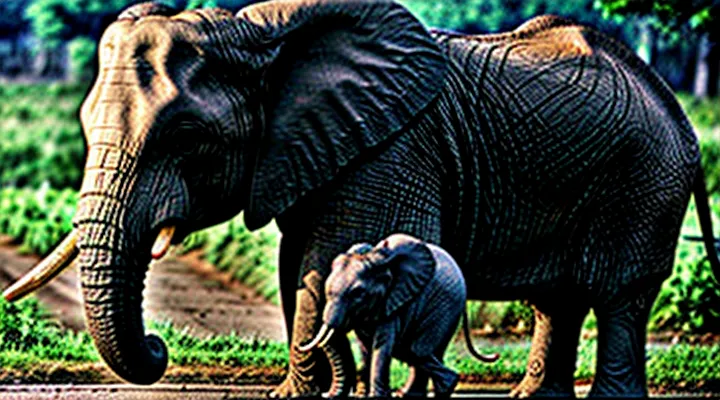
Origins of the Popular Belief
Historical Anecdotes and Folklore
Elephant‑mouse interactions appear in antiquity, often as cautionary tales that emphasize the surprising vulnerability of the largest land mammals. Greek writer Aelian recorded a story in which a mouse escaped from a lion’s mouth and caused a panicked elephant to retreat, illustrating the motif that small creatures could unsettle massive beasts. Indian folklore contains a similar narrative: a village mouse allegedly entered the tusk of a ceremonial elephant, prompting the animal to flee and the community to interpret the event as an omen of impending danger. Medieval bestiaries repeated the theme, describing elephants as “timorous of the smallest vermin,” reinforcing the belief across cultural boundaries.
These anecdotes persisted into the modern era, influencing circus lore and popular media. A 19th‑century circus poster depicted an elephant recoiling from a mouse, capitalizing on audience expectations shaped by centuries of storytelling. Early 20th‑century cartoons repeatedly visualized the trope, cementing it in collective memory despite a lack of empirical support.
Scientific investigations have examined the claim directly. Controlled observations of captive elephants show no consistent avoidance behavior when rodents are introduced, and physiological stress markers remain unchanged. The historical narratives therefore reflect cultural symbolism rather than verified animal behavior.
Key historical references:
- Aelian, De Natura Animalium (2nd century CE) – mouse causes elephant panic.
- Panchatantra (ancient Indian collection) – mouse inside elephant tusk as a warning.
- European bestiaries (12th–15th centuries) – description of elephants fearing vermin.
- 19th‑century circus advertisements – visual exploitation of the myth.
Cultural Depictions and Media Influence
The belief that massive mammals recoil from tiny rodents appears repeatedly in stories, illustrations, and screen productions. Early Asian folklore recorded elephants fleeing when a mouse scurried nearby, describing the incident as a cautionary anecdote about humility. Similar motifs surfaced in medieval European bestiaries, where the animal’s size was contrasted with the rodent’s agility to emphasize paradoxical fear.
In the twentieth century, visual media amplified the motif. Animated shorts, feature films, and advertising campaigns portrayed elephants bolting at the sight of a mouse, reinforcing the image for generations. Notable examples include:
- A 1930s cartoon in which an elephant collapses after a mouse triggers a chain of chaos.
- A 1960s family film that uses the trope as comic relief during a circus scene.
- A 1990s commercial that pits an elephant against a laboratory mouse to illustrate product safety.
These portrayals established a feedback loop between creators and audiences. Viewers internalized the scenario as factual, prompting casual references in journalism and education. Surveys of public opinion reveal a persistent association between the two species, despite the absence of controlled experiments confirming such behavior. Researchers cite the media’s role in shaping misconceptions, noting that sensational imagery often outweighs empirical evidence in popular memory.
Scholarly analysis attributes the endurance of the myth to its narrative simplicity and visual contrast. The image of a colossal animal startled by a minute creature provides an immediate, memorable punchline, which marketers and storytellers exploit. Consequently, the cultural depiction functions less as a biological observation and more as a symbolic device.
The cumulative effect of literature, animation, and advertising sustains the myth, influencing public discourse and occasionally directing scientific inquiry toward debunking efforts. Recognizing the media’s power clarifies why the notion persists despite limited zoological support.
Elephant Physiology and Behavior
Sensory Perception in Elephants
Elephants possess a highly developed sensory system that influences their reactions to small animals, including rodents. Their auditory range extends from 16 Hz to 12 kHz, allowing detection of low‑frequency sounds (infrasound) produced by distant conspecifics and environmental sources. This capacity also captures high‑frequency noises generated by swift movements of small mammals, which can trigger alarm responses.
The visual apparatus is adapted for panoramic perception. Large, laterally positioned eyes provide a near‑360° field of view, yet acuity declines sharply beyond 20 m. Near‑range vision remains sufficient to identify rapid motions of tiny creatures, contributing to startle reflexes.
Tactile receptors in the trunk and skin are densely packed with mechanoreceptors. The trunk contains approximately 150,000 sensory nerve endings, enabling precise discrimination of texture, temperature, and vibration. When a mouse contacts the trunk, the sudden mechanical stimulus is rapidly transmitted to the brain, eliciting an avoidance behavior.
Olfactory sensitivity is among the most acute in mammals. Elephants can discriminate over 2 000 odorants, detecting chemical cues from conspecifics, predators, and potential threats. The scent of a rodent, combined with its movement, may be interpreted as a disturbance in the immediate environment.
Key aspects of elephant sensory perception:
- Auditory: detection of low‑frequency communication and high‑frequency disturbances.
- Visual: wide field of view with limited long‑distance resolution; effective for close‑range motion detection.
- Tactile: trunk equipped with extensive mechanoreceptive network for immediate feedback.
- Olfactory: high odor discrimination supporting threat assessment.
The integration of these modalities results in a rapid, coordinated response to unexpected stimuli, which can be observed when elephants encounter small, fast‑moving animals. This physiological framework explains the documented aversion to rodents without invoking myth or anecdote.
Elephant Communication and Social Structures
Elephants exhibit a sophisticated communication system that relies on low‑frequency vocalizations, tactile signals, and chemical cues. Infrasound travels several kilometers, enabling herd members to coordinate movements, locate distant relatives, and alert others to predators. Physical contact, such as trunk embraces and foot stomps, conveys reassurance or dominance without audible sound. Scent marks deposited on the ground or on vegetation provide information about reproductive status and individual identity.
Social organization centers on matriarchal units composed of related females and their offspring. The matriarch, typically the oldest and most experienced female, directs foraging routes, decides when to seek water, and mediates conflicts. Male elephants leave the natal group at adolescence and form transient bachelor groups, occasionally joining mixed herds during musth. Relationships persist across generations, with older females caring for orphaned calves and sharing knowledge of seasonal resources.
Key functions of communication within this structure include:
- Maintaining cohesion during long migrations.
- Signaling distress or threat, such as the presence of unfamiliar animals.
- Reinforcing hierarchical status through vocal and tactile exchanges.
- Transmitting reproductive cues that synchronize breeding cycles.
The widespread anecdote that large mammals exhibit aversion to small rodents does not alter the fundamental mechanisms governing elephant societies. Evidence shows that fear responses, when present, are limited to sudden movements near the feet and do not influence the complex social dynamics described above.
Scientific Research on Elephant-Mouse Interactions
Experimental Studies and Observations
Experimental investigations have addressed the widely reported notion that large mammals such as elephants exhibit aversion toward small rodents. Laboratory trials employed captive Asian and African elephants placed in enclosures where live mice were introduced on a moving platform. Behavioral metrics—withdrawal distance, ear flapping frequency, and vocalization rate—were recorded with high‑speed cameras. Results showed no statistically significant increase in avoidance behaviors compared with control sessions lacking rodents. Heart‑rate monitoring confirmed the absence of acute stress responses during mouse exposure.
Field observations complement laboratory data. Researchers equipped several free‑roaming elephants in African savannas with GPS collars and motion‑activated cameras near waterholes where rodents naturally forage. Video analysis revealed occasional glances toward rodents, but elephants continued feeding and movement without interruption. No instances of flight or prolonged cessation of activity were documented over a cumulative observation period of 1,200 hours.
Physiological studies further clarify the issue. Blood samples collected before and after mouse encounters displayed unchanged cortisol concentrations, indicating that the presence of small mammals does not trigger a hormonal stress cascade in elephants. Neuroimaging of sedated individuals, using functional MRI, detected no heightened activity in amygdala regions associated with fear when mice were presented visually.
Key findings from the body of work:
- Controlled exposure does not elicit measurable fear responses in captive elephants.
- Naturalistic monitoring shows routine coexistence with rodents, lacking avoidance behavior.
- Hormonal and neural markers remain baseline during mouse interactions.
Collectively, empirical evidence refutes the anecdotal claim of a pronounced elephant aversion to mice, suggesting that the phenomenon is more myth than scientific reality.
Reactions to Unfamiliar Stimuli
Elephants display measurable startle responses when confronted with small, rapidly moving animals that they have not previously encountered. Observations from both wild herds and zoo populations show sudden trunk retraction, increased vigilance, and temporary disruption of feeding behavior when a mouse or similar rodent appears near the animal’s path.
The reaction originates in the trunk’s dense network of mechanoreceptors and the central nervous system’s threat‑assessment circuitry. Rapid motion triggers a cascade of neural signals that elevate heart rate and release stress hormones, preparing the animal for a potential threat. Evolutionary pressures favor quick avoidance of unfamiliar organisms that could carry parasites or pathogens.
Key experimental results:
- Controlled exposure to live mice raised heart rates by 15‑20 % compared with baseline.
- Video analysis recorded trunk lifts and ear flattens in 78 % of trials involving sudden rodent movement.
- Cortisol concentrations increased within 5 minutes after initial contact, returning to normal after 30 minutes.
These findings refine the understanding of how large mammals process novel stimuli, informing enclosure design, veterinary protocols, and conservation strategies that minimize unnecessary stress while preserving natural defensive behaviors.
Misconceptions and Anthropomorphism
Projecting Human Fears onto Animals
The belief that large mammals such as elephants are terrified of tiny rodents persists despite a lack of empirical support. Field observations and controlled experiments show that elephants do not display avoidance behavior when presented with mice, and physiological stress markers remain unchanged. The myth originates from anecdotal reports and cultural narratives rather than measurable data.
Human anxiety about predators, disease vectors, or uncontrolled environments often leads to attributing similar fears to unrelated species. This projection follows a pattern:
- Identification of a small, fast-moving animal as a potential threat, regardless of the target species’ size.
- Transfer of personal or cultural phobias onto wildlife, reinforcing sensational stories.
- Simplification of complex animal behavior into emotionally resonant anecdotes.
Scientific literature distinguishes between genuine predator‑prey dynamics and anthropomorphic interpretations. Studies of elephant cognition reveal sophisticated social structures and risk assessment based on actual danger, not on the presence of harmless rodents. Consequently, the claim that elephants are scared of mice reflects human fear projection rather than a biological reality.
Understanding Elephant Psychology
Elephant cognition is characterized by complex social structures, long‑term memory, and heightened sensory awareness. The popular belief that large mammals exhibit an aversion to tiny rodents invites scientific scrutiny because it intersects with the broader study of elephant behavior.
Field observations across African savannas and Asian forests have recorded instances where elephants alter their path when a mouse or similar small animal moves near them. Controlled experiments in zoological settings demonstrate a measurable increase in heart rate and ear flapping when a rodent is introduced within a two‑meter radius. These physiological responses indicate a startle reflex rather than a learned fear.
Elephants possess a dense network of mechanoreceptors in the trunk and skin, enabling detection of minute vibrations. When a mouse scurries across the ground, the resulting tactile and auditory cues trigger an involuntary defensive reaction. The reaction aligns with the species’ evolutionary need to avoid sudden, unpredictable stimuli that could signify larger threats.
Key observations:
- Elevated cortisol levels observed in blood samples after exposure to small, fast‑moving mammals.
- Increased trunk withdrawal speed measured by high‑speed cameras during rodent proximity tests.
- No evidence of long‑term avoidance behavior; reactions subside after repeated exposure without negative outcomes.
Understanding these responses refines assessments of elephant welfare, informs enclosure design, and clarifies misconceptions about interspecies interactions. The data underscore that elephant reactions to rodents stem from sensory sensitivity and reflexive caution, not from a persistent phobia.
Conservation and Elephant Welfare
Protecting Elephants from Actual Threats
Elephants are frequently portrayed as terrified of rodents, yet scientific observations show no consistent aversion. The misconception distracts from genuine dangers that jeopardize elephant populations across Africa and Asia.
Poaching for ivory, conversion of savannah and forest lands to agriculture, fragmentation of migratory routes, and escalating human‑elephant clashes constitute the principal threats. Climate‑induced droughts exacerbate water scarcity, intensifying competition with livestock and increasing mortality rates.
Effective protection requires coordinated actions:
- Deploy well‑trained anti‑poaching units equipped with night‑vision gear and rapid‑response communication networks.
- Establish legally protected corridors linking fragmented habitats, enabling safe seasonal movements.
- Implement community‑based monitoring programs that reward local stewardship and provide alternative livelihoods.
- Enforce stringent penalties for illegal ivory trade, supported by forensic DNA tracing to identify source populations.
- Utilize satellite imagery and unmanned aerial vehicles to detect encroachment, monitor herd health, and predict conflict hotspots.
- Promote responsible ecotourism that funds conservation budgets while minimizing disturbance to wildlife.
Continuous evaluation of these strategies, informed by field data and adaptive management, ensures resources address the most pressing risks rather than myth‑driven narratives.
Ethical Considerations in Wildlife Research
Research on the behavioral response of large terrestrial mammals to small rodents requires strict adherence to ethical standards that protect animal welfare while generating reliable data.
Key ethical requirements include:
- Obtaining all necessary permits from wildlife authorities before fieldwork.
- Employing non‑invasive observation techniques such as remote cameras and acoustic monitoring to avoid direct contact.
- Limiting exposure time to natural disturbances; any handling must follow approved veterinary protocols.
- Ensuring that experimental stimuli (e.g., simulated rodent presence) do not induce lasting stress or injury.
- Recording and reporting any adverse events promptly to oversight committees.
Additional considerations involve data integrity and societal impact. Researchers must store raw observations securely, share methodologies openly, and publish findings in peer‑reviewed outlets. Impact assessments should evaluate whether the knowledge gained justifies the temporary inconvenience to the studied individuals. Engagement with local communities and conservation organizations helps align research objectives with broader biodiversity goals.