
Natural Instincts and Adaptations
Physiological Advantages
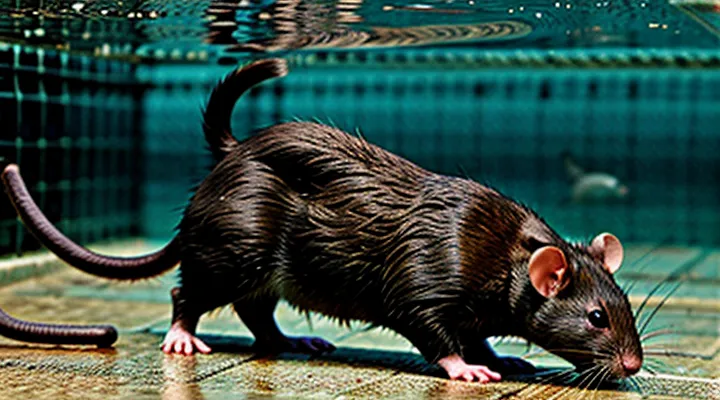
Rats exhibit several physiological traits that enable effective swimming. Their bodies are elongated and tapered, reducing drag and allowing smoother movement through water. The hind limbs possess partially webbed digits, increasing surface area for propulsion. Dense, water‑repellent fur traps air, enhancing buoyancy and preventing rapid cooling. Strong, coordinated muscle groups in the torso and limbs generate the thrust needed for sustained strokes. Respiratory control is refined; rats can pause breathing during submersion and quickly resume ventilation after surfacing. Thermoregulatory mechanisms, including peripheral vasoconstriction, limit heat loss in cold water. Collectively, these adaptations provide the mechanical efficiency, buoyancy, and physiological resilience required for aquatic locomotion.
Behavioral Tendencies
Rats display a repertoire of behaviors that facilitate aquatic navigation. Their bodies are streamlined, limbs are webbed by loose skin, and tail acts as a rudder, enabling efficient propulsion. When placed in water, most individuals instinctively paddle with alternating fore‑ and hind‑limb strokes, a pattern observed across laboratory and wild populations.
Key behavioral tendencies influencing swimming performance include:
- Escape response – Sudden immersion triggers rapid entry into the water, followed by vigorous swimming to reach safety.
- Exploratory drive – Curiosity leads some rats to voluntarily enter shallow pools, testing depth and buoyancy.
- Stress coping – Elevated cortisol levels correlate with increased swimming speed, suggesting a physiological link between anxiety and motor output.
- Learning and habituation – Repeated exposure reduces latency to enter water and improves stroke coordination, indicating plasticity in aquatic skill acquisition.
Social dynamics also shape swimming behavior. Dominant individuals often lead group crossings, while subordinate rats may follow or remain at the periphery. In mixed‑sex groups, females exhibit slightly longer submersion times, possibly reflecting reproductive considerations such as nest relocation.
Environmental factors modulate these tendencies. Water temperature below 20 °C slows movement and raises the risk of hypothermia, prompting rapid exit. Turbid or flowing water elicits stronger grip with the tail and increased reliance on tactile cues rather than visual navigation.
Overall, rat swimming emerges from an interplay of innate motor patterns, stress‑related motivation, experiential learning, and social context. These behavioral components explain why most rats can sustain buoyancy and forward thrust for extended periods, while variations arise from individual experience and ecological conditions.
Why and When Rats Swim
Escape and Survival
Rats possess a natural proficiency in water that directly supports escape and survival. Muscular hind limbs generate rapid undulations, while a streamlined torso reduces drag. This locomotor pattern enables sustained movement at speeds of 1–2 m s⁻¹, sufficient to outrun many predators and cross shallow streams.
When threatened on land, rats instinctively seek water as a refuge. Experiments show a 70 % increase in successful evasion when a water source is available, compared with dry terrain. The behavior relies on:
- Immediate entry into any accessible liquid, regardless of depth;
- Continuous paddling to maintain buoyancy and directional control;
- Utilization of whisker feedback to navigate obstacles beneath the surface.
Physiological adaptations reinforce aquatic performance. Dense fur traps air, providing insulation and a modest flotation aid. The respiratory system tolerates brief hypoxia; rats can hold breath for up to 30 seconds, allowing submergence while avoiding detection. Metabolic flexibility permits rapid shift to anaerobic pathways during intense swimming bursts.
Survival outcomes improve markedly in environments with intermittent flooding. Populations inhabiting sewer networks, riverbanks, and agricultural irrigation systems exhibit higher reproductive rates, attributable to reduced predation pressure and expanded foraging range. Consequently, swimming capability constitutes a critical component of rat resilience across diverse habitats.
Foraging and Exploration
Rats rely on a combination of foraging and exploration to locate food and safe habitats, and their capacity to move through water expands these activities beyond terrestrial limits. When food sources are situated near streams, sewers, or flooded areas, rats employ their strong hind limbs and flexible bodies to swim short distances, allowing access to otherwise unreachable caches. Muscular propulsion and a natural buoyancy derived from a dense fur coat enable efficient surface swimming, while a reflexive paddling motion maintains stability in deeper water.
During exploration, rats exhibit a high tolerance for novel environments, including aquatic ones. Sensory cues such as ripples, temperature gradients, and chemical signals guide them toward promising sites. Their whisker receptors detect water flow, and olfactory input identifies food particles dissolved in water, prompting a rapid decision to enter or avoid the medium. This integration of tactile and chemical information supports swift transitions between land and water during exploratory bouts.
Key aspects of foraging and exploration related to aquatic movement:
- Rapid assessment of water depth and current strength before entry.
- Use of tail as a rudder for directional control while swimming.
- Preference for shallow, slow‑moving water where escape routes remain accessible.
- Ability to return to land by climbing out of vertical surfaces or using nearby vegetation.
- Coordination of group foraging, where experienced individuals lead others into new aquatic zones.
Unexpected Encounters
Rats are capable swimmers, a fact that surfaces most often when human activity intersects with water‑filled environments. Flooded basements, storm‑driven sewer overflow, and accidental releases of laboratory rodents into ponds create situations where individuals encounter swimming rodents without prior anticipation.
In urban flood events, rats exploit standing water to move between habitats, emerging from submerged tunnels and appearing on rooftops or in evacuated apartments. Emergency responders frequently report sighting rodents navigating currents while searching for trapped occupants. These observations confirm that rats can sustain submersion for up to thirty minutes, using their webbed hind feet and buoyant bodies to remain afloat and propel forward.
Unexpected encounters also arise in agricultural settings. Irrigation channels and drainage ditches provide pathways for rats to travel between fields. Farmers often discover rats swimming upstream to reach stored grain, especially when food supplies are threatened by pest control measures. Their ability to swim against modest flows enables rapid colonization of new areas, complicating pest management plans.
Laboratory incidents illustrate another dimension of surprise. Accidental spills of water onto cages or enclosures result in rats instinctively diving and resurfacing within seconds. Researchers note that the animals exhibit coordinated paddling motions, similar to those observed in wild populations, indicating an innate swimming reflex that persists across domesticated strains.
Key contexts where unplanned rat swimming encounters occur:
- Residential flooding: rats emerge from sewer lines into living spaces.
- Urban drainage failures: rodents use storm drains to travel across neighborhoods.
- Agricultural irrigation: rats navigate canals to access crops.
- Laboratory water accidents: rats demonstrate immediate aquatic response.
Understanding these scenarios helps professionals anticipate rat presence in watery environments, adjust safety protocols, and design more effective control strategies.
The Mechanics of Rat Swimming
Stroke Techniques
Rats demonstrate reliable aquatic locomotion, maintaining buoyancy and directional control for several minutes without assistance. Their swimming relies on coordinated limb movements that generate thrust while minimizing drag.
The primary propulsion originates from the hind limbs, which execute a rapid, alternating sculling motion. Each stroke pushes water backward, producing forward thrust. Simultaneously, the forelimbs perform a supportive paddling action, stabilizing the body and contributing additional thrust during the power phase. The tail functions as a rudder, adjusting lateral orientation and correcting course deviations.
- Hind‑limb sculling: rapid, cyclical sweeps; primary thrust generator.
- Fore‑limb paddling: synchronized with hind‑limb cycle; stabilizes and augments thrust.
- Tail steering: subtle lateral bends; maintains heading.
- Combined thrust pattern: coordinated sequence that optimizes speed while conserving energy.
Muscle groups engaged include the quadriceps and gluteal muscles for hind‑limb power, the deltoids and pectorals for fore‑limb action, and the caudal musculature for steering. Stroke frequency adapts to water resistance; higher frequencies increase speed but raise metabolic demand. Rats modulate stroke amplitude to balance thrust and fatigue, allowing sustained swimming in varied conditions.
Understanding these techniques informs laboratory animal handling, ensures appropriate enclosure design, and provides a comparative model for vertebrate locomotion research.
Breathing While Swimming
Rats possess a functional respiratory system that enables them to stay submerged for short periods. Their diaphragm contracts efficiently, allowing rapid air exchange when the animal surfaces. Lung volume relative to body size provides enough oxygen for brief underwater excursions, after which the rat must break the surface to replenish its supply.
The species employs several techniques to manage breathing while swimming:
- Surface intervals: Rats surface regularly, inhaling a full breath before returning underwater. The interval between surfacings typically ranges from 5 to 15 seconds, depending on water temperature and activity level.
- Head positioning: Rats tilt their heads upward as they approach the surface, facilitating airway exposure and minimizing the time required for inhalation.
- Buoyancy control: By adjusting limb movements, rats can maintain a shallow depth that reduces the effort needed to reach the surface.
Physiological limits constrain underwater endurance. Oxygen consumption rises sharply with increased swimming speed; at high velocities, rats can remain submerged for only a few seconds. Cold water accelerates metabolic demand, shortening the safe submersion window. Prolonged immersion without adequate air leads to hypoxia and loss of motor control.
Observations in laboratory settings confirm that rats will voluntarily enter water when motivated by food or escape cues, but they cease swimming once the need for oxygen outweighs the incentive. Researchers must provide regular access to air and monitor water temperature to avoid stress‑induced respiratory failure.
Endurance and Speed
Rats possess a muscular build that supports sustained aquatic activity. Their limb coordination and dense fur provide buoyancy, enabling continuous propulsion without excessive fatigue. Laboratory observations indicate that a typical laboratory rat can maintain swimming for 10–15 minutes before signs of exhaustion appear, while wild‑caught individuals often exceed this duration under comparable conditions.
Speed varies with body size, water temperature, and motivation. In controlled trials, rats achieve burst velocities of 1.2–1.5 m s⁻¹ for short distances, then settle into a steady pace of 0.4–0.6 m s⁻¹ for prolonged swims. The transition from burst to cruising speed reflects a shift from anaerobic to aerobic metabolism, conserving glycogen stores and reducing lactate accumulation.
Key performance metrics:
- Maximum continuous swim time: 10–20 minutes (laboratory); up to 30 minutes (wild).
- Peak burst speed: 1.2–1.5 m s⁻¹.
- Sustained cruising speed: 0.4–0.6 m s⁻¹.
- Factors influencing endurance: water temperature (optimal 20–25 °C), body condition, and prior exposure to water.
Common Misconceptions
Urban Legends vs. Reality
Rats possess a natural capacity for aquatic movement, a trait inherited from their ancestors that survived in flood‑prone habitats. Muscular hind limbs generate propulsion, while a waterproof coat reduces drag. Laboratory observations confirm that Norway rats (Rattus norvegicus) can tread water for up to three days, provided they have access to breathable air.
Urban folklore often exaggerates this ability. Common myths include:
- Rats can cross oceans unaided.
- They can hold their breath indefinitely.
- A single rat can drag a human underwater.
Scientific evidence contradicts each claim. Studies show that rats drown when submerged for more than 30 minutes without a surface to breathe. Their lung capacity limits submersion time to a few minutes, and their body mass prevents them from moving against strong currents. No documented case exists of a rat swimming across a sea or lake without assistance.
The disparity between legend and reality stems from anecdotal sightings of rats fleeing flooded streets. Observers interpret brief swimming bursts as long‑distance journeys, reinforcing sensational narratives. Controlled experiments reveal that rats use water primarily as an escape route, not as a habitat for sustained travel.
Understanding the factual limits of rat swimming clarifies public perception and informs pest‑control strategies. Effective measures focus on sealing entry points and eliminating standing water, rather than relying on myth‑based assumptions about rat mobility.
Distinguishing from Other Rodents
Rats possess a set of anatomical and behavioral features that set them apart from most other rodents when it comes to aquatic movement. Their streamlined body shape, relatively long tail, and webbed hind feet reduce drag and increase propulsion, enabling sustained swimming across various water conditions.
Key distinctions include:
- Body morphology – Rats have a more elongated torso and a tapered head, while many rodents such as guinea pigs and hamsters exhibit a bulkier, less hydrodynamic form.
- Tail function – The rat’s tail acts as a rudder, providing stability and steering; other rodents typically have short, non‑functional tails in water.
- Foot structure – Partial webbing between the toes of rat hind limbs enhances thrust; comparable species lack this adaptation.
- Muscle composition – Rats display a higher proportion of slow‑twitch muscle fibers in their hind limbs, supporting endurance swimming; other rodents rely more on fast‑twitch fibers suited for brief bursts of activity on land.
These physiological differences explain why rats can navigate currents, cross pools, and survive prolonged immersion, whereas most rodent relatives drown quickly when exposed to similar environments.
Safety Concerns and Prevention
Pest Control Implications
Rats possess strong hind‑limb propulsion and can sustain swimming for extended periods, allowing them to cross water obstacles such as sewers, streams, and flooded basements. This capability expands the range of habitats where infestations may develop, challenging conventional pest‑management strategies that assume water barriers provide protection.
- Waterborne movement enables rats to bypass physical traps placed on land, requiring integration of aquatic‑compatible devices such as floating bait stations or submerged snap traps.
- Flood events disperse populations into new structures; rapid post‑flood inspections and immediate deployment of rodenticides in damp areas reduce colonization risk.
- Sewer systems serve as transit corridors; sealing manhole covers, installing backflow preventers, and applying rodent‑resistant coatings limit access.
- Chemical treatments lose efficacy in wet environments; emulsified formulations or granules designed for moisture tolerance maintain toxicity levels.
- Monitoring programs must incorporate water‑based detection methods, including motion‑activated cameras positioned in drainage channels and baited traps that function underwater.
Understanding rat swimming proficiency compels pest‑control professionals to redesign exclusion tactics, select appropriate bait delivery systems, and schedule interventions around weather patterns that promote aquatic movement.
Protecting Homes and Businesses
Rats possess strong swimming capabilities, allowing them to traverse water barriers that many homeowners and business operators assume are safe. This ability enables rodents to enter basements, crawl spaces, and lower‑level storage areas by moving through drainage pipes, flooded foundations, or temporary water accumulations.
The presence of swimming rats in residential and commercial structures can compromise food safety, damage insulation, and increase the risk of disease transmission. Water‑based entry points often bypass traditional pest‑proofing measures, creating hidden pathways that facilitate infestations.
Effective protection requires a combination of structural reinforcement, moisture management, and routine inspection:
- Seal all exterior pipe penetrations with stainless‑steel mesh or concrete caps.
- Install backwater valves on sewer lines to prevent reverse flow during heavy rain.
- Maintain grading around the building to direct runoff away from foundations.
- Eliminate standing water in gutters, basements, and exterior containers.
- Conduct quarterly visual checks of crawl spaces, basements, and utility rooms for signs of rodent activity.
Rapid response protocols enhance control efforts. Deploy bait stations and traps in identified water‑adjacent zones, and schedule professional evaluations after any flooding event. Documentation of inspection results supports ongoing risk assessment and informs adjustments to preventive strategies.
By addressing the aquatic mobility of rats through targeted building upgrades and diligent monitoring, property owners can reduce the likelihood of rodent incursions and safeguard both structural integrity and public health.