
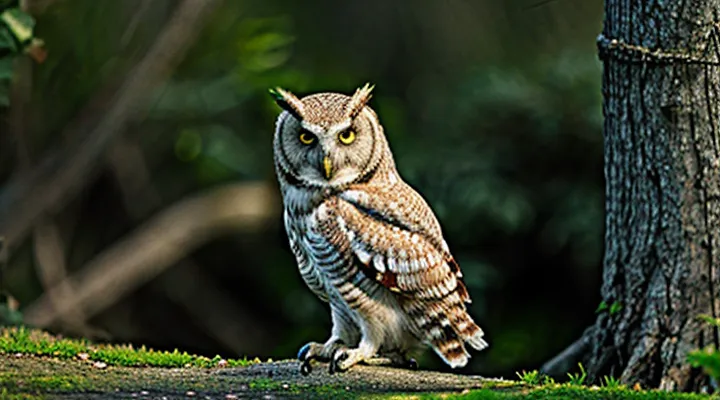
Predatory Behavior and Hunting Strategies
Nocturnal Hunting Adaptations
Owls capture rodents such as mice through a suite of specialized nocturnal hunting adaptations that maximize stealth, sensory acuity, and strike precision.
- Feather morphology – serrated edge feathers on the wing surface break up airflow, eliminating turbulence and producing near‑silent flight.
- Facial disc – a circular array of stiff feathers surrounds the eyes, acting as a parabolic reflector that directs sound toward the ears.
- Auditory asymmetry – ears positioned at different heights detect minute time and intensity differences, allowing three‑dimensional localization of prey in total darkness.
- Retinal specialization – a high density of rod cells and a large pupil enlarge the visual aperture, enhancing image resolution under low‑light conditions.
- Talons and grip – curved, razor‑sharp claws generate rapid, high‑force closure, while a muscular foot contracts to immobilize struggling prey.
- Neck flexibility – up to 270° rotation provides a wide field of view without moving the body, reducing exposure to detection.
These adaptations operate synergistically: silent approach prevents alerting the target; acute auditory and visual systems locate the mouse despite minimal illumination; rapid, forceful capture secures the prey. The combined effect explains why nocturnal raptors efficiently prey on small mammals, confirming that mice constitute a regular component of their diet.
Silent Flight and Keen Senses
Owls capture mice through a combination of stealthy aerodynamics and acute sensory systems. Their feather structure minimizes turbulence, allowing flight without audible wingbeats. Specialized serrated edges on the leading feathers break up airflow, reducing sound emission and preventing prey detection.
Key sensory adaptations support nocturnal hunting:
- Vision: Large eyes collect maximum light, providing high-resolution image formation in low‑light conditions.
- Audition: Asymmetrical ear placements create a vertical sound‑localization axis, enabling precise triangulation of rustling rodents.
- Tactile feathers: Facial discs channel sound toward the ears, amplifying faint noises produced by small mammals.
Silent flight reduces the distance between predator and target, while keen senses locate the animal once within striking range. The integration of these features ensures that owls efficiently locate and seize mice during night hours.
Mice as a Primary Food Source
Nutritional Value of Mice for Owls
Owls frequently capture mice as a primary prey item, providing a substantial portion of their dietary protein and energy requirements. The small mammal’s body composition aligns with the metabolic demands of nocturnal raptors, delivering nutrients essential for growth, reproduction, and sustained flight.
Key nutritional contributions of mice include:
- Protein: Approximately 20 % of mouse body mass consists of high‑quality protein, supplying essential amino acids for muscle maintenance and feather development.
- Lipids: Fat stores represent 8–12 % of body weight, offering a dense energy source that supports prolonged hunting periods and thermoregulation.
- Carbohydrates: Limited glycogen reserves satisfy short‑term glucose needs during rapid bursts of activity.
- Vitamins and minerals: Mouse tissue contains calcium, phosphorus, iron, and B‑complex vitamins, which are critical for bone health, blood formation, and metabolic processes.
Overall, the caloric density and balanced macro‑ and micronutrient profile of mice make them an optimal food resource for owls, directly influencing survival and reproductive success.
Common Mouse Species Consumed
Owls frequently include small rodents in their diet, and several mouse species dominate the prey spectrum across temperate and subtropical habitats.
- House mouse (Mus musculus) – abundant in human‑altered environments; regularly captured by barn, great, and tawny owls.
- Wood mouse (Apodemus sylvaticus) – common in forest edges and hedgerows; primary target for long‑eared and little owls.
- Deer mouse (Peromyscus maniculatus) – widespread in North American grasslands and shrublands; frequently taken by spotted and barred owls.
- Field mouse (Apodemus agrarius) – occupies agricultural fields and riverbanks; preyed upon by Eurasian eagle‑owl and other large species.
- Southern red‑backed vole (Myodes gapperi) – inhabits boreal forests; occasionally consumed by boreal owl species.
Studies of pellet contents reveal that these five species account for the majority of murine remains recovered from owl nests and roosts. Consumption rates correlate with local mouse population density, demonstrating that owls adjust predation pressure in response to seasonal fluctuations of these common rodents.
Other Prey Animals
Insects and Small Birds
Owls are opportunistic predators; their stomach contents regularly include insects and diminutive avian species. Field studies across temperate zones report that arthropods constitute 15‑30 % of the total biomass consumed by most owl species, while passerines and other small birds account for 10‑25 %. These figures contrast with the higher proportion of small mammals, which typically represent 40‑60 % of the diet in species that hunt in open habitats.
Key observations:
- Insect prey are captured primarily at dusk and dawn, when nocturnal activity peaks.
- Small birds are seized during brief daylight forays or in edge habitats where they perch near cover.
- Rodent capture rates increase in open fields, where visibility and prey density favor rapid pursuit.
The inclusion of insects and small birds supplements the nutritional profile of owls, providing essential proteins and lipids during breeding seasons when energy demands rise. Their predation pressure helps regulate insect populations that could otherwise reach pest levels, and it influences the survival rates of fledgling passerines, contributing to broader ecosystem balance.
Amphibians and Reptiles
Owls are primarily nocturnal predators that target small vertebrates. While rodents such as mice constitute a major portion of their diet, many owl species also capture amphibians and reptiles when these prey are abundant and accessible. Field observations confirm that species like the Barn Owl (Tyto alba) and the Eastern Screech‑Owls (Megascops asio) regularly ingest frogs, toads, salamanders, lizards, and small snakes, especially during seasons when rodent populations decline.
Key factors influencing the inclusion of amphibians and reptiles in owl meals are:
- Habitat overlap: forest edges, wetlands, and grasslands provide simultaneous access to rodents and ectothermic prey.
- Prey size: amphibians and reptiles within the 30–150 g range fit comfortably in an owl’s gape.
- Activity period: many amphibians and nocturnal reptiles are active at dusk, matching owl hunting windows.
Comparative analysis of stomach‑content studies shows that amphibian and reptile remains appear in 5‑12 % of sampled owls, varying by region and species. These data demonstrate that owls do not restrict themselves to mice; they opportunistically exploit a broader spectrum of small vertebrates, including amphibians and reptiles, to satisfy nutritional requirements.
Impact of Diet on Owl Populations
Food Availability and Breeding Success
Owls rely heavily on small mammals, particularly rodents, to sustain reproductive efforts. When mouse populations surge, owls experience a measurable increase in prey capture rates, which translates into higher clutch sizes and improved chick survival. Conversely, prolonged declines in mouse abundance correspond with reduced egg production and elevated nest abandonment.
Key relationships between prey abundance and breeding outcomes include:
- Direct correlation between nightly mouse capture numbers and the number of fledglings per brood.
- Shorter incubation periods observed in nests supplied with abundant rodent prey.
- Increased frequency of second clutches in years with sustained mouse availability.
Research across temperate regions demonstrates that owl species with flexible hunting strategies adjust nesting timing to align with peak mouse activity. This phenological shift maximizes energy intake during critical growth phases of offspring. Populations lacking such adaptability exhibit lower reproductive success under fluctuating prey conditions.
Management practices that maintain healthy rodent habitats—such as preserving meadow edges and limiting pesticide use—support consistent food supplies for owls. Stable prey resources foster higher reproductive rates, contributing to long‑term population stability.
Ecosystem Role as Pest Control
Owls regularly capture and swallow small rodents, including mice, as part of their natural hunting behavior. This predation occurs primarily at night, when owls’ acute vision and silent flight give them a decisive advantage over prey that is active after dark.
By removing a significant number of mice from ecosystems, owls reduce the pressure on crops, stored grain, and residential structures. Their impact on pest populations translates into measurable economic benefits:
- Decreased loss of agricultural yield, especially in grain and vegetable production.
- Lower incidence of rodent‑borne diseases affecting humans and livestock.
- Reduced need for chemical rodenticides, which minimizes environmental contamination.
The presence of healthy owl populations correlates with stable, self‑regulating rodent numbers, reinforcing ecosystem resilience without human intervention.
Digestion and Pellet Formation
Regurgitation of Undigested Remains
Owls frequently capture small rodents, including mice, as part of their hunting repertoire. After ingestion, the digestive system extracts nutrients from soft tissues, while indigestible components such as fur, bones, and feathers remain in the stomach. Once the stomach is emptied, owls eject these remnants in a process known as regurgitation, producing a compact pellet.
The pellet formation follows a predictable sequence:
- Muscular contractions force the undigested material toward the esophagus.
- Salivary secretions coat the particles, facilitating cohesion.
- The bird expels the consolidated mass through the mouth, typically within 12–24 hours after the meal.
Scientific observation of pellets provides reliable data on prey composition. Researchers dissect pellets to identify species-specific skeletal fragments, confirming that mice constitute a regular portion of the owl’s diet in many habitats.
Regurgitated pellets serve ecological functions beyond waste removal. They reduce the risk of internal injury from sharp bone fragments, maintain digestive efficiency, and prevent bacterial overgrowth by eliminating material unsuitable for enzymatic breakdown.
Analyzing Owl Pellets to Understand Diet
Analyzing owl regurgitated pellets provides direct evidence of prey selection. Researchers collect pellets from roost sites, clean them, and separate bone fragments, fur, and insect exoskeletons. Each component is identified through comparative collections and reference guides, allowing precise species-level classification.
The frequency of mouse remains in pellets quantifies how often these rodents constitute a portion of the diet. Typical findings include:
- Small mammals: mice, voles, shrews – 45 % of identified prey in many barn‑owl studies.
- Birds: sparrows, quails – 20 % of remains.
- Insects: beetles, moths – 15 % of fragments.
- Amphibians and reptiles – 5 % of specimens.
- Unidentified debris – 15 % of total mass.
Variations arise from habitat type, seasonal prey abundance, and owl species. In agricultural landscapes where mice proliferate, pellet analyses consistently show a higher proportion of murine bones, confirming that owls regularly consume these rodents. Conversely, in forested regions with abundant alternative mammals, mouse representation declines but never disappears entirely.
Long‑term pellet monitoring tracks shifts in prey availability, informs conservation strategies, and validates the premise that owls incorporate mice into their regular diet.