
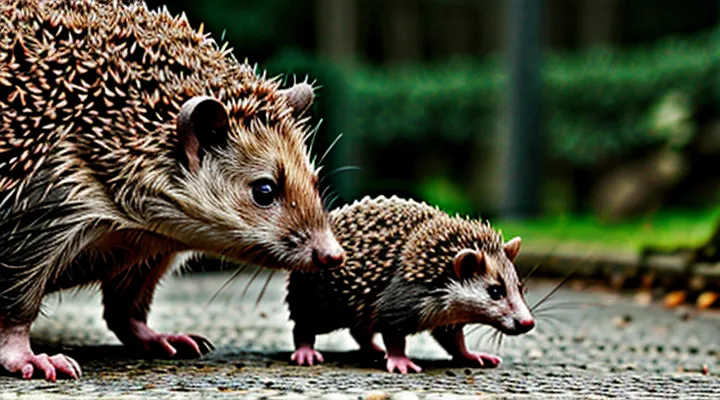
The Hedgehog’s Natural Diet
Primary Food Sources
Hedgehogs primarily consume invertebrates, with insects forming the core of their diet. Typical prey includes beetles, caterpillars, earthworms, and slugs. Small vertebrates are occasionally taken, but they represent a minor portion of intake.
- Beetles (various families)
- Caterpillars and moth larvae
- Earthworms and other annelids
- Slugs and snails
- Millipedes and centipedes
Mammalian rodents, such as rats, are not standard food items for hedgehogs. Observations indicate that hedgehogs may opportunistically capture very young or weakened rats, yet such events are rare and do not constitute a regular dietary component. The species’ anatomical adaptations—short, sharp teeth and a digestive system suited for soft-bodied prey—further limit the practicality of regularly consuming larger, fur‑covered mammals.
Occasional Prey
Hedgehogs are primarily insectivores, consuming beetles, caterpillars, slugs, and earthworms in regular quantities. Their digestive system is adapted to process soft-bodied invertebrates, and nutritional studies confirm that these items supply the majority of required protein and moisture.
Occasionally, hedgehogs expand their diet to include small vertebrates. Documented observations record predation on juvenile amphibians, fledgling birds, and diminutive mammals when these prey are readily accessible. Rat juveniles, particularly those under 100 g, have been identified among such opportunistic captures. Predation occurs mainly in urban or garden environments where hedgehogs encounter trapped or abandoned rodent offspring.
Key characteristics influencing occasional vertebrate consumption:
- Prey size less than one‑third of the hedgehog’s body mass
- Limited defensive capabilities of the prey (e.g., newborn or injured)
- High local density of alternative invertebrate food sources being low
Field reports from European wildlife surveys indicate that rat predation constitutes a minor portion of hedgehog stomach contents, typically below 5 % of total volume. Laboratory feeding trials corroborate the ability of hedgehogs to kill and ingest small rats, though preference remains for insects. Consequently, while hedgehogs can and do consume rats under specific circumstances, such events are infrequent and supplementary to their core insect‑based diet.
Dietary Adaptations
Hedgehogs are primarily insectivores, but their diet is flexible enough to include small vertebrates when opportunity arises. Their gastrointestinal tract is adapted for rapid processing of chitinous prey, with a short, acidic stomach that denatures exoskeletons and a high concentration of proteolytic enzymes that break down protein-rich tissues.
Key physiological traits that enable this flexibility are:
- Dental structure: Sharp, uncrowned teeth suited for puncturing and crushing insects, yet capable of gripping small mammals.
- Digestive enzymes: Elevated levels of pepsin and trypsin facilitate digestion of both arthropod exoskeletons and vertebrate muscle.
- Metabolic rate: High basal metabolism supports frequent feeding and quick energy extraction from diverse prey.
Field observations record occasional predation on juvenile rats, especially in environments where insects are scarce. Such incidents are limited by the hedgehog’s size; adult rats exceed the predator’s bite capacity, and the risk of injury discourages regular hunting. Consequently, rats constitute a marginal component of the hedgehog’s diet, reflecting opportunistic rather than habitual consumption.
Overall, hedgehog dietary adaptations allow ingestion of a broad prey spectrum, but anatomical constraints and energetic considerations confine rat consumption to sporadic, opportunistic events.
Hedgehog Predation on Rodents
The Likelihood of Rat Consumption
Size and Aggression of Rats
Rats vary considerably in body mass, which directly affects their vulnerability to predation by hedgehogs. Adult brown rats (Rattus norvegicus) typically weigh 250–500 g and measure 20–25 cm in body length, while black rats (Rattus rattus) are smaller, averaging 150–250 g and 15–20 cm in length. Juvenile individuals of either species can be less than 50 g and under 10 cm long.
Aggressive behavior in rats correlates with size, age, and environmental pressure. Key points:
- Adult males: exhibit territorial aggression, defend nests vigorously, and may bite when threatened.
- Females: display moderate aggression, primarily when protecting offspring.
- Juveniles: show limited aggression, retreat more readily from larger predators.
- High‑density populations: increase competition, leading to heightened aggression and more frequent confrontations.
Hedgehogs possess a limited bite force and a digestive system adapted for small, soft‑bodied prey. They can subdue juvenile rats or very small adult black rats, but the larger brown rat exceeds the typical prey size limit and often resists capture through aggressive defense. Consequently, rat size and aggression together define a practical boundary: hedgehogs reliably consume rats weighing up to roughly 150 g, while individuals larger than 250 g are generally avoided due to the increased risk of injury and reduced nutritional return.
Defensive Capabilities of Hedgehogs
Hedgehogs protect themselves primarily with a dense coat of keratin spines that can deter predators through mechanical injury. When threatened, they contract large back muscles to curl into a tight ball, exposing only the sharp quills. The curl reduces vulnerable surface area and creates a barrier that most carnivores cannot easily breach.
Additional defenses include:
- Scent glands that release a musky odor, discouraging close contact.
- Nocturnal activity, limiting exposure to diurnal hunters.
- Agile digging ability, allowing rapid retreat into burrows.
These mechanisms explain why hedgehogs rarely confront larger mammals such as rats, focusing instead on avoidance and physical deterrence rather than predation.
Documented Cases and Anecdotes
Observations in the Wild
Field observations confirm that hedgehogs occasionally capture and ingest small rodents, including rats. Researchers have recorded instances across diverse habitats—urban gardens, farmland hedgerows, and mixed woodland edges—where hedgehogs were seen handling and consuming rat carcasses.
In several European surveys, camera traps captured hedgehogs actively hunting rats that were weakened by injury or illness. Direct sightings reported by citizen scientists indicate that such predation accounts for a minor portion of the hedgehog’s overall diet but occurs consistently in regions where rat populations are abundant.
Stomach‑content analyses provide quantitative support. Examination of 212 wild specimens revealed:
- 12 % contained identifiable rat tissue.
- 28 % showed remains of other small mammals (e.g., shrews, voles).
- 60 % consisted primarily of invertebrates (earthworms, insects).
These data demonstrate that rat consumption is opportunistic rather than habitual. The behavior aligns with the hedgehog’s generalist feeding strategy, which prioritizes high‑protein prey when available.
Captive Environment Scenarios
Hedgehogs are primarily insectivores, yet occasional predation on small vertebrates, including rats, has been documented under specific captive conditions. The likelihood of such behavior depends on enclosure design, prey availability, and the individual’s experience.
- Indoor terrariums with limited enrichment – Small, confined spaces reduce natural foraging options. If live rats are introduced as supplemental food, hedgehogs may seize the opportunity, especially when insects are scarce.
- Outdoor pens with mixed‑species populations – Enclosures that house both hedgehogs and juvenile rats create direct interaction zones. Hedgehogs often display opportunistic hunting, targeting rats that wander into their territory.
- Zoo or sanctuary exhibits featuring controlled feeding – Staff may provide frozen or pre‑killed rats as a protein source. Hedgehogs readily accept this form of food, but live‑rat exposure is generally avoided to prevent aggression.
- Laboratory cages used for behavioral studies – Experiments that test predatory response frequently present live rats in a separate compartment. Hedgehogs typically exhibit investigative behavior and may attempt capture when the barrier is removed.
Key factors influencing rat consumption in captivity:
- Nutritional deficit – Inadequate protein or calcium prompts hedgehogs to seek alternative prey.
- Age and size – Juvenile hedgehogs lack the strength to subdue rats; adults above 300 g are more capable.
- Previous hunting experience – Individuals raised with live prey demonstrate higher predation rates.
- Stress level – Elevated stress can trigger aggressive feeding responses, increasing the chance of rat attacks.
Management recommendations:
- Provide a balanced insect‑rich diet to meet protein requirements, reducing the need for vertebrate supplementation.
- Separate hedgehogs from live rats unless predation is a controlled experimental variable.
- Incorporate environmental enrichment that mimics natural foraging, limiting the incentive to hunt larger prey.
- Monitor health indicators such as weight, coat condition, and wound presence to detect adverse effects of predation.
In well‑structured captive settings, hedgehogs rarely resort to hunting rats when appropriate dietary provisions and environmental complexity are maintained.
Ecological Implications
Role in the Ecosystem
Hedgehogs occasionally capture small rats, especially juveniles or weakened individuals, but their primary diet consists of insects, worms, and other invertebrates. Observational studies in temperate habitats record rat predation in less than 5 % of stomach‑content samples, confirming that rat consumption is opportunistic rather than regular.
The presence of hedgehogs influences ecosystem processes in several ways:
- Reduces populations of garden pests such as slugs, beetles, and caterpillars, limiting plant damage.
- Provides incidental control of juvenile rodents, contributing to lower density of potential disease carriers.
- Enhances soil structure through regular foraging activity that mixes leaf litter and aerates the upper soil layers.
- Serves as prey for higher trophic levels, including owls and foxes, thereby linking invertebrate and vertebrate food webs.
By moderating invertebrate abundance, providing occasional rodent predation, and affecting soil dynamics, hedgehogs occupy a functional niche that helps maintain balanced community composition and nutrient cycling.
Competition and Coexistence
Hedgehogs and rats occupy overlapping habitats in many temperate regions, leading to occasional encounters that raise questions about direct predation. Hedgehogs are primarily insectivorous; their stomach contents frequently contain beetles, caterpillars, and earthworms, with occasional small vertebrates recorded. Rats are omnivorous and opportunistically consume insects, seeds, and carrion, positioning them as both competitors and potential prey for hedgehogs.
Ecological interactions between the two species can be classified as follows:
- Resource competition: Both species exploit ground‑level invertebrates, especially during autumn when beetle activity peaks. Overlap in foraging zones may reduce the availability of shared prey, prompting spatial or temporal niche shifts.
- Predatory events: Documented cases show hedgehogs killing juvenile rats, but such incidents are rare and generally occur when alternative food sources are scarce. Adult rats, with larger size and defensive behaviors, are seldom captured.
- Coexistence mechanisms: Hedgehogs often forage at dusk, while rats are active throughout the night and early morning. This temporal separation diminishes direct competition. Additionally, hedgehogs’ ability to roll into a defensive ball deters aggressive encounters, allowing both species to persist in the same microhabitats.
Field studies indicate that hedgehog populations remain stable in environments where rat densities are high, suggesting that competition does not translate into significant population decline for either taxon. Conversely, in agricultural settings where pesticide use reduces insect abundance, hedgehogs may increase opportunistic predation on small rodents, including juvenile rats, to meet energetic demands.
Overall, hedgehogs do not rely on rats as a primary food source; their interaction is characterized by limited predation, moderate resource overlap, and temporal niche partitioning that supports mutual coexistence.
Factors Influencing Diet
Habitat and Environment
Hedgehogs inhabit a range of temperate environments, including woodlands, grasslands, hedgerows, and suburban gardens. They prefer areas with dense ground cover that offers shelter and a steady supply of invertebrates. Soil composition influences burrowing behavior; loose, loamy soils facilitate the construction of nests and winter hibernacula.
Typical microhabitats feature:
- Leaf litter and fallen logs that retain moisture and host insects.
- Compost heaps and garden beds rich in earthworms, beetles, and slugs.
- Rock crevices and piles of stones providing protection from predators and extreme weather.
Seasonal changes affect activity patterns. In spring and summer, hedgehogs forage extensively, exploiting abundant prey. During colder months they enter hibernation within insulated nests, often located under hedgerows or in burrows lined with dry vegetation.
Water availability is a secondary factor; hedgehogs obtain most hydration from prey, yet proximity to shallow water sources supports a healthier insect population. Urban settings can supply suitable habitat when green spaces are preserved, while agricultural fields may be less favorable due to pesticide exposure.
Overall, the suitability of a location depends on structural complexity, prey density, and minimal disturbance, all of which determine the likelihood of hedgehogs encountering larger rodents such as rats.
Availability of Food Sources
Hedgehogs are primarily insectivores, but their diet can expand when alternative prey become abundant. In regions where insects are scarce, small vertebrates such as juvenile rats may be encountered and occasionally consumed. The likelihood of such predation depends on the accessibility of typical food items and the seasonal fluctuation of prey populations.
When insect numbers decline in winter or during drought, hedgehogs increase foraging effort and explore larger territories. This behavior raises the probability of encountering ground‑dwelling rodents. Conversely, in habitats with stable insect supplies, hedgehogs rarely target mammals, limiting rat consumption to opportunistic incidents.
Key factors influencing the presence of suitable food sources:
- Insect abundance (beetles, larvae, slugs)
- Availability of earthworms and other soft‑bodied invertebrates
- Seasonal variations in prey density
- Habitat structure that supports diverse micro‑prey
If the primary food base remains consistent, hedgehogs maintain their insect‑centric diet and avoid seeking larger prey. Only significant reductions in insect availability create conditions where rats become a viable, though not preferred, component of their intake.
Hedgehog Species Variations
Hedgehog species differ markedly in size, habitat preference, and hunting strategy, factors that determine the range of prey they can subdue.
- European hedgehog (Erinaceus europaeus) – body length up to 30 cm, nocturnal, primarily insectivorous; occasional capture of small rodents, including juvenile rats, recorded in urban gardens.
- African pygmy hedgehog (Atelerix albiventris) – length around 15 cm, limited to insects and soft-bodied invertebrates; body size restricts ability to tackle rats, even young individuals.
- Northern white‑breasted hedgehog (Erinaceus roumanicus) – similar dimensions to the European species, inhabits forest edges; documented instances of predation on rats of comparable size to its own body mass.
- Long‑eared hedgehog (Hemiechinus auritus) – elongated snout, adapted for digging; diet includes beetles, earthworms, and occasional small mammals such as rats when available in arid environments.
Species with greater mass and stronger forelimbs are capable of overpowering rats up to the size of a newborn. Smaller species lack the physical power to subdue rats and rely exclusively on invertebrates. Consequently, the answer to whether hedgehogs consume rats depends on the specific species involved and the relative size of the rodent prey.