
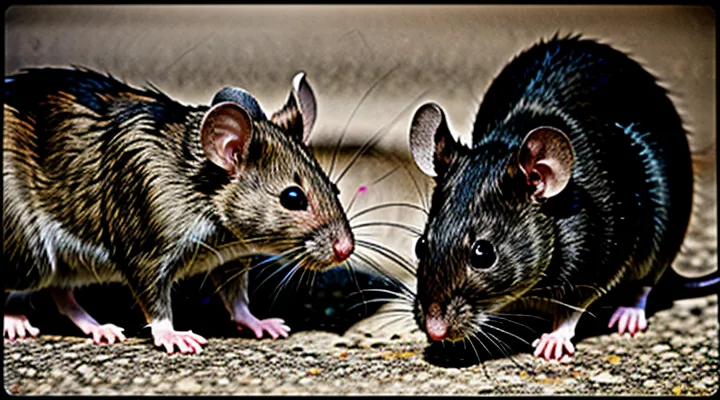
Understanding the Distinction: General Overview
Size and Body Proportions
Body Length
Rats typically exhibit a longer body than mice, with adult specimens measuring between 20 cm and 30 cm from nose to tail base, excluding the tail. In contrast, adult mice range from 7 cm to 10 cm under the same criteria. This disparity results from divergent growth patterns and ecological niches.
-
Rats:
• Body length (head‑to‑base): 20–30 cm
• Tail length: 18–25 cm, often nearly equal to body length -
Mice:
• Body length (head‑to‑base): 7–10 cm
• Tail length: 6–9 cm, generally shorter than the body
The pronounced size difference facilitates rapid visual identification in laboratory and field settings. Accurate measurement of body length, combined with tail proportion, reduces misclassification risk and supports species‑specific experimental protocols.
Weight
Weight provides a clear metric for separating rats from mice. Adult rats usually weigh between 250 g and 500 g, with some large individuals exceeding 600 g. In contrast, adult mice typically fall in the 15 g to 30 g range, rarely surpassing 35 g.
- Norway (brown) rat: 300–500 g
- Roof (black) rat: 250–350 g
- House mouse: 15–25 g
- Field mouse: 20–30 g
Weight varies with age, sex, and nutrition. Juvenile rats under two months may weigh less than 100 g, overlapping with large juvenile mice. Males generally weigh more than females within each species. Access to high‑calorie feed can increase adult mass by 10–20 % in both groups.
These mass differences aid rapid visual identification and inform handling protocols, as equipment and dosage calculations depend on precise weight estimates.
Body Shape
Rats possess a more robust body than mice. Their torso is elongated and muscular, giving a heavier appearance. In contrast, mice have a slender, compact form with a relatively short torso.
Tail length also distinguishes the two. A rat’s tail is thick, nearly equal in diameter to its body, and can reach up to 25 cm in adult specimens. Mice display a thin, hair‑covered tail that is proportionally longer relative to body size but much narrower, typically measuring 7–10 cm.
Key dimensions:
- Body length (head‑to‑base of tail): rat ≈ 20–25 cm; mouse ≈ 6–10 cm
- Weight: rat ≈ 200–500 g; mouse ≈ 15–30 g
- Tail thickness: rat ≈ 1 cm; mouse ≈ 0.2 cm
Overall, rats exhibit a bulkier, more muscular silhouette, while mice retain a petite, delicate shape.
Detailed External Feature Comparison
Head and Facial Features
Snout Shape
Rats and mice exhibit distinct external morphologies; the shape of the snout provides a reliable visual cue for species identification.
Rats possess a relatively elongated snout that tapers gradually toward the tip. The nasal region is broad, with a blunt end that supports powerful incisors and accommodates a larger olfactory epithelium. The palate extends far back, contributing to the overall length of the facial profile.
Mice display a markedly shorter snout. The nasal tip is sharply pointed, and the overall facial length is reduced compared with that of rats. The palate is correspondingly brief, giving the mouse a more compact head shape.
Key comparative points:
- Length: rat snout > mouse snout
- Profile: rat = blunt, mouse = pointed
- Width: rat = broader, mouse = narrower
These morphological differences reflect adaptations to divergent foraging strategies and habitat use, allowing rapid visual discrimination between the two rodent species.
Ear Size and Shape
Rats possess larger, more rounded ears that extend noticeably beyond the head outline. The average ear length in laboratory rats ranges from 15 to 20 mm, and the pinna is thick with a prominent central ridge. Mice have smaller, triangular ears measuring 8 to 12 mm, with a thinner cartilage layer and a smoother edge.
The shape of the rat ear contributes to a broader surface area, facilitating heat dissipation in larger bodies. Mouse ears, being narrower, provide sufficient thermal regulation for their reduced mass while maintaining acute auditory sensitivity.
Key distinguishing characteristics:
- Size: rat ears ≈ 15–20 mm; mouse ears ≈ 8–12 mm.
- Form: rat pinna rounded and bulky; mouse pinna triangular and slim.
- Cartilage: rat ear cartilage thick, with a central ridge; mouse cartilage thin, lacking a pronounced ridge.
- Position: rat ears sit slightly higher on the skull; mouse ears attach lower, closer to the eyes.
Eye Prominence
Rats and mice display distinct ocular morphology that aids species identification. In rats, the eyes are set deeper within the skull, giving a recessed appearance; the orbital rim is less pronounced and the eyeball occupies a smaller proportion of the head’s width. Mice possess eyes that project farther forward, creating a comparatively bulging look; the orbital rim is more defined and the eye diameter approaches the width of the snout.
Key points of contrast:
- Depth of placement: rat eyes sit lower relative to the facial plane; mouse eyes sit higher and more forward.
- Relative size: rat eye diameter ≈ 30 % of head width; mouse eye diameter ≈ 40 % of head width.
- Orbital rim definition: subtle in rats, pronounced in mice.
- Visibility of sclera: minimal in rats, more evident in mice due to greater protrusion.
These traits provide reliable visual cues for distinguishing the two rodents in field and laboratory settings.
Whiskers (Vibrissae)
Rats possess longer and thicker vibrissae than mice, with average lengths of 30–45 mm compared to 12–20 mm in mice. The increased size enhances tactile resolution over a broader spatial area, supporting navigation in complex burrow systems.
The distribution of whiskers differs markedly. Rats have a well‑defined mystacial pad containing 12–14 macro‑vibrissae per side, supplemented by numerous smaller micro‑vibrissae on the cheek and rostral regions. Mice display a reduced mystacial pad with 8–10 macro‑vibrissae per side and fewer micro‑vibrissae overall.
Sensory innervation follows the same pattern in both species, yet the density of mechanoreceptors is higher in rat macro‑vibrissae, providing finer discrimination of surface texture and airflow.
Key comparative points:
- Length: rat ≈ 30–45 mm; mouse ≈ 12–20 mm
- Number of macro‑vibrissae (per side): rat ≈ 12–14; mouse ≈ 8–10
- Micro‑vibrissae abundance: rat > mouse
- Mechanoreceptor density: rat > mouse
These structural variations directly affect the animals’ ability to detect obstacles, locate food, and communicate through whisker‑based signaling.
Tail Characteristics
Tail Length Relative to Body
Rats possess tails that measure approximately 70–80 % of their body length, providing a robust, relatively thick appendage suited for balance and thermoregulation. Mice exhibit tails that are proportionally longer, often reaching 90–100 % of the body length, and are markedly slender, reflecting adaptations for agility and heat dissipation.
Key comparative points:
- Proportion: Rat tail ≈ 0.7–0.8 × body length; mouse tail ≈ 0.9–1.0 × body length.
- Diameter: Rat tails are thicker and more muscular; mouse tails are thin and flexible.
- Functionality: Rat tails contribute to stability during climbing and support body heat retention; mouse tails enhance maneuverability and act as a primary surface for heat loss.
Tail Covering (Hair vs. Scales)
Rats possess a tail that is largely naked, with a thin layer of fine hairs sparsely distributed along the dorsal surface. The underlying integument consists of smooth, overlapping scales that provide flexibility and protection. The hair density is insufficient to conceal the scale pattern, giving the tail a predominantly scaly appearance.
Mice exhibit a tail covered more extensively by fine, soft hairs that mask the scale architecture. The hair coat is denser and extends across the entire length, resulting in a visibly furry tail. Scales remain present beneath the hair but are not readily observable.
Key distinctions:
- Hair density: rat – sparse; mouse – dense.
- Visual presentation: rat – scaly; mouse – furry.
- Functional implication: rat tail retains greater tactile sensitivity due to exposed scales; mouse tail benefits from additional insulation provided by the hair coat.
Tail Thickness
Rats possess relatively thick tails, often measuring 60–70 % of their body length and displaying a robust, cylindrical shape. The diameter remains uniform along most of the tail, providing structural support for balance and thermoregulation. Skin covering the tail is relatively loose, allowing slight expansion without compromising strength.
Mice exhibit slender tails, typically 70–80 % of body length but markedly narrower than those of rats. The tail tapers toward the tip, and its reduced thickness limits load‑bearing capacity while enhancing flexibility for maneuvering in confined spaces. The skin is tighter, revealing visible blood vessels that facilitate rapid heat exchange.
Key distinctions:
- Diameter: Rat tails are 2–3 mm thick; mouse tails are 1–1.5 mm.
- Uniformity: Rats maintain consistent thickness; mice taper noticeably.
- Functional emphasis: Rats rely on tail rigidity for support; mice prioritize flexibility and heat dissipation.
Feet and Paws
Foot Size
Rats possess noticeably larger feet than mice, reflecting their greater overall body mass. An adult Norway rat typically measures 30–40 mm from the heel to the tip of the longest toe, while a common house mouse averages 15–20 mm for the same dimension. This disparity influences locomotion; the broader rat foot provides a more stable platform for rapid, straight‑line running, whereas the smaller mouse foot supports agile, high‑frequency movements in confined spaces.
Key measurements:
- Hind foot length: rat ≈ 35 mm, mouse ≈ 17 mm
- Forefoot width (at the widest point): rat ≈ 10 mm, mouse ≈ 5 mm
- Pad thickness: rat ≈ 2.5 mm, mouse ≈ 1.5 mm
The larger surface area of rat feet distributes weight more evenly, reducing pressure on substrates such as sand or loose soil. In contrast, the compact mouse foot concentrates force, enabling effective grip on smooth surfaces like laboratory equipment. These morphological differences are consistent across common species and are observable in both live specimens and skeletal preparations.
Digit Proportion
Rats possess longer forelimb digits than mice, with the third digit (digit III) extending approximately 30 % beyond the second digit (digit II). In mice, digit III is only about 10–15 % longer than digit II, resulting in a more compact paw appearance.
The relative length of the fifth digit (digit V) also distinguishes the species. In rats, digit V reaches roughly 70 % of the length of digit III, whereas in mice it accounts for only 50–55 % of digit III. This proportion contributes to the broader, flatter footpad observed in rats.
Digit width varies proportionally to length. Rat digits exhibit a width-to-length ratio near 0.35, providing a sturdier structure for digging and climbing. Mouse digits display a ratio close to 0.25, reflecting a lighter build suited to rapid movements.
Key comparative points:
- Digit III extension: rat ≈ 30 % > mouse ≈ 10–15 %
- Digit V proportion: rat ≈ 70 % of digit III, mouse ≈ 50–55 %
- Width‑to‑length ratio: rat ≈ 0.35, mouse ≈ 0.25
These measurements enable reliable identification of the two rodents based solely on paw morphology.
Claw Development
Rats possess relatively large, robust claws that develop early in gestation and continue to grow throughout life. The keratin layers are thick, providing strong resistance to wear when rats gnaw or climb. Growth is continuous, with the distal phalanx extending as the claw matrix deposits new keratin at the base.
Mice exhibit smaller, more delicate claws. The keratinization process yields thinner plates, suited for precise manipulation of food and fine-textured substrates. Claw elongation proceeds at a slower rate than in rats, reflecting the reduced mechanical demands placed on mouse digits.
Key distinctions in claw development:
- Size: rat claws exceed mouse claws by 30‑40 % in length.
- Thickness: rat keratin layers are markedly thicker, enhancing durability.
- Growth rate: rats add approximately 0.5 mm of claw material per week; mice add about 0.3 mm.
- Functional adaptation: rat claws support heavy gnawing and climbing; mouse claws favor delicate handling and surface exploration.
Fur and Coat
Fur Texture
Rats possess a coarse, relatively thick coat that feels rough to the touch. Individual hairs are longer and less densely packed than those of mice, creating a visible layer of fur that can range from brown to black or gray depending on the species. The texture provides a degree of protection against abrasive surfaces and helps retain body heat in cooler environments.
Mice display a fine, soft pelage with short, tightly packed hairs. The surface of their fur feels silky and is typically lighter in color, often appearing as a pale gray, white, or light brown. This delicate coat facilitates rapid heat dissipation, which is advantageous for the small-bodied animal that frequently inhabits warmer microhabitats.
Key distinctions in fur texture:
- Hair length: Rats – longer; Mice – shorter.
- Density: Rats – moderate; Mice – high.
- Surface feel: Rats – coarse; Mice – soft.
- Thermal function: Rats – better insulation; Mice – efficient cooling.
These characteristics directly affect how each species interacts with its environment, influences grooming behavior, and determines susceptibility to external conditions such as humidity and temperature fluctuations.
Fur Coloration
Fur coloration provides a reliable criterion for distinguishing rats from mice in field and laboratory settings.
Rats display a limited palette of coat hues. Most common laboratory and wild species exhibit brown, gray, or black dorsal fur with a lighter ventral surface. Some strains possess a reddish‑brown dorsal shade, while others show a uniformly dark coat. The transition between dorsal and ventral colors is generally abrupt, creating a clear demarcation.
Mice present a broader spectrum of pigmentation. Typical laboratory strains range from white to agouti (mixed brown and black hairs) and from gray to brown. Wild mice often display a speckled or mottled pattern, with dorsal fur interspersed with lighter patches. Ventral fur is usually pale, but the boundary between dorsal and ventral areas is often gradual rather than sharply defined.
Key points of contrast:
- Color range: Rats – narrow (brown, gray, black, occasional reddish); Mice – wide (white, agouti, gray, brown, mottled).
- Dorsal‑ventral transition: Rats – abrupt line; Mice – gradual shading.
- Pattern complexity: Rats – generally uniform; Mice – frequently patterned or speckled.
Albinism and other pigment mutations occur in both genera, producing completely white individuals with pink eyes. However, such variants remain less common in rats than in mice, reinforcing the typical coloration differences described above.
Hairlessness (Tail)
Rats possess a largely hairless tail covered with sparse, fine fur only near the tip. The skin is thin, translucent, and contains numerous small blood vessels, giving the tail a pinkish appearance. This lack of dense fur enhances thermoregulation, allowing rapid heat dissipation.
Mice display a tail that is also mostly hairless, but the fur density is higher along the entire length, especially on the dorsal surface. The skin is less translucent, and the tail often appears darker due to the denser pelage. The additional hair provides modest insulation while preserving the tail’s primary sensory and balance functions.
Key distinctions:
- Fur distribution: rats – minimal hair, confined to tip; mice – extensive hair along most of the tail.
- Skin visibility: rats – highly visible blood vessels; mice – reduced visibility, darker coloration.
- Insulation effect: rats – primarily for heat loss; mice – modest thermal protection.
Identifying Markings and Patterns
Rats and mice can be separated by distinct markings and patterning on their bodies.
- Dorsal fur – Rats typically display a uniform brown to gray coat; mice often have a lighter dorsal hue with a noticeable darker stripe running along the spine.
- Ventral coloration – Rats possess a pale, almost white belly that contrasts sharply with the dorsal side; mice show a more mottled ventral surface, sometimes with faint gray speckles.
- Tail surface – Rat tails are thick, scaly, and may exhibit faint dark rings; mouse tails are slender, hair‑covered, and lack visible banding.
- Facial markings – Rats commonly have a dark mask surrounding the eyes and a distinct nose bridge; mice frequently exhibit a small dark spot at the nose tip and lack a pronounced mask.
- Ear size and shape – Rat ears are larger, rounded, and often display a pinkish hue; mouse ears are proportionally larger relative to head size, thin, and may show a slight translucence.
- Foot pads – Rat hind foot pads are broader and darker; mouse pads are narrower and lighter.
These visual cues provide reliable criteria for field identification and laboratory classification, eliminating ambiguity when observing small rodent specimens.