
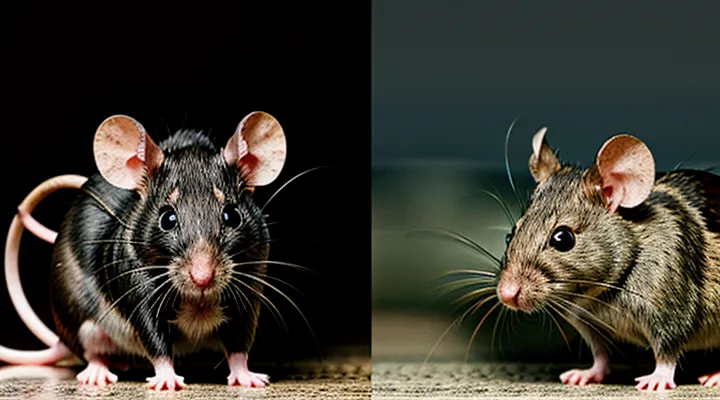
Physical Characteristics
Size and Weight
Body Length
Body length is a primary metric for distinguishing mice from rats. Mus musculus typically measures 6–10 cm from nose to the base of the tail, while Rattus norvegicus averages 20–25 cm over the same span. These dimensions exclude the tail, which varies considerably between species.
- Mouse: average head‑body length 6 cm (smallest individuals 5 cm, largest 10 cm).
- Rat: average head‑body length 22 cm (range 18–25 cm).
The disparity reflects divergent ecological niches and growth patterns. Mice maintain a compact form suited to confined habitats; rats develop a longer torso to accommodate larger musculature and enhanced foraging capacity. Consequently, body length serves as a reliable, quantifiable characteristic for species identification.
Tail Length
Mice and rats possess markedly different tail proportions, a primary feature for distinguishing the two groups.
A typical house mouse (Mus musculus) exhibits a tail length that ranges from 70 % to 100 % of its head‑body length, often matching or slightly exceeding the body size. In contrast, a common brown rat (Rattus norvegicus) displays a tail that measures approximately 40 % to 60 % of its head‑body length, noticeably shorter relative to its larger body.
- Mouse tail: 6–10 cm; proportionally long, slender, covered with fine hair.
- Rat tail: 12–20 cm; proportionally shorter, thicker, often sparsely haired or naked.
- Scale: mouse tail length ≈ body length; rat tail length ≈ half of body length.
- Function: mouse tail aids in balance during rapid, agile movements; rat tail provides support for climbing and thermoregulation but is less critical for locomotion.
These measurements enable reliable identification in field studies, laboratory settings, and pest‑control operations, where accurate species recognition is essential.
Head and Facial Features
Snout Shape
Mice possess a short, triangular snout that tapers sharply toward the tip, giving the facial profile a pointed appearance. The rostrum is relatively narrow, and the nostrils are positioned close together at the apex of the snout.
Rats exhibit a broader, more blunt snout with a rounded front edge. Their facial region is wider, and the nostrils are set farther apart, creating a less acute angle compared to mice.
Key morphological distinctions:
- Length: mouse snout is proportionally shorter; rat snout extends further forward relative to head size.
- Width: mouse snout is narrow; rat snout is noticeably wider.
- Shape: mouse snout forms a sharp triangle; rat snout forms a blunt, rounded rectangle.
These differences affect feeding mechanics and sensory perception, providing reliable visual cues for species identification.
Ear Size and Shape
Mice possess relatively small, rounded ears that sit close to the head. The pinna (outer ear) typically measures 5–7 mm in length, with a smooth curvature and minimal visible folds. This compact shape facilitates maneuverability through narrow burrows and tight spaces.
Rats display larger, more elongated ears. The pinna can reach 12–15 mm, extending outward from the skull and often showing a distinct notch at the tip. The increased surface area enhances auditory sensitivity and aids in thermoregulation.
Key distinctions:
- Size: mouse ears are roughly half the length of rat ears.
- Shape: mouse ears are uniformly rounded; rat ears are elongated with a subtle notch.
- Position: mouse ears lie flatter against the head; rat ears project more prominently.
These morphological differences reflect each species’ ecological adaptations and sensory requirements.
Eye Size
Mice have relatively larger eyes compared with their skull size than rats. The ocular diameter of a typical house mouse (Mus musculus) measures about 3 mm, while a common Norway rat (Rattus norvegicus) exhibits an eye diameter of roughly 4 mm. Although the absolute size is greater in rats, the mouse eye occupies a higher percentage of the head length, influencing visual field coverage.
- Mouse eye‑to‑head ratio: approximately 0.12–0.14.
- Rat eye‑to‑head ratio: approximately 0.08–0.10.
The larger proportional eye in mice enhances peripheral vision, which supports rapid detection of predators in open environments. Rats, with comparatively smaller proportional eyes, rely more on whisker‑mediated tactile sensing and olfaction. Both species possess a rod‑dominated retina, suited for low‑light activity, but the mouse’s wider visual field compensates for its smaller absolute eye size.
Eye size also affects focal length. Mice have a shorter focal length (≈ 1.5 mm) than rats (≈ 2 mm), resulting in a broader but less detailed image. Consequently, mice detect motion more efficiently, whereas rats achieve slightly better visual acuity at longer distances.
Fur and Coloration
Fur texture and coloration are reliable indicators for separating mice from rats.
Mice possess a fine, short pelage that lies close to the skin. The coat often appears uniformly gray, brown, or black, with occasional lighter patches on the ventral side. Some species exhibit a distinct dorsal stripe or a subtle mottling, but overall the pattern remains simple and unremarkable.
Rats display a coarser, longer fur that may stand up slightly, especially on the back. Their dorsal coloration ranges from dark brown to black, frequently interspersed with reddish or orange tones. The ventral surface is usually paler, ranging from light gray to creamy white. Unlike mice, rats often show a pronounced contrast between the darker upper coat and the lighter underside, and some individuals develop a spotted or speckled pattern on the head and shoulders.
Key distinctions:
- Texture: mouse fur – fine, short; rat fur – coarse, longer.
- Dorsal color: mouse – uniform gray/brown/black; rat – dark brown/black with reddish hues.
- Ventral color: mouse – light gray to white, minimal contrast; rat – noticeably lighter, often creamy, creating strong dorsal‑ventral contrast.
- Pattern complexity: mouse – simple, occasional dorsal stripe; rat – more varied, possible spotting or speckling.
These characteristics enable accurate identification of the two rodent groups without reliance on size or behavior.
Feet and Paws
Mice and rats exhibit distinct foot morphology that reflects their differing ecological niches. Both species possess four forelimb digits and five hind‑limb digits, yet the size, proportion, and pad arrangement differ markedly.
The mouse foot is compact, with short, slender toes. The plantar surface contains a single large central pad surrounded by smaller lateral pads. Claws are relatively fine, enabling precise grip on thin substrates such as wires and plant stems. The overall footprint measures approximately 5–7 mm in length, allowing mice to navigate narrow gaps and dense vegetation.
The rat foot is larger and more robust. Hind‑foot length reaches 10–12 mm, with elongated toes that spread wider during locomotion. The plantar region features a broader central pad and more pronounced lateral pads, providing greater surface area for weight distribution. Claws are sturdier, supporting activities that demand higher traction, such as burrowing and climbing on rough surfaces.
Key functional implications:
- Weight support: Rat paws accommodate greater body mass; mouse paws are optimized for minimal load.
- Climbing ability: Mouse toes and fine claws favor vertical navigation on fine structures; rat claws excel on coarse bark and masonry.
- Burrowing efficiency: Larger rat pads distribute pressure, facilitating soil displacement; mouse pads offer limited excavation capacity.
These anatomical variations underpin the divergent locomotor strategies of the two rodents, influencing habitat selection and foraging behavior.
Behavioral Differences
Habitat and Environment
Mice and rats occupy distinct ecological niches, reflecting variations in food availability, shelter preferences, and tolerance to human activity.
Mice commonly inhabit:
- Rural fields and grasslands where seed and grain resources are abundant.
- Forest understory and shrub layers, utilizing dense vegetation for protection.
- Human dwellings in temperate regions, favoring small cracks, closets, and stored food containers.
Rats are adapted to:
- Urban environments, thriving near sewage systems, dumpsters, and subway tunnels.
- Agricultural settings, exploiting irrigation canals and livestock facilities.
- Coastal and riverine zones, where flood‑plain debris offers nesting sites.
These habitat preferences influence population density, predator exposure, and disease transmission potential. Mice favor areas with limited human disturbance and abundant natural seeds, whereas rats excel in densely populated, waste‑rich locales that provide continuous food sources and shelter.
Diet and Foraging
Mice and rats exhibit distinct dietary preferences that reflect differences in body size, metabolic demand, and ecological niche.
Mice consume primarily seeds, grains, and small insects. Their diet is high in carbohydrates and low in protein, allowing rapid energy acquisition from readily available plant material. Food items are typically small enough to be handled with their delicate incisors, and mice often harvest from stored grain or fallen seed heads.
Rats ingest a broader spectrum of resources. In addition to grains and seeds, they regularly consume fruits, vegetables, meat scraps, carrion, and human refuse. Their larger jaws process bigger, tougher items, and the higher protein intake supports greater muscle mass and reproductive output. Rats exploit waste streams and refuse piles, which provide a reliable caloric source in urban and agricultural settings.
Foraging behavior further separates the two rodents. Mice operate within compact home ranges, conducting intensive, short‑duration searches near nesting sites. They rely heavily on olfactory cues to locate food and tend to hoard excess provisions for later use. Their nocturnal activity peaks shortly after dusk, minimizing exposure to predators.
Rats maintain expansive territories and display flexible foraging schedules that include both night and crepuscular periods. They employ social learning, following conspecifics to abundant food sources, and demonstrate a willingness to explore novel environments. Their foraging routes often intersect human structures, enabling exploitation of diverse anthropogenic resources.
Key contrasts:
- Food size: mice – small seeds/insects; rats – larger plant matter and animal protein.
- Diet breadth: mice – narrow, carbohydrate‑focused; rats – wide, omnivorous.
- Foraging range: mice – limited, localized; rats – extensive, habitat‑spanning.
- Resource acquisition: mice – hoarding, scent‑guided; rats – opportunistic, socially informed.
Social Structure
Mice and rats exhibit distinct social organizations that reflect their ecological strategies. In laboratory and wild settings, mice typically form small, loosely structured groups. Their interactions are dominated by brief affiliative contacts and occasional aggression, with no permanent dominance hierarchy. Reproductive females often occupy central positions in the nest, while males display transient territorial behavior that dissolves when resources shift.
Rats develop larger, more stable colonies characterized by a clear dominance hierarchy. Adult males establish permanent territories that overlap with subordinate individuals, and the hierarchy is reinforced through consistent aggressive encounters. Female rats cooperate in nest building and pup care, forming sub‑groups that support shared foraging and predator avoidance.
Key contrasts in social structure:
- Group size: mice – 2‑10 individuals; rats – 10‑30 or more.
- Hierarchy: mice – fluid, temporary; rats – defined, long‑lasting.
- Territory: mice – individual or pair territories; rats – overlapping male territories with a central dominant male.
- Cooperative behavior: mice – limited, primarily maternal; rats – extensive, including communal nesting and coordinated foraging.
These differences influence disease transmission, population dynamics, and responses to environmental changes, providing a practical framework for distinguishing the two rodent species in research and pest management contexts.
Reproduction and Lifespan
Mice reach sexual maturity at 5–8 weeks, whereas rats mature at 8–12 weeks. Gestation lasts about 19–21 days for mice and 21–23 days for rats. Both species can breed throughout the year under favorable conditions, but the interval between litters differs markedly.
- Mice: average litter size 5–8 pups; postpartum estrus enables a new litter roughly every 21 days.
- Rats: average litter size 6–12 pups; postpartum estrus produces a new litter about every 28 days.
These reproductive parameters give mice a higher potential population growth rate, while rats compensate with larger litters and slightly longer intervals between births.
Lifespan also separates the two rodents. In laboratory settings, mice typically live 1.5–3 years, whereas rats commonly reach 2–4 years. In the wild, predation and disease reduce both species, but mice seldom survive beyond 1 year, while rats may persist up to 2 years. The longer longevity of rats contributes to a slower turnover of individuals despite their larger litters.
Temperament and Interaction with Humans
Mice exhibit skittish behavior, reacting to sudden movements with rapid flight. Their small size intensifies the perception of threat, leading to brief, high‑frequency bursts of activity followed by periods of cautious exploration. Rats, by contrast, display a more measured temperament; they assess novel stimuli, often approaching with tentative investigation before deciding on a course of action. This calmer disposition allows rats to tolerate a broader range of environmental changes without immediate retreat.
Interaction with humans reflects these temperamental differences. Mice typically avoid direct contact, preferring indirect cues such as scent trails and peripheral vision. Handling requires swift, gentle restraint to prevent stress‑induced injury. Rats are more amenable to handling; they can be trained to accept touch, respond to vocal cues, and perform simple tasks for food rewards. Their larger size facilitates safe manipulation, and they readily form social bonds with caregivers when exposure is consistent.
Key comparative points:
- Flight response: mice – immediate; rats – delayed, investigative.
- Tolerance for handling: mice – low; rats – high.
- Trainability: mice – limited; rats – moderate to high.
- Social affinity toward humans: mice – minimal; rats – noticeable.
Identification and Classification
Scientific Classification
Mice and rats belong to the order Rodentia but differ at the family, genus, and species levels. Their scientific classification is as follows:
-
Mouse (house mouse)
- Kingdom: Animalia
- Phylum: Chordata
- Class: Mammalia
- Order: Rodentia
- Family: Muridae
- Subfamily: Murinae
- Genus: Mus
- Species: Mus musculus
-
Rat (brown rat)
- Kingdom: Animalia
- Phylum: Chordata
- Class: Mammalia
- Order: Rodentia
- Family: Muridae
- Subfamily: Murinae
- Genus: Rattus
- Species: Rattus norvegicus
Both species share the same higher taxa (kingdom through subfamily) but diverge at the genus and species levels, reflecting distinct evolutionary lineages. The genus Mus comprises smaller-bodied rodents with a shorter tail relative to body length, whereas Rattus includes larger rodents with proportionally longer tails. These taxonomic differences underpin the primary morphological and behavioral distinctions between the two groups.
Common Species Examples
Mice
Mice (Mus musculus) are small, nocturnal rodents averaging 6–10 cm in body length, with tails of similar size. Their weight typically ranges from 15 to 30 g. Compared with rats, mice exhibit a higher surface‑to‑volume ratio, resulting in faster metabolism and greater sensitivity to temperature fluctuations.
Reproductive capacity is notable: a female can produce up to ten litters per year, each containing 5–8 offspring. Gestation lasts 19–21 days, and weaning occurs at three weeks. This rapid turnover contrasts with the longer gestation (≈22 days) and fewer litters of rats.
Dietary habits are omnivorous; mice readily consume grains, seeds, insects, and household waste. Their incisors grow continuously, requiring constant gnawing to prevent overgrowth. Unlike rats, mice prefer finer food particles and are more selective about texture.
Key physiological and behavioral traits:
- Size: 6–10 cm body, 15–30 g.
- Lifespan: 1–2 years in the wild, up to 3 years under laboratory conditions.
- Reproduction: 5–8 pups per litter, up to ten litters annually.
- Activity: Primarily nocturnal; high exploratory drive.
- Habitat: Prefer enclosed spaces such as burrows, walls, and cluttered indoor areas; less tolerant of open water than rats.
- Social structure: Form small colonies with defined hierarchies; aggressive encounters are brief and less severe than in rat groups.
These characteristics define mice as distinct from rats, emphasizing their smaller stature, faster reproductive cycle, and preference for confined habitats.
Rats
Rats belong to the genus Rattus, with the most common species being the brown rat (Rattus norvegicus) and the black rat (Rattus rattus). They are medium‑sized rodents, distinguished from other members of the order by their robust bodies and highly adaptable nature.
- Body length: 20–25 cm (excluding tail)
- Tail length: 18–25 cm, often longer than the body, scaly and hairless
- Weight: 200–500 g, varying with species and sex
- Fur: coarse, dense; coloration ranges from brown to black
- Incisors: continuously growing, self‑sharpening, enabling gnawing of hard materials
Rats exhibit strong social organization, forming hierarchical colonies with defined dominance structures. They are omnivorous, capable of exploiting a wide range of food sources, from grains to carrion. Reproductive capacity is high: a female can produce up to 12 litters per year, each containing 6–12 offspring. Average lifespan in the wild is 1–2 years, extending to 3–4 years under laboratory conditions.
Habitat preference includes sewers, basements, agricultural fields, and urban environments. Their ability to burrow, climb, and swim facilitates colonization of diverse ecosystems. Interaction with humans is notable: rats serve as disease vectors, laboratory models, and occasional sources of meat in certain cultures. Their ecological role includes seed dispersal and predation on insects, contributing to ecosystem balance.
Distinguishing Signs
Droppings
Droppings provide a reliable means of distinguishing mice from rats in residential, laboratory, and pest‑control settings. Their size, shape, and composition differ consistently between the two species.
Mouse feces are typically 2–6 mm long, 1 mm wide, and have a pointed, spindle‑shaped appearance. The pellets are dry, dark brown to black, and often found in clusters near food sources, nesting material, or along walls at low height (under 12 inches).
Rat feces are markedly larger, measuring 10–20 mm in length and 3–5 mm in width. The pellets are more cylindrical, blunt‑ended, and may display a slightly glossy surface. Color ranges from dark brown to reddish‑brown, and they are commonly deposited along runways, in concealed corners, or near burrow entrances, often at heights up to 24 inches.
Key diagnostic points:
- Length: mouse ≈ 2–6 mm; rat ≈ 10–20 mm
- Width: mouse ≈ 1 mm; rat ≈ 3–5 mm
- Shape: mouse – spindle, pointed; rat – cylindrical, blunt
- Typical location: mouse – low walls, near food; rat – runways, higher elevations, concealed areas
Recognizing these differences enables precise identification of the offending rodent, informing targeted management strategies.
Nests
Mice and rats construct nests to provide shelter, thermoregulation, and a safe environment for offspring, yet the characteristics of these structures differ markedly between the two species.
Mice typically create compact nests composed of shredded paper, fabric fibers, or plant material. Nests are usually located in concealed corners of walls, under furniture, or within stored grain. The dimensions rarely exceed 10 cm in diameter, reflecting the small body size of the animal. Construction is rapid, often completed within a few hours, and the interior is densely packed to retain heat.
Rats build larger, more elaborate nests. Materials include wood shavings, insulation, and sometimes discarded plastic. Nests are situated in subterranean burrows, basements, or attics where space permits structures up to 30 cm across. The design incorporates multiple chambers for sleeping, food storage, and rearing young, and may feature a reinforced entrance to deter predators.
Key distinctions:
- Size: mouse nests ≤ 10 cm; rat nests up to 30 cm.
- Location: mice favor surface cavities; rats prefer underground or hidden interior spaces.
- Materials: mice use fine, lightweight fibers; rats employ bulkier, sturdier substances.
- Complexity: mouse nests are single‑room; rat nests often contain several compartments.
Understanding these variations aids in accurate identification of rodent activity and informs effective control measures.
Gnaw Marks
Gnaw marks provide reliable evidence for distinguishing between mice and rats, especially when visual confirmation of the animal is unavailable.
Mice produce shallow, paired incisions approximately 2–4 mm long. The cuts intersect at a narrow angle, creating a V‑shaped profile. Teeth leave fine, parallel ridges that are barely perceptible on soft materials such as cardboard or plastic. The spacing between parallel marks rarely exceeds 5 mm, reflecting the animal’s small skull width.
Rats generate deeper, broader gouges 5–10 mm in length. Incisions intersect at a wider angle, forming a more open V or U shape. Tooth impressions are pronounced, with distinct, coarse ridges visible on a variety of substrates, including wood and metal. Parallel marks are spaced up to 12 mm apart, consistent with the larger jaw span.
Key comparative points:
- Length: mouse ≈ 2–4 mm; rat ≈ 5–10 mm
- Angle of intersecting cuts: mouse ≈ narrow; rat ≈ wide/open
- Ridge depth: mouse = fine; rat = coarse
- Spacing between parallel marks: mouse ≤ 5 mm; rat ≤ 12 mm
Recognizing these patterns enables accurate identification of the responsible rodent, informs pest‑control decisions, and supports forensic assessments of damage.