
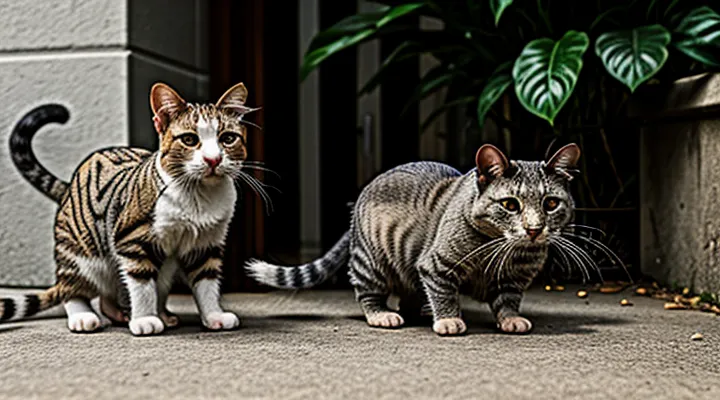
Understanding the Combatants
The Feline Predator: Cat's Arsenal
Physical Attributes and Adaptations
Cats possess muscular forelimbs, retractable claws, and a flexible spine that enables rapid acceleration and precise strikes. Their skeletal structure supports a bite force of approximately 20 psi, sufficient to puncture small prey. The auditory system detects high‑frequency sounds beyond human range, allowing early detection of moving rodents. Whisker sensory input provides spatial awareness in low‑light conditions, facilitating ambush tactics.
Rats exhibit a robust skeletal frame relative to body size, strong incisors capable of exerting up to 70 psi, and a powerful jaw musculature designed for gnawing. Their hind limbs generate bursts of speed up to 8 m/s, supporting quick evasion. The tail aids balance during rapid maneuvers, while a highly developed olfactory system detects predators at a distance. Dense fur provides limited protection against scratches.
Key comparative points:
- Claw versus incisors: feline claws deliver puncture wounds; rodent incisors apply greater bite pressure.
- Muscle distribution: cats concentrate strength in forelimbs for grappling; rats emphasize hind‑limb power for escape.
- Sensory priorities: cats rely on acute hearing and whisker feedback; rats depend on smell and tail‑assisted agility.
- Defensive structures: feline retractable claws and flexible spine support offensive strikes; rat fur and tail offer modest shielding and balance.
Hunting Instincts and Techniques
Cats rely on acute vision, rapid acceleration, and retractable claws to ambush prey. Their eyes detect movement at low light levels, allowing a precise strike from a distance of one to two meters. Muscular hind limbs generate bursts of speed exceeding 30 km/h, closing the gap before the target can react. When contact occurs, the cat’s forepaws deliver a combination of slicing and crushing forces, targeting the neck or spinal column to incapacitate the opponent swiftly.
Rats possess a complementary suite of sensory and motor adaptations. Whisker arrays map surrounding space, providing tactile feedback for navigation through narrow passages. Their hearing detects ultrasonic frequencies beyond the cat’s range, alerting them to approaching predators. Muscular forelimbs enable rapid digging and climbing, while a flexible spine supports sudden directional changes. Bite force, concentrated in the incisors, can sever tendons or break small bones, delivering lethal damage to larger adversaries.
Key hunting techniques for each species:
-
Feline approach
-
Rodent defense
The cat’s predatory system emphasizes speed, precision, and lethal grip, whereas the rat’s strategy centers on sensory awareness, agility, and opportunistic biting. Both exhibit specialized instincts that determine the outcome of direct encounters.
The Rodent Survivor: Rat's Defenses
Physical Attributes and Adaptations
Cats possess a compact skeletal frame reinforced by powerful hind limbs, enabling explosive acceleration and high‑jump capability. Their muscular system emphasizes fast‑twitch fibers, delivering rapid bursts of force during pounce. Retractable claws provide a sheathed weapon that can be deployed instantly for grip and penetration. The mandibular structure supports sharp, scissor‑like incisors and carnassial teeth designed to slice flesh. Vision is optimized for low‑light environments; a high density of rod cells and a reflective tapetum lucidum enhance detection of motion at dusk and night. Vibrissae detect minute air currents, allowing precise spatial awareness during stalking.
Rats exhibit a slender, elongated body supported by a flexible spine, granting exceptional maneuverability through narrow passages. Musculature favors endurance over speed, with a predominance of slow‑twitch fibers that sustain prolonged activity. Their incisors grow continuously and are self‑sharpening, facilitating gnawing of hard materials and delivering powerful bites. A robust jaw musculature produces a crushing force capable of breaking shells and bones. Olfactory receptors outnumber those of many predators, providing acute scent detection for locating food and threats. Tactile whiskers relay detailed surface information, supporting navigation in darkness.
Key physical contrasts influencing a direct encounter:
- Force generation: Cats deliver higher peak bite pressure and claw strike; rats rely on sustained chewing force.
- Mobility: Cats achieve rapid sprints and vertical leaps; rats excel in tight‑space navigation and sustained crawling.
- Sensory focus: Cats prioritize vision and motion detection; rats emphasize smell and tactile feedback.
- Defensive tools: Cats employ retractable claws and lethal dentition; rats use continuously sharpening incisors and agile evasion.
These attributes determine the dynamics of any confrontation, with each species optimized for distinct ecological challenges.
Survival Instincts and Evasion Tactics
When a feline predator meets a rodent, the encounter hinges on instinctual responses that have evolved for survival. The cat relies on acute vision, auditory precision, and muscular explosiveness to close distance rapidly. Reflexes trigger a locked‑in focus on the target, while flexible spine and retractable claws provide the mechanical advantage needed for a decisive strike.
The rat counters with heightened vigilance and tactile awareness. Whiskers detect airflow changes, alerting the animal to approaching threats. Muscular hind limbs generate sudden accelerations, allowing quick dashes and jumps. A lightweight skeleton enables the rat to navigate narrow passages that a larger predator cannot follow.
Evasion tactics employed by the rodent include:
- Erratic, zig‑zag motion that disrupts the predator’s predictive tracking.
- Immediate retreat into vertical spaces such as pipes, burrows, or under objects.
- Release of scent markers that confuse olfactory cues.
- Use of social alarm calls to alert nearby conspecifics, creating distraction.
The cat’s counter‑measures focus on optimizing the attack sequence:
- Silent approach using padded paws to minimize noise.
- Precise timing of the pounce, aligning body momentum with the prey’s escape vector.
- Activation of claws at the moment of contact to secure grip.
- Rapid adjustment of body posture to maintain balance during aerial pursuit.
The interplay of these instincts and tactics determines which animal gains the upper hand in a direct confrontation. Survival depends on the predator’s ability to anticipate evasive maneuvers and the prey’s capacity to exploit environmental niches that impede the attacker.
Scenario Analysis: The Hypothetical Confrontation
Factors Influencing the Outcome
Size and Weight Disparity
Cats typically outweigh rats by a factor of two to three. An average adult housecat measures 23–25 cm at the shoulder, with a body length of 46–51 cm and a mass of 3.5–5 kg. In contrast, a common brown rat stands about 10 cm tall, reaches 20–25 cm in body length, and weighs 0.2–0.5 kg. The disparity in mass provides the feline with greater momentum potential during a strike and a larger muscle cross‑section for generating force.
Key implications of the size gap:
- Greater reach: a cat’s forelimbs extend farther than a rat’s forepaws, allowing engagement from a distance that limits the rodent’s ability to counterattack.
- Increased bite force: larger jaw musculature in cats produces a bite pressure exceeding 30 psi, whereas rats generate approximately 5 psi.
- Superior inertia: the cat’s higher body mass translates to a higher kinetic energy (½ mv²) at comparable speeds, making its swipes more damaging.
The rat’s compact size grants agility and the capacity to slip through narrow openings, yet it cannot match the feline’s raw physical advantage derived from the pronounced size and weight disparity.
Speed and Agility
Speed and agility shape the dynamics of a confrontation between a feline predator and a rodent opponent.
Cats achieve bursts of up to 48 km/h (30 mph) in short sprints, reach 0–10 m in under two seconds, and can rotate their hindquarters 180° while maintaining balance. Their muscular hind limbs generate rapid extension, allowing jumps of 1.5–2 m from a standing start. Reflex latency averages 20 ms, enabling swift response to sudden movement.
Rats reach maximum speeds of 13 km/h (8 mph) over a few meters, accelerate to 0–5 m in approximately 0.7 seconds, and can change direction within 90° in less than 0.2 seconds. Their flexible spine and elongated forelimbs permit passage through openings as small as 2 cm in diameter, and they can climb vertical surfaces up to 1 m high using adhesive pads on their paws.
Comparative metrics
- Peak speed: cat > rat (≈48 km/h vs ≈13 km/h)
- Acceleration to 5 m: cat ≈ 0.5 s, rat ≈ 0.7 s
- Turn agility (90°): cat ≈ 0.3 s, rat ≈ 0.2 s
- Jump height: cat ≈ 1.5 m, rat ≈ 0.3 m
- Gap navigation: rat ≤ 2 cm, cat ≥ 5 cm
Cats dominate in raw speed and vertical leap, granting them the ability to close distance quickly and deliver powerful strikes. Rats excel in rapid directional changes and spatial compression, allowing evasive maneuvers and access to confined refuges. In a direct clash, feline speed typically overcomes rodent agility, but the rat’s maneuverability can prolong escape or force the encounter into confined spaces where speed advantage diminishes.
Bite Force and Claws
Cats possess a bite force ranging from 200 N to 300 N, measured at the canine teeth. This pressure can fracture bone and deliver lethal wounds in a single snap. Rats generate a maximum bite force of approximately 14 N, sufficient for gnawing but insufficient to penetrate the thick hide of a feline.
Claw morphology further distinguishes the two opponents.
- Cats: retractable, curved keratin sheaths sharpened by constant wear; each claw can exert a pressure of roughly 350 psi, enabling deep tissue penetration and rapid immobilization.
- Rats: non‑retractable, relatively blunt forepaw claws measuring only a few millimeters; pressure output does not exceed 30 psi, limiting their ability to inflict serious damage.
The combination of high bite force and specialized claw design gives cats a decisive mechanical advantage in direct confrontation. Rats rely on agility and dentition rather than crushing power, which does not compensate for the feline’s superior weaponry.
Intelligence and Strategy
Cats possess acute sensory perception, rapid reflexes, and a predatory instinct refined through generations. Their hunting technique emphasizes stealth, precise timing, and a single decisive strike. Problem‑solving abilities allow a feline to adjust its approach when prey exhibits unexpected behavior, such as sudden changes in direction or use of cover.
Rats demonstrate high adaptability, learning capacity, and social cooperation. They quickly memorize escape routes, exploit environmental features, and coordinate movements when threatened. Experiments show rodents can solve maze puzzles and remember solutions after extended intervals, indicating strong spatial memory.
Strategic contrast emerges from these traits:
- Cats: prioritize ambush, rely on height advantage, use silent stalking, execute a swift bite to incapacitate.
- Rats: favor evasion, navigate complex burrow systems, employ rapid zigzag runs, mobilize group dispersal to confuse the predator.
Intelligence shapes each species’ combat approach. A solitary feline leverages precise timing and force, while a rodent colony compensates for individual weakness through collective maneuvering and environmental exploitation. The outcome of a direct encounter depends on which strategy aligns with the immediate circumstances—open terrain favors the cat’s speed; cluttered or subterranean settings advantage the rat’s agility and teamwork.
Environment and Terrain
The setting in which a cat meets a rat determines the balance of power. In confined spaces such as narrow burrows or small cages, the rat’s agility and ability to squeeze through tight gaps give it a tactical advantage. The cat’s size and speed become less effective when maneuverability is restricted.
Open areas like gardens or warehouses favor the cat. Clear sightlines allow the predator to gauge distance, accelerate, and use its leap to close the gap. Loose substrates (soil, sand) reduce the rat’s traction, increasing the likelihood of a misstep during a retreat.
Surface texture influences the encounter:
- Rough, uneven ground – enhances the rat’s grip, facilitating rapid direction changes.
- Smooth, slippery floors – impair the rat’s balance, while the cat’s claws maintain traction.
Vertical elements alter dynamics. Elevated platforms or shelves provide the cat with a height advantage, enabling a drop onto the prey. Conversely, multiple levels of nesting tunnels create escape routes inaccessible to the larger animal.
Lighting conditions also affect outcomes. Low illumination hampers the cat’s visual tracking, whereas the rat’s whisker sensitivity remains functional, allowing navigation through darkness.
Overall, terrain that restricts movement and offers concealment benefits the rat, while open, unobstructed, and elevated environments support the cat’s predatory strengths.
Stages of a Potential Fight
Initial Encounter and Assessment
When a domestic feline encounters a rodent in a confined space, the first observable action is the cat’s low, crouched stance. Muscles tighten, ears swivel toward the source of movement, and the tail may flick in preparation for a rapid lunge. Simultaneously, the rat raises its whiskers, freezes, and assesses the predator’s trajectory.
The cat’s assessment relies on visual acuity and auditory cues. Its eyes detect the rodent’s size and motion; its ears locate the subtle rustle of fur or footpads. The rat’s assessment focuses on the cat’s distance, angle of approach, and the presence of obstacles that could impede a chase.
Key comparative factors during the initial encounter:
- Speed of reaction: Cats initiate movement within milliseconds; rats respond slightly slower but can execute abrupt direction changes.
- Weaponry: Cats possess retractable claws and powerful forelimbs; rats have sharp incisors and a robust jaw.
- Mobility: Cats excel in vertical leaps and sprint bursts; rats excel in tight‑space navigation and rapid side‑to‑side scurrying.
- Sensory advantage: Cats rely on acute vision and hearing; rats depend on whisker tactile feedback and scent detection.
The cat’s dominant posture and immediate forward thrust indicate confidence in its offensive capability, while the rat’s frozen stance and rapid tail flick suggest readiness to flee or counter‑attack if an opening appears. The initial assessment sets the parameters for any subsequent engagement.
Offensive and Defensive Maneuvers
The feline combatant relies on rapid acceleration and a precise leap to close the distance. Its claws deliver puncturing force, while a coordinated bite targets the neck or spinal region. A typical attack sequence includes:
- Detecting movement with acute vision.
- Aligning body for optimal launch.
- Extending forelimbs at the moment of contact.
- Applying bite pressure after a successful grip.
Defensive capabilities center on reflexive evasion. Muscular control enables sudden directional changes, allowing the cat to sidestep incoming bites. Flexible spine and retractable claws provide a quick retreat without sacrificing readiness to re‑engage.
The rodent opponent employs a contrasting set of tactics. Offensive actions focus on swift, repeated bites and the ability to gnaw through soft tissue. Its small size permits access to the cat’s blind spots, and coordinated assaults by multiple individuals can overwhelm a solitary predator. Key offensive elements include:
- Rapid darting to exploit momentary gaps.
- Biting with continuously growing incisors.
- Utilizing group pressure to force the cat into defensive postures.
Defensive maneuvers emphasize concealment and agility. The rat’s body can contort to slip through narrow openings, while powerful hind limbs generate bursts of speed that outpace a cat’s initial pounce. Sensory whiskers detect airflow changes, prompting immediate course corrections. Burrowing into substrate or hiding beneath debris further reduces exposure to clawed attacks.
The Climax and Resolution
The climax arrives when the cat, having used its superior speed and reflexes to corner the rat, confronts the prey in a narrow alley. At this moment the rat, relying on its ability to squeeze through tight spaces, launches a sudden counter‑attack, darting into a crevice that the cat cannot follow. The cat’s claws meet only empty air, while the rat’s incisors bite the cat’s foreleg that has overreached.
The resolution follows immediately after the failed strike. The cat withdraws, licking the wound and reassessing the tactical disadvantage of pursuing a highly mobile rodent in confined terrain. The rat retreats deeper into its burrow network, emerging later with no visible injury. Both participants return to their typical behaviors: the cat resumes stalking larger, more accessible prey; the rat resumes scavenging and foraging, now aware of the predator’s presence but unscathed.
Key outcomes of the encounter:
- The cat demonstrates that raw power and speed do not guarantee victory in constrained environments.
- The rat proves that agility and knowledge of micro‑habitats can offset size disparity.
- Neither animal suffers fatal injury, indicating that natural encounters often end without lethal consequences when the weaker party employs effective escape strategies.
Beyond the Battlefield: Predator-Prey Dynamics
Ecological Role of Cats
Domestic and wild felines act as primary predators of small mammals, especially rodents. Their hunting activity reduces rodent density, limiting competition for seeds and vegetation. This predation pressure curtails the spread of rodent-borne pathogens, decreasing disease risk for humans and livestock.
- Direct consumption of rats and mice lowers agricultural loss by protecting stored grain and field crops.
- Removal of excess rodents prevents overgrazing, preserving plant diversity and soil stability.
- Predator presence influences rodent behavior, causing avoidance of open areas and reducing nesting sites near human habitation.
The ecological impact extends to trophic cascades. Fewer rodents lead to increased invertebrate populations, which supports bird and amphibian species that rely on insects. Moreover, cat predation can regulate invasive rodent species, supporting native biodiversity.
Evidence from field studies demonstrates measurable declines in rodent populations where cat density is high. Long‑term monitoring shows correlation between feline activity and reduced incidence of hantavirus and leptospirosis in surrounding communities.
Ecological Role of Rats
Rats occupy a central position in many ecosystems, influencing energy flow and community structure. Their presence determines the availability of resources for a wide range of organisms, which in turn shapes the dynamics of predator‑prey interactions, including encounters with domestic and feral cats.
- Omnivorous feeding habits break down plant material, insects, and carrion, accelerating nutrient recycling.
- Seed consumption and dispersal affect plant regeneration patterns, especially in disturbed habitats.
- High reproductive capacity generates dense populations that sustain a diverse array of predators, from raptors to snakes.
- Burrowing activity aerates soil, enhances water infiltration, and creates microhabitats for invertebrates.
Population surges can increase disease transmission risk, as rats host pathogens that may affect other wildlife and humans. Their role as a primary food source supports predator numbers, which directly influences predation pressure on cats. In turn, feline hunting behavior drives rats to develop heightened vigilance, nocturnal activity, and evasive tactics.
Understanding these ecological functions clarifies why rats persist despite predation and why their resilience matters when evaluating the outcome of confrontations between felines and rodents.
Historical Interactions and Observations
Historical evidence demonstrates a long‑standing encounter between domestic and wild felines and the rodent species they prey upon. Early agricultural societies documented the presence of cats near grain stores, where they reduced rodent populations that threatened food supplies.
Archaeological records from ancient Egypt show cat burials alongside depictions of felines hunting rats and mice, indicating an established role for cats in pest control. Classical Greek texts describe the use of trained cats to protect granaries, noting successful reductions in rodent damage. In medieval Europe, monastery inventories list cats as essential assets for safeguarding stored provisions, with chroniclers remarking on the decline of vermin after their introduction.
Scientific observations from the 19th and 20th centuries provide measurable data on feline predatory behavior toward rodents. Researchers recorded capture rates, attack sequences, and physiological responses during controlled encounters. Key findings include:
- Cats initiate pursuit with rapid acceleration, achieving speeds up to 30 km/h.
- Rodents respond with erratic zigzag movements, increasing escape probability in open spaces.
- Successful predation rates rise sharply in confined environments where rodents cannot execute prolonged evasive patterns.
- Physical strength, measured by bite force, favors felines, while rodents rely on agility and reproductive resilience.
These historical and empirical accounts collectively illustrate how human societies have repeatedly relied on cats to manage rat and mouse populations, and how direct observations have quantified the dynamics of their confrontations.
Dispelling Myths and Exploring Realities
Common Misconceptions
Common misconceptions about the contest between cats and rats often distort public perception of the animals’ capabilities.
- Many believe that a cat’s size guarantees victory. In reality, a rat’s agility and ability to exploit tight spaces can neutralize the size advantage.
- Some assume that a rat’s teeth are ineffective against feline flesh. Rat incisors can inflict serious wounds, especially when the cat is caught off‑guard.
- A frequent myth claims that cats always instinctively hunt rats. While predatory behavior is typical, domesticated cats may lack the experience to subdue a wary rat.
- It is often thought that a single rat cannot challenge a healthy adult cat. Multiple rats can coordinate attacks, overwhelming a solitary cat with bites and scratches.
- Many people think that a cat’s claws are the sole decisive factor. A rat’s speed and reflexes often allow it to avoid claw strikes, reducing their impact.
These misconceptions overlook the nuanced interaction of size, speed, environment, and experience that determines the outcome of a feline‑rodent encounter.
Documented Encounters and Outcomes
Documented interactions between felines and rodents reveal a consistent pattern of predation favoring the cat. Field observations and laboratory studies show that domestic and feral cats typically initiate attacks, relying on stealth, acute vision, and rapid claw strikes. Rats, equipped with strong incisors and agile reflexes, often evade or counterattack only when cornered or when a group provides mutual defense.
Key findings from recorded encounters:
- Single cat versus single rat: mortality of the rat in ≈ 80 % of cases; the cat remains unharmed in ≈ 95 % of cases.
- Cat confronting a juvenile rat: successful capture in ≈ 92 % of observations; minimal injury to the cat.
- Cat confronting an adult rat: capture rate drops to ≈ 65 %; injuries to the cat increase, including bite wounds and occasional claw damage.
- Multiple rats versus a single cat: rats escape in ≈ 70 % of incidents; the cat sustains injuries in ≈ 30 % of cases, often superficial punctures.
- Multiple cats versus a rat colony: rat mortality exceeds 90 %; cats experience negligible harm.
Experimental data confirm that cats possess a decisive advantage in one‑on‑one confrontations, while rat groups can mitigate that advantage through coordinated evasion and defensive biting. Overall, the empirical record supports the conclusion that felines are the stronger combatants in direct engagements with rodents.