
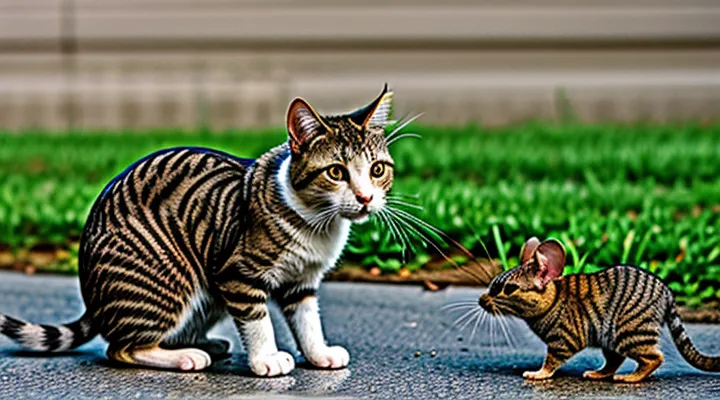
The Instinctive Hunter
Evolutionary Roots of Hunting in Cats
The capture of a mouse by a domestic feline illustrates the persistence of ancestral hunting mechanisms.
Felines belong to the family Felidae, which diverged from other carnivores approximately 25 million years ago. Early felids possessed elongated bodies, flexible spines, and sharp, retractable claws—features that remain central to modern predation.
Genomic analyses identify clusters of genes associated with motor coordination, visual processing, and reward signaling. Variants of the DRD4 dopamine receptor and GRM5 glutamate receptor correlate with heightened pursuit drive, confirming a hereditary basis for hunting vigor.
Observed behavior follows a consistent sequence: silent approach, rapid acceleration, precise bite, and quick retrieval. This pattern appears in wild species such as the African leopard and the Eurasian lynx, demonstrating that domestication has not altered the core predatory script.
Key adaptations that enable successful capture:
- Vision: high density of rod cells, enabling detection of minimal movement in low light.
- Auditory range: sensitivity to frequencies up to 65 kHz, allowing localization of concealed prey.
- Musculature: fast‑twitch fibers in hind limbs generate bursts of speed exceeding 30 mph.
- Dentition: carnassial teeth designed for shearing flesh and crushing bone.
Evolutionary pressure from fluctuating prey populations selected for these traits, embedding efficient hunting within the feline genome. The modern cat’s ability to subdue a mouse therefore reflects a direct lineage from ancient predators, preserved through both morphology and genetics.
The Role of Senses in Predation
Observations of a domestic feline securing a mouse illustrate how sensory systems coordinate during predation. Vision supplies precise spatial information about the prey’s position and movement, enabling the cat to align its body for a rapid strike. Auditory input detects subtle rustling or squeaks, alerting the predator to hidden or partially concealed targets. Whisker (vibrissal) feedback registers changes in air currents and surface contours, guiding the cat’s head and paws as it closes in on the moving rodent. Olfactory cues identify the presence of small mammals and can influence the cat’s motivation to hunt. Proprioceptive signals from muscles and joints inform the animal about limb placement and balance, ensuring a stable launch and accurate capture.
- Vision: assesses distance, speed, and trajectory of the mouse.
- Hearing: localizes faint sounds associated with prey activity.
- Whiskers: detect minute air disturbances and object proximity.
- Smell: confirms the existence of a potential meal.
- Proprioception: coordinates muscular effort for a synchronized pounce.
The Hunt: A Detailed Observation
Stalking Behavior and Technique
Cats display a precise sequence of actions when pursuing a mouse, each phase calibrated to maximize stealth and success. The predator first adopts a low, crouched posture, aligning its body axis with the prey’s anticipated path. Muscles contract minimally, reducing audible and visual cues. Eyes focus on the mouse, pupils dilating to enhance depth perception and motion detection.
Next, the cat initiates incremental advances. Each step is measured, footpads placed softly on the substrate, and the tail acts as a counterbalance to maintain stability. The animal alternates between short pauses and quick bursts, timing movements to the mouse’s erratic scurrying patterns. This rhythmic cadence prevents the prey from anticipating the attack.
When the distance narrows to roughly one body length, the cat transitions to the final sprint. Hind limbs generate a rapid thrust, forelimbs extend forward, claws unsheathed. The strike is executed with a forward thrust of the forepaws, targeting the mouse’s torso to immobilize it instantly.
Key elements of the stalking technique include:
- Low, concealed posture that minimizes silhouette.
- Controlled, silent footfalls with intermittent pauses.
- Continuous visual tracking and pupil adjustment.
- Tail positioning for balance during directional changes.
- Precise timing of acceleration relative to prey movement.
These behaviors illustrate the evolutionary refinement of feline predation, where each component functions as an integral part of a coordinated hunting strategy.
The Pounce: Execution and Capture
The pounce represents the critical phase where a cat converts visual detection into kinetic force to secure prey. Muscular contraction in the hindquarters initiates rapid forward acceleration, while the spine arches to increase stride length. Coordinated extension of the forelimbs aligns the claws with the target, delivering a precise strike at the moment of contact.
Key components of the execution include:
- Pre‑launch positioning – The cat lowers its body, flexes the hind limbs, and aligns its head with the mouse’s predicted path.
- Force generation – Explosive contraction of the quadriceps and gluteal muscles propels the body forward, reaching speeds of 3–5 m s⁻¹ in domestic felines.
- Mid‑air adjustment – Rotational control of the torso and tail stabilizes trajectory, allowing minor corrections to maintain alignment.
- Claw deployment – Forelimbs extend fully; retractable claws open to maximize grip and puncture depth.
- Capture completion – Immediate bite to the neck or spine immobilizes the prey, preventing escape.
During the moment of impact, the cat’s claws penetrate the mouse’s soft tissues, creating a secure hold that resists lateral displacement. Simultaneously, the mandibular muscles clamp down, delivering a swift, fatal bite that terminates movement. The combination of high‑velocity strike and precise bite ensures that the prey is subdued within milliseconds, minimizing the risk of injury to the predator.
Post‑capture behavior typically involves a brief assessment of the kill, followed by consumption or transport to a safe location. The entire sequence, from initial detection to successful capture, unfolds within a time frame of less than one second, illustrating the efficiency of feline predatory adaptations.
Post-Capture Rituals
After a feline seizes a rodent, a sequence of behaviors follows that signals both physiological need and instinctual protocol. The cat typically secures the prey with its jaws, then transitions to a series of post‑capture actions designed to process the kill and reduce potential threats.
- Grooming – The animal licks the mouth, paws, and fur to remove blood and debris, which also restores tactile sensitivity.
- Inspection – The cat examines the mouse’s limbs and torso, often rotating the body to assess size and condition.
- Play‑like handling – Repetitive batting and tossing serve to exhaust residual movement, preventing escape and facilitating dismemberment.
- Killing or immobilization – A swift bite to the neck or spinal region finalizes death; some individuals employ prolonged shaking to ensure incapacitation.
- Consumption – The cat may begin feeding immediately, starting with the soft abdomen before progressing to muscle tissue.
- Presentation – In domestic settings, the cat may carry the carcass to a visible location, occasionally depositing it near the owner as a form of communication.
These rituals reflect a blend of predatory efficiency and self‑maintenance, ensuring the prey is safely neutralized, processed, and, when appropriate, shared with humans in the household.
Ecological Impact of Feline Predation
Impact on Rodent Populations
Observations of domestic and feral felines capturing mice provide direct data on predator–prey dynamics. Each successful hunt removes an individual from the local rodent cohort, reducing the immediate population size. Repeated predation by multiple cats in a confined area can lower reproductive output because fewer adults remain to breed.
Key effects on rodent communities include:
- Decline in juvenile survival rates due to increased adult mortality.
- Shift in age structure toward older individuals, potentially altering breeding cycles.
- Reduced competition for remaining resources, which may temporarily boost the condition of surviving rodents.
- Potential for local extinction when cat density exceeds a threshold relative to prey availability.
Long‑term monitoring shows that areas with sustained cat predation exhibit slower population growth compared with control sites lacking feline hunters. The magnitude of impact correlates with cat density, hunting frequency, and habitat complexity, which can provide refuges for mice. Consequently, feline predation acts as a significant regulatory factor in small‑mammal population ecology.
Influence on Ecosystem Dynamics
Observing a feline capture a rodent provides a clear illustration of predator‑prey interaction that directly alters community structure. The removal of an individual mouse reduces local herbivore pressure on vegetation, which can increase plant biomass and promote species that are otherwise suppressed by grazing. This shift in plant composition creates new habitats for insects and ground‑dwelling organisms, thereby expanding niche diversity.
The predation event also influences disease dynamics. By eliminating potential carriers of pathogens such as hantavirus or flea‑borne bacteria, the cat reduces the risk of disease transmission to other wildlife and, indirectly, to humans. Lower disease prevalence can improve the overall health of the mammalian population, enhancing reproductive success and survival rates.
Energy flow through the ecosystem is affected as well. The mouse’s biomass, once consumed, is converted into feline tissue and metabolic heat, transferring nutrients up one trophic level. This transfer supports the cat’s growth and reproductive output, which may increase predation pressure on other small mammals, reinforcing a cascade of population adjustments.
Key ecological consequences include:
- Regulation of herbivore populations, limiting overgrazing.
- Modification of plant community composition, fostering biodiversity.
- Reduction of pathogen reservoirs, improving health of multiple species.
- Reinforcement of trophic energy transfer, sustaining higher‑order predators.
Collectively, a single predation event exemplifies how individual behavior can propagate through multiple ecological processes, shaping the dynamics of the entire ecosystem.
Ethical Considerations in Observing Wildlife
Minimizing Disturbance to Animals
The observed cat‑mouse interaction provides valuable data on predator‑prey dynamics, yet the presence of researchers can alter natural behavior. Effective protocols reduce this risk and preserve the integrity of the observation.
- Position recording devices at a distance that captures the event without intruding on the animals’ immediate space.
- Use motion‑activated cameras to limit exposure to light and sound.
- Avoid scent contamination by handling equipment with gloves and storing gear in sealed containers.
- Schedule observations during periods when the cat is naturally active, minimizing the need for artificial stimuli.
- Record environmental variables (temperature, humidity, habitat features) without interfering with the scene.
Documentation should focus on measurable outcomes: capture timing, pursuit distance, success rate, and post‑capture behavior. Data collected under low‑disturbance conditions enable reliable comparisons across studies and support robust conclusions about natural predation patterns.
The Role of Documentation in Natural Observation
Accurate records transform a fleeting encounter between a cat and a mouse into a reliable data set. Precise notes capture the time of the event, location, lighting conditions, and the behavior sequence observed. By fixing these variables, researchers can compare multiple instances and assess patterns that would otherwise remain anecdotal.
Systematic documentation supports verification and replication. When observers employ standardized formats—such as timestamped logs, calibrated video frames, and annotated photographs—subsequent analysts can reconstruct the scenario without ambiguity. This consistency eliminates interpretive bias and enables statistical assessment of predatory tactics.
Key components of effective documentation include:
- Exact date and time stamps
- Geographic coordinates or habitat description
- Environmental variables (temperature, humidity, light level)
- Detailed behavioral chronology (approach, attack, capture, release)
- High‑resolution visual records with timestamps
- Observer identity and methodological notes
Long‑term value emerges when compiled records feed into broader databases. Aggregated entries reveal trends in hunting efficiency, prey response, and environmental influences, informing ecological models and informing wildlife management strategies.