
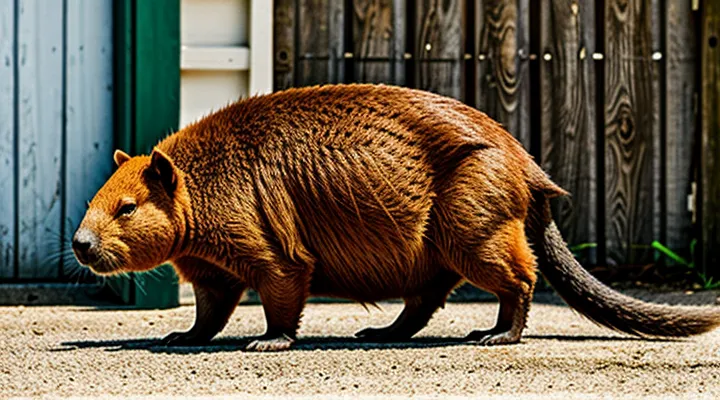
Capybara: The World’s Largest Rodent
Distinguishing Features and Habitat
Physical Characteristics
Capybaras are the largest extant rodents, reaching body lengths of 100–130 cm and standing 50–60 cm at the shoulder. Adult weight ranges from 35 kg to 66 kg, with males typically heavier than females.
- Fur: Dense, coarse hair covering the dorsal surface, brown to reddish‑brown; ventral region lighter, often grayish. Guard hairs measure 2–3 cm, providing water repellency.
- Head: Broad, blunt skull with a short snout. Incisors continuously grow, exposing orange enamel; molars are hypsodont, adapted for fibrous plant material.
- Limbs: Four short, sturdy legs ending in partially webbed toes. Each foot bears four digits, the outermost bearing a small claw for digging. Webbing enhances swimming efficiency.
- Tail: Vestigial, reduced to a fleshy nub less than 5 cm, lacking external visibility.
- Skin: Thick epidermis with a subcutaneous layer of fat that insulates against temperature fluctuations and supports buoyancy.
- Sensory organs: Large, laterally positioned eyes and ears enable wide peripheral vision and acute hearing, essential for predator detection in open habitats.
These physical traits support a semi‑aquatic lifestyle, enable herbivorous feeding on grasses and aquatic plants, and distinguish capybaras from other rodent species commonly mistaken for rats.
Natural Environment and Geographic Range
Capybaras inhabit the low‑lying wetlands and riverine ecosystems of tropical South America. They thrive in marshes, swamps, lakeside grasses, and flood‑prone forest clearings where water is readily available for swimming and foraging. Dense vegetation along riverbanks provides both shelter from predators and grazing material, primarily grasses and aquatic plants.
The species occupies a broad geographic range that includes:
- Brazil (Amazon Basin, Pantanal, coastal lowlands)
- Venezuela (Orinoco floodplains)
- Colombia (Amazon and Orinoco regions)
- Peru (upper Amazon)
- Bolivia (Beni and Santa Cruz lowlands)
- Paraguay (Paraná River basin)
- Argentina (northeastern Mesopotamia)
- Ecuador (Amazonian foothills)
- Guyana, Suriname, and French Guiana (coastal mangroves)
Populations are most dense in areas where seasonal flooding creates extensive shallow water bodies. Altitudinal distribution rarely exceeds 1,500 m above sea level; higher elevations lack the persistent aquatic habitats required for the animal’s thermoregulation and diet. Seasonal migrations follow water level fluctuations, with groups moving to higher ground during dry periods and returning to flooded zones when rains rise.
Dispelling the «Rat» Misconception
Capybara vs. Common Rat: A Comparative Analysis
Size and Weight Differences
Capybaras are the largest living rodents, reaching 100–130 cm in head‑body length and weighing 35–66 kg. In contrast, typical brown rats measure 20–30 cm (excluding the tail) and weigh 100–500 g. The disparity in mass exceeds two orders of magnitude, placing capybaras in a size class comparable to small ungulates rather than murids.
Key dimensions:
- Body length: capybara ≈ 1.0–1.3 m; rat ≈ 0.2–0.3 m.
- Tail length: capybara ≈ 0 cm (tail is vestigial); rat ≈ 0.15–0.20 m.
- Body mass: capybara ≈ 35–66 kg; rat ≈ 0.1–0.5 kg.
- Shoulder height: capybara ≈ 50–60 cm; rat ≈ 10–15 cm.
These metrics demonstrate that capybaras occupy a niche of semi‑aquatic, herd‑living herbivores, whereas rats function as small, omnivorous opportunists. The pronounced size and weight differences alone refute any classification of capybaras as merely oversized rats.
Dietary Habits
Capybaras, the world’s largest rodents, share a taxonomic order with rats, yet their feeding strategies diverge sharply. Understanding these strategies clarifies why the two species occupy distinct ecological niches.
Capybaras consume a strictly herbivorous diet. Primary items include short‑grass species and aquatic vegetation such as water hyacinth and cattail shoots. Seasonal supplements consist of tender bark, fruit pulp, and tubers. An adult ingests roughly 5 % of its body weight in plant material daily, relying on constant access to fresh water for digestion and thermoregulation.
Rats exhibit omnivory. Core components comprise cereals, seeds, and processed human waste. Opportunistic intake adds insects, small vertebrates, and occasional fruit. Daily consumption averages 3–4 % of body mass, with a high tolerance for varied nutrient sources and limited dependence on water bodies.
The contrast is evident:
- Capybara: exclusive herbivore, high fiber, water‑rich plants, continuous grazing.
- Rat: adaptable omnivore, grain‑heavy, protein from animal matter, occasional scavenging.
These dietary distinctions reinforce the view that, despite shared order, capybaras occupy a herbivore‑dominated niche, whereas rats thrive as generalist feeders. The divergence supports classification based on ecological function rather than superficial taxonomic similarity.
Social Structures and Behavior
Capybaras live in groups that range from a few individuals to colonies of 20‑30 members. Group composition typically includes multiple adult females, their offspring, and one or two dominant males. The social hierarchy is maintained through vocalizations, scent marking, and occasional physical displays, allowing the herd to coordinate movement, foraging, and predator avoidance.
Cooperative behaviors dominate daily life. Adults share grooming duties, reinforcing bonds and reducing ectoparasite loads. When threatened, the group forms a tight circle, positioning the most vulnerable members at the center while the strongest individuals keep watch. This collective vigilance lowers individual predation risk compared with solitary rodents.
Key aspects of capybara behavior relevant to their taxonomic discussion:
- Semi‑aquatic lifestyle: frequent immersion in water for thermoregulation and escape.
- Diurnal activity pattern with peaks at dawn and dusk, differing from many strictly nocturnal rat species.
- Complex vocal repertoire, including alarm calls, contact chirps, and mating songs, indicating advanced communication abilities not typical of common rats.
The Capybara’s Unique Place in the Animal Kingdom
Classification and Evolutionary Lineage
Capybaras belong to the order Rodentia, family Caviidae, subfamily Hydrochoerinae, genus Hydrochoerus. The species recognized are Hydrochoerus hydrochaeris (the common capybara) and Hydrochoerus isthmius (the lesser capybara).
- Rodentia → Caviidae → Hydrochoerinae → Hydrochoerus
- Closest extant relatives: guinea pigs (Cavia spp.) and other South‑American cavies
- Divergence from guinea pig lineage estimated at 5–10 million years ago
- Ancestral caviomorphs arrived in South America from Africa during the Eocene, likely by oceanic rafting
- Adaptive radiation produced diverse forms; capybaras evolved large body size, semi‑aquatic habits, and social structures suited to wetlands
- Fossil record (e.g., Carlocephalus, Neochoerus) shows progressive increase in size and specialization toward herbivory and aquatic foraging
These points place capybaras firmly within the rodent clade, distinct from murine rodents such as rats, and trace their evolutionary path from early African migrants to the largest living rodent in the Americas.
Conservation Status and Threats
The large South American rodent is classified by the IUCN as Least Concern, reflecting a broad distribution and sizable populations across wetlands, savannas, and forest margins. Nevertheless, regional assessments reveal declining trends where human activities intensify.
Key threats include:
- Habitat conversion for agriculture, cattle ranching, and urban expansion, which reduces available grazing and water sources.
- Unregulated hunting for meat and skin, especially in areas lacking effective enforcement.
- Competition with livestock for pasture, leading to overgrazing and erosion.
- Pollution of waterways from agro‑chemical runoff, compromising water quality essential for the species’ semi‑aquatic lifestyle.
- Climate‑driven alterations in flood regimes, affecting breeding sites and food availability.
Conservation measures focus on maintaining protected wetland corridors, enforcing hunting regulations, and promoting sustainable land‑use practices that preserve the rodent’s ecological niche. International trade is monitored under CITES Appendix III in several countries, providing an additional legal framework to curb exploitation.
Life with Capybaras
Capybaras as Pets: Considerations and Challenges
Legalities and Regulations
Capybaras are large rodents native to South America, and their classification as non‑domestic wildlife triggers specific legal frameworks that govern ownership, transport, and trade.
Internationally, capybaras are listed in CITES Appendix II. Exporting or importing specimens requires a CITES export permit from the country of origin and an import permit from the receiving nation. Both documents must confirm that the trade will not threaten wild populations and that the animals were obtained legally.
In the United States, federal oversight includes the USDA’s Animal Welfare Act, which mandates licensing for commercial breeders and exhibitors. The US Fish and Wildlife Service enforces the Endangered Species Act, although capybaras are not listed as threatened; nevertheless, a USDA‑issued Certificate of Veterinary Inspection is required for interstate movement. The Animal and Plant Health Inspection Service (APHIS) also regulates the entry of capybaras to prevent the introduction of zoonotic diseases.
State regulations vary widely. Common restrictions include:
- Prohibition of private ownership in California, Hawaii, and New York.
- Mandatory permits for possession in Texas, Florida, and Pennsylvania.
- No specific legislation in states such as Colorado and Oregon, where general wildlife‑possession laws apply.
European Union member states apply the EU Wildlife Trade Regulation, which mirrors CITES requirements. Countries like Germany and the United Kingdom demand an EU‑wide import permit and a health certificate. France and Spain impose additional veterinary checks before release into private collections.
Compliance best practices advise prospective owners to: verify federal and state permits before acquisition; obtain CITES documentation for any cross‑border transaction; ensure animals receive a USDA‑approved health inspection; and maintain records of enclosure standards to satisfy animal‑welfare inspections. Failure to adhere to these regulations can result in fines, seizure of the animals, and criminal prosecution.
Care Requirements and Enclosure
Capybaras, often mistaken for large rodents, demand specific husbandry to thrive in captivity. Their natural habitats consist of dense vegetation near water sources; therefore, enclosures must replicate these conditions.
A suitable enclosure includes:
- Minimum dimensions of 8 ft × 12 ft for a single adult, with additional space for each companion.
- Secure, waterproof perimeter to prevent escapes and protect against predators.
- Shallow pool or trough providing at least 10 gal of water for soaking and thermoregulation.
- Substrate of mixed grass, mulch, and soil to support grazing and burrowing behavior.
- Shade structures and elevated platforms to offer retreat from sun and heat.
Daily care tasks encompass:
- Providing 1–2 lb of fresh vegetation (e.g., timothy hay, lettuce, carrots) supplemented with high‑protein pellets.
- Changing water daily to maintain cleanliness and prevent bacterial growth.
- Monitoring temperature; optimal range lies between 72 °F and 84 °F with humidity around 50‑70 %.
- Conducting weekly health checks for signs of respiratory issues, skin lesions, or dental wear.
- Rotating enrichment items such as logs, tunnels, and toys to encourage natural foraging and social interaction.
Long‑term health depends on consistent veterinary oversight, regular parasite control, and a balanced diet. Failure to meet space, water, or temperature standards results in stress, reduced immunity, and potential aggression within the group.
Temperament and Interaction
Capybaras exhibit a calm, docile temperament that distinguishes them from most rodent species. Their low‑stress behavior persists across a range of environments, allowing them to remain relaxed even when exposed to routine human activity. Individual animals typically display minimal aggression, preferring avoidance over confrontation when threatened.
Social organization centers on large, mixed‑sex groups that maintain constant physical contact. Grooming, huddling, and synchronized feeding reinforce group cohesion and reduce tension. Within these colonies, dominant individuals exert influence through subtle body language rather than overt hostility, and subordinate members respond with deference, preserving hierarchical stability.
Interaction with other species follows predictable patterns:
- Domestic dogs: often accept capybaras as neutral companions; aggressive responses are rare unless provoked.
- Farm livestock (cattle, horses): share grazing areas without competition, as capybaras consume low‑lying vegetation that does not overlap significantly with larger herbivores.
- Humans: readily tolerate handling; capybaras adapt to captive settings, showing curiosity rather than fear when approached.
These characteristics enable capybaras to thrive in mixed‑species habitats and make them suitable candidates for educational and therapeutic programs that require gentle, sociable mammals.
The Capybara’s Role in Ecosystems
Ecological Impact
Capybaras, the world’s largest rodents, belong to the family Caviidae and are distinct from true rats (family Muridae). Their ecological functions stem from their size, semi‑aquatic habits, and social structure.
In native South‑American wetlands, capybaras graze on grasses and aquatic plants, limiting excessive vegetation growth and maintaining open water channels. Their foraging creates heterogeneous patches that support diverse invertebrate communities. By ingesting seeds and excreting them elsewhere, they contribute to plant dispersal across floodplains.
Capybaras serve as a substantial prey source for apex predators such as jaguars, anacondas, and caimans. Their abundance influences predator population dynamics and, indirectly, the distribution of smaller prey species through trophic cascades.
Human‑related effects include:
- Crop consumption that can reduce yields of rice, sugarcane, and pasture grasses.
- Hosting ectoparasites (ticks, mites) and pathogens (e.g., Rickettsia, leptospirosis) that may affect livestock and people.
- Potential invasiveness when introduced to non‑native regions; released populations have altered local vegetation and competed with indigenous herbivores.
Overall, capybaras shape wetland structure, sustain predator communities, and intersect with agricultural and public‑health interests, highlighting their multifaceted role in ecosystem dynamics.
Relationships with Other Species
Capybaras (Hydrochoerus hydrochaeris) share a family with guinea pigs and porcupines, not with true rats. Their closest relatives are other hystricognath rodents, which explains similarities in dental structure and digestive physiology.
Predatory interactions shape capybara behavior. Jaguars, caimans, anacondas, and large eagles regularly target them; group vigilance and water‑based escape routes reduce mortality. In turn, capybaras influence predator populations by providing a reliable food source, supporting higher reproductive rates among apex hunters.
Symbiotic relationships emerge in mixed‑species herds. Capybaras often coexist with coatis, monkeys, and birds that feed on ectoparasites removed during grooming. These attendant species gain nutrition while capybaras experience reduced parasite loads.
Human‑capybara connections span agriculture and domestication. In some South American regions, capybaras are raised for meat and leather, contributing to local economies. Their docile nature allows integration into ecotourism programs, where they serve as ambassadors for wetland conservation.
Key ecological links can be summarized:
- Rodent kinship: Shared hystricognath lineage, similar gut flora, and comparable breeding cycles.
- Predator‑prey dynamics: Primary prey for large carnivores; group defense mechanisms mitigate risk.
- Mutualistic associates: Ectoparasite cleaners (birds, small mammals) and grazing partners that maintain vegetation structure.
- Human utilization: Livestock, wildlife tourism, and cultural symbolism in regional folklore.
Understanding these interspecific connections clarifies why capybaras occupy a distinct niche separate from true rats, despite superficial resemblances.