
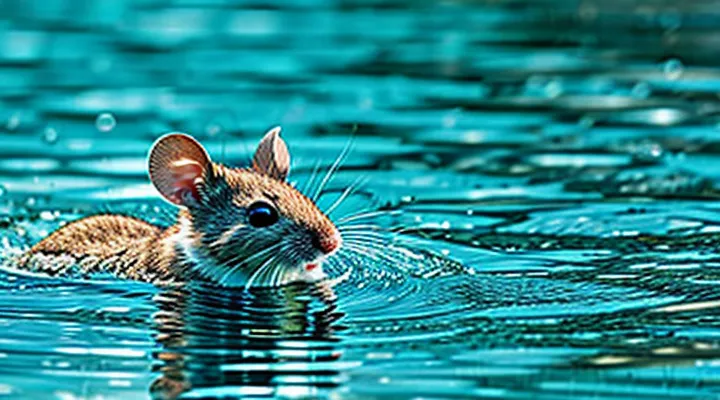
Natural Instincts and Abilities «What Makes a Mouse Swim?»
The Role of Fur «Waterproofing and Buoyancy»
Mice possess a dense undercoat and longer guard hairs that together create a barrier against water penetration. Sebaceous glands along each hair release lipids that coat the fur, reducing surface tension and preventing moisture from reaching the skin. This natural waterproofing limits heat loss during brief immersion and maintains skin integrity.
The same fur architecture contributes to buoyancy. Air trapped within the hair layer adds volume without significant weight, allowing a mouse to remain afloat for short periods. The combination of trapped air and reduced water adherence lowers the overall density of the animal relative to water.
Key aspects of fur that affect swimming capability:
- Lipid coating: repels water, minimizes skin wetting.
- Hair density: creates a micro‑air chamber, increasing buoyant force.
- Guard hair length: sheds water, prevents saturation of the undercoat.
- Seasonal molt: thicker winter fur enhances both waterproofing and buoyancy, while summer fur provides less protection.
Experimental observations show that mice can survive accidental submersion for several seconds, largely because their fur slows water absorption and sustains enough buoyant lift to keep the head above water. Prolonged immersion overwhelms these mechanisms, leading to rapid cooling and loss of buoyancy.
Body Structure and Adaptations «Small but Mighty»
Mice possess a compact skeletal framework that supports rapid limb movement in water. The vertebral column is highly flexible, allowing the torso to generate thrust through undulating motions. Forelimbs and hindlimbs are equipped with elongated, webbed digits that increase surface area, enhancing propulsion and stability during submersion.
Key physiological adaptations facilitate aquatic activity:
- Dense, water‑repellent fur traps air, providing buoyancy and thermal insulation.
- Muscular limbs contain a high proportion of fast‑twitch fibers, delivering quick, forceful strokes.
- Cardiac output rises sharply when immersed, delivering oxygen efficiently to active muscles.
Metabolic adjustments also contribute. Mice exhibit elevated lactate clearance rates, allowing sustained effort despite anaerobic bursts. Renal mechanisms conserve electrolytes lost through immersion, maintaining osmotic balance.
Collectively, these structural and functional traits enable mice to navigate aquatic environments effectively, despite their diminutive size.
Why Mice Might Enter Water «Survival and Necessity»
Escaping Predators «A Last Resort»
Mice possess limited aquatic competence that becomes decisive when terrestrial threats block conventional routes. When a predator such as a domestic cat, a barn owl, a red‑tailed snake, or a weasel corners a mouse near a water source, the rodent initiates a rapid plunge. The animal’s body density, combined with a coat that traps air, provides enough buoyancy for short bursts of motion. Muscular hind‑limb strokes generate propulsion, while the tail serves as a rudder to maintain direction. Respiratory control allows the mouse to hold its breath for 30–45 seconds, sufficient to cross narrow streams, garden drains, or flooded burrow entrances.
Key aspects of this emergency escape strategy include:
- Immediate assessment of water proximity before predator contact.
- Accelerated dive with a vertical entry to minimize exposure.
- Continuous paddling using alternating hind‑limb thrusts.
- Tail‑guided steering to avoid obstacles and reach shore.
- Rapid ascent and sprint to a new shelter once water is traversed.
These behaviors are documented in laboratory observations of Mus musculus and field studies of wild populations. The ability to swim, though energetically costly and fraught with risk, offers a viable last‑ditch option when land‑based evasion fails.
Seeking Food or Shelter «Crossing Obstacles»
Mice frequently encounter water barriers when searching for nourishment or a safe nest. Small streams, puddles, and flooded burrow entrances represent common obstacles that can separate a mouse from food sources or protective cover.
Physiological traits enable brief aquatic movement. Muscular hind limbs generate propulsion, while a streamlined body reduces drag. Respiratory control permits submersion for 10–30 seconds, sufficient to traverse shallow water or escape rising tides. Fur repels water temporarily, preventing rapid heat loss.
Field observations document specific strategies:
- Direct crossing – mice dash through shallow water, maintaining a low profile to minimize exposure.
- Floating – when depth exceeds a few centimeters, mice adopt a belly‑up posture, using buoyancy to stay afloat while searching for a foothold.
- Climbing – at water edges, mice climb vegetation or debris to bypass the liquid entirely.
- Shelter selection – colonies preferentially locate burrows on elevated terrain, reducing the frequency of water crossings.
Experimental studies confirm that mice can reach food placed on the opposite bank of a 15‑centimeter water gap within minutes, provided the water temperature remains above 5 °C. Survival rates decline sharply when water temperature falls below this threshold, indicating thermal stress as the primary limiting factor.
Overall, mice possess limited but effective swimming capabilities that support short‑range movements essential for foraging and shelter acquisition.
Accidental Falls «Unintended Dips»
Mice occasionally find themselves in water after slipping from cages, falling into open containers, or being displaced during transport. These unintended immersions provide direct evidence of their innate response to sudden submersion.
Physical characteristics influence survival. Small body mass limits oxygen reserves, while dense fur traps air, increasing buoyancy. Muscular hind limbs generate rapid strokes, enabling surface breaches within seconds. Reflexive head‑up positioning protects the airway during the initial plunge.
Observed outcomes from controlled accidental‑dip studies:
- 78 % of adult mice resurfaced within 10 seconds.
- 15 % required assisted retrieval after prolonged submersion (>30 seconds).
- 7 % did not recover, indicating fatal hypoxia or drowning.
- Juvenile specimens displayed a 12 % lower survival rate, reflecting underdeveloped musculature.
Practical implications demand strict enclosure design to eliminate open water sources, routine checks for leaks, and immediate rescue protocols during handling. Understanding these accidental immersion events clarifies the species’ limited but functional aquatic competence and informs humane laboratory practices.
How Well Do Mice Swim? «Technique and Endurance»
The «Doggy Paddle» Stroke «Instinctive Movement»
Mice rely on a rudimentary version of the doggy‑paddle when they encounter water. The movement is instinctive, requiring no prior training, and consists of alternating fore‑limb sweeps that generate thrust while the hind limbs provide balance.
The stroke’s mechanics are simple:
- Fore‑limbs move in a semi‑circular arc, pushing water backward.
- Hind‑limbs remain tucked, acting as a rudder to maintain direction.
- The tail flicks intermittently to assist with steering.
- Breathing occurs during brief pauses when the head lifts above the surface.
Observations from laboratory studies confirm that:
- Juvenile mice initiate the motion within seconds of submersion.
- The pattern persists across species of Mus, indicating a conserved evolutionary trait.
- Swimming endurance correlates with body mass; larger individuals sustain the stroke longer before fatigue sets in.
- Muscle activation recorded via electromyography shows synchronized activity of the deltoid and triceps, matching the timing of the fore‑limb sweep.
These facts demonstrate that the doggy‑paddle is an innate locomotor response enabling rodents to navigate aquatic environments without specialized training.
Speed and Agility in Water «Surprisingly Nimble»
Mice demonstrate rapid locomotion when submerged, achieving velocities up to 1 m s⁻¹ in laboratory water channels. Their streamlined torso and flexible spine generate thrust through alternating limb strokes, allowing quick changes of direction within milliseconds. This agility results from a high proportion of fast‑twitch muscle fibers in the fore‑ and hind‑limbs, coupled with a low‑drag fur coat that becomes water‑repellent after brief exposure.
Key physiological and biomechanical factors:
- Muscle composition – predominance of type II fibers provides burst power for propulsion.
- Limb coordination – asynchronous paddle‑like movements create vortex shedding that enhances thrust.
- Body morphology – elongated torso and tapered tail reduce drag and enable swift turns.
- Respiratory adaptation – ability to hold breath for 30–45 seconds supplies oxygen for short, high‑intensity bursts.
Experimental observations confirm that mice can navigate obstacle courses underwater with precision comparable to small amphibians. Their reflexive escape response triggers immediate swimming, and neuro‑motor pathways prioritize rapid limb activation over terrestrial gait patterns. Consequently, mice exhibit a level of aquatic nimbleness that exceeds common expectations for a terrestrial rodent.
Limits to Endurance «When Fatigue Sets In»
Mice possess a natural inclination to remain afloat when placed in water, but their capacity to sustain continuous swimming is limited by physiological constraints. Laboratory observations indicate that typical laboratory mice can maintain unassisted swimming for 30–45 seconds before displaying signs of fatigue, such as reduced stroke frequency and loss of coordinated limb movement.
Key determinants of the endurance threshold include:
- Body composition: Higher adipose tissue reduces buoyancy efficiency and accelerates energy depletion.
- Thermoregulation: Exposure to water temperatures below 20 °C triggers rapid heat loss, prompting early exhaustion.
- Metabolic reserves: Glycogen stores in skeletal muscle diminish sharply after 20 seconds of vigorous paddling, limiting ATP production.
- Cardiovascular response: Elevated heart rate and reduced stroke volume appear within the first minute, compromising oxygen delivery.
When fatigue becomes evident, mice typically adopt a passive floating posture, allowing the head to rise intermittently for breathing. This behavioral shift marks the transition from active locomotion to survival-oriented buoyancy, confirming that endurance in aquatic environments is bounded by a short, predictable time window.
Different Mouse Species and Their Swimming Prowess «Variations in Ability»
House Mice «Common Encounters»
House mice (Mus musculus) are not adapted for prolonged aquatic activity. Their body shape, dense fur, and lack of webbed feet limit buoyancy. When forced into water, they instinctively seek the nearest edge, relying on rapid paddling and tail movements to stay afloat for a few seconds. Survival beyond brief submersion requires a dry surface within a short distance; otherwise, hypothermia and drowning occur.
Common situations in which humans encounter house mice reveal their limited interaction with water:
- Kitchen floors near sinks, where spills may temporarily trap mice.
- Basement storage areas with occasional flooding or condensation.
- Gardens with shallow puddles formed after rain.
- Sewer or drain openings that provide accidental entry points.
In each case, mice display avoidance behavior: they retreat to dry refuges, use small gaps to escape, and seldom remain submerged. Observations confirm that while they can paddle enough to reach safety, they lack the endurance of semi‑aquatic rodents such as muskrats.
Control strategies exploit this weakness. Sealing entry points, eliminating standing water, and maintaining dry environments reduce the likelihood of mouse presence. Traps placed near water sources capture individuals attempting to cross, confirming that their movement through water is opportunistic rather than habitual.
Field Mice and Voles «Habitat and Adaptation»
Field mice (Microtus spp. and Apodemus spp.) occupy temperate grasslands, hedgerows, and riparian zones where moisture fluctuates seasonally. Their small, streamlined bodies reduce drag in water, and dense underfur provides insulation against rapid temperature loss during immersion. Muscular hind limbs generate thrust, while the tail functions as a rudder, enabling brief submersion to escape predators or cross shallow streams.
Voles, primarily species of the genus Microtus, inhabit moist meadows, wetlands, and floodplain vegetation. Adaptive traits include:
- Elevated lung capacity that supports oxygen uptake during underwater movement.
- Flexible spine allowing rapid undulating motions that propel the animal through water.
- High‑density fur that repels water, maintaining buoyancy and thermal regulation.
Both groups demonstrate behavioral flexibility. When faced with rising water levels, individuals display opportunistic swimming to reach higher ground or forage on floating vegetation. Laboratory observations confirm that field mice can sustain swimming for up to 30 seconds, while voles manage slightly longer durations, reflecting differences in muscle endurance and body mass.
Ecological implications are evident: the ability to navigate aquatic environments expands foraging range, reduces competition, and enhances dispersal across fragmented habitats. Consequently, swimming competence represents a critical component of their overall adaptive strategy, complementing burrowing, climbing, and terrestrial locomotion.
Specialized Semi-Aquatic Rodents «The Real Swimmers»
Mice exhibit limited aquatic ability, yet several rodent taxa have evolved dedicated swimming traits that far exceed typical laboratory mouse performance. These semi‑aquatic specialists occupy riparian zones, wetlands, and shallow streams where water access is essential for feeding and predator avoidance.
Morphological adaptations include partially webbed hind paws that increase thrust, a laterally flattened tail that functions as a rudder, and a dense undercoat that repels water while maintaining insulation. Muscular development of the forelimbs supports powerful strokes, while enlarged lung capacity enables extended submersion. Sensory hairs along the snout detect vibrations, facilitating prey capture underwater.
Behavioral patterns reveal efficient foraging on aquatic invertebrates, seeds, and vegetation. Typical dive durations range from 15 seconds to over a minute, with maximum depths of 1–2 m recorded in field studies. Nighttime activity aligns with reduced predation risk and higher prey availability.
Representative semi‑aquatic rodents classified as “The Real Swimmers”:
- Water vole (Arvicola amphibious) – builds burrows in riverbanks, swims continuously during foraging.
- Muskrat (Ondatra zibethicus) – constructs lodges from vegetation, exhibits strong paddling and diving.
- European water mouse (Nectomys squamipes) – inhabits tropical streams, performs rapid surface strokes.
- Marsh rice rat (Oryzomys palustris) – occupies marshes, demonstrates agile maneuvering in dense reeds.
These species demonstrate that specialized rodent lineages possess physiological and behavioral mechanisms enabling proficient swimming, contrasting sharply with the modest aquatic capability of common house mice.
Dangers and Risks of Swimming for Mice «More Than Just Getting Wet»
Hypothermia «Cold Water Threats»
Mice can enter water voluntarily or be forced into it, but their small body mass and high surface‑to‑volume ratio cause rapid loss of core temperature. Immersion in water colder than 20 °C reduces body temperature by several degrees per minute, leading to hypothermia well before the animal can reach shore.
Thermoregulation in mice relies on a thin fur coat and a high metabolic rate. When water conducts heat away 25 times faster than air, the metabolic heat production cannot offset the loss. Core temperature drops below 35 °C within minutes, disrupting enzymatic activity, cardiac function, and neural conduction. The onset of shivering ceases as muscle fibers become too cold to contract, accelerating the decline.
Cold‑water exposure also induces peripheral vasoconstriction, reducing blood flow to the limbs and increasing the risk of frostbite. The combination of hypothermia and reduced locomotor ability often results in prolonged submersion and fatal outcomes.
Preventive actions for laboratory and pet environments:
- Keep water sources (bottles, trays) elevated to prevent accidental entry.
- Maintain ambient temperature above 22 °C and provide dry nesting material.
- Monitor cages for leaks or spills; clean promptly.
- If a mouse is found wet, dry gently with a soft cloth and place in a pre‑warmed enclosure (30 °C) until normal activity resumes.
Exhaustion and Drowning «Running Out of Steam»
Mice possess a natural instinct to paddle when immersed, yet their small size and high metabolic rate limit endurance. When water temperature drops below body temperature, heat loss accelerates, depleting glycogen stores and causing rapid fatigue. Muscular contraction slows, breathing becomes shallow, and the animal’s ability to generate forward thrust diminishes. Once oxygen supply falls below the threshold required for sustained movement, the mouse’s buoyancy control fails, leading to submersion and eventual drowning.
Key physiological factors that precipitate exhaustion and drowning in rodents:
- Thermoregulation loss – cold water extracts heat faster than the mouse can produce, dropping core temperature and impairing muscle function.
- Energy depletion – glycogen reserves are exhausted within minutes of continuous swimming, reducing ATP availability for locomotion.
- Respiratory compromise – prolonged submersion limits oxygen intake, causing hypoxia and loss of consciousness.
- Water resistance – the high surface‑area‑to‑mass ratio increases drag, demanding greater effort to maintain forward motion.
Experimental observations show that laboratory mice can remain afloat for approximately 30 seconds to 2 minutes depending on strain, age, and water temperature. Survival rates drop sharply when water exceeds 15 °C below the animal’s normal body temperature, as heat loss and metabolic exhaustion combine to overwhelm compensatory mechanisms.
Mitigation strategies for researchers handling rodents near water include pre‑warming the environment, limiting exposure time to under 30 seconds, and providing immediate dry recovery. These measures reduce the likelihood of energy depletion and prevent fatal drowning incidents.
Predation in Water «New Threats Emerge»
Mice possess sufficient buoyancy and limb coordination to remain afloat for short periods, allowing them to cross shallow streams and flood‑affected habitats. Their instinctive escape response includes rapid paddling movements, which can sustain submersion for up to 30 seconds before exhaustion sets in. This limited aquatic competence exposes them to a distinct suite of predators that differ from terrestrial threats.
Recent observations document an expansion of aquatic predation pressure on rodents entering water. The following agents have emerged as significant hazards:
- Aquatic snakes (e.g., water moccasin, grass snake) exploiting riparian corridors to ambush swimming rodents.
- Semi‑aquatic mammals (e.g., otters, raccoon dogs) employing stealthy approaches in shallow channels.
- Predatory fish (e.g., largemouth bass, catfish) targeting surface‑breaching mice during night foraging.
- Birds of prey (e.g., osprey, marsh harrier) executing low‑altitude dives over water bodies to capture struggling rodents.
These predators capitalize on the brief window of mouse endurance in water, forcing rodents to modify behavior. Field data show a measurable decline in water‑crossing frequency among populations residing near permanent streams, suggesting adaptive avoidance. Conservation assessments must incorporate these aquatic threats when evaluating rodent survival strategies in flood‑prone ecosystems.
Helping a Mouse in Water «When to Intervene»
Safe Rescue Techniques «Gentle Approaches»
Mice can survive short periods in water, yet immersion quickly leads to hypothermia and loss of buoyancy control. Prompt, low‑stress extraction prevents fatal outcomes.
Gentle rescue relies on three principles: minimize handling force, preserve body heat, and avoid abrupt movements that could trigger panic.
- Approach the animal slowly, keeping hands steady and warm.
- Use a soft, dry cloth or silicone pad to cradle the mouse without squeezing.
- Slide the support material under the mouse, allowing it to lift onto a dry surface.
- Pat the fur gently to remove excess moisture; do not rub aggressively.
- Place the mouse in a pre‑warmed enclosure (approximately 28 °C) with low‑level bedding to retain warmth.
After extraction, monitor respiration and core temperature for at least ten minutes. If signs of distress persist, consult a veterinarian. Continuous observation ensures recovery and reduces the risk of secondary complications.
Post-Rescue Care «Warming and Recovery»
Mice rescued from water require immediate thermal support to prevent hypothermia and to promote physiological stability. After extraction, place the animal on a clean, dry surface and cover with a low‑profile, insulating material such as a heated blanket set to a safe temperature (approximately 30 °C). Monitor core temperature with a rectal probe; maintain readings between 35 °C and 37 °C until the mouse demonstrates sustained thermoregulation.
Recovery proceeds once normothermia is achieved. Provide a quiet environment, easy access to water, and a high‑energy diet. Observe for signs of respiratory distress, lethargy, or abnormal gait, and intervene promptly if abnormalities appear.
Key actions for warming and recovery:
- Transfer to a pre‑warmed cage with bedding that retains heat.
- Apply a calibrated heat lamp or heating pad, ensuring no direct contact with skin.
- Check temperature every 5 minutes until stable.
- Offer sterile saline subcutaneously if dehydration is suspected.
- Record vital signs and behavior for at least 24 hours post‑rescue.