
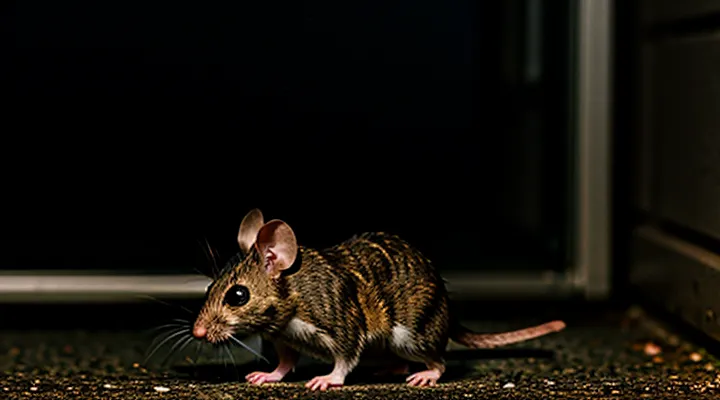
Understanding Mouse Vision
Rods and Cones: The Basics of Photoreceptors
The Dominance of Rods in Nocturnal Animals
Rod photoreceptors dominate the retinal architecture of nocturnal mammals, providing the primary mechanism for visual perception under low‑light conditions. In species that are active during night, rods constitute up to ninety‑five percent of the total photoreceptor population, while cone cells are markedly reduced. This disproportionate allocation enhances photon capture efficiency, allowing detection of single photons and supporting image formation when ambient illumination is minimal.
Key functional attributes of rods include:
- High photopigment density, which expands the cross‑section for photon absorption.
- Long outer segments that increase the probability of photon capture along the phototransduction cascade.
- Slow response kinetics, delivering heightened sensitivity at the expense of temporal resolution.
The prevalence of rods directly influences the visual capabilities of small rodents. Comparative analyses reveal that mice possess retinal rod densities exceeding those of diurnal rodents by several folds, enabling reliable visual discrimination in environments lacking detectable light sources. Consequently, the visual system of these animals relies on rod‑mediated scotopic vision rather than on any residual cone activity.
Evolutionary pressure favors this rod dominance, as it aligns with the ecological niche of night‑time foraging and predator avoidance. The resulting retinal specialization ensures that visual information remains accessible even when external illumination approaches absolute darkness.
Limited Cone Presence and Color Perception
Mice possess a retinal architecture dominated by rod photoreceptors, with cones representing a small minority of the photoreceptive cells. The cone population in laboratory mice accounts for approximately 3 % of total photoreceptors, a proportion markedly lower than that observed in diurnal mammals.
The limited cone complement restricts spectral discrimination. Rods respond maximally to wavelengths around 500 nm, providing high sensitivity under low‑light conditions but lacking color resolution. Cones in mice are divided into two subtypes:
- S‑cones, tuned to ultraviolet light (≈360 nm);
- M‑cones, tuned to middle‑green wavelengths (≈511 nm).
Because cones constitute a sparse and unevenly distributed layer, color perception is confined to well‑illuminated environments where sufficient photon flux activates both cone classes. In dim or absent light, rod activity overwhelms cone signals, rendering chromatic information unavailable.
Consequently, the ability of mice to detect visual stimuli in total darkness relies exclusively on rod‑mediated scotopic vision, which delivers monochromatic perception without hue discrimination. The scarcity of cones therefore precludes any meaningful color experience when ambient illumination falls below the activation threshold of these photoreceptors.
Adapting to Low Light Conditions
Mice possess a retinal architecture optimized for low‑light environments. A high concentration of rod photoreceptors dominates the peripheral retina, providing maximal photon capture when illumination is scarce.
Physiological adjustments enhance visual sensitivity. Pupillary muscles expand the aperture to its maximum diameter, allowing more light to reach the retina. Phototransduction cascades in rods amplify weak signals, while neural circuits in the visual thalamus increase gain, preserving image information under dim conditions.
Behavioral strategies compensate for the absence of visual cues in total darkness. Mice rely on:
- Vibrissal (whisker) mechanoreception for spatial navigation.
- Auditory localization to detect predators and conspecifics.
- Olfactory sampling to identify food sources and territories.
These modalities operate concurrently with the visual system, ensuring survival when photons are insufficient for image formation. Consequently, while retinal and neural adaptations permit detection of minimal light, complete darkness eliminates visual input, prompting reliance on tactile, auditory, and chemical senses.
Navigating in the Dark
The Role of Whiskers (Vibrissae) in Spatial Awareness
Tactile Sensation and Environmental Mapping
Mice rely on a highly developed tactile system to construct spatial representations when visual information is unavailable. Vibrissae, the specialized whiskers covering the snout, function as mechanoreceptive organs that detect minute air currents and surface textures. Each whisker is innervated by a dense array of sensory receptors, transmitting precise temporal and directional data to the somatosensory cortex.
The brain integrates these signals into an internal map of the surrounding environment. This map updates continuously as the animal moves, allowing rapid adjustments to obstacles and prey. The process involves several neural pathways:
- Primary afferent fibers convey whisker deflection to the brainstem nuclei.
- Thalamic relay nuclei transmit the information to cortical barrel fields.
- Higher‑order cortical areas synthesize tactile inputs with proprioceptive feedback to generate a coherent spatial model.
Behavioral experiments demonstrate that mice can navigate complex mazes in complete darkness with performance comparable to sighted conditions, provided their whiskers remain intact. Removal of vibrissae results in marked deficits in route selection and collision avoidance, confirming the essential contribution of tactile perception to environmental mapping.
Overall, tactile sensation supplies mice with a reliable alternative to vision, enabling accurate orientation and exploration even when light is absent.
Olfactory Senses: A Powerful Tool for Navigation
Detecting Food, Predators, and Mates
Mice rely on a combination of sensory systems to locate nourishment, avoid threats, and find reproductive partners when visible light is absent.
The olfactory apparatus detects volatile compounds released by food sources, enabling mice to follow concentration gradients toward grains, seeds, or stored provisions. High‑sensitivity receptors in the nasal epithelium can discriminate minute differences in odorant intensity, supporting rapid foraging even in pitch‑black environments.
Tactile whiskers (vibrissae) provide spatial information through mechanical contact with obstacles and moving objects. By interpreting the frequency and direction of whisker deflections, mice assess the proximity of predators and navigate complex burrow systems without visual input.
Auditory cues complement these modalities. Acute hearing detects low‑frequency rustles and ultrasonic vocalizations, allowing mice to recognize the approach of carnivorous mammals or the calls of conspecifics signaling mating readiness.
Key detection mechanisms can be summarized as follows:
- Odor detection: chemical gradients guide food acquisition.
- Whisker feedback: mechanical sensing identifies predators and structural features.
- Acoustic perception: sound localization reveals danger and potential mates.
Collectively, these non‑visual senses compensate for the lack of illumination, ensuring survival and reproductive success in total darkness.
Auditory Cues and Echolocation (Limited)
Utilizing Sound for Orientation and Communication
Mice rely on auditory cues to navigate environments lacking visual input. Their large pinnae amplify a broad frequency range, enabling detection of subtle echoes generated by self‑produced ultrasonic calls. By interpreting time delays and intensity variations in reflected sound, mice construct spatial maps that guide locomotion around obstacles and toward resources.
Ultrasonic vocalizations serve dual functions. First, they provide real‑time feedback about the surrounding geometry, effectively acting as an acoustic sonar. Second, they convey social information, such as territorial boundaries or mating readiness, to conspecifics within the same darkened area. The rapid modulation of frequency and amplitude allows simultaneous transmission of orientation data and communicative signals without interference.
Key auditory mechanisms include:
- Echoic localization: analysis of returning sound waves to estimate distance and direction of objects.
- Frequency discrimination: separation of environmental noises from conspecific calls for precise signal interpretation.
- Temporal patterning: synchronization of call sequences with movement cycles to maintain continuous spatial awareness.
Debunking the «Complete Darkness» Myth
The Perception of Light vs. Darkness
The Concept of «Absolute Darkness» in Scientific Context
Absolute darkness refers to an environment in which the photon flux reaching the retina falls below the physiological detection threshold of photoreceptive cells. In practice, this condition is quantified as fewer than 10⁻⁶ photons µm⁻² s⁻¹, a level at which rod and cone cells cannot generate a measurable electrical response. The definition excludes residual illumination from thermal emission, cosmic background radiation, or stray light that exceeds the detection limit of the visual system.
Experimental replication of «Absolute Darkness» requires light‑tight enclosures, double‑sealed chambers, and verification with calibrated photomultiplier tubes. Typical protocols involve:
- Verification of zero external light using a spectroradiometer calibrated to the detection limit of rod photoreceptors.
- Installation of baffling and blackened interior surfaces to suppress reflections.
- Monitoring of ambient temperature to minimize thermal photon generation from the enclosure walls.
Under these conditions, visual information is absent, and the visual cortex receives only spontaneous neural noise. Rodent photoreceptors, dominated by rods, exhibit a single‑photon response threshold near 0.1 isomerizations per rod per second. When photon incidence drops below this threshold, the visual system cannot resolve spatial patterns, rendering vision effectively non‑functional.
Consequently, any claim that a mouse can extract visual cues in true «Absolute Darkness» contradicts the established limits of phototransduction. Behavioral responses observed in nominally dark environments are attributable to non‑visual cues such as auditory, olfactory, or tactile information, not to residual visual perception.
How Mice Respond to Different Light Levels
Mice possess a visual system adapted to a broad spectrum of illumination, from bright daylight to dim twilight. Photoreceptor cells in the retina contain both rods, which dominate under low‑light conditions, and cones, which function primarily in brighter environments. When ambient light falls below the threshold required for rod activation, visual perception rapidly declines, and mice rely increasingly on non‑visual cues such as whisker input and olfactory signals.
Responses to varying light levels can be summarized as follows:
- High illumination (≥ 100 lux): Cone‑mediated color discrimination and sharp spatial resolution enable navigation of complex environments.
- Intermediate illumination (1–100 lux): Rods become the principal photoreceptors; visual acuity diminishes, but motion detection remains effective.
- Very low illumination (0.01–1 lux): Rods operate near their sensitivity limit; mice detect broad outlines and movement but lose fine detail.
- Complete darkness (< 0.01 lux): Photoreceptor activation ceases; visual input is absent, prompting a shift to tactile and olfactory modalities for orientation and foraging.
Experimental observations indicate that, in total darkness, mice exhibit increased reliance on whisker‑based exploration, heightened auditory startle responses, and amplified pheromone tracking. These behavioral adjustments demonstrate a flexible sensory hierarchy that compensates for the loss of visual information.
Implications for Pest Control and Research
Designing Effective Traps and Bait Stations
Mice possess limited visual acuity and rely heavily on tactile and olfactory cues when navigating environments devoid of light. Consequently, traps that depend solely on visual triggers lose effectiveness in total darkness, whereas devices that exploit scent, vibration, and scent‑based attraction retain high capture rates.
Effective trap construction must address three core factors: sensory activation, mechanical reliability, and strategic placement. Sensory activation requires bait that emits strong, mouse‑attractive odors such as grain, peanut butter, or synthetic pheromones. Mechanical reliability involves spring‑loaded or snap‑type mechanisms that close rapidly upon contact, minimizing escape opportunities. Strategic placement targets established runways, wall junctions, and concealed nesting sites, where mouse activity concentrates regardless of illumination.
Bait stations benefit from sealed compartments that protect attractants from moisture and non‑target species while allowing scent diffusion. Materials should be non‑porous, easy to clean, and resistant to gnawing. Position stations at least 12 inches from walls to intersect natural travel paths, and secure them at floor level where mouse movement predominates.
Practical recommendations:
- Use bait with high volatile organic compound emission; refresh every 48 hours to maintain potency.
- Deploy snap traps with a minimum trigger force of 0.5 lb, calibrated to activate under light pressure from mouse contact.
- Install bait stations in concealed corners, behind appliances, or within wall voids, ensuring a direct line of approach without obstacles.
- Monitor stations daily; replace malfunctioning devices promptly to sustain overall efficacy.
Designs that integrate olfactory attraction, rapid closure, and optimal positioning achieve consistent performance even when mice navigate in complete darkness.
Optimizing Laboratory Environments for Mice Studies
Laboratory conditions that support reliable murine visual research must align with the physiological limits of rodent photoreception. Studies on rodent vision under near‑absent illumination demonstrate that mice retain limited perception through residual rod activity and non‑image‑forming pathways. Consequently, experimental setups should avoid complete darkness unless the objective is to isolate non‑visual responses.
Control of ambient lighting is essential. Light intensity should be measured in lux and maintained within a range that mimics natural nocturnal environments (0.1–1 lux during the dark phase). Spectral composition must favor wavelengths that stimulate rod photoreceptors while minimizing retinal stress; blue‑light filters (≈460 nm) are commonly employed. Consistency of the dark‑light cycle, typically a 12:12 h schedule, preserves circadian rhythms and stabilizes behavioral outputs.
Housing design influences visual performance. Cages equipped with opaque lids prevent stray illumination. Bedding and enrichment items should be non‑reflective to reduce unintended glare. Infrared illumination, invisible to mice, enables video monitoring without disrupting visual conditions. Cameras equipped with sensitivity down to 0.01 lux provide clear recordings during the dark phase.
Temperature and humidity regulation complement visual parameters. Stable ambient temperature (20–24 °C) and relative humidity (40–60 %) prevent physiological stress that could alter visual responsiveness. Airflow should be laminar to avoid turbulence that might create transient light pockets.
Best‑practice checklist:
- Calibrate lighting devices weekly using a calibrated lux meter.
- Apply spectral filters to all light sources emitting wavelengths above 500 nm.
- Implement infrared video systems with shielding to eliminate visible light leakage.
- Verify cage opacity before each experimental session.
- Record environmental metrics (lux, temperature, humidity) alongside behavioral data.
Adherence to these standards ensures that visual assessments reflect genuine murine capabilities rather than artifacts introduced by uncontrolled laboratory conditions.