
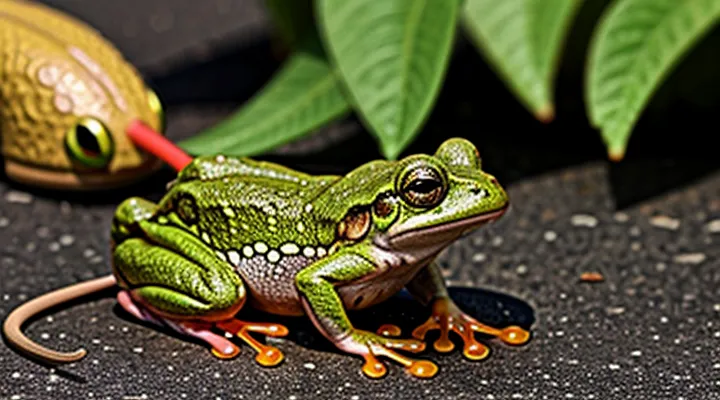
«Understanding Frog Diets»
«General Frog Feeding Habits»
Frogs are primarily carnivorous, capturing prey with a rapid tongue extension and a suction‑feeding action. Most species target invertebrates—arthropods, worms, and larvae—because these organisms match the size and handling capabilities of typical anuran jaws and digestive tracts. Larger amphibians, particularly members of the families Ranidae, Bufonidae, and Hylidae, expand their diet to include small vertebrates such as fish, tadpoles, and occasionally rodents.
Key aspects of frog feeding behavior include:
- Prey detection: Visual cues dominate during daylight; nocturnal species rely on motion and chemical signals.
- Capture mechanism: The tongue, anchored at the front of the mouth, projects at speeds exceeding 0.5 m s⁻¹, adheres to the target via mucus, and retracts within milliseconds.
- Handling: Small prey are swallowed whole; larger items are immobilized with the forelimbs before ingestion.
- Digestive processing: Stomach acidity (pH ≈ 2–3) rapidly breaks down soft tissues; indigestible parts, such as exoskeletons, are expelled as fecal pellets.
Size limits dictate feasible prey. An adult bullfrog (Lithobates catesbeianus) can ingest vertebrates up to 10 % of its body mass, which includes mice and small birds. Smaller frogs, like the common tree frog (Hyla arborea), lack the gape and muscular strength required for such prey and remain restricted to insects.
Ecological implications follow: opportunistic predation on vertebrates can reduce local rodent populations, while reliance on invertebrates sustains energy flow within aquatic and terrestrial food webs. Feeding flexibility varies with habitat, seasonal prey availability, and ontogenetic stage, allowing frogs to adjust their diet throughout their life cycle.
«Size and Prey Limitations»
«Gape Size and Swallowing Capacity»
The capacity of a frog to ingest a mouse depends on the dimensions of its oral aperture and the elasticity of its digestive tract. Gape size, measured as the maximum distance between the upper and lower jaws when fully opened, sets the upper limit for prey width. In most anuran species, the fully expanded gape ranges from 1 cm in small tree frogs to over 5 cm in large aquatic species such as the African bullfrog (Pyxicephalus adspersus).
Typical adult house mouse (Mus musculus) presents a body width of approximately 2–3 cm and a length of 6–9 cm. The critical factor is whether the mouse’s cross‑sectional diameter fits within the frog’s gape. Species capable of exceeding a 3 cm gape include:
- African bullfrog – up to 5 cm
- American bullfrog (Lithobates catesbeianus) – up to 4 cm
- Goliath frog (Conraua goliath) – up to 5.5 cm
Frogs with smaller gapes cannot accommodate the bulk of a mouse, regardless of swallowing technique.
Swallowing capacity relies on the stretchability of the esophagus and the ability to generate sufficient peristaltic force. Amphibian esophagi can expand to roughly 150 % of their resting diameter, allowing ingestion of prey up to about 1.5 times the gape width. However, larger prey impose a risk of obstruction and reduced oxygen exchange, limiting the practical upper size.
Consequently, only large, robust frogs with gapes exceeding 3 cm and demonstrable esophageal elasticity can successfully consume a mouse. Smaller species lack the necessary oral aperture and swallowing mechanics, making such predation improbable.
«Predator-Prey Size Ratios»
Frogs that capture vertebrate prey must overcome a size disparity that determines the feasibility of successful ingestion. The predator‑prey size ratio, defined as prey mass divided by predator mass, provides a quantitative framework for evaluating such interactions.
Research on anuran feeding mechanics indicates an upper functional limit near a ratio of 0.5 to 0.8. Species whose body mass is 100 g can reliably swallow prey weighing up to 50–80 g. Larger ratios exceed the capacity of the buccal cavity and esophageal stretch, leading to failed capture or fatal choking.
Empirical observations of amphibians that have taken rodents illustrate the following patterns:
- Small tree frogs (≈10 g): prey ratio ≤0.2; typical victims are insects or juvenile arthropods.
- Medium-sized bullfrogs (≈250 g): documented mouse prey up to 150 g, ratio ≈0.6.
- Giant African frogs (≈1 kg): reported consumption of rats up to 300 g, ratio ≈0.3.
These data align with biomechanical models that relate tongue projection speed, gape width, and stomach elasticity to the permissible ratio. When the ratio approaches the upper bound, handling time increases dramatically, and the risk of injury rises.
Consequently, a frog of average size (≈150 g) could theoretically ingest a small mouse (≈30 g) with a ratio of 0.2, well within the functional range. Larger mice that approach half the frog’s mass push the limits of the species’ anatomical design, making successful predation unlikely for most anurans.
«The Mechanics of Frog Predation»
«Hunting Strategies of Frogs»
«Sit-and-Wait Predators»
Frogs that capture relatively large vertebrates, such as mice, belong to the category of sit‑and‑wait predators. These hunters remain motionless, often concealed in vegetation or on a stable surface, and launch a rapid strike when prey contacts their sensory field.
Key traits of sit‑and‑wait predators include:
- Energy conservation – minimal locomotion reduces caloric expenditure while awaiting prey.
- Ambush strategy – reliance on camouflage and sudden extension of the jaw or tongue.
- Sensory specialization – heightened visual or vibrational detection to recognize movement within a limited range.
- Morphological adaptation – enlarged oral cavity, robust musculature, and adhesive tongue or forelimbs to secure struggling prey.
In amphibians, the tongue‑projection mechanism provides the primary means of capture. A frog capable of ingesting a mouse must possess:
- Sufficient gape – the mouth must open wide enough to accommodate the prey’s body dimensions.
- Powerful jaw closure – rapid, forceful compression prevents escape.
- Digestive capacity – gastric secretions and enzymatic activity must break down mammalian tissue and bone fragments.
Species such as the African bullfrog (Pyxicephalus adspersus) and the South American horned frog (Ceratophrys spp.) meet these criteria. Their large heads, expansive jaws, and strong forelimbs enable them to seize rodents that wander into their vicinity. Once the mouse contacts the frog’s visual field, the animal remains still, then releases a swift tongue strike or lunges forward, securing the prey before swallowing whole.
Constraints on this predatory mode arise from prey size relative to the frog’s body mass. A mouse exceeding roughly 30 % of the frog’s mass may cause handling difficulties, increased risk of injury, or digestive overload. Consequently, successful captures are observed primarily in juvenile or small adult rodents that align with the frog’s physical limits.
Overall, sit‑and‑wait predation provides a viable pathway for certain large frogs to consume mice, leveraging energy‑efficient ambush tactics, specialized morphology, and a digestive system adapted to process sizable vertebrate prey.
«Active Foragers»
Frogs that hunt by moving continuously through their environment are classified as active foragers. Unlike sit‑and‑wait predators, these amphibians patrol water margins, leaf litter, and low vegetation, seeking prey that exceeds typical insect size.
Active foraging frogs possess several adaptations that allow ingestion of vertebrate prey such as small rodents. Their muscular jaws generate rapid closure forces, while a highly distensible stomach expands to accommodate bulky items. Strong, unidirectional tongue projection enables capture of agile targets before they escape.
Examples of species that regularly consume mammals include:
- African bullfrog (Pyxicephalus adspersus): captures and swallows mice up to 25 % of its body mass.
- American bullfrog (Lithobates catesbeianus): documented to ingest house mice and shrews during summer feeding bursts.
- Large rainfrog (Leptodactylus fuscus): observed preying on juvenile rodents in tropical floodplains.
The likelihood of a frog successfully eating a mouse depends on relative size, prey availability, and environmental temperature. Warmer conditions increase metabolic demand, prompting active foragers to expand their diet to include higher‑calorie vertebrates. When prey size approaches the frog’s maximum gape, handling time rises and the risk of injury grows, limiting consumption to individuals capable of safely subduing the rodent.
«Physiological Adaptations for Feeding»
«Tongue Mechanism»
Frogs capture prey with a specialized tongue that combines speed, adhesion, and precise targeting. Muscular contraction of the hyoid apparatus propels the tongue forward at velocities exceeding 3 m s⁻¹, while the elastic recoil of the surrounding connective tissue stores energy for rapid extension. The tongue surface is coated with mucus containing mucopolysaccharides that create a wet, sticky film, enabling adhesion to a wide range of textures, from smooth insects to furred mammals.
Key anatomical and functional elements that determine whether a frog can handle a mouse-sized target include:
- Length and reach: Species capable of swallowing vertebrate prey possess tongues that can extend up to 150 % of body length, providing sufficient distance to strike larger organisms.
- Force generation: The combined action of the genioglossus and hyoglossus muscles produces launch forces able to overcome the inertia of a 20‑30 g mouse.
- Prey detection: Visual and auditory cues trigger a rapid neural response, synchronizing tongue launch with mouth opening to secure the animal before it escapes.
- Swallowing capacity: After capture, the esophagus expands elastically, allowing the transport of prey up to several centimeters in diameter, provided the frog’s cranial cavity can accommodate the bulk.
These mechanisms collectively explain why certain large amphibians, such as the African bullfrog (Pyxicephalus adspersus) and the South American horned frog (Ceratophrys spp.), successfully ingest small rodents. The same system would be insufficient in species with shorter tongues, weaker musculature, or limited esophageal elasticity.
«Digestive System»
A frog’s capacity to consume a mouse depends on the structure and efficiency of its digestive tract. The oral cavity contains a wide, hinged mouth and a protrusible tongue capable of seizing prey up to one‑third of the frog’s body mass. After capture, the prey passes through a short esophagus into a highly expandable stomach lined with gastric glands that secrete hydrochloric acid and pepsin, initiating protein breakdown.
The stomach’s muscular walls mix the partially digested mouse with gastric secretions, reducing particle size. From the stomach, chyme enters the small intestine, where pancreatic enzymes (trypsin, chymotrypsin, amylase) and bile from the liver further hydrolyze proteins, lipids, and carbohydrates. Absorption occurs primarily in the proximal intestinal segment, where villi increase surface area for nutrient uptake. Undigested material proceeds to the large intestine, where water reabsorption concentrates waste for excretion.
Key components of the frog digestive system:
- Mouth and tongue – capture and transport prey.
- Stomach – acidic environment, protein denaturation, mechanical mixing.
- Pancreas – secretion of proteolytic and lipolytic enzymes.
- Liver and gallbladder – bile production for lipid emulsification.
- Small intestine – enzymatic digestion and nutrient absorption.
- Large intestine – water absorption, feces formation.
These anatomical and physiological features enable a frog to ingest, digest, and assimilate a mouse, provided the prey size does not exceed the frog’s maximal gastric capacity.
«Examining the Mouse as Prey»
«Typical Mouse Habitats and Behaviors»
Mice inhabit a wide range of environments, each influencing their availability to opportunistic predators such as amphibians capable of swallowing small vertebrates. Typical settings include:
- Agricultural fields and grain stores, where abundant seeds support high population densities.
- Forest underbrush and leaf litter, providing cover and access to seeds, insects, and fungi.
- Urban structures, especially basements, walls, and attics, where human food waste creates supplemental resources.
- Wetland margins and riparian zones, offering both vegetation and insect prey while maintaining proximity to water sources favored by many frog species.
Behaviorally, mice display several traits that affect their susceptibility to predation. They are primarily nocturnal, emerging after dusk to forage, which aligns with the active periods of many carnivorous frogs. Their locomotion combines rapid scurrying with occasional climbing, enabling escape from ground-based threats but exposing them to predators capable of striking from water or low vegetation. Social organization varies: some species form loose colonies with shared burrows, while others remain solitary, influencing encounter rates with predators. Communication relies on ultrasonic vocalizations for mating and alarm signals, which are inaudible to most amphibians and therefore do not deter predatory attacks.
Feeding habits are omnivorous; mice consume seeds, grains, insects, and occasional carrion. This diet positions them at a trophic level where they serve both as prey for higher predators and as competitors for resources with other small mammals. Their high reproductive output—multiple litters per year with several offspring—ensures rapid population turnover, maintaining a steady supply of potential prey for frogs capable of ingesting small rodents.
«Nutritional Value of Mice»
Frogs that capture vertebrate prey occasionally encounter small rodents. Understanding the nutritional profile of such prey clarifies whether a frog can realistically digest and benefit from a mouse.
Mice provide a dense source of macronutrients. On a fresh‑weight basis, a typical adult mouse (≈20 g) contains approximately:
- Protein: 18–20 % (≈3.6–4 g), rich in essential amino acids.
- Fat: 8–10 % (≈1.6–2 g), predominantly unsaturated fatty acids.
- Carbohydrate: 1–2 % (≈0.2–0.4 g), mainly glycogen.
- Caloric energy: 120–130 kcal per 100 g, yielding about 25–30 kcal for a 20‑g mouse.
Micronutrient content supports metabolic needs:
- Vitamins: B‑complex (B1, B2, B6, B12) at levels comparable to small mammals; modest vitamin A and D.
- Minerals: High concentrations of phosphorus, potassium, magnesium, and trace zinc and iron.
The high protein and fat ratios supply the energy required for a frog’s active predation and growth. Digestive enzymes in amphibians efficiently break down vertebrate muscle tissue, allowing absorption of amino acids and fatty acids. Calcium and phosphorus from skeletal elements contribute to bone maintenance, while B‑vitamins facilitate aerobic metabolism.
Overall, the nutrient density of a mouse exceeds the typical caloric intake of an insect, making it a viable, though occasional, food item for larger, opportunistic frogs.
«Potential Risks of Consuming Larger Prey»
«Choking Hazards»
Frogs that capture rodents face a distinct choking risk because the prey’s size can exceed the amphibian’s oral cavity and esophageal diameter. When a mouse is larger than the frog’s maximum gape, the animal may attempt to swallow whole, causing obstruction of the pharynx or trachea.
Key factors that increase the likelihood of airway blockage include:
- Prey length greater than 1.5 times the frog’s snout‑vent length.
- Rigid skeletal elements such as mouse ribs or vertebrae that resist compression.
- Inadequate prey immobilization, leading to movement that pushes the mouse toward the glottis.
- Species with relatively narrow throats, for example many tree‑frogs and small aquatic frogs.
Preventive measures for amphibian keepers consist of offering appropriately sized rodents, pre‑killing and segmenting the mouse into bite‑size portions, and monitoring ingestion until the prey is fully processed. Regular observation reduces mortality caused by accidental airway blockage.
«Digestive Strain»
Frogs that attempt to swallow a mouse encounter significant digestive strain. Their relatively short gastrointestinal tract limits the volume of prey that can be processed before chyme moves into the intestine. A mouse, often exceeding the frog’s typical prey mass by several fold, forces the stomach to expand beyond normal limits, stretching muscular walls and increasing intragastric pressure.
Key physiological consequences include:
- Reduced gastric motility due to overdistension, slowing breakdown of tissue.
- Elevated secretion of digestive enzymes, which may become insufficient for the larger protein load.
- Increased risk of gastric rupture or mucosal injury, especially in species with thinner stomach linings.
- Extended absorption time, leading to delayed nutrient uptake and potential metabolic imbalance.
Adaptations observed in larger predatory frogs, such as the African bullfrog (Pyxicephalus adspersus), mitigate these effects by possessing a more elastic stomach and higher concentrations of proteolytic enzymes. However, even in these species, sustained consumption of oversized prey can lead to chronic stress on the digestive system, manifested by inflammation, reduced feeding efficiency, and higher mortality rates.
«Documented Cases and Scientific Evidence»
«Anecdotal Sightings vs. Verified Reports»
Observations of amphibians swallowing rodents appear sporadically in personal accounts, often shared on social media or in informal blogs. These reports typically describe a large, aquatic or semi‑aquatic frog grasping a mouse, sometimes accompanied by video footage of low resolution or brief clips. The narrative emphasis tends to highlight the shock value rather than provide measurable data.
Scientific documentation requires controlled observation, specimen identification, and verification of prey size relative to the frog’s gape. Peer‑reviewed studies have recorded instances of species such as Rana catesbeiana and Ceratophrys consuming vertebrate prey, but documented cases involving true mice are limited to a handful of field notes and museum records. In these verified instances, the mouse size does not exceed 30 % of the frog’s head width, a ratio consistent with known feeding mechanics.
Key differences between informal sightings and validated reports:
- Source credibility: personal testimony vs. peer‑reviewed publication.
- Evidence quality: anecdotal description or low‑resolution video vs. high‑definition imaging and specimen preservation.
- Contextual detail: vague location and time vs. precise coordinates, environmental conditions, and taxonomic verification.
The preponderance of anecdotal claims inflates perceived frequency, while the modest number of verified records confirms that rodent predation by frogs is possible but rare, constrained by morphological limits and ecological opportunity.
«Species-Specific Dietary Studies»
«Large Frog Species and Their Diets»
Large frog species such as the African Goliath frog (Conraua goliath), the South American Amazon horned frog (Ceratophrys cornuta), and the Asian bullfrog (Hoplobatrachus rugulosus) reach lengths of 30 cm or more and exhibit powerful jaws capable of subduing vertebrate prey. Their diets extend beyond typical invertebrates to include fish, reptiles, amphibian conspecifics, and occasionally small mammals.
- African Goliath frog – maximum mass ≈ 3.3 kg; diet includes insects, crustaceans, fish, and vertebrate carrion.
- Amazon horned frog – body length up to 15 cm; documented consumption of rodents, birds, and other frogs.
- Asian bullfrog – weight up to 0.5 kg; prey list features insects, tadpoles, small fish, and mice.
Field observations confirm that these frogs can capture and ingest laboratory mice weighing 20–30 g. Successful predation requires prey size not exceeding roughly one‑third of the frog’s body mass, allowing the animal to swallow whole without compromising the esophagus. Digestive enzymes rapidly break down mammalian tissue, and the stomach expands to accommodate the bulk.
Evidence demonstrates that large frogs possess the anatomical and physiological capacity to eat mice, provided the prey falls within the size limits defined by the frog’s own dimensions. Consequently, mouse consumption is an opportunistic, not primary, component of their feeding strategy.
«Unusual Prey Items in Frog Diets»
Frogs exhibit a broad spectrum of dietary flexibility, extending beyond typical insect prey to include vertebrates that exceed ordinary size expectations. Species such as the African bullfrog (Pyxicephalus adspersus) and the South American horned frog (Ceratophrys sp.) regularly capture and ingest small mammals, amphibians, and reptiles, demonstrating the physiological capacity to subdue and digest prey comparable in mass to a mouse.
Observations from field studies and captive husbandry reveal several unconventional food items accepted by opportunistic frogs:
- Juvenile rodents (e.g., house mice, rats) captured during nocturnal foraging.
- Small lizards and skinks seized with rapid tongue projection.
- Aquatic tadpoles of other amphibian species, sometimes larger than the predator’s own larvae.
- Miniature birds or nestlings taken from low vegetation or ground nests.
- Large arthropods such as beetles, scorpions, and centipedes that possess defensive toxins.
Digestive physiology supports these dietary extremes. Frogs possess highly acidic gastric secretions (pH ≈ 2) and robust proteolytic enzymes that break down complex tissues, including bone and keratin. Stomach expansion mechanisms allow temporary accommodation of prey up to 30 % of the frog’s body mass, after which peristaltic activity expedites nutrient absorption.
Ecological implications include opportunistic predation that can influence local vertebrate populations and alter food‑web dynamics. In habitats where conventional insect prey are scarce, the ability to exploit larger, atypical organisms provides a selective advantage, reinforcing the evolutionary success of these amphibians.
«Factors Influencing Unusual Predation»
«Environmental Conditions»
«Food Scarcity»
Frogs normally consume insects, arachnids, and other invertebrates. When the supply of these prey items declines, some species display opportunistic feeding behavior that includes vertebrates of comparable size to the predator’s gape.
Key biological constraints:
- Maximum prey width limited by jaw expansion and throat elasticity.
- Muscular power required to subdue prey larger than typical insects.
- Energy gain must exceed the cost of capture and digestion.
Under conditions of food scarcity, certain larger amphibians—such as the African bullfrog (Pyxicephalus adspersus) and the South American horned frog (Ceratophrys cornuta)—have been recorded swallowing rodents up to 30 % of their body mass. These events occur primarily when:
- Insect abundance falls below a threshold that sustains metabolic needs.
- The frog’s habitat includes ground‑dwelling mammals that are small enough to fit within the oral cavity.
- The frog exhibits a robust bite and powerful forelimbs for handling struggling prey.
Documented cases confirm that a frog can ingest a mouse when the animal’s size aligns with the predator’s physical limits and when alternative food sources are insufficient. This dietary shift provides a short‑term caloric boost, allowing the amphibian to maintain growth and reproductive output during periods of prey depletion.
Ecological consequences include:
- Temporary reduction in small‑mammal populations, influencing seed predation and disease vectors.
- Increased predation pressure on amphibian communities if larger prey become a regular component of the diet, potentially altering interspecific competition.
Overall, food scarcity can expand a frog’s prey spectrum to include small rodents, provided the anatomical and energetic criteria are met.
«Habitat Overlap»
Frogs that prey on vertebrates typically inhabit environments where small mammals are accessible. Wetlands, rice paddies, and slow‑moving streams often support both amphibian predators and rodent populations. Seasonal flooding expands the range of many frog species, bringing them into direct contact with mice that forage along water margins.
Key ecological factors that create this overlap include:
- Water proximity: Permanent or temporary water bodies attract insects and provide breeding sites for frogs, while rodents exploit the same moist soil for shelter and foraging.
- Vegetation density: Dense emergent plants offer concealment for both frogs and mice, increasing encounter probability.
- Temperature stability: Moderate temperatures in riparian zones sustain frog activity and support mouse activity cycles, aligning their periods of activity.
When these conditions converge, the likelihood of a frog encountering a mouse rises, making predation feasible for larger, opportunistic species such as the African bullfrog or the American bullfrog. Their size, jaw strength, and digestive capacity enable them to subdue and ingest a mouse, provided the animal is within a manageable size range.
«Individual Frog Behavior»
«Opportunistic Feeding»
Frogs exhibit opportunistic feeding, targeting prey that is readily available and within the limits of their gape and swallowing ability. When a mouse becomes accessible—typically after falling into water, being injured, or trapped in a confined space—certain larger amphibians will attack and ingest it.
Key factors that enable a frog to consume a rodent include:
- Species size: Adult African bullfrogs (Pyxicephalus adspersus) and American bullfrogs (Lithobates catesbeianus) reach body lengths of 10–15 cm, providing sufficient mouth opening for small mammals.
- Prey condition: Live, uninjured mice often evade capture; dead or incapacitated individuals are more likely to be seized.
- Habitat overlap: Aquatic or semi‑aquatic environments increase the probability of encountering a mouse that has entered water.
- Digestive capacity: Frogs possess strong gastric acids and enzymes capable of breaking down vertebrate tissue, though digestion of larger mammals may take several days.
Limitations are equally important:
- Maximum prey mass: Most frogs cannot swallow prey exceeding 10–15 % of their body mass; a mouse larger than this threshold will be rejected.
- Risk of injury: Rodents may bite or claw, causing damage to the frog’s mouth or digestive tract.
- Energy cost: Capturing and processing a mouse requires more effort than typical insect prey, potentially reducing net energy gain.
Documented observations confirm that opportunistic predation on mice occurs sporadically among large anuran species, especially under conditions of food scarcity or when alternative prey is scarce. The behavior reflects adaptive flexibility rather than a primary dietary strategy.
«Learning and Adaptation»
Frogs that attempt to capture mice must possess specific physiological and behavioral traits. Their tongues can extend rapidly, but the size and strength required to subdue a rodent exceed the capacity of most species. Larger amphibians, such as the African bullfrog, exhibit a proportionally stronger jaw and more robust musculature, allowing occasional ingestion of small mammals.
Learning influences predatory success. Juvenile frogs often practice striking at moving objects, refining motor coordination through repeated attempts. Field observations document individuals that adjust strike distance after failed attempts, indicating short‑term behavioral modification. Over generations, populations exposed to abundant rodent prey develop heightened sensitivity to mammalian scent cues, a genetic shift that enhances detection efficiency.
Key adaptive factors include:
- Morphology: enlarged gape, reinforced cranial muscles, digestive enzymes capable of breaking down mammalian tissue.
- Sensory adaptation: enhanced olfactory receptors for volatile compounds emitted by rodents.
- Behavioral plasticity: trial‑and‑error learning that optimizes strike timing and prey handling.
- Ecological pressure: environments with limited typical prey drive opportunistic feeding on larger vertebrates.
These elements collectively determine whether a frog can successfully consume a mouse, illustrating the interplay between innate anatomical features and experience‑driven adjustments.