
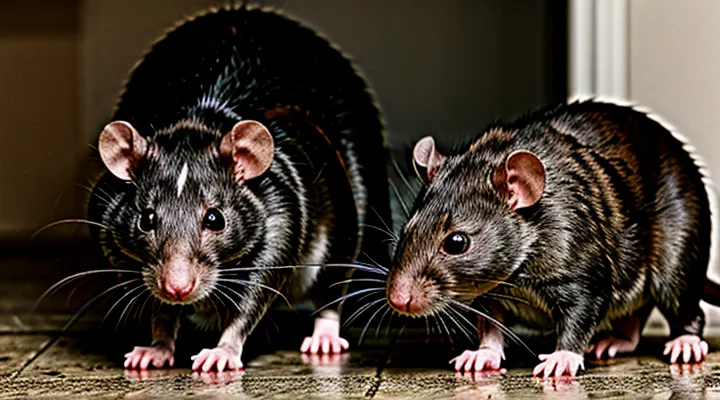
Understanding Mammals
Defining «Mammal»
Key Characteristics of Mammals
Rats belong to the class «Mammalia», which is defined by a set of anatomical and physiological traits shared by all mammals.
Key characteristics of mammals include:
- Presence of hair or fur covering the body.
- Production of milk by specialized mammary glands to nourish offspring.
- Three middle ear bones (malleus, incus, stapes) that transmit sound vibrations.
- A single lower jaw bone (dentary) articulating directly with the skull.
- Endothermy, enabling the maintenance of a constant internal temperature independent of ambient conditions.
Rats exhibit each of these features: they possess a fur-covered skin, female rats secrete milk for their young, their skull contains the three auditory ossicles, the jaw structure conforms to the mammalian pattern, and they regulate body temperature through metabolic heat production. Consequently, the classification of rats as mammals follows directly from these defining characteristics.
Evolutionary Origins of Mammals
Rats belong to the order Rodentia, which is nested within the class Mammalia. Their classification as mammals follows from the evolutionary history that defines all mammalian lineages.
Mammalian ancestry traces back to synapsid reptiles of the late Carboniferous period, approximately 300 million years ago. These early synapsids developed a single temporal opening in the skull, a trait that distinguishes them from other amniotes and foreshadows the mammalian jaw articulation.
Key stages in mammalian evolution include:
- Therapsid diversification (Permian–Triassic): emergence of advanced synapsids with differentiated teeth and a more erect posture.
- Cynodont emergence (Late Triassic): acquisition of a secondary palate and incipient fur, enabling endothermy.
- Mammaliaformes appearance (Early Jurassic): presence of a definitive middle ear and precise occlusion of teeth.
- Crown‑Mammal radiation (Cretaceous): diversification into monotremes, marsupials, and placentals, establishing the broad ecological dominance of mammals.
Rodents, including rats, evolved from early placental mammals during the Paleogene, exploiting niches left vacant after the Cretaceous–Paleogene extinction. Their mammalian characteristics—hair, three‑bone middle ear, mammary glands, and endothermic metabolism—are inherited from these deep evolutionary roots, confirming their status as true mammals.
The Classification of Rats
Scientific Taxonomy of Rats
Kingdom, Phylum, Class
Rats are classified within the biological hierarchy that defines all mammals. Their placement at the highest taxonomic levels confirms their mammalian nature.
- Kingdom Animalia – Multicellular organisms that obtain nutrients by ingestion and exhibit specialized tissues.
- Phylum Chordata – Animals possessing a notochord, dorsal nerve cord, pharyngeal slits, and post‑anal tail at some developmental stage.
- Class Mammalia – Vertebrates characterized by mammary glands, hair or fur, three middle ear bones, and a neocortex.
These three ranks collectively situate rats among the mammalian clade, supporting the scientific conclusion that they are indeed mammals.
Order and Family
Rats belong to the mammalian class and are placed within a well‑defined taxonomic hierarchy.
The order that includes rats is «Rodentia», the largest order of mammals, characterized by continuously growing incisors and a gnawing adaptation.
The family grouping for rats is «Muridae», which comprises the true mice and rats, distinguished by specific dental formulae, skull morphology, and reproductive traits.
Key taxonomic levels:
- Order: «Rodentia»
- Family: «Muridae»
- Subfamily (most common rats): «Murinae»
These classifications confirm that rats are unequivocally mammals, situated within the order of rodents and the family of true rats and mice.
Anatomical and Physiological Evidence
Endothermy and Hair
Rats belong to the class Mammalia, a group defined by two physiological traits: endothermy and the presence of hair. Endothermy enables the maintenance of a stable internal temperature independent of ambient conditions, allowing metabolic processes to function efficiently across diverse environments. Hair provides insulation, sensory input, and protection, and its follicles are a universal mammalian feature.
Key characteristics confirming rat classification:
- Core body temperature regulated around 37 °C through metabolic heat production.
- Dense coat of hair covering the skin, with specialized whiskers (vibrissae) serving tactile functions.
- Mammary glands present in females for lactation, another hallmark of the class.
These attributes collectively satisfy the criteria used by biologists to assign rats to the mammalian lineage, providing a clear scientific answer to their taxonomic status.
Mammary Glands and Live Birth
Rats belong to the class Mammalia, which is defined by the presence of functional mammary glands and the production of live offspring. Mammary glands develop during gestation, secrete nutrient‑rich milk, and provide the sole source of nourishment for neonates until they can ingest solid food. This physiological feature distinguishes mammals from other vertebrate groups.
Live birth, or viviparity, is another hallmark of mammals. Embryos develop within the maternal uterus, receiving oxygen and nutrients through a placental or chorial connection. Rats exhibit a short gestation period of approximately three weeks, after which fully formed pups are delivered. The young are born hairless and dependent, relying on maternal milk for early growth.
Key mammalian traits illustrated by rats include:
- Presence of mammary tissue capable of lactation
- Internal gestation culminating in live birth
- Body covering of hair or fur
- Three middle ear ossicles (malleus, incus, stapes)
These characteristics collectively confirm that rats meet the scientific criteria defining mammals. The combination of lactation and viviparity provides a reliable framework for classifying any species within Mammalia.
Four-Chambered Heart and Diaphragm
Rats belong to the class Mammalia, a group defined by specific anatomical traits. Among these, the presence of a four‑chambered heart distinguishes mammals from most other vertebrates. The heart consists of two atria and two ventricles, enabling complete separation of oxygenated and deoxygenated blood. This separation supports efficient circulation, higher metabolic rates, and endothermy, all characteristic of mammals.
Another definitive mammalian feature is the diaphragm, a muscular partition separating the thoracic and abdominal cavities. In rats, the diaphragm contracts rhythmically to create negative pressure within the thorax, facilitating lung expansion and efficient gas exchange. The coordinated action of the diaphragm and the four‑chambered heart sustains the elevated oxygen demand required for the animal’s active lifestyle.
Key anatomical markers confirming rat classification as mammals include:
- Four‑chambered cardiac structure with complete septation
- Muscular diaphragm controlling respiration
- Presence of mammary glands in females
- Hair covering the body
These features collectively provide a scientific basis for affirming the mammalian status of rats.
Common Misconceptions
Distinguishing Rats from Other Animals
Rats belong to the class Mammalia, a taxonomic group defined by the presence of mammary glands, hair, and three middle ear bones. This classification distinguishes them from reptiles, amphibians, and birds, which lack one or more of these characteristics.
Key anatomical features separate rats from other vertebrates:
- Hair covering the body, providing insulation and sensory function.
- Incisors that grow continuously and are self‑sharpening, a hallmark of rodents.
- A single pair of large, external ears that contrast with the ear openings of many non‑mammalian species.
- A bifurcated tail covered with sparse hair, unlike the scaly tails of reptiles.
- Presence of a well‑developed neocortex, supporting complex learning and memory.
Physiological traits further clarify rat identity:
- Endothermy, allowing internal temperature regulation independent of environmental conditions.
- Production of milk by females for offspring nourishment.
- Four‑chambered heart, a structure shared with all mammals and absent in most other animal groups.
Behavioral observations also aid identification:
- Social structures based on hierarchies and communal nesting.
- Nocturnal foraging patterns coupled with keen olfactory and tactile senses.
- Grooming rituals that involve the use of forepaws and teeth.
Collectively, these morphological, physiological, and behavioral markers confirm that rats are unequivocally mammals, setting them apart from reptiles, birds, amphibians, and other non‑mammalian taxa.
Debunking Myths about Rodents
Rats belong to the order Rodentia, a group classified within the class Mammalia. This classification rests on defining mammalian traits: presence of hair, three middle ear bones, and mammary glands that produce milk for offspring. Rodents share these characteristics, confirming their status as mammals.
Common misconceptions often blur the distinction between rodents and other small mammals. The following points clarify frequent errors:
- Myth: All rodents are pests that spread disease. Fact: Only a minority of rodent species thrive in human‑dominated environments; many live in natural habitats and play essential roles in seed dispersal and soil aeration.
- Myth: Rats lack parental care. Fact: Female rats nurse their young continuously for several weeks, and both parents contribute to nest building and protection.
- Myth: Rodents are genetically identical to insects. Fact: Rodents possess a vertebrate skeletal structure, a closed circulatory system, and a complex brain, all absent in insects.
Scientific literature documents that rat physiology aligns with mammalian standards, including a four‑chambered heart and a diaphragm that facilitates lung ventilation. Comparative studies show that rat metabolic rates, thermoregulation, and reproductive strategies parallel those of other small mammals such as mice and shrews.
Understanding the biological reality of rodents dispels myths that hinder effective wildlife management and public health policies. Accurate classification supports targeted research, informs pest‑control measures, and promotes appreciation of rodents’ ecological contributions.
Significance of Mammalian Classification
Ecological Roles of Rats
Rats belong to the order Rodentia within the class Mammalia, confirming their status as mammals. Their biology includes hair, three‑middle ear bones, and lactation, traits that satisfy the diagnostic criteria for mammalian classification.
Within ecosystems, rats perform several functions that influence community dynamics and nutrient cycles. Their activities affect plant regeneration, invertebrate populations, and energy flow across trophic levels.
- Seed dispersal through consumption and excretion of fruits and grains
- Soil modification by burrowing, which enhances aeration and water infiltration
- Predation on insects, arachnids, and small vertebrates, reducing pest densities
- Scavenging of carrion, accelerating decomposition and nutrient release
- Provision of prey for predators such as raptors, snakes, and carnivorous mammals
These processes illustrate how rats integrate into food webs, support biodiversity, and contribute to ecosystem resilience.
Implications for Research and Conservation
Rats belong to the class Mammalia, sharing defining traits such as hair, three‑middle ear bones, and live birth. Recognizing this taxonomic status shapes experimental design, ethical review, and conservation policy.
Research implications include:
- Alignment of rodent models with mammalian physiology, enhancing translational relevance of drug trials and disease mechanisms.
- Mandatory compliance with mammalian welfare regulations, influencing housing standards, anesthesia protocols, and humane endpoints.
- Inclusion of rats in comparative genomics studies, facilitating identification of conserved genetic pathways across mammals.
Conservation implications involve:
- Classification of rats as mammals justifies protection under legislation that prioritizes mammalian species, affecting habitat management and invasive‑species control.
- Recognition of ecological functions—seed dispersal, prey for predators—supports ecosystem‑based management plans that integrate rat populations into biodiversity assessments.
- Funding allocation for mammalian wildlife programs can extend to urban and peri‑urban rat studies, promoting data collection on population dynamics and disease reservoirs.
Accurate taxonomic placement thus informs both scientific methodology and policy frameworks, ensuring that rats receive appropriate consideration in research ethics and conservation strategies.