
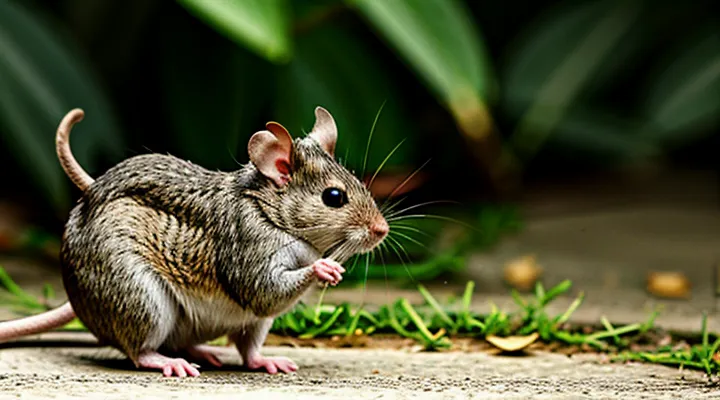
The Rodent «Mouse»: Biological Context
Common Characteristics and Habitat
The term mouse derives from Old English mus, a word shared by many Germanic languages to denote small, agile rodents. This linguistic continuity reflects the animal’s long‑standing presence alongside human settlements.
Common characteristics of the species commonly referred to as mouse include:
- Body length typically between 6 cm and 10 cm, with proportionally large ears.
- Fur ranging from gray to brown, often speckled.
- Prominent whiskers that serve tactile functions.
- Sharp incisors that grow continuously and require gnawing to maintain length.
- High reproductive rate, with gestation periods around three weeks.
Habitat preferences are diverse yet display clear patterns:
- Domestic environments, where access to stored food and shelter in walls provides abundant resources.
- Agricultural fields, especially grain stores, offering both nourishment and nesting sites.
- Natural grasslands and forests, where dense vegetation supplies cover from predators.
- Sewage and drainage systems, which mimic subterranean burrows and maintain stable humidity.
These traits and ecological niches have facilitated the mouse’s close association with human activity, reinforcing the historic use of the name across cultures.
Early Human Interaction and Coexistence
Early human settlements created environments where small rodents thrived alongside stored grain. Archaeological evidence shows that grain stores in ancient Mesopotamia attracted the animal, leading to frequent contact between people and the creature. This proximity prompted the development of a specific term to identify the pest that repeatedly infiltrated food supplies.
The name that eventually became «mouse» emerged from Old English mus, itself derived from Proto‑Germanic musaz and ultimately from the Proto‑Indo‑European root mūs. The continuity of the term across centuries reflects the animal’s persistent presence in human habitations.
Key aspects of early coexistence include:
- Grain storage practices that unintentionally provided shelter and food.
- Depictions in Egyptian tomb reliefs illustrating the creature’s role as a household intruder.
- References in classical literature, such as Latin mus and Greek μῦς, documenting the animal’s notoriety.
These interactions established the rodent as a recognizable entity, necessitating a distinct lexical label that survived linguistic evolution into the modern English word «mouse».
Tracing the Linguistic Ancestry
The Proto-Indo-European Foundation
Reconstructing the PIE Root: *muh₂s
The English term for the small rodent derives from Old English «mus», a direct continuation of Proto‑Germanic mus‑. This form aligns with Proto‑Indo‑European reconstruction «muh₂s», where the laryngeal *h₂ accounts for the rounded vowel observed in descendant languages. Cognates appear across the family: Latin «mus», Greek «μῦς», Sanskrit «mūs», Old Irish «mú», and Lithuanian «mus». All preserve the bilabial stop and a back vowel, confirming a common origin.
Phonological development from «muh₂s» follows established regularities. The laryngeal h₂, characterized by a /a/ coloring effect, merges with the following u, yielding a long /ū/ in Greek and a short /u/ in Germanic and Italic branches. The final s is retained in most languages, except in Celtic where it disappears after a vowel, producing Old Irish «mú». The consistency of the root across divergent branches supports the reconstruction’s reliability.
Key evidence for the PIE root includes:
- Comparative forms: Latin «mus», Greek «μῦς», Sanskrit «mūs», Old Irish «mú», Lithuanian «mus».
- Regular sound changes: loss of h₂ after rounding, preservation of final s in Germanic and Italic.
- Semantic stability: all terms denote the same small mammal, indicating no semantic shift during transmission.
The reconstructed root explains the uniformity of the name for the rodent across Indo‑European languages, confirming that the English word ultimately traces back to the ancient form «*muh₂s».
Proposed Meanings and Phonetic Imitation Theories
The term applied to the small rodent derives from a Proto‑Indo‑European root *mūs, reconstructed on the basis of cognates across Germanic, Celtic and Baltic languages. The root conveys the notion of a diminutive animal, reflected in Old English «mus», Old High German «mus», and Old Norse «mús». This semantic continuity supports the view that the name originally signified “small creature” rather than describing a specific behavior.
A second line of explanation treats the word as an onomatopoeic formation. The high‑pitched squeaks emitted by the animal approximate the vowel pattern of the ancient forms, suggesting that early speakers imitated the sound when naming the creature. The theory gains traction from parallel cases in which animal names mimic vocalizations, such as the English “cuckoo” and the German “Kuckuck”.
Additional considerations include:
- The Latin designation «mus» appears in classical texts, indicating early adoption of the same root in the Mediterranean sphere.
- The Greek term «μῦς» (mūs) aligns phonetically with the Germanic forms, reinforcing a shared ancestral source.
- Evidence from Celtic languages, for example Old Irish «músa», demonstrates the root’s widespread diffusion across Europe.
Collectively, the proposed meanings and phonetic imitation theories converge on a common origin: a Proto‑Indo‑European lexical element denoting a small, squeaking animal, later preserved in the modern English name for the rodent.
Evolution through Classical Languages
Development in Ancient Greek: mûs («μῦς»)
The Ancient Greek term for a small rodent is «μῦς», transliterated as mûs. This word appears in Homeric epics, where it denotes both the animal and, metaphorically, swift movement. The root of mûs belongs to the Proto-Indo-European *mūs, a lexical element shared by several Indo‑European languages.
In Classical Greek literature, «μῦς» functions as a common noun without gender distinction, appearing in works by Hesiod, Aristophanes, and later philosophers. The noun’s declension follows the third‑declension pattern: nominative singular mûs, genitive singular mûos, plural mýes, with corresponding forms in other cases.
Latin adopted the Greek term as mus, preserving both phonology and meaning. The Latin word entered early Germanic languages through contact with the Roman Empire, influencing Old English mus, which later evolved into mouse. This phonological shift involved the addition of the final -e to mark the plural, a development characteristic of Middle English orthography.
The semantic continuity from «μῦς» to modern English mouse demonstrates a stable lexical lineage spanning over two millennia. The persistence of the core consonantal structure *m‑s across languages underscores the term’s resilience in describing the small rodent that has inhabited human environments since antiquity.
Transition to Latin: mūs and its Usage
The transition of the rodent’s name into Latin produced the form «mūs», directly inherited from the Proto‑Indo‑European root mus. This root also generated the Greek μῦς and the Proto‑Germanic mūs, establishing a widespread cognate group across Eurasian languages.
In classical Latin, «mūs» functioned as a common noun denoting the small mammal, appearing in literary and technical contexts. Notable instances include:
- Virgil’s Georgics: «… et mus in agris…» describing the creature’s presence in fields.
- Ovid’s Metamorphoses: «… mūs, qui … » employing the animal as a metaphor for transformation.
- Pliny the Elder’s Naturalis Historia: a zoological entry cataloguing habits and habitats of the mouse.
The Latin term influenced the development of Romance vocabularies: Old French adopted mouse (later souris), Italian retained topo from a Latin derivative, and Spanish formed ratón through diminutive processes. In Germanic branches, the cognate mūs persisted, giving Old English mus and ultimately Modern English mouse. The parallel evolution demonstrates that the English word shares a direct etymological lineage with the Latin «mūs», rather than being a later borrowing.
Across centuries, the consistency of the form underscores the stability of the name for this rodent. The Latin «mūs» provided a linguistic anchor that survived phonological shifts, semantic extensions, and the emergence of specialized terminology in scientific classification.
Early Etymological Theories Surrounding the Sound
Early scholars traced the English term for the small rodent to the Old English word «mus», itself derived from Proto‑Germanic «*musaz». The same root appears in Latin «mus» and Greek μῦς, suggesting a common Indo‑European source that predates written records.
One line of reasoning treats the name as onomatopoeic. Observers in the early Middle Ages noted the high‑pitched squeak produced by the animal and argued that the word imitates that sound. This view appears in medieval glossaries that explain the term as “the creature that makes a soft murmur”.
Another perspective links the name to the notion of silence. Latin authors occasionally described the mouse as a “quiet” creature, and later commentators interpreted the root as related to the Proto‑Indo‑European *mūs‑, meaning “to be mute”. The theory posits that the name reflects the animal’s stealth rather than its vocalization.
A third, less common, hypothesis connects the word to a mythic creature known for whispering. Early Celtic texts mention a spirit called «Musa», associated with faint sounds in fields. Some etymologists proposed that the rodent’s name borrowed this element, emphasizing the creature’s subtle presence.
Key early theories can be summarized:
- Onomatopoeic origin: the word imitates the mouse’s squeak.
- Silence‑derived origin: the term denotes the animal’s quiet nature.
- Mythic‑association origin: the name derives from a Celtic spirit linked to soft sounds.
These proposals illustrate the diversity of medieval attempts to explain the lexical choice for the rodent, each rooted in observable or cultural characteristics of the animal.
The Name’s Path into Modern English
Germanic Linguistic Shifts
Old English: mūs
The Old English term for the small rodent was written as «mūs». This word derived from the Proto‑Germanic musaz, which in turn traced back to the Proto‑Indo‑European root mūs, meaning “mouse”. Cognates appear across several ancient languages: Latin «mus», Greek «μῦς» (transliterated as «mous»), and Old Norse «mús». The continuity of form demonstrates a stable lexical item that survived the transition from Old English to Middle English, eventually becoming the modern English word “mouse”.
Key points in the linguistic development:
- Proto‑Indo‑European mūs → Proto‑Germanic musaz → Old English «mūs».
- Parallel evolution in Latin «mus» and Greek «mous» shows a shared ancestral term.
- The shift from Old English spelling «mūs» to Middle English “mouse” involved the addition of the silent “e” to indicate the long vowel, a common orthographic practice of the period.
- The word retained its meaning throughout the centuries, referring consistently to the diminutive rodent species.
The preservation of the original phonetic core across languages underscores the deep historical roots of the name applied to the creature known today as the mouse.
Phonetic Changes Leading to the Modern Pronunciation
The English word for the small rodent traces back to Old English «mus», a direct descendant of Proto‑Germanic mus. Proto‑Indo‑European roots yield mūs, a form preserved in many Germanic languages. Over centuries, systematic phonetic shifts reshaped the original vowel and consonant qualities, producing the contemporary pronunciation.
- Old English «mus» → Middle English «mus» (vowel lengthened, final consonant softened)
- Middle English «mus» → Early Modern English «mouse» (dipthongisation of the vowel, insertion of a silent e to signal the long vowel)
- Early Modern English «mouse» → Modern English «mouse» (final s voiced to z in certain dialects, but standard pronunciation retains voiceless s)
The transition from a short, pure vowel to the modern diphthong reflects the Great Vowel Shift, which raised and fronted many English vowels between the 15th and 18th centuries. Consonantal stability persisted; the initial /m/ remained unchanged, while the terminal /s/ retained its voiceless quality despite orthographic variations. Consequently, the present‑day pronunciation «mouse» embodies a cumulative series of vowel modifications and orthographic standardisation without altering the core consonantal framework.
Cognates Across Modern Language Families
Examples in Romance Languages
The Romance language families preserve the ancient Latin term for the small rodent, adapting it through phonological shifts and morphological processes. In French, the word «souris» descends from Latin «mus», with a nasal vowel introduced during Old French development. Spanish employs «ratón», formed from the base «rata» plus the augmentative suffix –ón, yet historically it designates the same species as the English mouse. Italian uses «topo», a direct evolution from Vulgar Latin *tupus, itself a variant of «mus». Portuguese retains «rato», identical to the Spanish form but without the augmentative suffix. Romanian presents «șoarece», derived from Latin «mus» through a Slavic-influenced diminutive pattern.
Key examples:
- French: «souris»
- Spanish: «ratón»
- Italian: «topo»
- Portuguese: «rato»
- Romanian: «șoarece»
These terms illustrate how a single Latin root diversified across the Romance linguistic spectrum, reflecting regional phonetics and morphological conventions while maintaining the reference to the same animal. The evolution mirrors the broader historical process that produced the English designation for the rodent.
Examples in Slavic and Indo-Iranian Branches
The term that designates the small rodent in English derives from Old English mus, itself a cognate of Proto‑Germanic musaz and ultimately linked to the Proto‑Indo‑European root mūs. Parallel developments occurred in other language families, producing distinct yet semantically equivalent names.
In the Slavic linguistic branch, several languages preserve forms that trace directly to the same PIE root:
- Russian: «мышь» (mysh’)
- Polish: «mysz»
- Czech: «myš»
- Bulgarian: «мишка» (mishka)
All these terms exhibit regular sound changes from the original mūs while retaining the core consonantal structure m‑s.
The Indo‑Iranian branch displays a comparable pattern, though the phonetic outcome diverges due to specific evolutions in the descendant languages:
- Sanskrit: «मुस्» (mus)
- Persian: «موش» (mush)
- Kurdish: «مُش» (muş)
These examples illustrate how the original PIE designation spread across diverse linguistic environments, adapting to phonological rules yet preserving the semantic reference to the rodent. The convergence of form and meaning across Slavic and Indo‑Iranian languages underscores the deep antiquity of the name and its resilience through millennia of language change.
Cultural and Figurative Usage of the Term
Metaphorical Meanings of «Mouse»
The term «mouse» extends far beyond the small rodent, serving as a versatile metaphor in language, technology, and culture.
- In computing, «mouse» designates a handheld pointing device, symbolizing precision and user‑controlled navigation.
- In personality description, «mouse» characterizes individuals who exhibit extreme timidity, quietness, or a tendency to avoid attention.
- Literary works employ «mouse» to evoke vulnerability, innocence, or the notion of a hidden presence that influences events from the shadows.
- Business jargon adopts «mouse» for low‑volume traders or companies that operate unnoticed yet maintain steady performance.
- Scientific research frequently references «mouse» models, implying a proxy organism that mirrors human biological processes for experimental purposes.
- Popular idioms such as “quiet as a «mouse»” or “to «mouse» around” convey stealth, subtle movement, or indecisiveness.
These metaphorical applications illustrate the word’s capacity to encapsulate concepts of subtlety, control, and understated influence across diverse domains.
The Technological Transfer: Naming the Computer «Mouse»
The device that controls a graphical cursor was introduced in the early 1960s as part of a research project on interactive computing. Engineers needed a simple, hand‑held tool to translate physical motion into screen movement; the resulting prototype featured a wooden shell, two orthogonal wheels, and a cord resembling a tail. Its shape and the way it scurried across a desk surface prompted the informal label «mouse», a term already familiar from the small rodent whose swift, whiskered movements suggested agility.
Douglas Engelbart’s laboratory at the Stanford Research Institute popularized the name when the device was demonstrated publicly in 1968. The demonstration highlighted the device’s ability to select, drag, and manipulate objects on a screen, and the term «mouse» quickly entered technical reports, patents, and media coverage. The choice of the word reinforced the metaphor of a tiny, nimble creature navigating a complex environment, aligning the hardware’s function with an intuitive animal behavior.
Subsequent commercial products retained the designation, cementing «mouse» as a standard component of personal computing. Manufacturers refined the mechanism, replacing wheels with optical sensors and eliminating cords, yet the original nickname persisted, illustrating the power of metaphor in technology adoption.
Key milestones in the naming process:
- 1963 – Prototype built; informal reference to «mouse» appears in internal notes.
- 1968 – Public demonstration; term «mouse» used in press releases and documentation.
- 1981 – First mass‑produced commercial mouse released; branding retains «mouse».
- 1999 – Introduction of optical technology; name «mouse» remains unchanged.
- 2020s – Integration of wireless and gesture‑based devices; legacy term continues in software interfaces.
The linguistic transfer from animal to apparatus demonstrates how a simple visual analogy can shape technical vocabulary, ensuring that the term «mouse» endures across decades of hardware evolution.