
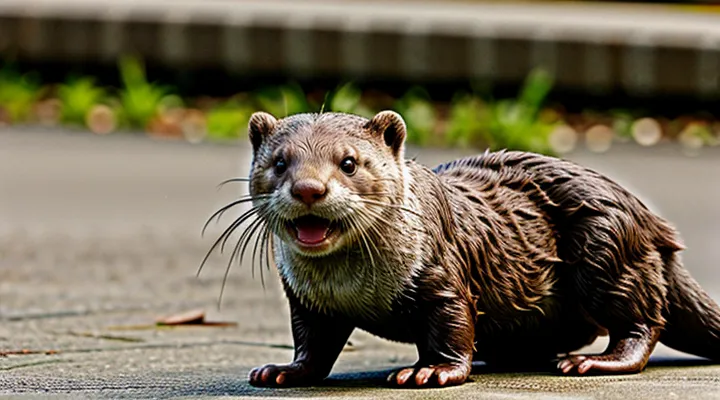
Внешний вид и физические характеристики
Размер и вес
Otters are substantially larger than rats. Adult river otters (Lontra canadensis) typically measure 90–130 cm from nose to tail tip, with a body length of 60–80 cm and a tail of 30–50 cm. Their mass ranges from 5 to 14 kg, depending on sex and season. In contrast, common brown rats (Rattus norvegicus) reach a total length of 20–25 cm, including a 10–12 cm tail, and weigh between 200 and 500 g.
Key size and weight figures:
- River otter length: 90–130 cm; weight: 5–14 kg
- Brown rat length: 20–25 cm; weight: 0.2–0.5 kg
The disparity reflects distinct ecological roles: otters are semi-aquatic predators requiring robust bodies for swimming and hunting, while rats are small, terrestrial omnivores adapted for rapid movement and concealment.
Форма тела и строение
Otters possess a streamlined, torpedo‑shaped body that reduces drag while swimming. Their musculature is dense, especially along the spine, supporting powerful undulatory movements. The fore‑ and hind‑limbs end in webbed digits, and the tail is thick, laterally flattened, and acts as a rudder. A dense undercoat of water‑repellent fur covers the entire surface, providing insulation and buoyancy. Skeletal structure includes elongated vertebrae with reinforced ribs, contributing to flexibility and strength during propulsion.
Rats exhibit a more cylindrical, elongated torso adapted for terrestrial locomotion and occasional climbing. Limbs terminate in naked, dexterous paws lacking webbing, while the tail is long, slender, and hairless, serving primarily for balance. Fur is short and sparse, offering minimal insulation compared to aquatic mammals. The skeletal framework features a lighter rib cage and a more compact spine, facilitating agility in confined spaces rather than sustained swimming.
Key contrasts in body shape and structure
- Body profile: streamlined, torpedo‑like (otter) vs. cylindrical, rat‑like (rat)
- Limbs: webbed feet with strong claws (otter) vs. naked, agile paws (rat)
- Tail: thick, flattened, propulsive (otter) vs. thin, hairless, balancing (rat)
- Fur: dense, waterproof coat (otter) vs. short, sparse coat (rat)
- Skeleton: reinforced vertebrae and ribs for swimming (otter) vs. lighter, compact skeleton for maneuverability (rat)
These anatomical differences reflect each species’ primary habitat and locomotor demands.
Шерстный покров и окрас
Otters possess dense, water‑repellent fur composed of two layers: a soft undercoat that provides insulation and long, stiff guard hairs that shed water. The guard hairs are typically dark brown to black, while the undercoat may appear lighter, giving the animal a glossy, uniform appearance when wet. Seasonal molting can slightly lighten the coat, but the overall coloration remains predominantly dark, which aids in camouflage in murky riverine environments.
Rats are covered by a single layer of coarse fur that lacks the waterproof properties of otter pelage. Their hair is generally short and varies in color, ranging from brown, gray, black, to white, depending on species and domestication. The coloration is often uneven, with patches or dorsal‑ventral contrasts, reflecting a terrestrial lifestyle where camouflage against varied backgrounds is advantageous.
Key contrasts
- Structure: otters – dual‑layer, waterproof; rats – single, non‑waterproof layer.
- Texture: otters – soft undercoat with stiff guard hairs; rats – uniformly coarse.
- Color range: otters – primarily dark (brown/black); rats – broad spectrum (brown, gray, black, white).
- Pattern uniformity: otters – consistent, glossy coat; rats – often mottled or patched.
Хвост: функции и особенности
Otters and rats possess tails that serve distinct mechanical and sensory purposes, reflecting their divergent lifestyles.
Otter tail
- Broad, muscular, flattened laterally; provides powerful propulsion during swimming.
- Acts as a rudder, enabling precise turns and rapid stops underwater.
- Stores fat, contributing to thermal regulation in cold aquatic environments.
- Contains a high concentration of blood vessels, supporting heat exchange.
Rat tail
- Long, slender, cylindrical; functions primarily as a counterbalance for arboreal and terrestrial locomotion.
- Enhances agility by allowing rapid direction changes while climbing or navigating tight spaces.
- Serves as a tactile organ; vibrissae at the tip detect obstacles and airflow.
- Lacks significant adipose tissue, reflecting a minimal role in temperature control.
The otter’s tail emphasizes propulsion and thermoregulation, whereas the rat’s tail focuses on balance and tactile feedback. This functional divergence aligns with each species’ ecological niche and locomotor demands.
Конечности и адаптации
Otters possess fully webbed hind feet and partially webbed front paws, creating a paddle‑like surface that maximizes thrust during swimming. Muscular forearms generate powerful strokes, while elongated, flexible toes aid in steering and grasping slippery prey. Dense, waterproof fur provides insulation, and a streamlined body reduces drag, allowing efficient underwater locomotion.
Rats feature four non‑webbed limbs with sharp, curved claws on each foot. Forepaws exhibit a high degree of dexterity, enabling precise manipulation of objects and food. Hind limbs support rapid sprinting and agile climbing, assisted by a flexible ankle joint. Fur is coarse and dry, suited for terrestrial habitats rather than aquatic environments.
Key adaptations related to limb structure:
- Otter: webbing → propulsion; muscular forearms → forceful strokes; flexible digits → maneuverability.
- Rat: sharp claws → digging and climbing; dexterous forepaws → handling; agile hind legs → quick terrestrial movement.
Среда обитания и образ жизни
Предпочитаемые места обитания
Otters are primarily associated with freshwater ecosystems such as rivers, streams, lakes, and coastal marine environments. They require clean water with abundant fish and invertebrate prey, as well as bank vegetation or submerged logs for resting and den construction. Species that specialize in marine habitats, like sea otters, occupy rocky shorelines and kelp forests where they can forage on shellfish.
Rats thrive in a broader range of settings, from natural habitats like grasslands, forests, and wetlands to human‑dominated areas such as cities, farms, and sewers. Their adaptability stems from omnivorous diets and the ability to nest in burrows, building material, or crevices. Urban populations exploit garbage, stored food, and shelter within structures, while wild populations favor dense ground cover and proximity to water sources.
Key contrasts in habitat preference:
- Water quality: otters need unpolluted water; rats tolerate varied moisture levels.
- Spatial range: otters are limited to aquatic or semi‑aquatic zones; rats occupy terrestrial and urban niches.
- Shelter: otters use natural riverbanks or seaweed mats; rats use burrows, walls, and debris.
Водные привычки и навыки
Otters spend the majority of their active time in aquatic environments. Their bodies are streamlined, with webbed feet and a dense, water‑repellent coat that traps air for insulation. They employ powerful hind‑limb strokes and a flexible tail to generate thrust, allowing sustained swimming at speeds up to 7 km/h. When submerged, otters close their nostrils and ears, and a specialized flap covers the trachea to prevent water entry. They can remain underwater for 30–60 seconds, using a high metabolic rate to support rapid oxygen consumption.
Rats exhibit limited affinity for water. While they can swim short distances, their limbs lack webbing and their fur offers little resistance to water penetration. A rat’s typical swim involves a paddling motion of all four limbs, producing modest propulsion. Respiratory control is less specialized; rats surface for air after a few seconds of submersion. Their body heat dissipates quickly in water, restricting prolonged immersion.
Key contrasts in aquatic behavior:
- Habitat reliance: otters are semi‑aquatic mammals; rats are primarily terrestrial.
- Locomotion: otters use dorsal undulation and tail thrust; rats rely on limb paddling.
- Duration: otters sustain dives for up to a minute; rats surface within seconds.
- Adaptations: otters possess webbed feet, dense fur, and a tracheal seal; rats lack these features.
Социальное поведение и группы
Otters organize into stable family units that typically consist of a breeding pair and their offspring. Within these groups members engage in frequent allogrooming, coordinated foraging, and vocal exchanges that maintain cohesion. Juveniles remain with parents for several months, learning hunting techniques and nest construction through observation.
Rats form colonies composed of multiple breeding females, subadult helpers, and a dominant male hierarchy. Social interactions revolve around scent marking, ultrasonic vocalizations, and reciprocal grooming. Colonies exhibit cooperative nest building and collective defense, but hunting is primarily solitary and opportunistic.
Key contrasts in social structure:
- Group size – otter families rarely exceed a dozen individuals; rat colonies can number in the hundreds.
- Leadership – otters lack a rigid dominance hierarchy; rat colonies depend on a clear alpha male and dominant females.
- Cooperative activities – otters regularly hunt together and share prey; rats seldom share food, focusing on individual foraging.
- Communication – otters use a broad repertoire of audible calls; rats rely heavily on ultrasonic sounds and pheromonal cues.
Both species demonstrate complex social organization, yet otters emphasize familial bonds and cooperative foraging, whereas rats prioritize hierarchical colony dynamics and individual resource acquisition.
Размножение и цикл жизни
Otters and rats exhibit distinct reproductive strategies and life‑cycle patterns.
Otters reproduce seasonally. Mating occurs in late winter to early spring; females enter estrus once per year. Gestation lasts 60–70 days, after which a single pup or, rarely, a twin is born. Pups are altricial, relying on the mother’s milk for 6–8 weeks before weaning. The mother provides extensive care, teaching swimming and foraging skills. Sexual maturity is reached at 2–3 years, and lifespan in the wild averages 8–10 years.
Rats reproduce continuously throughout the year, provided food and shelter are available. Females experience a 4‑day estrous cycle and can become pregnant shortly after giving birth. Gestation is 21–23 days, yielding litters of 5–12 offspring. Neonates are hairless and blind, gaining independence after 3–4 weeks of maternal nursing. Sexual maturity occurs at 5–6 weeks, allowing multiple generations within a single year. Wild rats typically live 1–2 years, though captivity can extend life to 3 years.
Key contrasts:
- Breeding frequency: seasonal (otters) vs. year‑round (rats)
- Gestation length: ~65 days (otters) vs. ~22 days (rats)
- Litter size: 1–2 (otters) vs. 5–12 (rats)
- Parental investment: prolonged, skill‑focused care (otters) vs. brief nursing period (rats)
- Age at sexual maturity: 2–3 years (otters) vs. <2 months (rats)
- Typical lifespan: up to a decade (otters) vs. 1–2 years (rats)
These differences shape each species’ population dynamics and ecological roles.
Питание и диета
Основной рацион выдры
Otters are primarily carnivorous, obtaining energy from aquatic and semi‑aquatic prey. Their diet consists of:
- Small fish such as minnows, trout, and salmonids, which provide the bulk of caloric intake.
- Crustaceans, including crayfish, crabs, and freshwater shrimp, especially during winter months when fish are less abundant.
- Amphibians like frogs and tadpoles, consumed opportunistically.
- Mollusks, notably freshwater mussels and snails, cracked open with strong jaws.
- Occasionally, small mammals, birds, and eggs supplement protein needs.
Feeding behavior reflects the contrast with rodents: otters hunt actively in water, rely on sight and tactile senses, and process prey whole, whereas rats exploit terrestrial food sources, store grains, and exhibit omnivorous foraging. This dietary specialization underlies morphological differences such as elongated bodies, webbed feet, and dense fur adapted for swimming.
Основной рацион крысы
Rats consume a primarily omnivorous diet that distinguishes them from the fish‑based nutrition of otters. Their intake reflects adaptability to urban and rural environments, emphasizing high‑calorie and protein sources.
Typical components of a rat’s diet include:
- Grains and cereals (wheat, corn, rice)
- Seeds and nuts
- Fruits and vegetables (apples, carrots, leafy greens)
- Insects and small arthropods
- Human food waste (bread, cheese, processed snacks)
- Occasionally small vertebrates or carrion
Dietary flexibility enables rats to thrive in diverse habitats, whereas otters rely on aquatic prey such as fish, crustaceans, and amphibians. The contrast in food preferences underscores a fundamental ecological divergence between the two species.
Методы охоты и поиска пищи
Otters and rats obtain sustenance through markedly different strategies shaped by their habitats and physiological adaptations.
Otters are primarily aquatic predators. They pursue fish, crustaceans, and amphibians by diving and using their streamlined bodies to chase prey underwater. A keen sense of touch, enhanced by vibrissae, locates movements in murky water. Once a target is detected, the otter employs rapid, precise strokes of its forelimbs to grasp and subdue the animal, often using its powerful jaws to deliver a bite that severs the spinal cord. In addition to active pursuit, otters occasionally employ ambush tactics, positioning themselves near fish migration routes or in shallow pools where prey congregates.
Rats, by contrast, are opportunistic omnivores that exploit terrestrial and semi‑aquatic environments. Their foraging relies on keen olfactory and auditory cues to locate seeds, fruits, insects, and discarded human food. Rats manipulate objects with dexterous forepaws, extracting insects from crevices or cracking open nuts. When hunting small vertebrates, they use rapid lunges and a grip that immobilizes the prey before delivering a bite to the neck. Scavenging behavior complements active searching, allowing rats to consume carrion and refuse when available.
Key differences in food acquisition:
- Habitat focus: otters → water; rats → land and edge habitats.
- Sensory emphasis: otters → tactile (vibrissae) and visual underwater; rats → olfactory and auditory.
- Capture method: otters → pursuit and ambush with strong jaws; rats → manipulation, gnawing, and opportunistic scavenging.
- Dietary breadth: otters → carnivorous, fish‑centric; rats → omnivorous, highly adaptable.
These contrasting approaches reflect each species’ evolutionary niche, dictating how they locate, capture, and process food resources.
Поведение и интеллект
Интеллектуальные способности выдры
Otters demonstrate advanced cognitive functions that set them apart from rodents such as rats. Their problem‑solving capacity is evident in laboratory experiments where individuals manipulate objects to obtain hidden food, often after several unsuccessful attempts.
- Rapid learning of complex foraging tasks; performance improves within a few trials.
- Use of tools, including rocks to crack shells and sticks to extract prey from crevices.
- Spatial memory that allows recall of multiple den locations and optimal routes across aquatic territories.
- Social learning; juveniles acquire hunting techniques by observing experienced adults.
- Flexible adaptation to novel environments, evidenced by successful exploitation of artificial habitats in captivity.
These traits indicate a higher level of intelligence compared with typical rodent cognition, where tool use and extensive social transmission are rare. Consequently, otters’ mental abilities constitute a key differentiator in any systematic comparison of the two species.
Интеллектуальные способности крысы
Rats demonstrate advanced cognitive functions that distinguish them from many other rodents and influence comparative assessments with otters. Their learning capacity manifests in rapid acquisition of maze navigation, operant conditioning, and discrimination tasks. Memory performance includes both short‑term spatial recall and long‑term retention of complex patterns, enabling efficient foraging and habitat exploitation.
Key intellectual traits of rats:
- Problem solving: Ability to manipulate objects, open latches, and devise shortcuts in laboratory puzzles.
- Social learning: Observation of conspecifics leads to imitation of food‑retrieval techniques and avoidance behaviors.
- Flexibility: Adjustments to altered reward schedules and novel environments occur with minimal trial‑and‑error.
- Communication: Ultrasonic vocalizations convey information about predators, food sources, and social status, reflecting nuanced perception.
These capabilities contribute to a sophisticated behavioral repertoire, providing a clear contrast to the more instinct‑driven actions observed in otters. The rat’s intellectual profile supports its success in diverse habitats and underscores the importance of cognition in interspecies comparisons.
Коммуникация и звуки
Otters and rats employ distinct acoustic and visual signals to convey information within their social groups. Otters produce a range of vocalizations—chirps, whistles, growls, and clattering sounds—each associated with specific contexts such as territorial defense, mother‑infant interaction, or alarm. Their calls often contain frequency modulations that travel efficiently through water, allowing communication over several meters underwater. Body movements, including tail slaps and facial expressions, complement vocal output, creating a multimodal signaling system.
Rats rely primarily on high‑frequency ultrasonic vocalizations (USVs) that exceed the human hearing range, emitted during mating, pup retrieval, and stress responses. In addition to USVs, rats generate audible squeaks and teeth chattering when threatened. Olfactory cues and whisker‑mediated tactile signals serve as secondary channels, reinforcing the acoustic messages. Their communication is rapid, enabling immediate coordination in confined environments such as burrows.
Key contrasts in communication and sounds:
- Medium: Otters use both air and water; rats communicate mainly through air.
- Frequency range: Otter calls fall within audible spectra (0.5–8 kHz); rat USVs operate above 20 kHz.
- Complexity: Otters combine vocal and physical displays; rats depend heavily on ultrasonic tones with limited visual accompaniment.
- Social function: Otter vocalizations support group cohesion in semi‑aquatic colonies; rat USVs facilitate pair bonding and maternal care in dense, underground networks.
Защитные механизмы
Otters rely on aquatic adaptations for protection. Dense, water‑repellent fur provides insulation and hinders parasites, while a streamlined body enables rapid swimming to escape predators. Muscular fore‑limbs generate powerful thrusts, allowing bursts of speed and maneuverability in turbulent water. Sharp canine teeth deliver lethal bites when confronted on land. Vocalizations such as low growls or high‑pitched whistles serve as warning signals to conspecifics. Scent glands along the anal region deposit strong odors that mark territory and deter intruders.
Rats employ terrestrial strategies. Highly developed olfactory receptors detect predators and locate safe shelter. Flexible skeletons and strong hind limbs facilitate swift, erratic runs through narrow passages. Continuously growing incisors inflict painful wounds during defensive bites. Social groups emit alarm chirps that trigger collective flight. Burrowing behavior creates concealed refuges, and the ability to climb vertical surfaces expands escape routes. Rapid reproductive cycles compensate for high mortality, sustaining population numbers despite predation.
Key contrasts in defensive mechanisms include:
- Medium: otters exploit water; rats depend on ground and subterranean habitats.
- Primary weapon: otters use powerful jaws and teeth; rats rely on incisors and bite force.
- Communication: otters produce low‑frequency warnings; rats emit high‑frequency alarm calls.
- Physical barrier: otters possess thick, oily fur; rats conceal themselves in burrows and tight crevices.
These distinctions illustrate how each species has evolved specialized defenses aligned with its ecological niche.
Экологическое значение и взаимодействие с человеком
Роль в экосистеме
Otters function as apex or mesopredators in freshwater and coastal habitats, regulating populations of fish, crustaceans, and amphibians. Their foraging creates localized disturbances that increase habitat complexity, facilitating benthic invertebrate diversity. By transporting prey remains to dens, they contribute organic material to riparian soils, enhancing nutrient cycling.
Rats occupy a broad trophic niche, consuming seeds, fruits, insects, carrion, and human refuse. Seed predation and dispersal by these rodents influence plant community composition and regeneration patterns. Their burrowing aerates soil, improves water infiltration, and redistributes organic matter. As prey, rats sustain a range of predators, including raptors, snakes, and mustelids, linking lower trophic levels to higher ones.
Key contrasts in ecosystem contributions:
- Predatory pressure: otters exert top‑down control on aquatic prey; rats exert limited predation, primarily on invertebrates.
- Habitat modification: otters alter water‑column structure; rats modify terrestrial substrates through burrowing.
- Nutrient pathways: otters channel aquatic nutrients to terrestrial zones; rats recycle terrestrial organic matter within the soil matrix.
- Food‑web connectivity: otters connect aquatic and semi‑aquatic food webs; rats provide a consistent resource for diverse terrestrial predators.
Статус сохранения
Otters are represented by several species, each assessed independently by the International Union for Conservation of Nature (IUCN). The North American river otter (Lontra canadensis) and the European otter (Lutra lutra) are listed as Least Concern, reflecting stable populations across much of their range. In contrast, the Asian small‑clawed otter (Aonyx cinereus) holds a Near‑Threatened status due to habitat loss and water pollution. The sea otter (Enhydra lutris) is classified as Endangered, with numbers recovering only after extensive protection measures.
Rats encompass a broad taxonomic group, but the most widespread species, the brown rat (Rattus norvegicus) and the black rat (Rattus rattus), are both categorized as Least Concern. Their adaptability to urban and agricultural environments sustains large, stable populations worldwide. Some island‑restricted rat species, such as the Santa Cruz rice rat (Aegialomys santacrucensis), receive a Vulnerable rating because of limited distribution and habitat degradation.
Key points:
- Otters: multiple IUCN categories ranging from Least Concern to Endangered.
- Common rats: uniformly Least Concern.
- Island or habitat‑specialist rats: may be Vulnerable or higher risk.
Взаимодействие с человеком и влияние
Otters and rats engage with people in markedly different ways, reflecting their ecological roles and behavioral traits.
Otters attract attention through public displays and educational programs. Their playful swimming and grooming behaviors make them popular attractions in zoos, wildlife sanctuaries, and river‑bank tours. Direct contact is limited to controlled environments where trained staff handle animals for health checks or enrichment activities. The species’ charismatic image promotes conservation fundraising and supports legislative measures that protect freshwater habitats.
Rats, by contrast, intersect with human societies primarily as commensal and pest organisms. In urban and rural settings, they exploit food waste, building structures, and sewage systems. Human interaction often involves trapping, poisoning, or exclusion methods aimed at population control. Laboratory rats serve a scientific purpose, providing models for biomedical research under strict ethical protocols. These roles shape public perception, leading to negative attitudes and policies focused on eradication rather than coexistence.
Key points of human influence:
- Habitat alteration: river modification reduces otter territories, while improved waste management limits rat food sources.
- Legal frameworks: wildlife protection statutes safeguard otters; health regulations mandate rat control in food‑handling facilities.
- Economic impact: tourism and educational outreach generate revenue linked to otters; pest control expenditures and disease‑related costs arise from rat infestations.
Understanding these interaction patterns informs management strategies that balance ecological preservation with public health and economic considerations.