
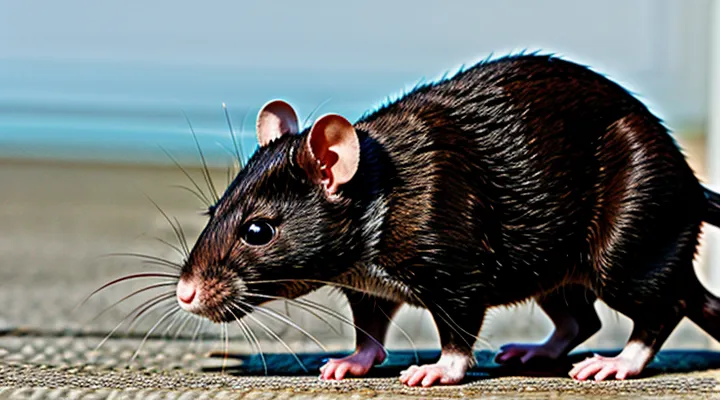
«General Overview of Rat Anatomy»
«Body Shape and Size»
Rats possess a compact, elongated torso that tapers toward a long, hair‑less tail. Adult body length typically ranges from 7 cm to 25 cm, varying by species and sex, while tail length matches or exceeds the torso, extending 10 cm to 30 cm. Overall weight falls between 150 g and 500 g for common laboratory and brown rats; larger specimens can approach 1 kg.
Key dimensions include:
- Head‑to‑body proportion: head constitutes roughly one‑quarter of total length, with a blunt snout and prominent whiskers.
- Tail-to‑body ratio: tail length often equals 80‑100 % of body length, providing balance and thermoregulation.
- Limb arrangement: forelimbs are short, bearing five small claws; hind limbs are longer, enabling agile jumps.
- Body mass distribution: muscular shoulders and hips support rapid movement; abdomen remains relatively slender.
Variations among species manifest in size extremes: the small “dwarf” rat may measure under 10 cm, whereas the giant African pouched rat exceeds 30 cm in body length. Seasonal and nutritional factors also influence weight, with well‑fed individuals gaining up to 30 % more mass than those in limited food environments.
«Fur and Coat Characteristics»
«Common Colors»
Rats display a limited palette of fur and skin tones that aid in species identification and habitat adaptation. Coloration varies among wild, laboratory, and pet strains, but several hues dominate the population.
- Brown (agouti) – dorsal coat mixes dark and light hairs, producing a speckled appearance; ventral side lighter, often gray‑tan.
- Black – uniform, dense pigmentation covering the whole body, common in laboratory lines.
- White – lack of melanin, resulting in pink skin and red eyes; prevalent in albino laboratory strains.
- Gray – medium‑dark fur with a smoother, less mottled texture than agouti; frequently observed in urban feral rats.
- Rex – soft, plush coat in various shades (often gray or brown), characteristic of specific pet breeds.
These colors arise from genetic variations in melanin production and are consistent markers for visual assessment of rat specimens.
«Texture and Density»
Rats possess a coat of short, fine hair that varies from smooth to slightly bristly depending on the species and environment. The fur lies close to the skin, creating a uniform surface that feels soft to the touch yet resists moisture. Underneath the fur, the skin is thin and supple, allowing the animal to navigate tight spaces without injury.
- Fur density: 25–35 hairs per square millimeter on the dorsal side; lower density on the ventral side, typically 15–20 hairs per square millimeter.
- Texture gradient: Coarse, darker guard hairs intermingle with finer, lighter underfur, producing a subtle roughness on the back while the belly remains smoother.
- Tail surface: Covered by sparse, scale-like keratin plates that feel leathery; the tail lacks fur, contributing to a distinct tactile contrast.
- Whisker (vibrissae) quality: Thick, rigid shafts with a smooth, glossy finish, providing precise sensory feedback.
Body density reflects a compact musculature wrapped in a lightweight skeleton. Average mass ranges from 150 g to 500 g for adult specimens, resulting in a body density close to 1.1 g/cm³, which supports agile movement and rapid acceleration. The combination of dense fur and modest body mass creates a sleek profile that minimizes drag when rats squeeze through narrow openings or climb vertical surfaces.
«Distinctive Facial Features»
«Eyes: Color and Placement»
Rats possess relatively large, forward‑facing eyes that provide a broad field of vision essential for navigating tight spaces and detecting predators. The ocular sockets sit high on the skull, giving the animal a distinctive profile when viewed from the side. This placement allows binocular overlap, improving depth perception during climbing and foraging.
Typical eye colors include:
- Dark brown or black in most laboratory and wild brown rats.
- Red or pink, known as “ruby eyes,” in albino individuals lacking melanin.
- Light amber or pale gray in certain Asian and tropical varieties.
Eye size varies slightly with age and breed; juveniles display proportionally larger pupils, which contract sharply in bright environments. The sclera is thin and often appears translucent, revealing the underlying vasculature. The cornea is smooth and clear, facilitating sharp focus at close range.
«Ears: Shape and Size»
Rats possess relatively large, rounded ears that project laterally from the head, giving the animal a distinctive silhouette. The external pinna is thin, covered with fine hair, and flexible enough to swivel toward sound sources. In most common species, such as the brown rat (Rattus norvegicus), ear length ranges from 1.5 cm to 2.5 cm, measured from the base to the tip, while the width is roughly 1 cm. The ear surface is densely vascularized, which aids thermoregulation; blood flow can increase to dissipate excess heat.
Key characteristics of rat ears include:
- Shape: Oval to circular outline; edges smooth, lacking prominent ridges.
- Size variation: Juvenile rats exhibit proportionally smaller ears; adults show growth up to the dimensions noted above. Laboratory strains may have slightly reduced ear length due to selective breeding.
- Hair coverage: Short, fine fur masks the pinna; the hair density can differ between subspecies, affecting visual texture in photographs.
- Cartilage structure: Flexible cartilage provides mobility while maintaining structural integrity, enabling rapid orientation toward acoustic stimuli.
- Auditory function: Ears house the external auditory canal leading to the tympanic membrane; the large surface area enhances sound capture across a broad frequency range (approximately 1 kHz–80 kHz).
Understanding these attributes assists in accurate visual identification and comparative analysis of rat morphology across environments and breeds.
«Nose and Whiskers (Vibrissae)»
Rats possess a small, triangular snout that tapers to a moist, black or pink tip, depending on pigmentation. The nasal opening is flanked by a pair of nostrils that remain open at rest, allowing continuous airflow for olfactory detection. The skin covering the nose is thin, with a fine, short fur that blends with the surrounding facial hair.
Whiskers, or vibrissae, extend from the muzzle, above the eyes, and along the cheeks. Each whisker is a stiff, tapering hair anchored in a richly innervated follicle. The primary functions include:
- Detecting air currents and obstacles with high spatial resolution.
- Conveying tactile information about texture, width, and shape of objects.
- Assisting in navigation within narrow passages and during nocturnal activity.
Typical measurements for a laboratory rat’s facial vibrissae range from 20 mm on the nose to 30 mm on the supra‑orbital region. The arrangement follows a predictable pattern: a central mystacial pad of long whiskers, lateral pads of shorter vibrissae, and a few specialized sensory hairs (e.g., supra‑orbital and genal). The rapid reflexive movement of whiskers, known as “whisking,” occurs at frequencies up to 10 Hz, providing real‑time feedback for precise environmental mapping.
«Limbs and Tail»
«Paws and Digits»
Rats possess four limbs, each ending in a compact paw that supports locomotion and manipulation. The forepaws are slightly larger than the hind paws, reflecting the animal’s reliance on the front limbs for handling food and building nests. Each paw contains five digits; the central three are robust and equipped with curved claws, while the outer digits are smaller and aid in balance. The pads beneath the digits are dense, hair‑free skin that provides traction on various surfaces, from smooth laboratory floors to rough outdoor terrain.
Key characteristics of rat paws and digits:
- Five toes per paw, arranged symmetrically.
- Curved keratinized claws on the inner three toes, facilitating digging and climbing.
- Ventral pads composed of thick epidermis, reducing wear and enhancing grip.
- Slight webbing between digits on the hind paws, improving stability during rapid movement.
- Sensory receptors concentrated at the toe tips, allowing precise tactile feedback.
The structure of the paws enables rats to navigate tight spaces, climb vertical surfaces, and manipulate objects with a degree of dexterity comparable to small primates. Adaptations such as retractable claws and flexible joints contribute to the species’ reputation for agility and resilience.
«Tail: Length and Appearance»
«Hairlessness and Scales»
Rats possess a coat of fine, short fur that varies in density across the body. The skin beneath the fur is thin and relatively smooth, giving the impression of partial hairlessness in certain areas such as the ears, paws, and tail. These regions reveal a delicate, pinkish membrane that is highly vascularized, allowing for efficient thermoregulation and tactile sensing.
The tail, a distinctive rodent feature, is covered by a thin layer of overlapping scales rather than fur. These scales:
- consist of keratinized plates arranged in a longitudinal pattern,
- provide a protective barrier against abrasion and moisture loss,
- contribute to the tail’s flexibility and grip when climbing.
Overall, the combination of sparse fur and scaled tail surface creates a visual profile that distinguishes rats from other small mammals, emphasizing both their adaptability and the specialized functions of their integumentary structures.
«Differences Between Common Rat Species»
«Brown Rat (Rattus norvegicus)»
The brown rat (Rattus norvegicus) is a medium‑sized rodent native to Eurasia and now worldwide. Adults typically measure 20–25 cm in body length, with a tail of comparable length, and weigh 250–500 g. Fur ranges from medium to dark brown on the dorsal side, often with a lighter, almost grayish ventral surface. The coat is dense, short, and glossy, providing a sleek appearance.
Key external characteristics include:
- Head: Broad skull, blunt muzzle, and a pronounced, black nose tip.
- Eyes: Small, dark, positioned on the sides of the head, granting a wide field of view.
- Ears: Rounded, hairless, and proportionally large relative to head size; each ear measures about 2 cm.
- Limbs: Four sturdy legs ending in sharp, semi‑retractable claws; forepaws possess a well‑developed opposable thumb (hallux) for manipulation.
- Tail: Hairless, scaly, slightly thicker near the base, tapering toward the tip; lacks a tuft.
- Whiskers: Long, stiff vibrissae extending from the snout and above the eyes, aiding tactile navigation.
The brown rat’s body exhibits a compact, muscular build, with a relatively short, broad chest and a thick, rounded abdomen. The dorsal fur may display occasional patches of black or reddish tones, while the ventral fur remains consistently pale. The species’ robust skeletal structure supports its reputation for adaptability and resilience across diverse habitats.
«Black Rat (Rattus rattus)»
The black rat (Rattus rattus) is a medium‑sized rodent commonly encountered in urban and rural environments worldwide. Adults measure 16–22 cm from nose to the base of the tail, with a tail length of 18–25 cm that exceeds the body length. Body mass typically ranges from 70 to 200 g.
Fur is uniformly dark brown to black, sometimes showing a slight glossy sheen. The dorsal coat is dense, while the ventral side is lighter, often gray‑brown. Hair on the back lies flat against the skin, giving a sleek appearance.
Key morphological traits include:
- Large, pointed ears that are proportionally longer than those of the brown rat (Rattus norvegicus);
- Prominent whiskers extending forward from the muzzle;
- Small, dark eyes set high on the head;
- A long, slender tail with a scaly, hairless surface, slightly longer than the head‑body length and lacking a noticeable tuft.
The skull is narrow with a relatively long rostrum; incisors are orange‑yellow and continuously grow. Feet are small, equipped with sharp claws for climbing, and the hind limbs are longer than the forelimbs, facilitating agile movement on vertical surfaces.
Photographic documentation typically captures the rat from three perspectives: lateral view to show body proportions, dorsal view to display fur coloration and tail length, and close‑up of the head to highlight ear shape and facial features. High‑resolution images under natural lighting reveal the glossy dorsal coat and the contrast between the dark tail and lighter ventral area, aiding accurate visual identification.
«Variations Within Domesticated Rats»
«Fancy Rat Breeds»
«Dumbo Rats»
Dumbo rats are a distinctive variety of domestic rats recognized primarily by their enlarged, low‑set ears that fold forward, resembling the ears of the famous animated elephant. The ears can extend several centimeters beyond the head, giving the animal a rounded silhouette when viewed from the side.
The facial structure mirrors that of standard Rattus norvegicus, with a short, blunt muzzle, black beady eyes, and a whisker‑rich cheek region. The ears are supported by a robust cartilage framework, allowing them to remain upright yet flexible enough to tilt toward sounds.
Coat types for Dumbo rats include:
- Standard short coat – sleek, close‑lying fur that highlights ear size.
- Rex coat – curly, plush fur that adds volume around the body.
- Hairless (nude) coat – minimal hair, exposing skin and emphasizing the ear morphology.
Common color patterns encompass agouti, black, white, and various roan or brindle mixes. Tail length matches that of typical laboratory rats, averaging 18–20 cm, and remains proportionally slender despite the enlarged ears.
Health considerations focus on ear hygiene; the larger surface area can trap debris and moisture, requiring regular cleaning to prevent infections. Dental health follows the same guidelines as other rats, with continuous incisor growth necessitating gnawing material.
Breeders select for the ear phenotype by pairing individuals with pronounced forward‑folded ears, monitoring genetic lines to avoid excessive inbreeding. The result is a rat with an unmistakable silhouette, easily identified in photographs and suitable for owners who appreciate its unique appearance.
«Hairless Rats»
Hairless rats are distinguished by the complete absence of fur, exposing a thin, delicate epidermis that often appears pink, gray, or slightly translucent. The skin is tightly stretched over the musculature, revealing fine vascular patterns, especially on the abdomen and limbs. Eyes are typically dark and prominent, while the lack of whisker follicles can make the facial structure seem smoother compared to haired counterparts. Ears retain their normal shape but lack the usual fur fringe, giving them a glossy surface. The tail is uncovered, showing a smooth, slightly ridged skin that may appear pale or pink, with visible blood vessels along its length.
Key visual characteristics include:
- Skin tone: pink to light gray, sometimes mottled with darker patches.
- Vein visibility: prominent capillary networks on the dorsal and ventral surfaces.
- Facial contour: smooth muzzle, reduced whisker presence.
- Ear texture: hairless, glossy, with clear demarcation of cartilage.
- Tail appearance: smooth, hairless, often lighter in color than the body.
Hairless rats originate from spontaneous genetic mutations found in laboratory colonies; the most frequently cited strain is the “nude” rat, employed in immunological research because the mutation also affects thymic development. These animals require environmental controls—higher humidity and temperature—to prevent skin desiccation. Their lack of fur makes them highly photogenic, allowing clear capture of skin texture, coloration, and anatomical detail in photographs without the visual interference of hair.
«Satin Rats»
Satin rats are a distinct breed known for their glossy, fine fur that resembles satin fabric. The coat lies flat against the body, giving a sleek, reflective appearance. Coloration includes a wide range of solid hues—black, white, chocolate, lilac, and silver—as well as patterned varieties such as brindle and tortoiseshell.
Key visual characteristics:
- Length: 7–9 inches (body) with a 4–5 inch tail, proportionally balanced.
- Weight: 150–250 g, indicating a medium‑sized rodent.
- Head: Broad, with a rounded nose and prominent whiskers.
- Ears: Small, rounded, set low on the skull.
- Eyes: Dark, almond‑shaped, providing a sharp contrast against the coat.
- Fur: Ultra‑smooth, dense, lacking the coarse texture seen in many other rat breeds.
The satin coat requires regular grooming to maintain its sheen and prevent matting. Dental structure mirrors that of typical laboratory rats, with continuously growing incisors that necessitate gnawing material. Overall, satin rats present a polished, elegant silhouette that distinguishes them visually from other domestic rat varieties.
«Size and Weight Variations»
Rats exhibit a broad spectrum of body dimensions, reflecting species, age, sex, and environmental conditions. Adult brown rats (Rattus norvegicus) typically measure 20–25 cm from nose to base of the tail, with tails adding another 15–20 cm. Their mass ranges from 250 g to 500 g, though well‑fed individuals can exceed 600 g. Black rats (Rattus rattus) are smaller, averaging 15–20 cm in body length and 100–300 g in weight; their tails are proportionally longer, often surpassing body length.
Key factors influencing size and weight:
- Species: Different rat species possess distinct skeletal and muscular structures, establishing baseline size ranges.
- Age: Juvenile rats grow rapidly; newborns weigh 5–7 g and reach adult dimensions within 8–10 weeks.
- Sex: Males generally surpass females by 10–15 % in both length and mass, a difference most pronounced in mature specimens.
- Nutrition: Access to high‑calorie food sources accelerates growth and increases adult weight, while scarcity limits size.
- Habitat: Urban populations tend to be larger due to abundant waste, whereas rural or wild groups often remain leaner.
Understanding these variations aids accurate identification and informs pest‑management strategies.
«Rat Identification Through Visual Cues»
«Identifying Wild Rats»
Identifying wild rats relies on observable physical traits and contextual clues. Accurate recognition assists in pest management, ecological surveys, and public health assessments.
Wild rats typically measure 20–30 cm in head‑body length, with tails of comparable length. Body mass ranges from 150 g to 500 g, depending on species and season. Fur coloration varies from dusky brown to grayish‑black; dorsal hair is coarser than ventral hair, which appears lighter.
Key diagnostic features include:
- Tail: naked, scaly, slightly longer than the body, lacking fur.
- Ears: large relative to head, thinly furred, with prominent pinna.
- Whiskers: long, stiff, extending forward from the snout.
- Feet: five toes on each foot, with prominent pads and clawed toes.
- Eyes: small, dark, set low on the skull.
Habitat indicators support visual identification. Presence of burrow entrances, gnaw marks on wood or plastic, and nocturnal activity patterns suggest wild populations. Photographic documentation should capture the tail, ear edges, and facial profile to confirm species.
Combining size measurements, fur texture, and the enumerated anatomical markers yields reliable differentiation of wild rats from domestic or juvenile specimens.
«Distinguishing Rats from Mice»
Rats and mice share many traits, yet several physical markers reliably separate the two species.
Rats are larger, typically measuring 9–11 inches (body length) with tails that equal or slightly exceed body length. Mice usually remain under 4 inches, and their tails are proportionally shorter. Body weight reflects the difference: adult rats range from 300–500 g, whereas mice weigh 15–30 g.
Key distinguishing characteristics:
- Tail: Rat tails are thick, scaly, and relatively hair‑less; mouse tails are slender, covered with fine hair.
- Ears: Rats possess small, rounded ears hidden by fur; mouse ears are large, prominent, and often appear hairless.
- Snout: Rats have blunt, broader snouts; mice display pointed, delicate snouts.
- Feet: Rat hind feet are larger with more pronounced pads; mouse feet are tiny with delicate pads.
- Fur texture: Rat fur is coarser and denser; mouse fur is softer and finer.
Behavioral cues also aid identification. Rats exhibit bolder foraging habits and tend to avoid tight spaces, while mice readily explore narrow gaps and climb vertically.
Accurate identification supports appropriate pest management, research classification, and public education about rodent species.