
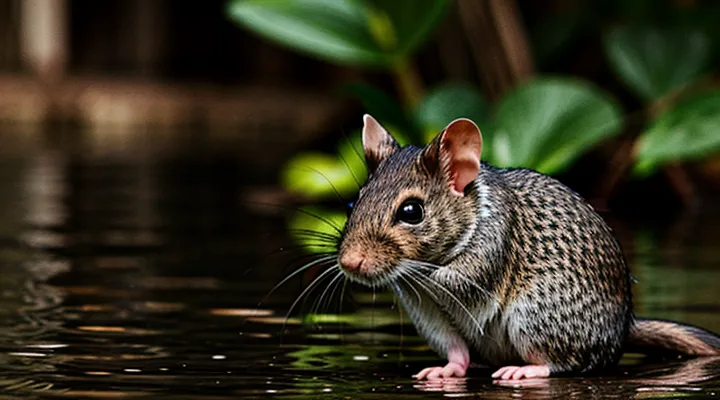
Overview of the Water Rat
Physical Characteristics and Appearance
The semi‑aquatic rodent measures 25–35 cm in head‑body length, with a tail extending 20–30 cm, nearly equal to the body. Body mass ranges from 350 to 800 g, reflecting sexual dimorphism in larger males. Fur is dense, water‑repellent, and exhibits a dark brown to black dorsum contrasted by a lighter, gray‑ish ventral surface; occasional reddish tones appear on the sides of the neck.
Key morphological features include:
- Broad, flat skull with a short, robust muzzle.
- Large, rounded ears set low on the head, partially covered by fur.
- Prominent, dark eyes equipped with a reflective tapetum for low‑light vision.
- Webbed hind feet and partially webbed forefeet, each bearing sharp, curved claws for gripping submerged substrates.
- Tail covered in short, stiff hairs, providing rudimentary steering capability during swimming.
Limbs are relatively short but muscular, supporting both terrestrial locomotion and efficient paddling. The pelage’s oily secretions enhance buoyancy and reduce heat loss in cold water. Overall, the animal’s anatomy combines terrestrial rodent traits with specialized adaptations for an amphibious lifestyle.
Habitat and Distribution
The water rat inhabits riparian zones where slow‑moving streams, marshes, and floodplain forests provide permanent water sources and dense vegetation. Its preference for soft, muddy banks allows easy burrowing and foraging for aquatic insects, crustaceans, and small fish. In temperate regions the species thrives at elevations up to 1,200 m, where cool temperatures and high humidity maintain suitable microclimates.
Distribution is limited to isolated pockets across three continents:
- Southern China, particularly the Yunnan and Guangxi provinces
- Northeastern India, in the Assam and Arunachal Pradesh river valleys
- Eastern Australia, confined to the coastal wetlands of New South Wales and Queensland
Populations occupy fragmented habitats, often separated by agricultural land or urban development. Genetic studies indicate low gene flow between these clusters, underscoring the species’ reliance on intact waterways for dispersal. Conservation assessments prioritize protection of riparian corridors to sustain viable populations.
Behavior and Ecology
Diet and Foraging Habits
The water rat consumes a diet dominated by aquatic and semi‑aquatic organisms. Primary items include insects (larvae, adult beetles, mayflies), small crustaceans (freshwater shrimp, amphipods), and mollusks (snails, small bivalves). Plant material—such as submerged grasses, algae, and emergent seeds—supplements animal prey, especially during periods of reduced invertebrate abundance.
Foraging occurs primarily at water’s edge and within shallow channels. The animal employs tactile whiskers to detect prey hidden under sediment or vegetation. It dives briefly, using its webbed hind feet to propel itself while maintaining buoyancy with a dense, water‑repellent coat. Surface swimming enables capture of swimming insects and floating debris. Nighttime activity increases, aligning with peak activity of many aquatic insects.
Seasonal shifts adjust dietary composition. In spring, abundant insect emergences raise protein intake, while autumn sees greater reliance on seeds and tubers as invertebrate populations decline. During drought or low‑water conditions, the rat expands its range to moist terrestrial habitats, exploiting earthworms and terrestrial arthropods.
Key foraging adaptations:
- Sensitive vibrissae for detecting prey motion beneath substrates.
- Strong, curved incisors for cracking shells and breaking tough plant tissue.
- Flexible forelimbs allowing precise manipulation of objects in water.
- Ability to store small food caches in burrow chambers for later consumption.
Overall, the water rat’s diet reflects opportunistic exploitation of readily available aquatic resources, supplemented by terrestrial foods when environmental conditions limit access to its preferred prey.
Reproductive Patterns
The water-dwelling rat exhibits a distinct breeding cycle aligned with regional rainfall patterns. Peak conception occurs during the wet season, when food abundance supports gestation and lactation.
Gestation lasts approximately 30 days, after which females give birth to litters of 2–5 offspring. Neonates are altricial, relying on maternal thermoregulation and milk for the first three weeks. Weaning is completed by week 5, and juveniles attain sexual maturity at 6–8 months.
Key reproductive traits:
- Seasonal breeding synchronized with water level fluctuations
- Short gestation period (≈30 days)
- Litter size range: 2–5 pups
- Maternal care limited to nursing and nest protection; males do not participate in offspring rearing
- First breeding opportunity typically reached after one year of age
Population dynamics are sensitive to habitat disturbance. Loss of riparian vegetation reduces shelter availability, directly affecting nesting success and juvenile survival rates. Conservation measures that preserve floodplain integrity help maintain the species’ reproductive output.
Social Structure
The water rat (an aquatic rodent native to Southeast Asian wetlands) lives in small, stable colonies that typically contain three to seven individuals. Each colony occupies a defined stretch of riparian vegetation and a network of burrows near water sources, which provides both shelter and foraging grounds.
Social organization follows a clear hierarchy. An adult male usually assumes the dominant position, controlling access to prime nesting sites and leading group movements. Females rank below the male but maintain influence over maternal duties and juvenile care. Subordinate juveniles and non‑breeding adults occupy peripheral burrows and assist with sentinel duties. The hierarchy is reinforced through frequent grooming, scent marking, and brief aggressive displays that establish rank without causing injury.
Reproductive activity is coordinated within the group. The dominant male mates with one or two females, while subordinate females may experience delayed breeding until a vacancy arises. Litters average two to four pups, which remain in the natal burrow for 30‑45 days, during which all adult members participate in feeding and protection. After weaning, juveniles either disperse to establish new colonies or integrate as subordinate members.
Communication relies on a combination of vocalizations, tail slaps on water, and chemical cues. Short chirps signal alarm, while low‑frequency growls convey territorial warnings. Tail slaps generate surface vibrations that travel across water, alerting distant conspecifics to predator presence. Scent glands on the cheeks and flank release pheromones that mark individual identity and reproductive status, facilitating recognition within the colony.
Conservation Status and Threats
Population Trends
The semi‑aquatic rodent known for its rarity has shown a marked decline in population size over the past two decades. Long‑term monitoring programs across its limited range indicate a reduction of approximately 35 % since 2005, with the most pronounced losses occurring in low‑lying wetlands that have been converted to agriculture.
Survey data collected in 2022 recorded fewer than 1,200 individuals across all known colonies, down from an estimated 1,850 in 2005. Annual census reports reveal a steady downward trajectory, averaging a loss of 2.5 % per year. Reproductive output has also diminished, with average litter sizes decreasing from 4.2 pups per female in the early 2000s to 3.1 in the most recent assessments.
Key drivers of the decline include:
- Habitat fragmentation caused by drainage projects and urban expansion.
- Increased predation pressure from introduced mustelids and feral cats.
- Seasonal fluctuations in water availability linked to climate variability.
- Pollution and eutrophication reducing food resources in riparian zones.
Regional patterns differ markedly. In the northern river basin, populations have stabilized at around 300 individuals due to recent restoration efforts. The central coastal marshes exhibit a 45 % reduction, reflecting extensive land‑use change. Southern highland streams maintain the smallest numbers, with fewer than 150 individuals, and show signs of local extirpation.
Conservation response requires intensified field surveys to refine abundance estimates, protection of remaining wetland habitats, and targeted predator control. Continuous data collection will enable adaptive management and assess the effectiveness of mitigation measures aimed at reversing the current trend.
Main Threats to Survival
The water rat faces several acute pressures that jeopardize its continued existence.
- Extensive drainage and conversion of wetlands for agriculture eliminate essential foraging and nesting sites.
- Contamination of rivers and streams with pesticides, heavy metals, and sewage reduces the availability of clean water and aquatic invertebrates, the primary food source.
- Introduction of predatory mammals such as feral cats and foxes increases mortality, especially where native predator control is insufficient.
- Climate‑driven alterations in precipitation patterns cause seasonal droughts and flood events that destabilize the microhabitats required for breeding and shelter.
- Recreational activities along riverbanks, including boating and shoreline development, disturb burrows and increase the risk of trampling.
- Outbreaks of rodent‑specific pathogens, often facilitated by high population densities in fragmented habitats, lead to rapid declines.
Collectively, these factors erode population stability, restrict dispersal opportunities, and elevate extinction risk for this rare semi‑aquatic rodent. Continuous monitoring and targeted mitigation—habitat restoration, pollution control, invasive predator management, and climate adaptation measures—are essential to halt the downward trajectory.
Conservation Efforts
The water rat, a semi‑aquatic rodent found only in limited riverine habitats, faces rapid population decline due to habitat loss, water pollution, and invasive predators. Conservation programs focus on preserving viable populations and restoring ecological conditions essential for survival.
Primary actions include:
- Designation of protected river corridors that prohibit development and enforce strict water‑quality standards.
- Implementation of captive‑breeding facilities that maintain genetically diverse stock and provide individuals for reintroduction.
- Systematic monitoring of wild colonies using radio telemetry and camera traps to assess abundance, health, and threats.
- Collaboration with local communities to promote sustainable land‑use practices and reduce by‑catch in fisheries.
- Enforcement of legal protections under national wildlife legislation, complemented by international agreements that restrict trade and transport of the species.
- Allocation of research grants to study the species’ diet, reproductive biology, and disease susceptibility, informing adaptive management.
Recent outcomes demonstrate measurable progress: protected waterways report a 12 % increase in observed individuals over three years, and captive‑breeding programs have successfully released 45 juveniles into restored habitats. Continued investment in these measures is required to secure long‑term viability of the species.
Water Rat in Culture and Folklore
The water rat, a semi‑aquatic rodent native to Australasia and parts of Southeast Asia, appears repeatedly in indigenous narratives and literary traditions. In Australian Aboriginal mythology, the creature is linked to creation stories that describe its role as a messenger between land and water realms. The creature’s adept swimming ability is portrayed as a symbol of transition, guiding spirits across the threshold of the physical world.
In the folklore of the Philippines, the water rat (locally known as “tangkal”) is featured in cautionary tales warning children against wandering near rivers after dusk. These stories emphasize the animal’s nocturnal activity and its capacity to disappear beneath the surface, reinforcing communal norms about safety and respect for natural waterways.
Japanese literature includes references to a water‑dwelling rodent in Edo‑period haiku, where the animal’s quiet presence on riverbanks serves as a metaphor for solitude and resilience. The brief verses capture the animal’s unobtrusive movement, reflecting broader aesthetic values of simplicity and harmony with nature.
Key cultural associations can be summarized as follows:
- Aboriginal Australian: messenger between terrestrial and aquatic domains; embodiment of transitional spaces.
- Filipino: figure in cautionary narratives; emblem of nighttime river hazards.
- Japanese: poetic symbol of quiet endurance; illustration of natural modesty.
These examples demonstrate the water rat’s integration into diverse cultural frameworks, where its ecological traits inform symbolic meanings across regions.
Interesting Facts About Water Rats
The water rat, a semi‑aquatic murid native to southeastern Australia and Tasmania, exhibits adaptations that enable a largely aquatic lifestyle.
- Dense, water‑repellent fur reduces heat loss while swimming.
- Webbed hind feet and a laterally flattened tail generate thrust, allowing bursts of speed up to 6 km/h underwater.
- Eyes and ears are positioned high on the skull, granting clear vision and hearing above the water’s surface while the body remains submerged.
- The species possesses a highly developed sense of smell; scent glands on the cheeks release pheromones that facilitate territorial marking and mate attraction.
- Diet consists of aquatic invertebrates, small fish, and occasionally amphibian eggs, reflecting opportunistic foraging in streams, swamps, and coastal lagoons.
Reproductive behavior includes a brief gestation of approximately 30 days, after which litters of two to four altricial young are born. The offspring remain in the nest for 3–4 weeks before venturing into the water under maternal supervision.
Population surveys indicate a fragmented distribution, with isolated colonies confined to pristine waterways. Habitat degradation, particularly the loss of riparian vegetation, poses a primary threat to long‑term survival. Conservation measures focus on protecting water quality, restoring native vegetation along banks, and monitoring colony dynamics through photographic documentation and field observations.