
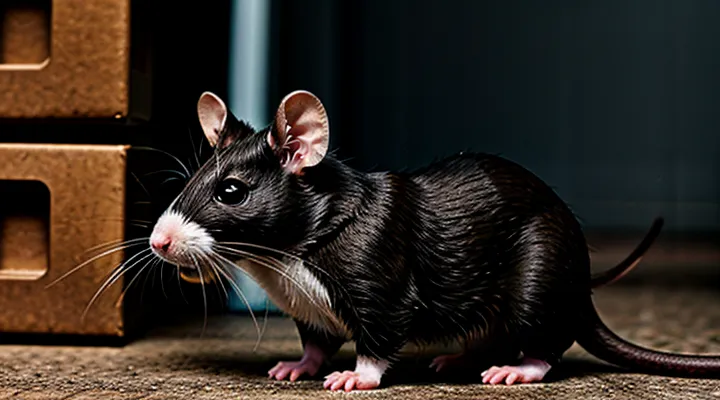
The Brown Rat: A Familiar Titan
Physical Characteristics of the Brown Rat
The brown rat (Rattus norvegicus) represents the most sizable rat variety, commonly reaching lengths of 20–25 cm from nose to base of the tail, with total lengths up to 40 cm including the tail. Adult males typically weigh 300–500 g, while females average 250–350 g. Body mass and length surpass those of other common rat types, establishing the brown rat as the dominant size class within the genus.
- Fur: Dense, coarse coat; dorsal coloration ranges from dark brown to almost black, with lighter, sometimes grayish, ventral fur.
- Tail: Scaled, slightly shorter than the body; length 15–20 cm; coloration matches dorsal fur, often darker on top, lighter underneath.
- Ears: Large, rounded, sparsely haired; positioned high on the skull, providing acute auditory perception.
- Eyes: Small, dark, set forward; pupil dilation adapts to low‑light environments.
- Snout: Broad, blunt; equipped with a strong, continuously growing incisor pair that extends beyond the upper lip.
- Limbs: Robust forelimbs with dexterous paws; hind limbs longer, facilitating powerful jumps and swift navigation through burrows and structures.
Sexual dimorphism appears in size, with males exhibiting slightly greater body mass and tail length. Skeletal structure includes a reinforced lumbar vertebrae column, supporting the animal’s capacity for extensive digging and climbing. Dental formula remains consistent across the species: 1/1 incisors, 0/0 canines, 0/0 premolars, 3/3 molars, reflecting a diet that includes both plant material and animal protein.
Natural Habitat and Distribution
The biggest rat variety occupies a range of temperate and subtropical environments where dense vegetation provides shelter and abundant food sources. Individuals thrive in grasslands, river valleys, and low‑elevation forest edges, favoring areas with loose soil that facilitates burrowing.
Natural habitats are characterized by:
- Moist soil layers supporting extensive tunnel networks
- Proximity to water bodies that sustain an ample supply of aquatic insects and plant matter
- Mixed vegetation that offers both cover from predators and foraging opportunities
Geographic distribution extends across several continents, primarily within the following regions:
- Eastern Asia: extensive populations in the river basins of China, Korea, and Japan
- Southeast Asia: presence in the lowland forests of Thailand, Vietnam, and Malaysia
- Central Europe: scattered colonies in riverine corridors of Poland, Hungary, and the Czech Republic
Populations adapt to local climatic conditions by adjusting burrow depth and seasonal activity patterns, ensuring survival across the species’ broad distribution.
Social Structure and Behavior
The largest rat breed exhibits a clearly defined social hierarchy that governs group interactions. Dominant individuals occupy the top tier, controlling access to food, nesting sites, and mating opportunities. Subordinate rats recognize and defer to higher‑ranking members, reducing overt aggression and maintaining group stability.
Communication relies on a combination of ultrasonic vocalizations, scent marking, and tactile signals. Ultrasonic calls convey alarm, territorial boundaries, and social status, while scent glands on the flank and genital area deposit pheromones that encode individual identity and reproductive condition. Physical grooming reinforces alliances and hierarchal bonds.
Reproductive behavior follows a structured pattern:
- Alpha pair monopolizes breeding, producing the majority of offspring.
- Subordinates may assist in nest construction and juvenile care, increasing overall litter survival.
- Seasonal fluctuations trigger heightened mating activity, with males extending scent trails to attract receptive females.
Territorial organization centers on a core nesting area surrounded by foraging routes. Overlapping territories are limited to peripheral zones where scent markers delineate acceptable boundaries. Intruders entering a dominant’s core zone provoke rapid vocal and aggressive responses, often resulting in immediate retreat.
Group cohesion is reinforced by regular allogrooming sessions and synchronized activity cycles. These behaviors minimize stress, optimize energy expenditure, and support efficient resource allocation within the colony.
The Gambian Pouched Rat: An African Giant
Distinctive Features of the Gambian Pouched Rat
The Gambian pouched rat stands out among the largest members of the Muridae family, reaching body lengths of 40–50 cm and tail lengths up to 60 cm, with adult weights between 1.2 and 1.5 kg. Its most recognizable characteristic is a sizeable, expandable cheek pouch extending from the lower jaw to the shoulder, used for transporting food and nesting material.
Key distinguishing traits include:
- Robust skull and powerful incisor teeth capable of cracking hard seeds and nuts.
- Dense, coarse fur ranging from dark brown to gray, providing camouflage in savanna and forest margins.
- Highly developed olfactory system, enabling detection of low‑concentration odors; this ability underlies the species’ deployment in land‑mine and disease‑vector detection programs.
- Social structure based on small colonies, with cooperative nesting and shared foraging territories.
- Omnivorous diet comprising grains, fruits, insects, and small vertebrates, reflecting adaptability to varied environments.
Reproductive parameters reinforce its prominence: females produce litters of 2–4 offspring after a gestation period of approximately 30 days, with juveniles attaining adult size within six months. The combination of size, cheek‑pouch capacity, sensory acuity, and social behavior defines the Gambian pouched rat as a uniquely equipped representative of the most massive rat breed.
Its Role in Its Native Ecosystem
The biggest rat species inhabiting the Andean cloud forests attains body masses up to 1.2 kg, making it the most sizable member of the Muridae family in that region. Its morphological adaptations—robust incisors, strong forelimbs, and a dense pelage—enable it to exploit ground‑level fruits, tubers, and carrion unavailable to smaller rodents.
Ecological contributions include:
- Consumption of fallen seeds, followed by selective caching that enhances germination rates for native flora.
- Predation on invertebrates such as beetle larvae, reducing herbivore pressure on seedlings.
- Digging activities that aerate soil, improve water infiltration, and create microhabitats for arthropods.
- Serving as prey for raptors and small carnivores, thereby linking primary production to higher trophic levels.
Population fluctuations correlate with changes in forest composition; declines in the species often precede reduced seed dispersal effectiveness and increased invertebrate herbivory, while population surges can lead to heightened seed predation. Monitoring its abundance therefore provides a practical indicator of ecosystem health in its native range.
Domestication and Its Use in Detection
The giant rat variety, recognized for its considerable size, has been selectively domesticated for centuries. Controlled breeding emphasized temperament, health, and adaptability, producing individuals that coexist comfortably with humans while retaining heightened sensory capabilities.
Domesticated specimens serve detection tasks through innate olfactory acuity and trainable behavior. Their large body mass accommodates advanced harness systems, extending operational endurance compared to smaller counterparts.
Key detection functions include:
- Locating explosive residues in confined spaces
- Identifying trace narcotics in cargo shipments
- Sensing early-stage disease markers in agricultural settings
Training protocols rely on positive reinforcement, gradual exposure to target scents, and consistent performance evaluation. Handlers employ standardized cue–response drills to maintain reliability across varied environments.
Field deployment demonstrates rapid scent discrimination, low false‑positive rates, and resilience to temperature fluctuations. The combination of size, domestication stability, and sensory precision positions the largest rat breed as a valuable asset in modern detection programs.
Comparing the Giants: Size and Temperament
Size Comparison: Brown Rat vs. Gambian Pouched Rat
The brown rat (Rattus norvegicus) and the Gambian pouched rat (Cricetomys gambianus) represent two of the most sizable members of the rodent order. Both species are frequently cited when discussing the upper limits of rat dimensions.
Typical dimensions for the brown rat:
- Body length: 20–25 cm (head‑to‑base)
- Tail length: 15–20 cm
- Weight: 250–500 g
Typical dimensions for the Gambian pouched rat:
- Body length: 30–45 cm (head‑to‑base)
- Tail length: 25–35 cm
- Weight: 700 g–1.4 kg
The Gambian pouched rat exceeds the brown rat in every metric. Its body can be twice as long, its tail up to 75 % longer, and its mass more than double. Consequently, the pouched rat stands as the preeminent example of size within the group of large rat species.
Temperamental Differences
The giant rat breed displays a spectrum of behavioral traits that vary noticeably among individuals.
- Activity level ranges from highly energetic, characterized by frequent exploration of enclosure space, to markedly sedentary, where the animal spends most of its time resting.
- Social inclination differs; some specimens readily engage with conspecifics, forming stable groups, while others exhibit aggression toward cage mates and prefer solitary confinement.
- Response to handling shows a clear split: certain rats tolerate frequent human contact with minimal stress signals, whereas others react with heightened alertness, vocalizations, and attempts to escape.
Temperament also correlates with sex. Males tend to assert dominance through territorial marking and occasional fighting, whereas females often display nurturing behavior toward juveniles and are more tolerant of shared resources.
Age influences demeanor as well. Juveniles exhibit curiosity-driven play, frequent gnawing, and rapid adaptation to new environments. Adults develop consistent routines, showing reduced novelty seeking and increased predictability in feeding and nesting habits.
Environmental factors modulate these differences. Enclosures enriched with tunnels, climbing structures, and varied textures encourage active exploration, while barren habitats amplify passive behavior and stress responses.
Understanding the range of temperamental patterns assists caretakers in selecting appropriate housing, social grouping, and interaction protocols, thereby promoting welfare and minimizing conflict within this sizable rat variety.
Lifespan and Health Considerations
The biggest rat breed typically lives between 2 and 3 years when provided with optimal nutrition, regular veterinary care, and a low‑stress environment. Longevity can extend to 4 years in cases where genetic health is robust and chronic conditions are effectively managed.
Key health considerations include:
- Respiratory infections: prone to pneumonia and nasal discharge; prevent with clean bedding and adequate ventilation.
- Dental overgrowth: incisors continue to grow; supply of chewable materials prevents malocclusion.
- Obesity: high-calorie diets accelerate weight gain; monitor body condition score and adjust portions accordingly.
- Skin lesions: large size increases pressure on foot pads; inspect paws weekly and maintain dry, soft substrate.
- Cardiovascular strain: rapid growth may stress the heart; schedule periodic cardiac examinations, especially in individuals exceeding average weight.
Consistent health monitoring, balanced diet, and environmental enrichment are essential to maximize lifespan and reduce disease incidence in this extensive rat variety.
Living with Large Rats: Considerations for Pet Owners
Housing Requirements for Large Breeds
Large rat varieties demand spacious enclosures that accommodate their size and activity level. Minimum floor area should exceed 2 sq ft per animal, with additional space for multiple occupants to prevent crowding. Vertical space enhances enrichment; cages with multiple levels must provide sturdy platforms and secure ladders.
Key elements for suitable housing include:
- Cage dimensions: Minimum interior measurements of 24 in × 24 in × 18 in; larger dimensions recommended for groups.
- Bar spacing: No more than ½ in to prevent escape while allowing ventilation.
- Substrate depth: At least 2 in of absorbent, dust‑free material to support digging and nesting.
- Temperature control: Stable ambient temperature between 65 °F and 75 °F; avoid drafts and direct sunlight.
- Sanitation: Daily removal of waste, weekly deep cleaning with mild, non‑toxic disinfectant.
- Enrichment: Solid chewing blocks, tunnels, and hideouts; items must be securely anchored.
Structural integrity is critical; cages constructed from stainless steel or high‑grade aluminum resist corrosion and maintain hygiene. Locks must be tamper‑proof, with secondary safety latches to prevent accidental opening.
Ventilation must ensure fresh air exchange without creating strong currents that could stress the animals. Adjustable airflow vents allow fine‑tuning of humidity, which should remain between 40 % and 60 % to prevent respiratory issues.
Overall, housing for large rat breeds requires ample space, robust construction, precise environmental control, and regular maintenance to support health and natural behaviors.
Dietary Needs and Nutritional Considerations
The most massive rat variety requires a diet that supports rapid growth, high activity levels, and greater body mass. Energy intake must exceed that of standard laboratory or pet rats to maintain muscle development and thermoregulation.
- Protein: 20‑25 % of total calories; sources include lean chicken, turkey, boiled eggs, and high‑quality rodent pellets.
- Fat: 8‑12 % of calories; include fish oil, flaxseed oil, or modest amounts of unsalted nuts.
- Carbohydrates: 55‑70 % of calories; provide whole grains, cooked sweet potatoes, and oatmeal.
Vitamins and minerals are critical for skeletal health and immune function. Calcium and phosphorus should be balanced at a 1.2:1 ratio; supplement with powdered bone meal if necessary. Vitamin D3, vitamin E, and B‑complex vitamins help prevent metabolic disorders. Trace elements such as zinc, selenium, and magnesium must be present in adequate concentrations, achievable through fortified feeds or targeted supplements.
Feeding frequency should align with the animal’s size and metabolism. Provide two to three measured meals daily, ensuring fresh water is always available. Monitor body condition regularly; adjust portions if weight gain exceeds 2 % per week or if the rat appears underweight. Avoid sudden dietary changes; introduce new foods gradually over 3‑5 days to prevent gastrointestinal upset.
Training and Enrichment for Intelligent Rodents
The giant rat variety, renowned for its size and cognitive capacity, responds well to structured training and environmental enrichment. Consistent, short sessions reinforce desired behaviors while preventing stress. Positive reinforcement—treats, clicker cues, or brief petting—strengthens the association between the command and the outcome.
Effective enrichment strategies include:
- Puzzle feeders that require manipulation to release food, stimulating problem‑solving skills.
- Rotating climbing structures and tunnels to maintain novelty and encourage exploration.
- Interactive toys such as chewable ropes, wooden blocks, and safe mirrors that promote tactile and visual engagement.
- Daily foraging opportunities, scattering small portions of diet across the enclosure to mimic natural search behavior.
Training focus areas should cover basic obedience, target training, and gentle handling. Obedience commands (e.g., “come,” “stay”) build reliability; target training teaches the rat to touch a designated object, facilitating future tasks; handling protocols reduce fear and improve veterinary cooperation.
Monitoring progress involves recording response latency, accuracy, and willingness to engage. Adjustments—shortening session length, varying reward type, or introducing new challenges—maintain motivation and prevent habituation. Regular assessment ensures the large rat’s mental and physical health remain optimal.