
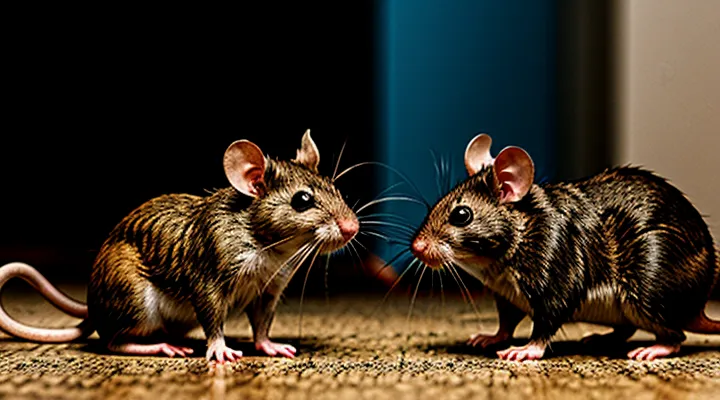
Understanding Rodent Dynamics
Defining «Rat» Versus «Mouse»
Physical Distinctions
Rats and mice differ markedly in morphology, a factor that influences competitive interactions. Size disparity is the most evident distinction: adult rats typically weigh 200–500 g and measure 20–30 cm in body length, whereas mice average 15–30 g and 7–10 cm. Tail proportion also varies; rat tails approach body length, while mouse tails are relatively longer, often exceeding the body. Ear dimensions follow a similar pattern, with rats possessing larger, thicker pinnae compared to the small, delicate ears of mice. Fur coloration diverges, as rats display a broader palette—including black, brown, and albinistic forms—while mice commonly exhibit gray or brown coats with limited variation. Skeletal structure reflects functional adaptation: rat skulls are more robust, supporting stronger jaw muscles, whereas mouse skulls are slender, suited for rapid gnawing.
- Body mass: rat > mouse by an order of magnitude
- Tail length: rat ≈ body length; mouse tail > body length
- Ear size: rat large, mouse small
- Fur diversity: rat broad, mouse limited
- Skull robustness: rat strong, mouse lightweight
These physical attributes translate into asymmetrical power dynamics. Greater mass and jaw strength enable rats to exert higher bite forces, granting them advantage in territorial disputes and resource acquisition. Enhanced musculature allows rats to manipulate larger objects and construct more complex burrows, reinforcing dominance over shared habitats. Conversely, mouse agility, facilitated by lighter frames and proportionally longer tails, supports rapid escape and exploitation of narrow niches, but does not offset the rat’s superior physical leverage in direct confrontations.
Behavioral Distinctions
Rats and mice exhibit distinct behavioral patterns that shape interspecies power dynamics. Rats form larger colonies with clearly defined hierarchies; dominant individuals maintain control through frequent grooming, scent marking, and assertive posture. Mice organize in smaller groups, display fluid rank structures, and rely more on passive avoidance than overt dominance.
Aggression levels differ markedly. Rats engage in direct confrontations, use bites and lunges to defend territory, and recover quickly from injuries. Mice prefer brief skirmishes, employ rapid retreats, and rarely sustain serious wounds. This disparity influences which species secures prime nesting sites.
Communication mechanisms reinforce dominance. Rats emit low‑frequency ultrasonic calls that signal aggression and territorial claims, while mice produce higher‑frequency chirps associated with social cohesion. Pheromonal profiles also vary: rat urine contains higher concentrations of major urinary proteins that convey status, whereas mouse scent marks emphasize reproductive readiness.
Resource competition favors rats. Their larger body mass enables efficient exploitation of bulk food sources, and their stronger jaws allow consumption of harder materials. Mice specialize in seed and grain selection, limiting their ability to outcompete rats when both species access the same supplies.
Key behavioral distinctions:
- Colony size: rats > mice
- Hierarchical rigidity: rats > mice
- Aggression intensity: rats > mice
- Vocalization frequency: rats (low) vs. mice (high)
- Pheromone potency: rats stronger vs. mice weaker
- Physical capability: rats dominant vs. mice subordinate
These traits collectively determine which species asserts dominance in shared environments.
Natural Habitats and Overlap
Rats and mice occupy a range of environments that reflect their adaptive flexibility. Urban sewers, abandoned buildings, and commercial kitchens provide rats with access to abundant waste and shelter. Mice thrive in grain stores, residential basements, and field margins where seed availability is high. Both species are present in agricultural landscapes, where crop residues and irrigation systems create microhabitats suitable for foraging and nesting.
Overlap occurs most frequently in settings where human activity concentrates resources. Shared locations include:
- Grain processing facilities where spillage attracts both rodents.
- Residential apartments with cracks in walls and unsanitized pantries.
- Outdoor compost piles that retain moisture and organic matter.
- Flood‑prone areas where temporary water channels connect sewer systems to fields.
The co‑occurrence of rats and mice intensifies competition for food, nesting sites, and shelter. In zones with abundant, diversified resources, rats often outcompete mice due to larger size and higher reproductive output. Conversely, in tightly confined spaces with limited food, mice may maintain a foothold because of their ability to exploit smaller niches. Understanding the spatial convergence of these habitats clarifies the conditions under which one species exerts dominance over the other.
Interspecies Interactions
Competition for Resources
Food Sources
Rats and mice compete for overlapping food resources, yet their dietary preferences and foraging strategies differ enough to influence hierarchical outcomes.
Both species exploit human‑derived waste, grains, and insects, but rats typically dominate high‑calorie, dense foods such as meat scraps, cheese, and processed snacks. Their larger body size and stronger bite force allow them to breach sealed containers and displace mice from rich caches. Mice excel at extracting seeds, dried fruit, and fine grains from narrow crevices, often accessing stores that rats cannot reach.
Key factors shaping resource‑based dominance:
- Food size and energy density – rats preferentially claim bulk, high‑fat items; mice favor smaller, low‑fat particles.
- Access points – mice navigate tight gaps, giving them exclusive entry to certain storage areas.
- Temporal activity – rats are more active during twilight, while mice often forage throughout the night, reducing direct encounters.
- Social foraging – rats forage in larger groups, reinforcing territorial claims; mice operate solitarily, limiting their ability to defend large supplies.
When abundant, high‑energy foods appear, rats typically assert control, pushing mice to peripheral sources. In environments where only fine grains or seed stores exist, mice maintain a competitive edge, exploiting niches inaccessible to rats. Consequently, the composition and distribution of food sources directly dictate which species holds dominance in shared habitats.
Shelter and Nesting Sites
Rats and mice frequently compete for limited shelter and nesting resources, a factor that directly influences hierarchical outcomes within shared habitats. Larger body size, higher reproductive output, and greater aggression give rats a competitive edge, allowing them to occupy preferred sites and force mice into peripheral or suboptimal locations.
Common shelter categories include:
- Burrows excavated in loose soil or under debris.
- Structural voids such as wall cavities, ceiling spaces, and pipe conduits.
- Man‑made objects like cardboard boxes, fabric piles, and stored goods.
- Elevated platforms or ladders that provide access to food sources.
When a rat secures a prime nest—characterized by stable temperature, low predator exposure, and proximity to food—mice typically relocate to secondary sites, resulting in spatial segregation that reinforces rat dominance. Conversely, in environments where shelter is abundant and evenly distributed, mice can maintain independent territories, reducing direct confrontations.
Predation and Prey Dynamics
Rats as Predators of Mice
Rats regularly exploit mice as a food source, especially in environments where both species coexist. Their larger size, stronger jaws, and aggressive foraging habits give them a clear advantage in direct encounters. Predatory behavior includes nocturnal ambushes, opportunistic scavenging of mouse carcasses, and the use of scent trails to locate hidden prey.
Key factors that enhance rat predation on mice:
- Superior bite force capable of crushing small vertebrates.
- Social structures that allow coordinated hunting in dense populations.
- Adaptive diet that shifts toward rodents when alternative foods are scarce.
Ecological consequences extend beyond individual mortality. Rat predation reduces mouse population density, influencing seed dispersion, disease transmission, and competition for limited resources. In agricultural settings, rat presence can suppress mouse‑driven crop damage, yet the overall impact varies with habitat complexity and species composition.
Management strategies that aim to control rodent pests must consider the predator‑prey relationship. Introducing or encouraging rat populations may lower mouse numbers, but it also raises concerns about rat‑related damage and disease. Effective control therefore requires integrated approaches that balance direct suppression of both species with habitat modification to limit opportunities for predation.
Factors Influencing Predation
Rats and mice often share habitats, yet predation patterns differ markedly. Understanding which species exerts pressure on the other requires analysis of environmental and biological variables that shape hunting behavior.
Key variables include:
- Body size and strength – larger individuals can subdue smaller opponents more effectively.
- Territorial density – crowded conditions increase encounters, raising the likelihood of aggressive acts.
- Resource availability – scarcity forces individuals to expand hunting ranges, while abundance reduces conflict.
- Seasonal cycles – breeding periods and temperature fluctuations alter activity levels and metabolic demands.
- Sensory acuity – superior olfactory or auditory detection enhances the ability to locate prey.
Physiological traits also influence outcomes. Faster metabolism in mice drives higher foraging rates, potentially exposing them to predators, whereas rats possess greater bite force, enabling them to capture and kill mice when opportunities arise.
Behavioral strategies further modulate predation. Rats often employ ambush tactics near nesting sites, while mice rely on rapid escape routes and group vigilance. The interplay of these factors determines which species dominates predatory interactions in shared ecosystems.
Territoriality and Dominance
Aggression and Confrontation
Aggressive interactions between Rattus spp. and Mus spp. are driven primarily by competition for limited resources such as food, shelter, and mating opportunities. Rats exhibit higher bite force, larger body mass, and more extensive scent-marking, which together increase the likelihood of initiating conflict. Mice rely on rapid evasive maneuvers and ultrasonic vocalizations to avoid direct confrontation.
Typical confrontations follow a predictable sequence: (1) visual and olfactory assessment, (2) threat displays, (3) physical engagement, (4) retreat or submission. Threat displays include raised fur, tail flicking, and dorsal posture. Physical engagement often results in bite wounds concentrated on the neck and flanks of the mouse, while rats frequently sustain minor scratches when the mouse escapes.
Empirical observations reveal a consistent pattern of rat dominance in mixed-species groups. When resource scarcity intensifies, rats increase aggression frequency, reducing mouse foraging time by up to 40 %. Mice compensate by shifting activity to nocturnal windows and employing stealth foraging routes.
Key behavioral markers of aggression:
- Rapid lunging and forward thrusts (rat)
- High‑frequency ultrasonic calls signaling distress (mouse)
- Persistent pursuit after initial contact (rat)
- Immediate retreat into narrow crevices (mouse)
These dynamics establish a hierarchical structure in which rats occupy the top tier, exerting control through superior physical force and territorial marking. Mice maintain population viability by exploiting temporal niches and avoiding direct clashes.
Avoidance Behaviors
Avoidance behaviors are central to the interaction patterns that determine which species exerts greater control over shared resources and space. In mixed‑species environments, both rats and mice employ distinct strategies to reduce direct conflict and maintain access to food, shelter, and nesting sites.
Rats typically adopt the following avoidance tactics:
- Rapid retreat to deep burrows or concealed cavities when a mouse approaches a contested area.
- Use of scent marking to delineate zones that are less attractive to mice, thereby discouraging incursions.
- Preference for elevated pathways that limit ground‑level encounters with mice.
Mice counteract with complementary measures:
- Frequent relocation to peripheral zones where rat activity is minimal.
- Deployment of high‑frequency ultrasonic vocalizations that signal potential danger and trigger dispersal.
- Exploitation of narrow crevices and small openings inaccessible to larger rats.
These opposing patterns create a dynamic equilibrium: rats dominate open, resource‑rich spaces, while mice occupy marginal niches that provide safety from rat aggression. The balance shifts when environmental conditions alter the availability of refuge or food, prompting one species to expand its avoidance range and temporarily gain dominance.
Factors Influencing Dominance
Size and Strength Disparity
Rats typically exceed mice in body mass, length, and muscular development. Adult brown rats (Rattus norvegicus) average 300–500 g and 20–25 cm body length, whereas common house mice (Mus musculus) range from 15–30 g and 7–10 cm. Skeletal muscle cross‑sectional area scales with body mass, giving rats a proportionally larger force‑generating capacity. Bite force measurements report 1.5–2.0 N for rats compared with 0.2–0.3 N for mice, reflecting a tenfold advantage in crushing strength.
The disparity translates into distinct physical interactions. When a rat encounters a mouse, the rat’s greater mass enables it to displace the mouse with minimal exertion. The mouse’s lower grip strength limits its ability to resist displacement or inflict injury. In confined environments, the rat’s longer reach and stronger forelimbs allow it to grasp and manipulate objects that a mouse cannot handle, further expanding its functional dominance.
However, size and strength do not guarantee exclusive control in all scenarios. Mouse agility, rapid acceleration, and ability to exploit narrow passages can offset the rat’s brute force in complex habitats. Consequently, the outcome of direct encounters depends on spatial constraints, resource availability, and the relative numbers of individuals present.
Population Density
Population density directly shapes the competitive balance between rats and mice. When individuals of both species occupy the same habitat, the number of competitors per unit area determines encounter frequency, resource depletion rate, and territorial pressure.
High densities increase overlap in food and shelter use. Rats, larger and more aggressive, typically secure priority access under these conditions. Their greater body mass allows them to displace mice from limited resources, reinforcing a hierarchical structure that favors rat dominance.
Lower densities reduce direct confrontations. Mice can exploit dispersed resources and avoid aggressive encounters with rats. In such environments, mouse populations often persist without being overtly suppressed, and the dominance hierarchy becomes less pronounced.
Key factors linking density to dominance outcomes:
- Encounter rate: rises with density, amplifying rat‑initiated aggression.
- Resource scarcity: intensified at high density, prompting rats to outcompete mice.
- Territory size: contracts as density grows, limiting mouse refuges.
- Social organization: rats maintain more cohesive groups, enhancing collective pressure on mice.
Environmental Conditions
Environmental conditions directly shape the competitive balance between rats and mice. Temperature extremes favor rats, whose larger body mass tolerates colder climates, while mice thrive in milder temperatures that support rapid reproduction.
- Temperature: Rats maintain activity at lower temperatures; mice reduce foraging when cold, shifting dominance to rats.
- Humidity: High humidity promotes mold growth in stored grain, a resource preferred by rats; mice avoid such environments, limiting their access.
- Food abundance: Abundant, coarse food sources (e.g., nuts, waste) are exploited more efficiently by rats; scarce, fine grains are accessed more readily by mice.
- Shelter availability: Complex burrow systems support mouse colonies; open sewers and basements provide rats with nesting sites.
- Predation pressure: Predators that specialize in larger prey reduce rat numbers, allowing mice to increase relative presence.
Each factor alters resource distribution, habitat suitability, and physiological stress, thereby influencing which species attains local dominance. In habitats where multiple conditions align—cool, humid, abundant coarse food, and extensive shelter—rat populations typically outcompete mice. Conversely, environments characterized by moderate temperature, low humidity, limited coarse resources, and simple shelter structures tend to favor mouse prevalence. Understanding these environmental drivers enables accurate prediction of dominance shifts between the two rodent groups.