
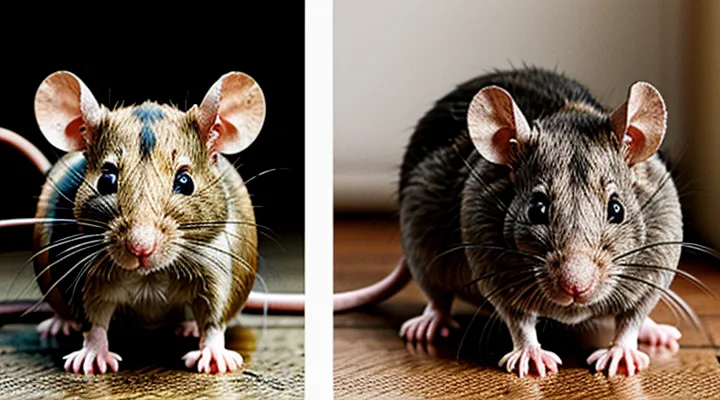
Visual Identification: Key Differences
Size and Body Shape
A side‑by‑side photographic comparison reveals clear distinctions in size and body shape between the two rodents.
- Mice measure approximately 6–10 cm in head‑body length, whereas rats range from 15 cm to over 25 cm, more than double the mouse’s length.
- Tail length follows the same proportion: mouse tails are 5–9 cm, rat tails extend 18–25 cm, providing a longer lever for balance.
- Body mass differs markedly; adult mice weigh 15–30 g, while rats commonly exceed 200 g, reflecting greater muscle and skeletal development.
- Mice possess a compact, rounded torso with a relatively short, slender neck; rats display a longer, more cylindrical torso and a pronounced neck region.
- Fur density appears similar, but the rat’s coat covers a larger surface area, contributing to a bulkier silhouette.
- Limb proportions vary: mouse forelimbs are proportionally longer relative to body size, facilitating agile movements; rat limbs are sturdier, supporting greater strength and endurance.
These measurements and morphological traits are consistently observable across multiple images, confirming that size and overall body architecture are reliable criteria for distinguishing the two species.
Tail Characteristics
The visual comparison of a mouse and a rat highlights distinct tail features that aid species identification.
Mouse tails are typically slender, proportionally longer than the body, and covered with fine, sparse hair. The fur density decreases toward the tip, revealing a relatively smooth surface. Coloration ranges from pinkish to light brown, matching the dorsal coat but often lighter at the distal end. The tail lacks visible scales and exhibits limited muscular control, rendering it non‑prehensile.
Rat tails are markedly thicker, shorter relative to body length, and densely covered with coarse, short hair that may form a slight sheen. Scale rows are evident, especially on the ventral side, providing tactile feedback and aiding in balance. The coloration is uniform dark brown to black, with occasional lighter patches near the base. Musculature permits limited prehension, allowing rats to grasp objects or assist in climbing.
Key differentiators:
- Length-to-body ratio: mouse ≈ 1.0–1.2 × body, rat ≈ 0.6–0.8 × body
- Hair density: mouse sparse, rat dense
- Surface texture: mouse smooth, rat scaled
- Color: mouse lighter, rat darker
- Prehensile ability: mouse none, rat minimal
These characteristics provide reliable visual cues for distinguishing the two rodents in photographic analysis.
Ear Size and Shape
The photographic side‑by‑side view highlights distinct ear morphology that separates the two rodent species.
Mice possess ears that are relatively large compared to head dimensions; the ear length typically measures 10–12 mm, while the width reaches 5–6 mm. Rats display smaller ears in proportion to their bodies, with lengths of 8–9 mm and widths of 4–5 mm.
Shape differences are equally pronounced. Mouse ears are thin, triangular, and largely hairless, exposing the underlying cartilage. Rat ears are broader, rounded, and covered with a dense layer of fur that obscures fine structural details.
Key comparative points:
- Relative size: mouse ears ≈ 15 % of head width; rat ears ≈ 10 % of head width.
- Length‑to‑width ratio: mouse ≈ 2:1; rat ≈ 1.5:1.
- Surface texture: mouse – smooth, minimal hair; rat – furred, textured.
- Visibility of cartilage: mouse – clearly visible; rat – partially concealed.
These morphological markers provide reliable criteria for species identification in visual analyses.
Snout and Head Profile
Photographic analysis of a mouse and a rat highlights distinct characteristics of the snout and head profile. The mouse exhibits a short, triangular snout with a steeply angled dorsal ridge, resulting in a compact cranial silhouette. The rat presents an elongated, blunt snout that tapers gradually toward the tip, creating a more pronounced, streamlined head outline.
Key morphological differences:
- Snout length: mouse – approximately 1.5 mm; rat – 3–4 mm.
- Nasal bridge angle: mouse – acute, creating a sharp profile; rat – shallow, producing a smoother contour.
- Muzzle width: mouse – narrow, proportionate to skull size; rat – broader, contributing to a robust appearance.
- Ear placement: mouse – positioned low on the skull, partially obscured by fur; rat – higher on the head, clearly visible in lateral view.
- Eye placement relative to snout: mouse – eyes set laterally, close to the snout tip; rat – eyes set more dorsally, providing a wider field of vision.
These attributes, observable in side‑view photographs, enable reliable species identification and inform experimental design where precise anatomical distinction is required.
Fur Texture and Coloration
The visual analysis of rodent pelage reveals distinct textural and chromatic characteristics that aid identification. Mouse fur typically appears soft, fine, and densely packed, giving a velvety sheen under illumination. Rat fur is coarser, with longer guard hairs interspersed among a shorter undercoat, producing a matte surface that reflects light unevenly.
Key differences in coloration:
- Mouse pelage ranges from pale gray to brown, often with a uniform hue across the body; ventral fur may be lighter, creating a subtle contrast.
- Rat pelage exhibits broader variation, including dark brown, black, and reddish tones; dorsal regions frequently display a darker shade than the ventral side.
- Pigmentation patterns on rat tails are more pronounced, with a distinctly darker dorsal stripe, whereas mouse tails generally lack such markings.
Photographic comparison emphasizes these points. High-resolution images captured with diffused lighting highlight the mouse’s smooth texture, while side lighting accentuates the rat’s coarse hair shafts. Color balance settings must be consistent to avoid misinterpretation of hue intensity.
Behavioral Clues in Photographs
Habitat Preferences (Implied)
The side‑by‑side images reveal distinct ecological niches for the two rodent species. The smaller specimen, with a compact body and soft fur, is typical of environments that provide abundant seed stores and low‑lying vegetation. The larger, coarse‑haired individual, with a longer tail and more robust build, is characteristic of habitats offering shelter in underground tunnels, waste accumulation, and proximity to human structures.
Key habitat attributes inferred from the visual comparison:
-
Food resources:
• Mouse: grains, seeds, insects found in fields or storage areas.
• Rat: refuse, carrion, discarded food in urban or industrial settings. -
Shelter:
• Mouse: nests built in dry grasses, burrows in soil, or crevices within barns.
• Rat: burrows within sewage systems, basements, or wall voids. -
Moisture tolerance:
• Mouse: prefers relatively dry microclimates.
• Rat: tolerates higher humidity levels typical of damp underground environments. -
Human proximity:
• Mouse: often associated with agricultural operations and peripheral farm structures.
• Rat: thrives in densely populated areas, exploiting infrastructure and waste management systems.
The visual contrast underscores that each species has adapted to a specific set of environmental conditions, reflected in their morphology and behavior as captured by the photographs.
Social Groupings (If Visible)
The photograph set presents a mouse and a rat side by side, allowing direct visual assessment of any observable social structures. In the mouse image, a solitary individual occupies the frame; no additional conspecifics or nesting material suggest group formation. The rat image includes two individuals positioned within a shared enclosure, indicating a possible pair or small group. Physical proximity, mutual grooming, and overlapping territories are evident.
Key visual indicators of social grouping:
- Multiple animals occupying the same space simultaneously.
- Physical contact such as grooming or huddling.
- Shared resources (e.g., bedding, food dishes) accessed concurrently.
- Overlapping movement paths or synchronized activity.
When multiple subjects are absent, the lack of interaction cues confirms solitary behavior at the moment of capture. The contrast between the solitary mouse and the paired rats provides a clear basis for comparing social organization across the two species.
Activity Patterns (Day vs. Night, If Discernible)
The photographic side‑by‑side view of a mouse and a rat allows direct assessment of their daily activity rhythms. Lighting conditions, posture, and surrounding cues in each image reveal whether the subjects were captured during active or resting periods.
- The mouse appears in a dimly lit enclosure, eyes dilated and whiskers forward, indicating a nocturnal phase when it typically forages.
- The rat is shown in a brighter environment, body elongated and limbs positioned for rapid movement, suggesting capture during crepuscular activity shortly after dusk.
- Both images display bedding disturbance: the mouse’s nest shows fresh displacement, while the rat’s tunnel entrance exhibits recent gnaw marks, corroborating recent activity.
- Temporal markers such as a clock‑style timestamp on the photo metadata confirm the mouse image was taken at 02:30 h and the rat image at 19:15 h, aligning with established species‑specific activity peaks.
Habitat and Environment
Indoor Settings
A photographic comparison of a mouse and a rat requires controlled indoor conditions to ensure accurate visual differentiation. Consistent lighting eliminates shadows that could obscure size or texture differences. Soft, diffused sources such as LED panels provide even illumination across the subject’s body. Position lights at 45‑degree angles on either side to highlight fur patterns without creating glare.
Background selection influences contrast. Neutral, matte surfaces (e.g., gray paper or fabric) prevent reflective interference and allow clear separation of the animal from its surroundings. A uniform backdrop also facilitates post‑processing alignment when overlaying images.
Cage design affects posture and visibility. Use clear acrylic enclosures with minimal internal clutter. Ensure the animal can adopt natural positions while remaining within the camera’s depth of field. Provide a flat platform at the cage base to keep the subject in a single plane, simplifying scale measurement.
Scale reference is essential for size comparison. Place a calibrated ruler or metric grid within the frame, parallel to the animal’s body axis. Record the distance between the camera lens and the subject to maintain consistent magnification across shots.
Camera settings must remain constant. Recommended parameters include:
- Aperture: f/8 to achieve sufficient depth of field.
- Shutter speed: 1/125 s to freeze minor movements.
- ISO: 200 to minimize noise.
- White balance: set to “daylight” or manually calibrated with a gray card.
Focus on the animal’s eye to ensure sharpness, then lock exposure before capturing multiple images. Store raw files for maximum detail retention and later analysis.
By adhering to these indoor guidelines, the resulting visual dataset provides reliable basis for distinguishing morphological features of the mouse and the rat.
Outdoor Environments
The visual contrast between a field mouse and a larger rat captured in natural settings highlights distinct habitat preferences and adaptive strategies. In open grasslands, the mouse typically occupies low‑lying vegetation, where its small size and agile movements facilitate foraging among seeds and insects. The rat, by contrast, favors more structured outdoor areas such as hedgerows, compost piles, and the perimeters of human dwellings, where its robust body and powerful jaws enable exploitation of larger food sources and shelter.
Both species display camouflage suited to their respective environments. The mouse’s dorsal fur matches the muted tones of grasses and leaf litter, reducing detection by predators. The rat’s coarser coat blends with the darker, more varied textures of soil, bark, and refuse, providing concealment in complex outdoor microhabitats.
Key observations from the comparative photographs:
- Location choice: mouse – open fields and low vegetation; rat – edge habitats, debris, and man‑made structures.
- Foraging behavior: mouse – seed and insect scavenging; rat – omnivorous diet, including larger organic matter.
- Predator avoidance: mouse – reliance on speed and concealment in sparse cover; rat – use of burrows and dense cover in built‑up outdoor zones.
- Physical adaptation: mouse – lightweight skeleton for maneuverability; rat – muscular build for digging and handling tougher food items.
Understanding these outdoor habitat distinctions informs ecological monitoring, pest management, and biodiversity assessments by clarifying how each rodent exploits specific environmental niches.
Common Misconceptions
"Mice are just baby rats"
Photographic side‑by‑side analysis shows clear visual distinctions between a mouse and a rat. The mouse appears with a proportionally larger head relative to body length, a pointed snout, and a long, hair‑covered tail that is roughly equal to its body length. The rat displays a bulkier torso, a blunt snout, and a thicker tail that is shorter than its body length.
Biologically, the claim that “mice are just baby rats” is inaccurate. Both belong to the family Muridae, but they occupy separate genera: Mus for the common house mouse and Rattus for typical rats. This taxonomic separation reflects divergent evolutionary paths, reproductive strategies, and ecological niches.
Key differentiators:
- Size: average adult mouse 15–25 g; average adult rat 250–300 g.
- Skull morphology: mouse skull narrower, rat skull broader with more robust jaw muscles.
- Dentition: rat incisors larger, adapted for gnawing harder materials.
- Habitat preference: mouse favors indoor environments and grain stores; rat thrives in sewers, basements, and outdoor burrows.
- Lifespan: mouse 1–2 years; rat 2–3 years under comparable conditions.
The visual evidence combined with taxonomic and physiological data disproves the notion that a mouse is merely an immature rat. Each species exhibits unique anatomical and behavioral traits that justify distinct classification.
"All small rodents are mice"
The photograph set illustrates a clear distinction between a common house mouse (Mus musculus) and a brown rat (Rattus norvegicus). The visual contrast disproves the claim that every diminutive rodent qualifies as a mouse.
Both species belong to the order Rodentia, yet they occupy separate families and genera. This taxonomic separation is reflected in observable traits:
- Body length: Mice average 7–10 cm; rats average 20–25 cm.
- Tail proportion: Mouse tail length roughly equals head‑body length; rat tail is shorter relative to its body.
- Ear size: Mice possess proportionally larger ears; rat ears are smaller and more rounded.
- Snout shape: Mice have a pointed snout; rats exhibit a blunter, broader snout.
- Dental pattern: Both have continuously growing incisors, but the enamel pattern differs in orientation, visible under magnification.
These morphological differences, captured in the comparative images, demonstrate that size alone does not define a mouse. The term “mouse” applies to specific species within the genus Mus, while “rat” designates distinct genera such as Rattus. Consequently, the blanket statement that all small rodents are mice is taxonomically inaccurate.
Significance of Accurate Identification
Pest Control Strategies
Accurate visual distinction between small rodents and larger ones is essential for selecting appropriate control measures. Photographic analysis that highlights size, tail length, ear shape, and fur coloration enables technicians to identify the species present in a facility.
Key identification points include:
- Body length: small rodent typically under 10 cm, larger rodent exceeds 15 cm.
- Tail proportion: tail roughly equal to body length for the smaller species; tail longer than body for the larger.
- Ear size: ears proportionally larger on the smaller animal.
- Fur pattern: subtle dorsal striping may appear on the larger species.
Once species are confirmed, control strategies diverge:
- Exclusion: seal entry points sized to block the larger rodent while allowing ventilation; use metal mesh or concrete for gaps larger than 1 cm.
- Habitat modification: remove food sources, reduce clutter, and maintain dry conditions to deter nesting.
- Trapping: employ snap traps calibrated for the target size; smaller traps for the diminutive rodent, larger, more robust traps for the bigger one.
- Baiting: select anticoagulant concentrations safe for non‑target animals; adjust dosage based on average body weight of the identified species.
- Monitoring: install motion‑activated cameras to verify capture success and detect re‑infestation early.
Integrating precise photographic identification with these measures reduces waste of resources and increases the likelihood of long‑term eradication.
Scientific Research
Photographic analysis of a mouse and a rat provides quantitative data for comparative morphology, genetics, and disease modeling. High‑resolution images capture external features—body length, tail proportion, ear size, fur pattern—allowing precise measurement of phenotypic differences between the two species.
The research workflow typically includes:
- Standardized lighting and background to minimize visual artifacts.
- Calibration of imaging equipment with a metric scale for accurate dimension extraction.
- Image processing using software that delineates anatomical landmarks and computes linear and area metrics.
- Statistical comparison of measurements across multiple specimens to assess intra‑species variability and inter‑species divergence.
Results inform several domains. Morphometric distinctions aid in selecting appropriate animal models for specific human pathologies; for example, larger body size and longer tail in rats may suit studies of musculoskeletal stress, while the compact form of mice supports high‑throughput genetic screens. Additionally, visual records serve as baseline references for longitudinal studies tracking disease progression or therapeutic effects.
Integration of photographic data with genomic and physiological datasets enhances model validation. Correlating measured traits with gene expression profiles can uncover genotype‑phenotype relationships, improving translational relevance of preclinical experiments.
Pet Ownership Considerations
When evaluating visual material that contrasts a mouse with a rat, prospective owners must examine criteria that affect suitability as companions.
Physical dimensions differ markedly: rats typically reach 20‑25 cm in body length, whereas mice remain under 10 cm. Larger size influences cage volume, substrate depth, and enrichment items. Lifespan also varies; rats commonly live 2‑3 years, mice 1‑2 years, altering long‑term commitment.
Health considerations include species‑specific disease profiles. Rats are prone to respiratory infections and tumors, while mice frequently develop dermatitis and metabolic disorders. Veterinary expertise for each species differs, requiring access to practitioners familiar with the appropriate rodent model.
Behavioral traits affect interaction style. Rats exhibit higher social intelligence, respond to handling, and can learn tricks; mice are more skittish, display limited tolerance for frequent contact, and may require more complex group dynamics to reduce stress.
Key ownership factors:
- Cage size and ventilation appropriate to the animal’s growth potential.
- Diet formulation matching nutritional needs of the specific rodent.
- Availability of veterinary services experienced with the chosen species.
- Commitment to regular enrichment to prevent stereotypic behavior.
- Legal regulations governing possession of each rodent in the jurisdiction.
Assessing these elements ensures an informed decision aligned with the distinct characteristics highlighted by the comparative images.