
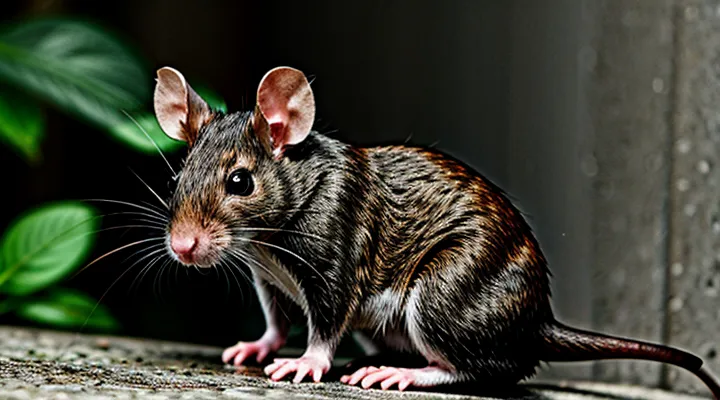
Understanding Rodents
Defining Rodents
Key Characteristics
Rats belong to the order Rodentia, family Muridae, and are therefore true rodents. Their classification rests on a set of morphological and physiological traits that define the order.
- Continuously growing incisors in both upper and lower jaws
- Single pair of incisors per jaw, each with a sharp, chisel‑like edge
- Presence of a diastema separating incisors from molars
- Enamel limited to the outer front surface of incisors, creating a self‑sharpening grinding edge
- Highly developed gnawing muscles and reinforced mandibular structure
Rat‑specific characteristics that align with these rodent criteria include:
- Robust skull with pronounced zygomatic arches supporting strong chewing muscles
- Tail length roughly equal to body length, covered with sparse hair and capable of thermoregulation
- Fur covering the body, typically dense and variable in color depending on species
- Reproductive strategy featuring rapid breeding cycles and large litter sizes
The combination of continuously renewing incisors, a single incisorial pair per jaw, and the associated dental and cranial adaptations unequivocally places rats within the rodent clade.
Examples of Rodent Species
Rodents constitute the most diverse mammalian order, encompassing more than 2,000 species that share the defining trait of continuously growing incisors. Their taxonomic placement falls within the order Rodentia, divided into several families that reflect variations in morphology, ecology, and geographic distribution.
- Muridae – includes the common house mouse (Mus musculus) and the Norway rat (Rattus norvegicus).
- Sciuridae – comprises tree and ground squirrels, chipmunks, and marmots; notable examples are the eastern gray squirrel (Sciurus carolinensis) and the alpine marmot (Marmota marmota).
- Caviidae – contains guinea pigs (Cavia porcellus) and capybaras (Hydrochoerus hydrochaeris), the latter being the largest living rodent.
- Cricetidae – covers voles, lemmings, and hamsters; the Syrian hamster (Mesocricetus auratus) and the meadow vole (Microtus pennsylvanicus) belong here.
- Hystricidae – includes porcupines, such as the North American porcupine (Erethizon dorsatum).
- Beaver family (Castoridae) – represented solely by the Eurasian and North American beavers (Castor fiber, Castor canadensis).
- Chinchillidae – features the chinchilla (Chinchilla lanigera) and its relatives.
These examples illustrate the breadth of rodent diversity, ranging from small, burrowing species to large, semi-aquatic engineers. Each taxonomic group exhibits adaptations that enable exploitation of distinct ecological niches, reinforcing the significance of rodents within mammalian biodiversity.
The Biological Classification of Rats
Kingdom, Phylum, Class, Order
Placing Rats within «Mammalia»
Rats belong to the class Mammalia, a taxonomic group defined by the presence of mammary glands, hair, three middle ear bones, and a neocortex. These characteristics differentiate mammals from other vertebrate classes such as Reptilia and Aves.
Within Mammalia, rats are placed in the subclass Theria, which includes all live‑bearing mammals. They further belong to the infraclass Eutheria (placental mammals), indicating development of a complex placenta that nourishes the embryo.
The complete hierarchical classification of the common brown rat (Rattus norvegicus) is:
- Kingdom: Animalia
- Phylum: Chordata
- Class: Mammalia
- Subclass: Theria
- Infraclass: Eutheria
- Order: Rodentia
- Family: Muridae
- Genus: Rattus
- Species: R. norvegicus
Key mammalian traits observed in rats include lactation, a fully developed neocortex responsible for advanced sensory processing, and a diphyodont dentition pattern (two sets of teeth). Their fur provides thermoregulation, while the presence of a sternum with a pronounced keel supports vigorous respiratory activity.
By meeting all diagnostic criteria of Mammalia, rats are unequivocally classified as mammals, occupying a well‑defined position in the broader vertebrate taxonomy.
The Order «Rodentia»
Rodents belong to the mammalian order Rodentia, the largest order of living mammals. Members share a single pair of continuously growing incisors in each jaw, which require constant gnawing to maintain functional length. The dental arrangement, combined with a skull structure that allows powerful bite forces, distinguishes rodents from other mammalian groups.
Rodentia comprises over 2,300 species, representing roughly 40 % of all mammal diversity. The order is divided into several families, each characterized by specific ecological adaptations and morphological traits:
- Muridae (true mice and rats, gerbils, hamsters) – the most species‑rich family, occupying a wide range of habitats.
- Sciuridae (squirrels, chipmunks, marmots) – primarily arboreal or ground‑dwelling, with robust limbs for climbing.
- Cricetidae (voles, lemmings, New World rats and mice) – diverse in size and habitat, many adapted to cold environments.
- Castoridae (beavers) – semi‑aquatic, with specialized tail and webbed feet.
- Dipodidae (jerboas, birch mice) – adapted for jumping, with elongated hind limbs.
- Others (Heteromyidae, Gliridae, Pedetidae, etc.) – each contributing unique ecological niches.
Rats, classified within the genus Rattus of the family Muridae, exemplify typical rodent features: ever‑growing incisors, a high reproductive rate, and a diet ranging from seeds to organic waste. Their placement within Rodentia confirms their status as true rodents, consistent with the broader biological classification that defines the order.
Rat Species and Their Lineage
Common Rat Types
Rats belong to the family Muridae, order Rodentia, confirming their status as true rodents. Their taxonomy places them in the genus Rattus, which includes several species widely distributed across continents.
- Rattus norvegicus (Norwegian or brown rat): largest urban species, robust body, brown to gray coat, omnivorous diet, high reproductive rate.
- Rattus rattus (Black rat): slender build, black or brown fur, prefers higher elevations, historically associated with shipborne dispersal.
- Rattus exulans (Polynesian rat): smallest of the genus, grayish coat, native to Pacific islands, often introduced by human activity.
- Rattus argentiventer (Ricefield rat): native to Southeast Asia, reddish-brown ventral fur, frequently found in cultivated fields.
- Rattus tanezumi (Tanezumi rat): similar to the black rat, common in East Asia, adaptable to both rural and urban environments.
These species share core rodent characteristics—ever‑growing incisors, gnawing adaptations, and rapid breeding cycles—yet differ in size, habitat preference, and geographical range. Recognizing the distinct types aids in ecological research, pest management, and disease monitoring.
Genetic Relationships
Rats belong to the order Rodentia, family Muridae, a placement confirmed by extensive molecular analyses. Comparative studies of mitochondrial cytochrome b, 12S rRNA, and nuclear genes such as IRBP and RAG1 demonstrate that rats cluster consistently with other rodents in phylogenetic trees. Sequence alignment reveals over 90 % nucleotide identity between rats and typical murid species, while divergence from non‑rodent mammals exceeds 30 %.
Key genetic markers supporting this classification include:
- Mitochondrial cytochrome b: identical haplotypes shared among murids.
- Nuclear IRBP: conserved exon patterns distinguishing Rodentia from Lagomorpha.
- RAG1 introns: rodent‑specific indels absent in other mammalian orders.
Molecular clock estimates place the split between Muridae and other rodent families at roughly 12–15 million years ago, well within the temporal range defining the rodent lineage. Genome‑wide studies further confirm that rats possess the characteristic expansion of the gnathic gene cluster responsible for continuously growing incisors, a definitive rodent trait.
Collectively, genetic evidence unequivocally situates rats within the rodent clade, validating their classification as true rodents.
Why Classification Matters
Scientific Accuracy
Avoiding Misconceptions
Rats belong to the order Rodentia, a taxonomic group defined by a single pair of continuously growing incisors in each jaw. Confusion often arises because the term “rodent” is sometimes used colloquially to describe any small, gnawing mammal, leading to inaccurate classifications.
Common misconceptions and their clarifications:
- All small mammals are rodents. Only species with the characteristic dental formula and skull morphology qualify; shrews, for example, are insectivores, not rodents.
- Rats are the same as mice. Both are rodents, but they differ in genus (Rattus vs. Mus), size, tail proportion, and ecological adaptations.
- Pet rats are exotic. Domesticated rats derive from the same species (Rattus norvegicus) that inhabits urban environments worldwide; they are not a separate taxonomic group.
- Rodents lack diversity. The order includes over 2,000 species across multiple families, ranging from beavers to porcupines, illustrating a broad evolutionary spectrum.
Accurate identification relies on observable traits: continuously growing incisors, a diastema separating incisors from molars, and specific skull features. Genetic analyses further confirm relationships within Rodentia, distinguishing rats from superficially similar mammals.
Understanding these criteria prevents the spread of erroneous statements and supports clear communication in scientific, educational, and public contexts.
Impact on Research
Rats are members of the order Rodentia, a fact that determines their suitability for a wide range of scientific investigations. Their placement among mammals provides a framework for interpreting physiological and genetic data in comparison with other rodents and vertebrates.
The classification influences experimental design, data interpretation, and regulatory compliance. Researchers select rats because their taxonomy predicts:
- Similarities in organ systems that facilitate translational studies of human disease.
- A well‑characterized genome that aligns with other rodent models, allowing cross‑species genetic analysis.
- Predictable reproductive cycles, supporting longitudinal experiments and breeding programs.
- Established ethical guidelines and housing standards derived from their taxonomic status.
Consequently, the rodent designation shapes funding priorities, publication standards, and collaborative networks, ensuring that findings derived from rat studies are integrated coherently into broader biological research.
Ecological Implications
Role in Ecosystems
Rats are members of the order Rodentia, family Muridae, and genus Rattus. Their taxonomic placement identifies them as true rodents, distinguished by continuously growing incisors and a specialized masticatory pattern.
In natural habitats rats perform several ecological functions:
- Consume seeds, fruits, and plant material, thereby influencing plant regeneration and seed dispersal patterns.
- Predate on insects, arthropods, and small vertebrates, reducing pest populations.
- Serve as prey for birds of prey, snakes, and mammalian carnivores, supporting higher trophic levels.
- Scavenge carrion and organic refuse, accelerating decomposition and nutrient return to the soil.
Through scavenging and foraging, rats contribute to nutrient cycling. Their burrowing activity aerates soil, mixes organic matter, and modifies microhabitat conditions, which can affect microbial communities and plant root dynamics.
Rats act as reservoirs for a range of zoonotic pathogens, including hantaviruses and leptospires. Their presence influences disease transmission cycles, affecting both wildlife health and human risk in adjacent areas.
In anthropogenic landscapes, rat populations thrive in urban and agricultural settings. Their synanthropic behavior leads to competition with native small mammals, alteration of seed predation rates, and increased pressure on stored crops. Management of these populations requires understanding of their ecological roles to mitigate negative impacts while recognizing their integration into ecosystem processes.
Pest Management Strategies
Rats belong to the order Rodentia, family Muridae, genus Rattus. Their biology—high reproductive rate, omnivorous diet, and adaptability to human environments—makes them frequent targets of pest control programs.
Effective control relies on an integrated approach that combines several tactics. Each tactic addresses a specific aspect of rat ecology and reduces reliance on any single method.
- Sanitation: Eliminate food sources by securing waste, cleaning spills, and storing feed in sealed containers.
- Exclusion: Seal entry points larger than ¼ inch, install metal flashing on foundations, and maintain screens on vents.
- Trapping: Deploy snap traps or electronic devices in active runways; position bait stations along walls and monitor capture rates.
- Chemical control: Apply rodenticides in tamper‑proof bait stations, rotate active ingredients to prevent resistance, and follow label safety guidelines.
- Biological control: Encourage predatory species such as owls and feral cats where appropriate, and consider the use of engineered viruses targeting rat populations.
- Monitoring: Conduct regular inspections, use tracking powders or motion‑activated cameras, and record activity levels to adjust tactics promptly.
Combining these measures creates a sustainable management plan that limits population growth, reduces health risks, and minimizes environmental impact. Continuous evaluation ensures that strategies remain effective as rat behavior and urban conditions evolve.