
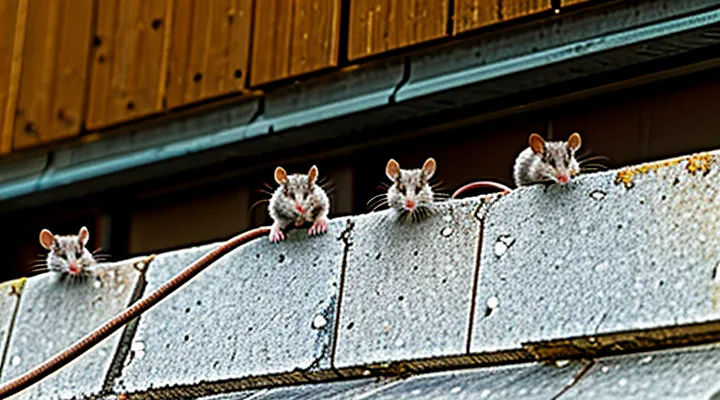
The Remarkable Agility of Mice
Physical Adaptations for Climbing
«Claws and Grip»
Mice rely on specialized fore‑ and hind‑limb claws to maintain adhesion on vertical substrates. Each claw consists of a hardened keratin sheath that tapers to a sharp point, allowing penetration into microscopic surface irregularities. The curvature of the claw tip aligns with the angle of the substrate, optimizing contact pressure and reducing slippage.
The grip achieved by mouse claws involves several coordinated mechanisms:
- Micro‑penetration: The tip inserts into micro‑grooves, creating mechanical interlocks that resist downward forces.
- Friction augmentation: Keratin’s textured surface increases shear resistance, especially on rough or porous materials.
- Dynamic adjustment: Muscular control modifies claw angle in real time, adapting to variations in surface texture and orientation.
- Weight distribution: Mice shift body mass toward the forelimbs during ascent, concentrating load on the claws that provide the greatest anchorage.
Experimental observations show that claw length correlates with climbing efficiency: longer claws enhance penetration depth but may reduce maneuverability on narrow ledges, while shorter claws improve precision on smooth surfaces. Muscular tension in the flexor tendons regulates the opening and closing of the claw, enabling rapid release when the mouse reaches a new foothold.
These anatomical and biomechanical features collectively enable mice to negotiate a wide range of vertical environments, from rough bark to smooth laboratory glass, without reliance on adhesive pads or external aids.
«Tail as a Counterbalance»
Mice maintain stability on vertical surfaces by using their tails as dynamic counterweights. The tail’s muscular control allows rapid adjustments of the body’s center of gravity, preventing rotational drift when the forepaws lose grip. This mechanism operates continuously during ascent, with the tail generating torque opposite to the direction of slip.
Key functions of the tail in wall climbing include:
- Shifting mass distribution to counterbalance forward thrust.
- Producing corrective angular momentum through lateral flexion.
- Enhancing proprioceptive feedback for precise limb placement.
Experimental observations show that tail‑intact mice achieve higher climbing speeds and sustain longer vertical runs than individuals with reduced tail length or impaired musculature, confirming the tail’s essential contribution to locomotor efficiency on steep substrates.
Sensory Perception in Navigation
«Vibrissae and Tactile Feedback»
Vibrissae are highly innervated facial hairs that function as active tactile sensors during wall ascent. Each whisker is anchored in a follicle‑sinus complex containing mechanoreceptors that transduce minute deflections into neural spikes. The dense innervation, primarily by Aβ and Aδ fibers, yields millisecond‑scale responses to surface contact.
During climbing, vibrissae generate continuous feedback about substrate geometry. Deflection patterns encode texture roughness, edge contour, and distance to the wall. This information allows mice to adjust grip force and limb trajectory without visual input. Precise temporal coupling between whisker signals and forelimb placement reduces slip incidents on vertical surfaces.
Sensory signals from the vibrissal system converge in the brainstem trigeminal nuclei and are relayed to motor cortices that coordinate limb kinematics. Real‑time modulation of motor output depends on the amplitude and direction of whisker deflection, enabling rapid correction of posture when encountering irregularities.
Empirical data support the functional importance of whisker feedback:
- Trimming all macrovibrissae lowers climbing speed by 30 % and increases fall frequency.
- Electrophysiological recordings show heightened firing rates in trigeminal neurons when whiskers contact textured surfaces.
- Optogenetic silencing of barrel cortex neurons disrupts the timing of forelimb placement, leading to missteps.
Collectively, vibrissae provide a high‑resolution tactile map that integrates with motor circuits to guide efficient vertical locomotion.
«Olfactory Cues»
Mice rely on airborne chemicals to locate and ascend vertical surfaces. Specialized olfactory receptors in the nasal epithelium detect volatile compounds emitted from familiar habitats, food sources, and conspecifics. When a scent signature is present on a wall, mice align their trajectory toward the gradient, adjusting limb placement to maintain contact with the substrate.
Key functions of olfactory cues in wall climbing include:
- Target identification – volatile markers signal the presence of a shelter or foraging area, prompting upward movement.
- Spatial mapping – odor gradients provide a reference frame that integrates with tactile feedback from whiskers and paws, enabling precise navigation.
- Learning reinforcement – repeated exposure to specific scents strengthens neural pathways in the olfactory bulb and hippocampus, improving future climbing efficiency.
Neurophysiological studies reveal that activation of the mitral cells in the olfactory bulb correlates with increased locomotor output during vertical exploration. Lesion experiments demonstrate a marked reduction in climbing attempts when olfactory input is disrupted, confirming the sensory modality’s necessity.
Laboratory observations show that mice placed on a vertical arena with a scented patch at the top initiate climbing within seconds, whereas unscented control walls elicit delayed or absent ascent. This behavior persists across strains, indicating a conserved reliance on chemical cues for vertical locomotion.
Climbing Techniques and Behavioral Strategies
Vertical Ascent Mechanisms
«Scrambling and Bracing»
Mice ascend vertical surfaces by alternating two coordinated actions: rapid limb repositioning (scrambling) and body stabilization (bracing). Scrambling involves swift, diagonal foot placements that generate upward thrust while maintaining contact with the substrate. Each step maximizes grip by exploiting the curvature of the toe pads and the micro‑texture of the wall surface.
Bracing follows each scramble, engaging the forelimbs and torso musculature to lock the body in place. This pause reduces slip risk and allows the animal to assess the next foothold. The sequence repeats in a rhythmic pattern that translates kinetic energy into vertical displacement.
Key characteristics of the combined behavior:
- Diagonal foot placement creates a self‑reinforcing traction vector.
- Forelimb flexion during bracing locks the spine and reduces torsional strain.
- Intermittent pauses between scrambles limit fatigue by distributing load across limb groups.
- Sensory feedback from whiskers and foot pads fine‑tunes grip pressure in real time.
«Exploiting Surface Irregularities»
Mice achieve vertical locomotion by targeting microscopic protrusions, cracks, and texture variations on a surface. These irregularities provide anchor points that compensate for the limited reach of their claws and generate sufficient friction for upward movement.
Morphological features that enhance this exploitation include:
- Curved ungual phalanges that interlock with raised edges.
- Plantar pads covered with fine keratinous spines that increase grip on rough substrates.
- Vibrissae that detect surface topology, allowing rapid adjustment of limb placement.
Behavioral tactics observed during climbing are:
- Scanning the wall with whiskers to locate the densest cluster of micro‑grooves.
- Positioning the forepaws on protruding ridges while the hind paws press against adjacent depressions, creating a push‑pull cycle.
- Modulating body angle to maximize normal force on contact points, thereby enhancing static friction.
- Releasing and re‑engaging claws in a staggered sequence to maintain continuous support.
Exploiting such micro‑features reduces energy expenditure compared with continuous claw digging. Experimental setups that smooth surfaces eliminate these anchor points, leading to a marked decline in climbing success rates. Conversely, introducing patterned textures can be used to direct or inhibit mouse movement in controlled environments.
Environmental Factors Influencing Climbing
«Surface Texture and Material»
Mice rely on the interaction between their footpads and the surface they encounter to generate traction. Rough textures, such as sandpaper or untreated wood, provide numerous micro‑asperities that interlock with the keratinized pads, allowing mice to push off with each stride. Smooth materials, including polished metal or glossy plastic, reduce contact points, forcing rodents to compensate by increasing limb frequency or using their claws more aggressively.
Key material properties affecting climbing performance:
- Coefficient of friction: higher values correlate with greater grip and lower slip risk.
- Porosity: porous surfaces retain moisture, enhancing adhesion through capillary forces.
- Elastic modulus: softer substrates deform under load, distributing pressure across a larger pad area and improving stability.
- Surface temperature: extreme cold or heat can alter pad flexibility, influencing traction.
Experimental observations show that mice ascend vertical acrylic panels faster when the surface is coated with a fine grit adhesive than when it remains untreated. Conversely, climbing speed declines on glass, even when the mouse’s claws are fully extended. Material selection therefore dictates the balance between pad‑surface adhesion and claw engagement, shaping the overall climbing strategy.
«Angle and Inclination»
Mice navigate vertical surfaces by adjusting their body posture to match the angle of the substrate. When the incline exceeds 45°, forelimb extension increases, allowing the animal to maintain grip on the limited contact points. Hindlimbs generate additional thrust, compensating for the reduced friction that steep slopes provide.
Key biomechanical responses to varying inclinations include:
- Grip modulation – pad surface area expands on steeper planes, increasing adhesive force.
- Center‑of‑mass shift – the torso tilts forward as the angle rises, keeping the center of mass within the support triangle formed by the limbs.
- Muscle recruitment – the gastrocnemius and forearm flexors activate proportionally to the slope, delivering the torque required to prevent slippage.
Experimental observations reveal a threshold near 60° where mice transition from a climbing gait to a scrambling pattern, characterized by rapid alternation of limbs and increased tail use for balance. On inclines below 30°, the gait remains rhythmic, with stride length unchanged and minimal tail involvement.
These adaptations demonstrate that angle and inclination are decisive factors shaping the locomotor strategy of rodents on vertical structures.
Learned Behaviors and Problem-Solving
«Trial-and-Error Learning»
Mice acquire wall‑climbing ability through repeated attempts that are evaluated and either reinforced or discarded. Each contact with a vertical surface provides tactile and proprioceptive data; successful footholds are retained, while slips trigger immediate modification of the subsequent maneuver.
During laboratory trials, rodents display a sequence of actions that evolve over minutes. Initial contacts often involve indiscriminate paw placement. Failure to secure grip leads to rapid repositioning, followed by adjusted angles and pressure distribution. Over successive cycles, the pattern converges on a stable climbing technique.
Key components of this learning process include:
- Sensory feedback from whiskers and foot pads that signals surface texture and orientation.
- Motor program adjustments that alter limb trajectory and grip force.
- Memory integration that stores successful configurations for future use.
The resulting behavior demonstrates flexibility: mice can transfer the refined climbing strategy to novel surfaces with different roughness or inclination, indicating that trial-and-error learning extends beyond a single context and supports adaptive locomotion in complex environments.
«Memory and Navigation Paths»
Mice that ascend vertical surfaces rely on spatial memory to locate optimal footholds and to reproduce successful routes. Repeated exposure to a textured wall creates a neural representation of climbable patterns, allowing the animal to predict the position of ridges and gaps. Hippocampal place cells fire in response to specific segments of the climb, reinforcing the association between visual‑tactile cues and motor commands.
During subsequent climbs, mice compare current sensory input with stored representations, adjusting limb placement to match previously rewarded trajectories. This process reduces trial‑and‑error movements and shortens ascent time. Evidence from electrophysiological recordings shows that disruption of hippocampal activity impairs route recall, leading to increased slip incidents and longer search phases.
Key observations on memory‑guided navigation:
- Consistent use of the same foothold sequence across multiple trials.
- Faster ascent after initial learning phase, measured by reduced latency.
- Increased reliance on distal visual cues when wall texture is altered.
- Persistent activation of specific neuronal ensembles during repeat climbs, indicating long‑term encoding of the route.